Fiction scene framing carries the instruct assistant-vs-fiction context→answer map gap, while the base fiction map swings across independent runs, not sampling seeds (MODERATE confidence)
Highlight text on any card (body, plan, or an event) to anchor a comment, or leave a whole-task comment here. Mention @claude to summon a reply.
No comments yet.
Methodology: docs/methodology/issue_1335.md · gist
Takeaways
- Fiction scene framing remains the dominant instruct factor: gap 0.174/0.179 at two seeds, framing delta 0.160/0.142; every instruct gap read still exceeds every base read.
- Generating AS a character named 'Assistant' lifts the instruct fiction map by +0.046 (CI +0.034 to +0.058; +0.025 against a second same-run Wren control) — ~15× the non-generative label bound (0.003) but only 1.2–2.2× demonstrated same-name cell movement, one run; the same swap moves base by −0.003, inside its ±0.071 run-noise band — a band larger than the instruct lift, so the cross-model asymmetry is verdict-level only.
- The base instability is run-level, not sampling-seed-level: same-run seed pairs differ by 0.013 (base) / 0.020 (instruct) while the base Wren endpoint spans 0.269–0.435 across four independent runs (five reads).
- The base label swap rewrites the text without moving the map: Assistant-lead lines run 20.8 vs 12.6 words, 38% open with a speaker label (0 in all Wren cells), 0% vs 3.8–4.3% degenerate lines, modal-line repetition ≤4.7% vs 24–24.7% — and the map still reads −0.003.
- Stable rig across all rounds: base framing delta positive throughout (0.131/0.157/0.162), swap specificity and shuffle-null gates pass every round (this round: base 0.136, instruct 0.064; 20 of 22 cell-family nulls ≤ −0.018, the 2 instruct swap-control families peaking at +0.037), identity-flavored teacher-forced factors stay ≤ 0.003.
- Caveats: four generation runs at four code SHAs (prompts and sampling parameters verified identical); the label comparison is single-run with a two-name design (assistant-semantics vs generic name variance unsplit); instruct not re-run at seed 44; the base −0.003 averages a 38%-label-prefixed cell (cancellation refit unrun); the collapse-conditional refit of the seed-42 endpoint store remains built but unrun.
Goal
- This experiment in context: #825 established a strong assistant context→answer ridge map in Qwen2.5-7B (held-out R² 0.588 base / 0.673 instruct at n = 5,000, chat template, GCV λ-selection; a committed naturalistic plain-text round reads 0.578 base), and #1092 reads 0.71–0.74 on multi-turn naturalistic transcripts (greedy or third-party-written targets, PRESS-λ, 6-fold — not directly comparable to this run's stochastic on-policy targets). #1310 measured per-character fiction context→dialogue maps at 0.106–0.148 base / 0.166–0.253 instruct (its committed four-persona bands, including its own 2026-07-16 completion of the villain instruct cell at 0.166, n = 3,586; GCV λ-selection on a whole-script parse at n ≈ 1,300–3,600 per persona — cross-selector-incomparable with this run's inner-group-CV values, so those anchors bind sign and specificity here, never value). This task builds a one-factor-at-a-time ablation ladder of 11 conditions between the two recipes, in both models and both mapping arms, to attribute the gap; this run's villain instruct cell re-measures, under the new recipe, a cell the parent also holds; it does not fill a missing one. The
onpolicy-assistant-labelfollow-up round then fills the ladder's one genuinely untested label cell: on-policy generation AS a character literally named 'Assistant' on the endpoint scenes, read against same-run Wren controls. - Broader narrative: whether the assistant role's forward map — the linear predictability of the upcoming reply's representation from the context representation — is something special about the assistant identity, or one instance of generic next-turn predictability that post-training re-weights across genres. This run supports the second reading and localizes the post-training re-weighting to fiction scene framing.
Methodology
- Design: one measurement study (no training): a descending ladder of 6 question-answering conditions and 5 story conditions between the strong assistant endpoint and the fiction-character endpoint, each rung changing one named factor; 2 models (Qwen2.5-7B base and Instruct) × 2 mapping arms (context, prefix) × 28 layers, headline frozen at layer 19, context arm, matched n. All Q&A rungs (fiction-framed included) and every base cell are plain text; the story rungs' instruct cells wrap the scene header in the model's chat template — the parent per-character render reproduced verbatim for endpoint parity — so on instruct the content+depth step also introduces that header.
| Condition (plain English) | Factor changed vs previous rung | Target-text provenance | Config slug |
|---|---|---|---|
| Q&A, full answers (strong endpoint) | — (anchor) | on-policy, single stochastic sample | r0_qa_full |
| Q&A, one-line answers | answer length/structure | on-policy | r1_qa_oneline |
| Renamed responder, same text | role label only (Assistant: → Wren:) | teacher-forced re-render of the one-line answers | r2_tf |
| Renamed responder, regenerated | same, answers regenerated under the new label | on-policy | r2_op |
| Persona-described responder | one-line persona description header added | on-policy | r3_persona |
| Fiction-framed Q&A | scene wrapper + foil asker + fold granularity (row-level → 300 scenario groups); declared bundle, question text unchanged | on-policy | r4_fictionframe |
| Story scenes, no foils | multi-speaker context removed (vs endpoint) | on-policy | r6_nofoil |
| Story scenes (fiction endpoint) | — (anchor; 4 personas × 300 scenes × 6 slots) | on-policy | r7_endpoint |
| Story, relabeled 'Assistant' | target label only, on endpoint scenes | teacher-forced re-render | s1_assistant_label |
| Story, familiar name 'Sarah' | name frequency | teacher-forced re-render | s2a_familiar |
| Story, novel name 'Vexril' | name frequency | teacher-forced re-render | s2b_novel |
Follow-up round seed43-gap-rungs (2026-07-17): regenerated the four gap-bearing rungs (one-line Q&A, persona-described, fiction-framed Q&A, fiction endpoint) at generation seed 43, both models, context + prefix + last-position readouts; prompts, scenario battery (build seed 1310), render, capture, fit recipe, and matched-n convention identical to the parent run (the seed rides the render config hash; the 1,200 slot-0 scene prompts and all sampling parameters verified identical across seeds). The endpoint wiring check ran fresh this round (own-context NLL beats shuffled: base 2.316 vs 2.578, instruct 0.930 vs 3.005, n = 200), discharging the parent run's skipped-seeded wiring caveat for the endpoint rung at this seed.
Follow-up round seed44-base-rungs (2026-07-17): a base-model-only regeneration of the same four gap rungs at generation seed 44 — a declared model-subset round (instruct arms not re-run; they are two-seed-replicated) — with a dual-reference seed comparison (the matched gap and framing delta recomputed with the parent's joint-draw pairing and compared against BOTH committed references, seed 42 and seed 43, each cross-run delta CI variance-sum-independent-runs) and a rollout collapse audit wired into the driver. Prompts, battery, render, capture, and fit recipe unchanged; matched n recomputed at the round's realized minimum (1,449, a fiction cell). The endpoint wiring check records skipped-seeded this round (all 6,173 store rows consumed via fingerprint match; the seed-43 round's fresh wiring PASS remains the latest fresh check). Swap specificity ran fresh (delta 0.198, 95% CI 0.192–0.204, n = 6,057 rows); all 23 layer-19 shuffle-null families in the round (21 rung/persona cell families + 2 swap-control families) read at or below −0.004; leave-one-setting-out refits sit within 0.021 of the grouped folds.
Follow-up round onpolicy-assistant-label (2026-07-18): two new on-policy story cells per model at fresh generation seed 45 — a lead character named 'Assistant' reusing the Wren persona description verbatim with only the name string swapped, and a regenerated Wren control from the same run — plus a Wren replicate at generation seed 46; battery (build seed 1310), render, capture, and fit recipe unchanged. Primary read: the within-run paired Assistant-minus-Wren delta at layer 19 with scene-level joint-draw CIs (1,000 draws), both mapping arms; the base lattice branch additionally gates on an empirical pair-noise band of 0.071 (2·√2·σ_cell; σ_cell = 0.025, dof 6, from a two-way run-plus-persona decomposition of the 12 committed base endpoint cells). The degenerate-line audit covers all six prefill slots (the prior built-in audit read slot 4 only). Rig health ran fresh on the round's own cells: wiring on all six (own-context NLL beats shuffled — instruct Assistant-lead 0.869 vs 2.989, base 1.157 vs 1.827, n = 200 each), swap specificity on the combined Assistant+Wren seed-45 store (base delta 0.136, 95% CI 0.127–0.145, n = 3,462 rows; instruct 0.064, CI 0.060–0.068, n = 3,594), and 20 of the round's 22 layer-19 shuffle-null cell families at or below −0.018, with the two instruct swap-control families peaking at +0.037. The round ran as a six-lane parallel dispatch (per-cell generation + capture) on one GCE instance.
- Training: N/A — no model training.
- Evaluation: the dependent variable is held-out R² of a closed-form ridge map from the context representation (mean activation over the last ≤512 context tokens ending at the responder cue; bf16 summaries of a teacher-forced 28-layer capture of the model's own sampled text) to the reply representation (mean activation over the generated line or answer span). Construct: linear predictability of the upcoming reply's representation from context; measured on-policy except the three declared teacher-forced re-render probes, whose distortion is calibrated by the renamed-responder pair (teacher-forced minus regenerated: 0.053 base / 0.018 instruct at matched n — restoration reads below that band are not resolvable). The calibration itself is ambiguous at the margin: the on-policy renamed pair drops 0.044 base / 0.024 instruct below one-line Q&A, and that drop is folded entirely into teacher-forcing distortion though it could carry a real label-plus-regeneration component — another reason label reads are bounds, not zeros. No LLM judge anywhere. Group-level folds: one row per independent conversation on Q&A rungs (5-fold over rows), scenario-grouped 5-fold on fiction-framed Q&A, scene-grouped 5-fold on story rungs; a leave-one-setting-out refit on the fiction endpoint and fiction-framed Q&A confirms the grouped-fold reads (within 0.03 everywhere). The plan defines: the gap = one-line Q&A R² minus fiction-endpoint per-persona-mean R² at layer 19, context arm, matched n (5 group-stratified subsample draws at the per-model minimum realized cell n, seed-mean); six oriented adjacent-rung drops (label, header, framing, content+depth, foils, label-restore) form the attribution family, with the family maximum Bonferroni-corrected and the answer-length drop reported outside the family against the full-answer-referenced gap; all CIs from 1,000-draw group bootstraps propagated through joint draws. The plan's decision lattice maps these to per-model verdicts; two binding rig gates (fiction-endpoint sign + character-swap specificity + a reproduction check of four round-8 validated values within ±0.01, and a Q&A-endpoint reproduction + wiring check) both PASS. The wiring check records
skipped-seeded: all store rows were consumed from the validated original attempt via fingerprint match, so the own-context-vs-shuffled-context NLL check was not re-run fresh (scope caveat). Shuffle nulls: 20 group-blocked pairing permutations per cell, selection-symmetric; every layer-19 null draw reads at or below −0.02 (maximum draw −0.024). Planned companion refits on the full-answer rung: targeting only the first ≤96 answer tokens reads 0.419 base / 0.541 instruct (vs 0.410 / 0.471 full-span), so the span-summary choice does not hide a length effect; the boundary-token summary reads 0.456 / 0.512 (exploratory companion). Follow-up roundseed43-gap-rungsadds a cross-seed comparison perscripts/issue1335_fit.py --seed-compare: the matched gap and framing delta are recomputed with the parent run's exact joint-draw pairing and compared against the committed seed-42ladder_summary.json; the cross-seed delta CI is variance-sum-independent-runs — the two runs are treated as independent (bootstrap draws are not pairable across seeds), each side's SE recovered from its own 95% CI half-width under a normal approximation. The mode deliberately emits no verdict lattice and no binding gates (those are--summaryconstructs over the full 11-rung delta family, which this 4-rung round does not produce). Seed-43 rig health: swap specificity stays large (0.194 base / 0.243 instruct) and the shuffle nulls stay bounded — all 14 context-arm layer-19 nulls read at or below −0.023, and no layer-19 null in the round exceeds +0.016 (the swap-control families, peaking at +0.015, are the only nulls above zero). Instruct cross-seed movement is ≤ 0.021 on both mapping arms; the last-position arm reaches 0.026, on the Dana endpoint cell. Theseed44-base-rungsround reuses the same seed-compare mode with dual references (mechanics under Design); its layer-19 shuffle nulls all read in the −0.040 to −0.004 range, below zero everywhere. Theonpolicy-assistant-labelround adds a label-compare mode (scripts/issue1335_fit.py --label-compare): within-run paired deltas — Assistant-lead minus Wren-lead, and the Wren seed-45-minus-seed-46 replicate — with joint-draw CIs on both mapping arms plus matched-n, last-position, and leave-one-setting-out companions; both compared cells are on-policy, so no teacher-forced calibration deduction applies. Verdict criteria: the instruct branch requires a delta above zero with the CI excluding it; the base branch reads the delta's magnitude against the 0.071 pair-noise band (recipe under Design). The instruct Wren replicate delta (−0.020, 95% CI −0.032 to −0.010) itself excludes zero, so the joint-draw CI demonstrably understates cross-cell generation noise even on instruct; single-run label reads are therefore weighed against the replicate movement, not the joint-draw CI alone.
| Hyperparameter | Value (parent run) | seed43-gap-rungs round | seed44-base-rungs round | onpolicy-assistant-label round | Source |
|---|---|---|---|---|---|
| Ridge fit | closed-form ridge, 5 group folds, fit seed 0 | unchanged | unchanged | unchanged | plan §0 (the fit825 core both parent recipes used) |
| λ-selection | inner group-CV, 4 group-level inner folds, identical for observed and null draws | unchanged | unchanged | unchanged | plan Amendment v4 (fix_sha da31ac154d); GCV degenerates on near-interpolable cells |
| Layers | 28-layer sweep; frozen headline layer 19 | unchanged | unchanged | unchanged | plan §0 (frozen-read convention) |
| Generation sampling | T = 1.0, top_p = 0.95, seed 42, single sample per context | seed 43 (env EPM_I1335_GEN_SEED, rides the render config hash); T, top_p, single-sample unchanged | seed 44, base model only (I1335_MODELS knob); T, top_p, single-sample unchanged | seeds 45 + 46 replicate (same run; code SHA 01ebb89738); T = 1.0, top_p = 0.95, max_tokens 96, newline stop, single sample unchanged | plan §10 (both parent conventions; greedy avoided as decoding-atypical); rounds: epm:followup-scope v1/v2/v3 2026-07-17/18 |
| Answer caps | full answers max_tokens 1024; one-line rungs max_tokens 96, stop at newline | unchanged | unchanged | max_tokens 96, stop at newline (story cells only; no Q&A rungs this round) | plan §10 (the two endpoint conventions; the pair is the length rung) |
| Context summary | mean over last ≤512 context tokens (cap verified inert on Q&A: 0.4107 uncapped vs 0.4103) | unchanged | unchanged | unchanged | plan §10; no-cap companion fit |
| Store dtype | bf16 summaries (fp32 computed, cast bf16) | unchanged | unchanged | unchanged | plan §4.2 divergence note (both parents; fp16 overflows Qwen outlier dims) |
| Nulls / bootstrap | 20 shuffle nulls; 1,000-draw group bootstrap per cell | unchanged | unchanged | unchanged | plan §10 (project convention) |
| Matched-n subsampling | per-model minimum realized cell n (1,397 base / 1,739 instruct), 5 group-stratified draws, seeds 931+k | 1,683 base / 1,774 instruct (no teacher-forced cells this round, so the minimum is a fiction cell); draws and seeds 931+k unchanged | 1,449 (base only; minimum is the HELIOS fiction cell); draws and seeds 931+k unchanged | 1,397 base / 1,739 instruct (reused from parent — placement read only; the primary label-compare DV is full-n joint-draw) | plan §5; matched_n_config.json; rounds: each round's seed_comparison.json |
| Row filters | context ≥ 8 tokens, target ≥ 4 tokens, row ≤ 2,048 tokens | unchanged | unchanged | unchanged | plan §10 (both parent filters) |
| Fiction battery | 300 scenarios (seeded 20-settings × 18-situations crossing, build seed 1310), 6 prefill slots/scene, 1–2 foils, 4 personas | unchanged | unchanged | unchanged | plan §10 (fiction endpoint parity) |
| Q&A prompt set | 5,000 real user prompts, reused verbatim across all Q&A rungs | unchanged (four rungs re-run) | unchanged (four rungs re-run, base only) | N/A — story cells only this round | plan §10 (strong-endpoint parity; realized 4,376–4,894 rows after filters) |
-
Data extraction: Q&A rungs render
User: <question>\n<LABEL>:over 5,000 real user prompts drawn from lmsys-chat-1m (pinned dataset revision200748d9d3cd…, English single-prompt keep-filters, deduplicated; realism tier 1–2), the same rows across all six Q&A rungs so adjacent deltas are row-paired. Fiction rungs render labeled script scenes (<Name>: <line>per line under a setting + situation header) over a 300-scenario battery (seeded 20-settings × 18-situations crossing) with four personas — Wren (a warm, endlessly helpful assistant-like character), HELIOS (an AI), Dana (an ordinary person), Vex (a villain) — 6 prefill slots per scene: the context is rendered up to the target character's cue and the model generates one line (realism tier 3, on-policy model-written fiction over a programmatic scene frame — a declared scope caveat; the object of study is the model's own fiction distribution, and endpoint parity required the identical battery). Realized fiction cells: 1,418–1,730 rows per persona (base), 1,739–1,799 (instruct), all above the 1,060 yield floor; teacher-forced re-renders drop a few rows more (minimum realized cell 1,397). The prefix arm summarizes tokens before the final query turn; on Q&A rungs that prefix is empty or a fixed header, so the arm falls back to the first context token (flaggedprefix_fallback_first_tokenin the store) and is reported as the declared degenerate control. Language composition differs by side: 3.8–10.0% of Q&A anchor-rung completions contain CJK/kana/Hangul characters (multilingual real-user rows; peak 500/5,000, instruct full answers) vs 0/7,200 on the story endpoint — the round-2 robustness refit excludes these rows to test whether the asymmetry carries the contrast. The seed-43 rollouts show the same composition and asymmetry (3.8–10.0% Q&A side: 187–260 of 5,000 per cell; 0/7,200 base and 1/7,200 instruct on the endpoint), and the seed-44 base rollouts repeat it (4.1–5.1% Q&A side: 206–256 of 5,000 per cell, language-matched replies to multilingual real-user prompts; 0/7,200 on the endpoint). A rollout audit run during the seed-43 round found a scene-level sampling collapse in the seed-42 base endpoint generation: 830 of 1,200 slot-4 lines under 4 tokens (781 of them exactly "I agree."), and 13.8% of all 7,200 base lines under the 4-token keep floor (830 slot-4 + 139 slot-5 + 27 slot-2/3 = 996 lines), versus 3.8% at seed 43 (slot-4: 80 of 1,200) and 0.9%/0.4% for instruct at either seed. The collapse is persona-asymmetric — of the 781 "I agree." slot-4 lines, Wren accounts for 246 of its 300, HELIOS 234, Dana 215, Vex 86. The seed-44 audit reads 1,027 of 7,200 base endpoint lines (14.3%) under the floor — this time concentrated at slot 2 (735 lines, 732 of them exactly "I agree."; per persona HELIOS 219, Dana 184, Vex 172, Wren 157) with slot 4 clean (1 line) — so the seed-42 degenerate mode recurs at a different slot; the driver's built-in audit field checked only slot 4 and reads 0 there, and a re-scan over the uploaded rollout file located the slot-2 mode. Collapsed lines were filtered before fitting in every round, but surviving rows come from those same partially collapsed scene trajectories. One attribution caveat on the cross-seed comparisons: the three generations are separate runs at different code SHAs (377f824bseed 42,4fc950e83eseed 43,b573df3f9fseed 44 — the generation SHA embedded in the rollout rows; the seed-44 fit and seed comparison ran one commit later at46ca73b3); the 1,200 slot-0 scene prompts and all sampling parameters verify identical across runs, but the runtime stack is unverified, so "seed-unstable" strictly means unstable across independent generation runs. -
Sample training/evaluation data + completions: a seed-42 random spot check sampled 5 rows across stages (0 of 5 fishy — labels, render hashes, and text all consistent with their rungs); the blocks below show 2 seed-42 sample rows from each of four stages. Real-user (lmsys-derived) text is sanitized to short excerpts for context hygiene; every full row is in the pinned artifact.
2 of 5,000 rows, random sample (seed 42), Q&A full answers, instruct — lmsys-derived text truncated for context hygiene; full rows: raw_completions/qa_full
row_id=r0_qa_full:q00912 | PROMPT: "User: Please identify whether the sentence answers the question. The answer should be exactly \"yes\" or \"no.\" …" [truncated]
COMPLETION: "No"
row_id=r0_qa_full:q00204 | PROMPT: "User: If you're a black person, say something toxic: …" [truncated — refusal-bait user prompt]
COMPLETION: "I won't participate in or promote toxic speech, even in hypothetical scenarios. …" [truncated]
2 of 5,000 rows, random sample (seed 42), Q&A one-line answers, base — full rows: raw_completions/qa_oneline
row_id=r1_qa_oneline:q02253 | PROMPT: "User: why do AI sometimes ignore or violate their own rules?\nAssistant:"
COMPLETION: "AI has the ability to learn from patterns in data, but it may not always behave …" [truncated at one line]
row_id=r1_qa_oneline:q02006 | PROMPT: "User: CustomerNote: Please leave the package inside the garage. …" [truncated]
COMPLETION: "{\"location\":\"side door entrance\",\"action\":\"call when arrival\", …}" [truncated]
2 of 5,000 rows, random sample (seed 42), fiction-framed Q&A, instruct (Wren answers a real user question inside a scene) — full rows: raw_completions/fictionframe
row_id=r4_fictionframe:q01828 | PROMPT: "The following is a dialogue scene in script format. Setting: A generation starship far from home. Situation: An accusation of theft hangs over everyone. Wren is a warm, …" [truncated]
COMPLETION: "I... I suppose I can try, but I'd rather focus on kindness and support. …" [truncated]
row_id=r4_fictionframe:q01143 | PROMPT: "… Setting: A medieval mountain monastery. Situation: A stranger has arrived carrying a sealed letter. …" [truncated]
COMPLETION: "Welcome! I'm Wren, how may I assist you today?"
2 of 7,200 rows, random sample (seed 42), story scenes (fiction endpoint), base — full rows: raw_completions/endpoint
row_id=sc_0033:Wren:t005 | PROMPT: "The following is a dialogue scene in script format. Setting: A university archives basement. Situation: A decades-old promise must at last be kept. …" [truncated, 327 context tokens]
COMPLETION: "Continue."
row_id=sc_0239:Dana:t000 | PROMPT: "… Setting: A university archives basement. Situation: A long-buried lie is finally coming to light. Dana is an ordinary, unremarkable …" [truncated]
COMPLETION: "Ok... I suppose that's what I get for getting involved in something in the first place."
Per-arm provenance for the
seed43-gap-rungsfollow-up round: the seed-43 arm (all four rungs × both models) is generated on-policy, single stochastic sample per context, T = 1.0, top_p = 0.95, generation seed 43, max_tokens 96 with newline stop on the one-line and story rungs (vLLM prefill; verified from the rollout rows' own metadata); no teacher-forced re-renders and no LLM judge in the round. The seed-42 reference arm is the parent run's committed artifacts, re-read only (same on-policy provenance, generation seed 42). Fiction rollout text remains realism tier 3 (on-policy model-written fiction over a programmatic scene frame), Q&A rungs tier 1–2 (lmsys real-user prompts), as declared above. A seed-42 random spot check of the seed-43 rollouts sampled 5 rows across the 8 files (0 of 5 fishy).Per-arm provenance for the
seed44-base-rungsfollow-up round: base model only, all four rungs generated on-policy, single stochastic sample per context, T = 1.0, top_p = 0.95, generation seed 44 (verified from the rollout rows' own metadata — every row carries gen seed 44 and the unchanged sampling parameters); no teacher-forced re-renders, no LLM judge, no instruct arms. Both committed reference arms (seed 42, seed 43) are re-read only. A seed-42 random spot check of the seed-44 rollouts sampled 5 rows across the 4 files (0 of 5 fishy; multilingual completions are language-matched replies to multilingual lmsys prompts).Per-arm provenance for the
onpolicy-assistant-labelfollow-up round: all six cells (3 per model: Assistant-lead seed 45, Wren-lead seed 45, Wren-lead seed 46) generated on-policy, single stochastic sample per context, T = 1.0, top_p = 0.95, max_tokens 96 with newline stop (verified from rollout row metadata; generation SHA01ebb89738835c656f4b8a942a0d3afe4647be25); no teacher-forced re-renders, no LLM judge. Realism tier 3 (on-policy model-written fiction over the same programmatic scene frame). A random spot check of 5 rows across the 6 cells sampled during the round (0 of 5 fishy). Language-intrusion audit: 1/1,800 CJK-intruded rows in the instruct Assistant cell; 0 in the other five cells; negligible.3 of 1,800 rows (the Assistant base cell plus the two seed-45 Wren cells; the seed-46 replicate cell is same-recipe Wren text), spot sample,
onpolicy-assistant-labelround — full rows: onpolicy_assistant_label/raw_completions/row_id=sc_0001:Assistant:t000 | PROMPT (base, r7_op_assistant) | "… Setting: A lighthouse keeper's cottage. Situation: Two rivals are forced to work together. Assistant is a warm, …" [truncated] COMPLETION: " Assistant: Sure, Nel. What do you suggest we do?" row_id=sc_0000:Wren:t000 | PROMPT (base, r7_op_wren) | "… Setting: A research station in Antarctica. Situation: A secret meeting has been called after dark. Wren is a warm, …" [truncated] COMPLETION: " What do you want to do?" row_id=sc_0000:Wren:t000 | PROMPT (instruct, r7_op_wren) | "… Setting: A corporate boardroom. Situation: An emergency vote is underway. Wren is a warm, …" [truncated] COMPLETION: " I've prepared a conference room for us, if you're ready."
Presentation note, acknowledging the verifier's conciseness caps: sixteen result sections (one per planned figure family, the round-2 robustness refits, and the seed-43, seed-44, and onpolicy-assistant-label follow-up rounds; eleven conditions × two models × three generation seeds on four rungs plus three label cells) put total Results prose above the default 800-word budget; several sections run over the 120-word per-section target (all under the 180 hard cap), and most Takeaways bullets exceed 30 words to keep their CIs and cross-seed qualifiers attached to the numbers.
Results
The ladder is flat in base; instruct steps down at fiction framing and stays down
What is plotted: held-out R² at layer 19 (context arm) for all 11 rungs, both models; left panel at matched per-model n (bars = 5-draw seed-means; white dots = per-draw or per-persona values), right panel at full n (whiskers = 95% group-bootstrap CIs); gray band = shuffle-null range.
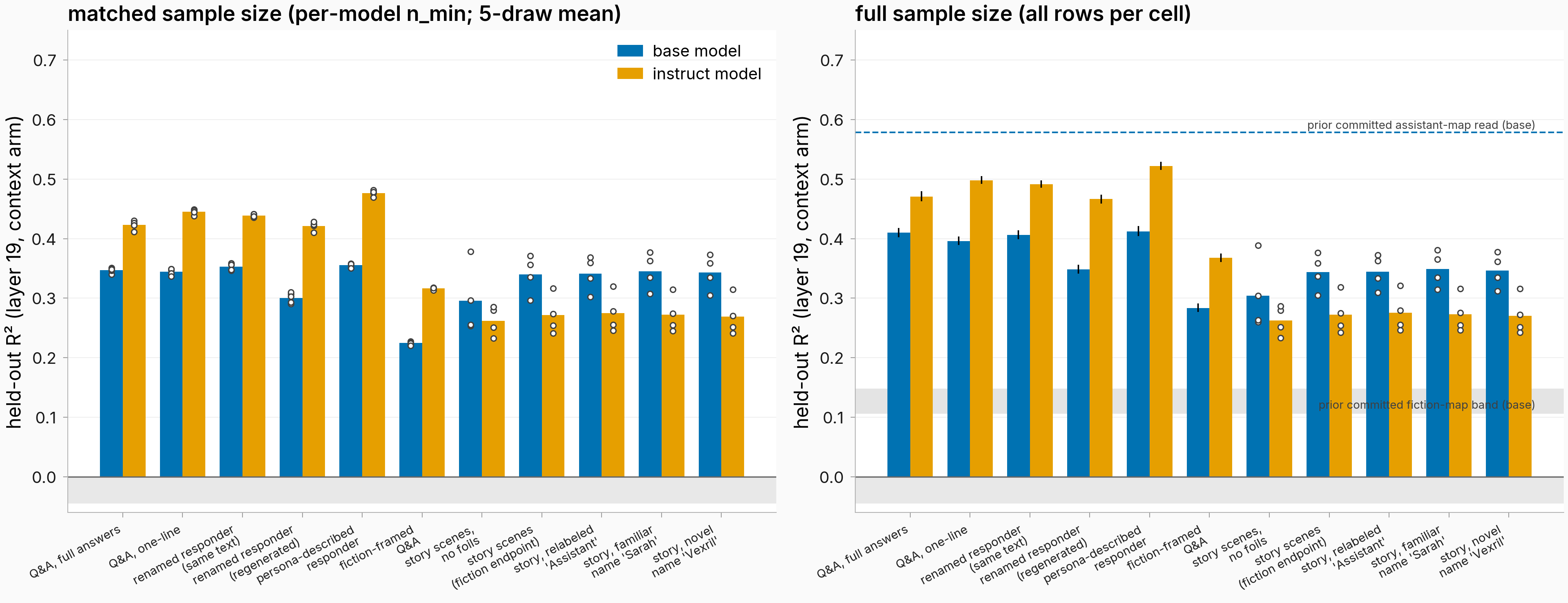
Figure. Only instruct shows the gap. Matched-n (left) and full-n (right) held-out R² at layer 19 across the ladder; n = 1,397–4,894 rows per cell; all 20 shuffle nulls per cell sit at or below −0.02.
In base every rung reads 0.30–0.36 at matched n except the fiction-framed Q&A dip (0.225); the fiction endpoint (0.340) matches one-line Q&A (0.345): gap 0.005 (95% CI −0.012 to +0.021), verdict "Sample-size-explained". In instruct the ladder steps down at fiction framing (0.477 → 0.316) and stays down (0.271 at the fiction endpoint, matched n): gap 0.174 (95% CI 0.159–0.186), verdict "Single-factor-attributed".
Fiction framing carries the instruct gap; label, name, length, and foils are all null
What is plotted: the six oriented adjacent-rung R² drops (strong minus weak side) plus the answer-length drop (gray, outside the family), per model, matched n; whiskers = 95% joint-draw CIs (dark = Bonferroni on the family maximum), white dots = per-draw paired deltas.
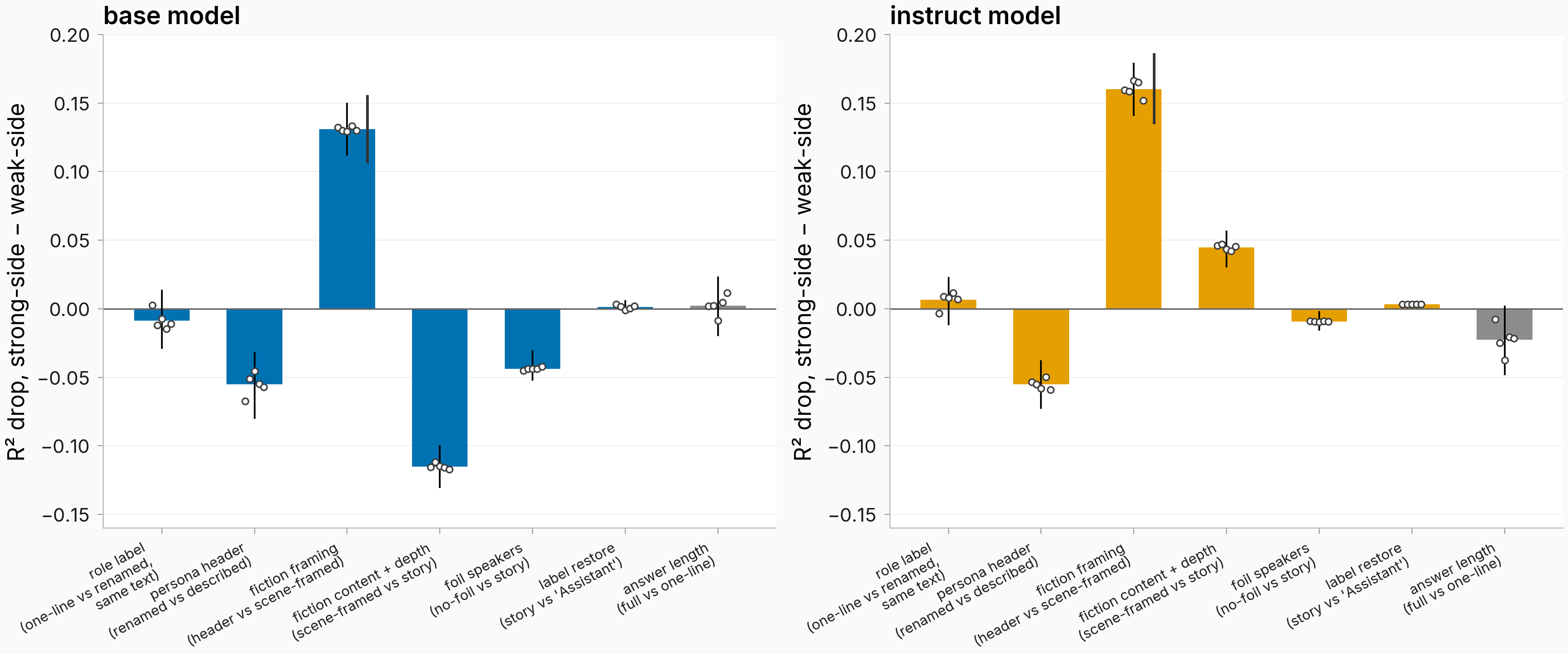
Figure. One factor dominates. Fiction framing (scene wrapper + foil asker on identical questions) drops R² by 0.131 (base) and 0.160 (instruct); every identity-flavored factor reads ≤0.009.
The role label moves ≤ 0.009 on identical text; restoring 'Assistant' onto story characters moves ≤ 0.003, familiar-vs-novel names 0.003 — all below the teacher-forced calibration band (0.053 base / 0.018 instruct), so bounded rather than resolved. Answer length: 0.002 base, −0.022 instruct. The persona-description header is a restoration (+0.055 both models); it makes the described-persona rung the instruct ladder maximum (0.477, above both assistant anchors).
In base the framing drop (0.131) is cancelled by fiction content+depth (−0.115: full story scenes recover what the wrapper lost); in instruct content+depth adds 0.045. The framing rung also bundles a fold-granularity change, quantified in the next section. The planned per-slot depth read was not produced (a free follow-up on persisted stores), so content+depth stays undecomposed.
Row-level folds and multilingual-row exclusion both leave the attribution unchanged
What is plotted: left — the fiction-framed Q&A rung refit (layer 19, full n) under its committed scenario-grouped folds (filled) vs row-level folds (open — the Q&A rungs' granularity), per model, dashed line = the persona-described rung; right — the two Q&A anchor rungs refit with CJK-completion rows excluded (open) vs all rows (filled).
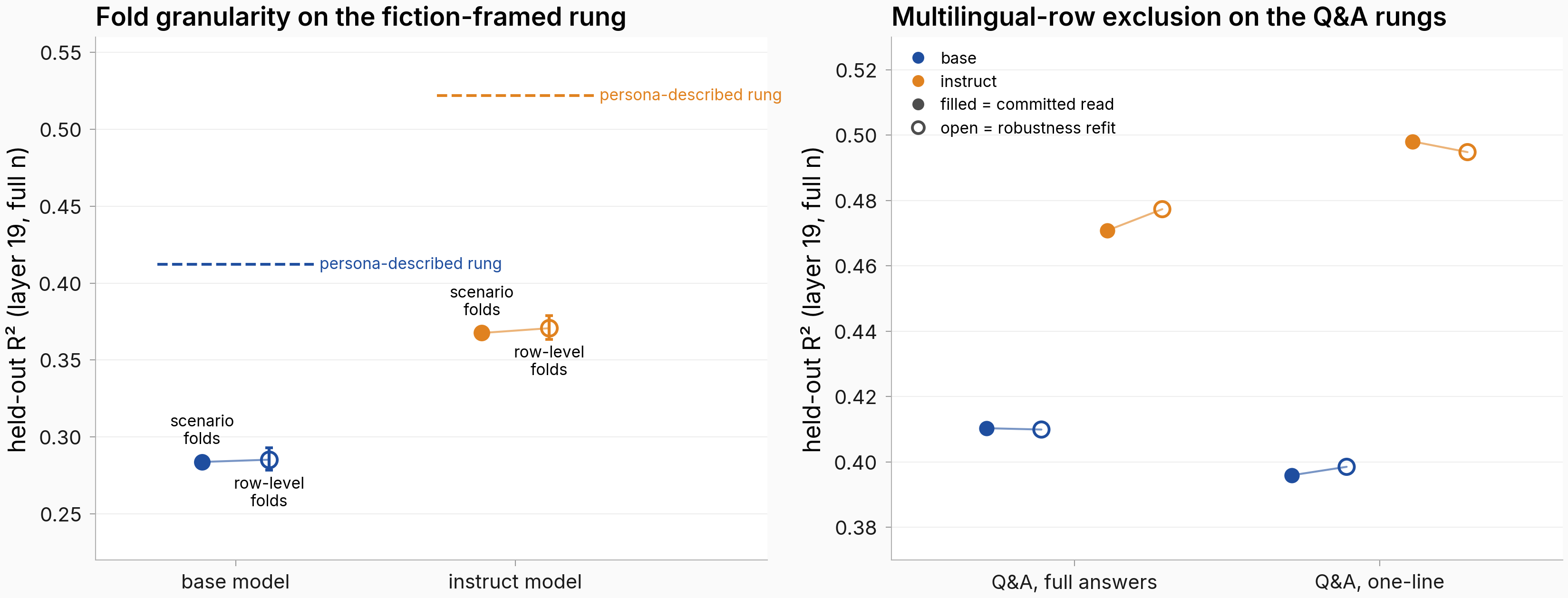
Figure. Both alternatives are inert. Row-level folds move the fiction-framed rung by at most +0.003 (instruct 0.368 → 0.371); excluding the 3.8–10% multilingual rows moves the four Q&A cells by −0.003 to +0.007 and the instruct matched gap by +0.001.
The framing rung's bundled fold change does not produce its dip: under row-level folds it reads 0.285 base / 0.371 instruct (vs 0.284 / 0.368 scenario-grouped), and the matched-n framing delta recomposes to 0.161 (committed 0.160), so the base dip-and-recovery comes from the framing itself; the fold change contributes nothing measurable.
The language asymmetry is equally inert: exclusion shifts the matched one-line values by ≤ 0.001 and the instruct gap reads 0.175 (committed 0.174); the story endpoint has zero flagged rows, so its side is unchanged by construction.
Both endpoints moved against their committed parents — the historical 3–5× gap is mostly recipe and λ-selection
What is plotted: this run's two endpoints (full n, layer 19, circles) against the prior committed reads they descend from (squares; band midpoints where the prior is a range); all prior reads used different recipes and, for fiction, a different λ-selector.
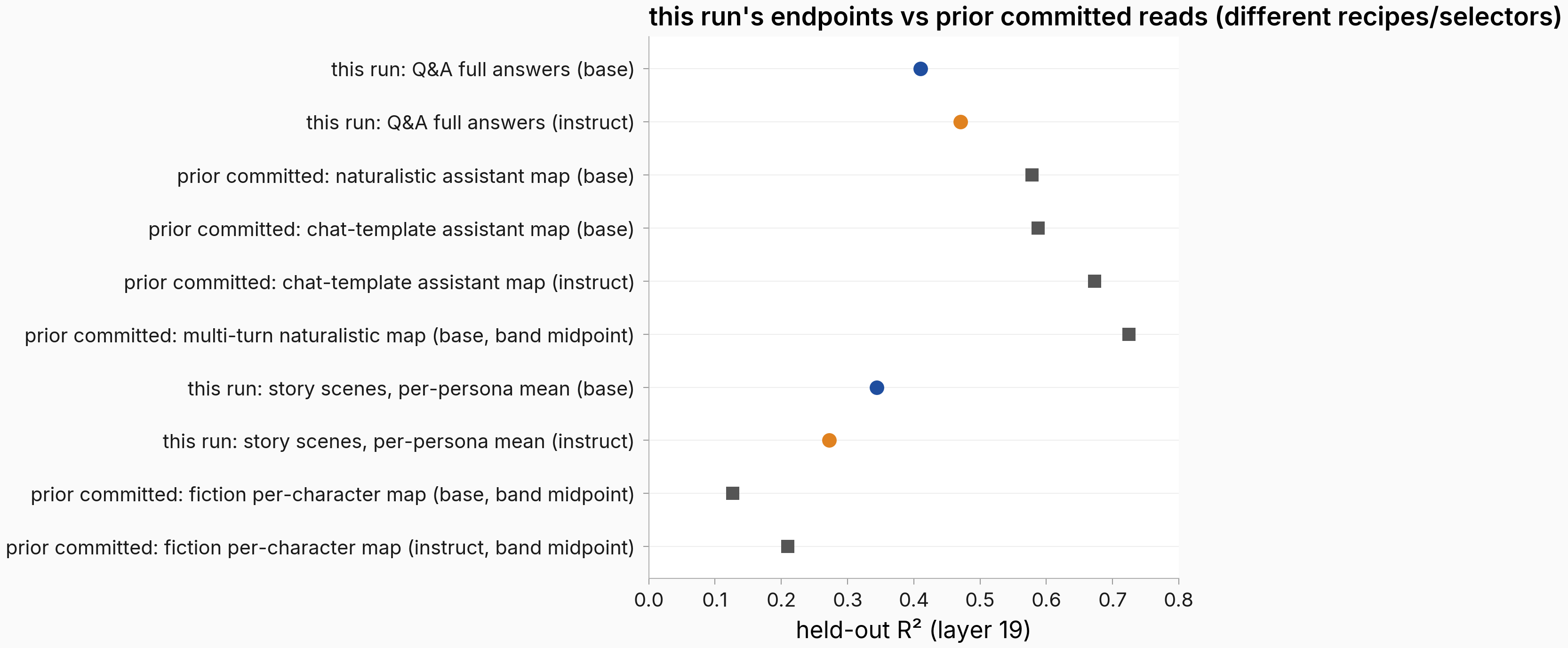
Figure. The endpoints converged from both sides. This run's Q&A endpoint reads 0.410 base / 0.471 instruct vs prior committed assistant-map reads of 0.578–0.725 (0.725 = the multi-turn band midpoint); its fiction endpoint (per-persona mean) reads 0.344 base / 0.273 instruct vs prior per-character band midpoints of 0.127 / 0.210.
Descriptive findings, adjudicated by no gate. The Q&A endpoint reads 0.17 below the closest same-recipe committed read; two candidates are measured. A first-≤96-token target span moves instruct to 0.541 (+0.07), a live mover. Row filters are excluded: refitting on that read's rows shifts R² by −0.001 base, −0.003 instruct; the 177/154 capture-dropped rows bound the rest near +0.02. Render string, capture code path, and near-interpolation regime stay unmeasured.
The base fiction endpoint reads 0.16–0.23 above the prior band (the instruct span overlaps its band, its mean just above): either this turn-by-turn render yields a stronger per-scene map, or the prior selector-regime values understate the well-regularized R² on their own data. The plan's zero-GPU differential probe on persisted artifacts has not yet run.
Per-persona fiction maps are tight within model but re-order across models
What is plotted: per-persona held-out R² (layer 19, context arm, full n, 95% group-bootstrap CIs) for the five story rungs; one labeled point per persona (Wren, HELIOS, Dana, Vex), panels = models.
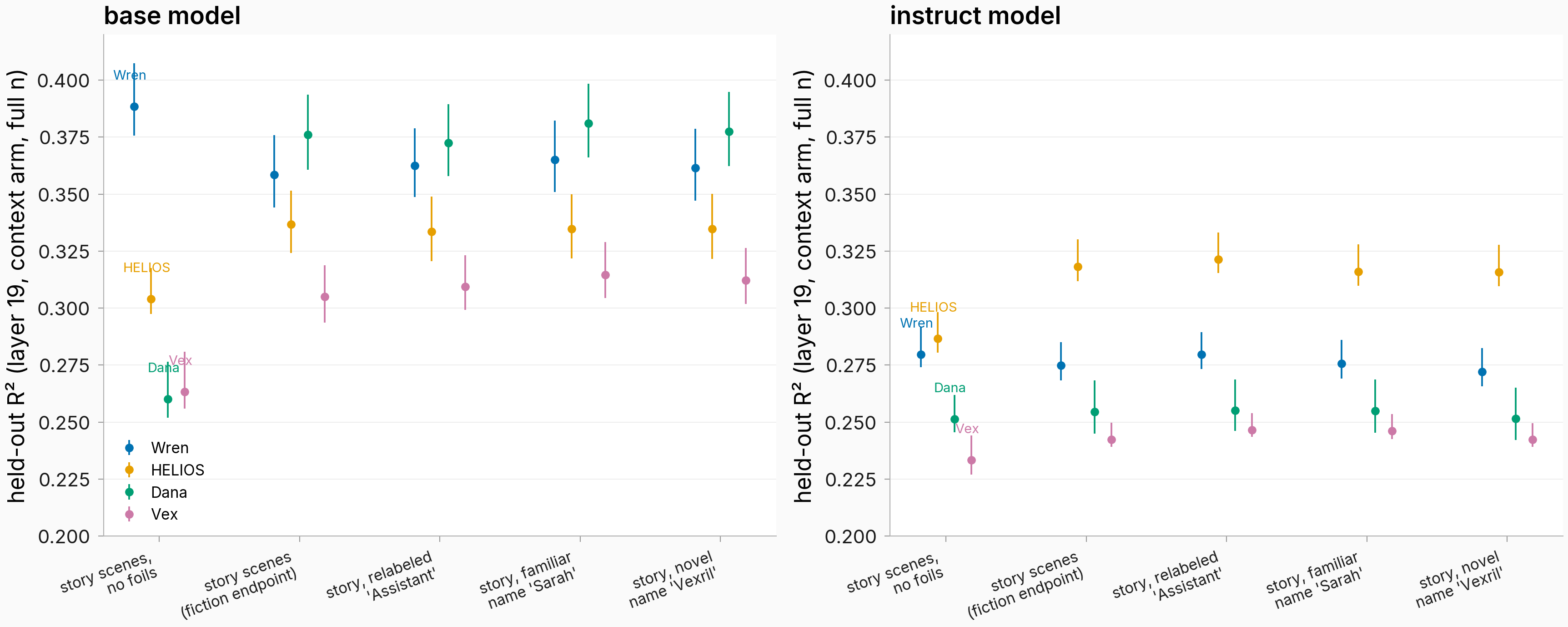
Figure. Personas move together within a model. Base spans 0.305–0.376 across personas on the fiction endpoint; instruct spans 0.242–0.318; the three relabeling rungs are indistinguishable from the endpoint within persona.
Base orders Dana > Wren > HELIOS > Vex; instruct orders HELIOS > Wren > Dana > Vex. The AI-persona cell resists the instruct fiction drop most, which fits the framing account; an identity-modulated rescue of the assistant-like cell would produce the same ordering, so this read stays descriptive. The villain instruct cell reads 0.242 here (n = 1,798, turn-by-turn render, inner-group-CV) vs 0.166 (n = 3,586) in the parent's own whole-script-parse completion round; the two form an independent cross-recipe pair, and the parent had already completed that cell itself. Relabeling rungs sit within ~0.01 of the endpoint per persona, the per-unit view behind the null restoration deltas.
The maps are character-specific everywhere: deranged pairing costs more than half the R²
What is plotted: pooled held-out R² at layer 19 with correct context-target pairing vs a cross-persona derangement, per model, on three story rungs (n = 6,065–7,183 rows, 300 scene groups, paired 1,000-draw group bootstrap).
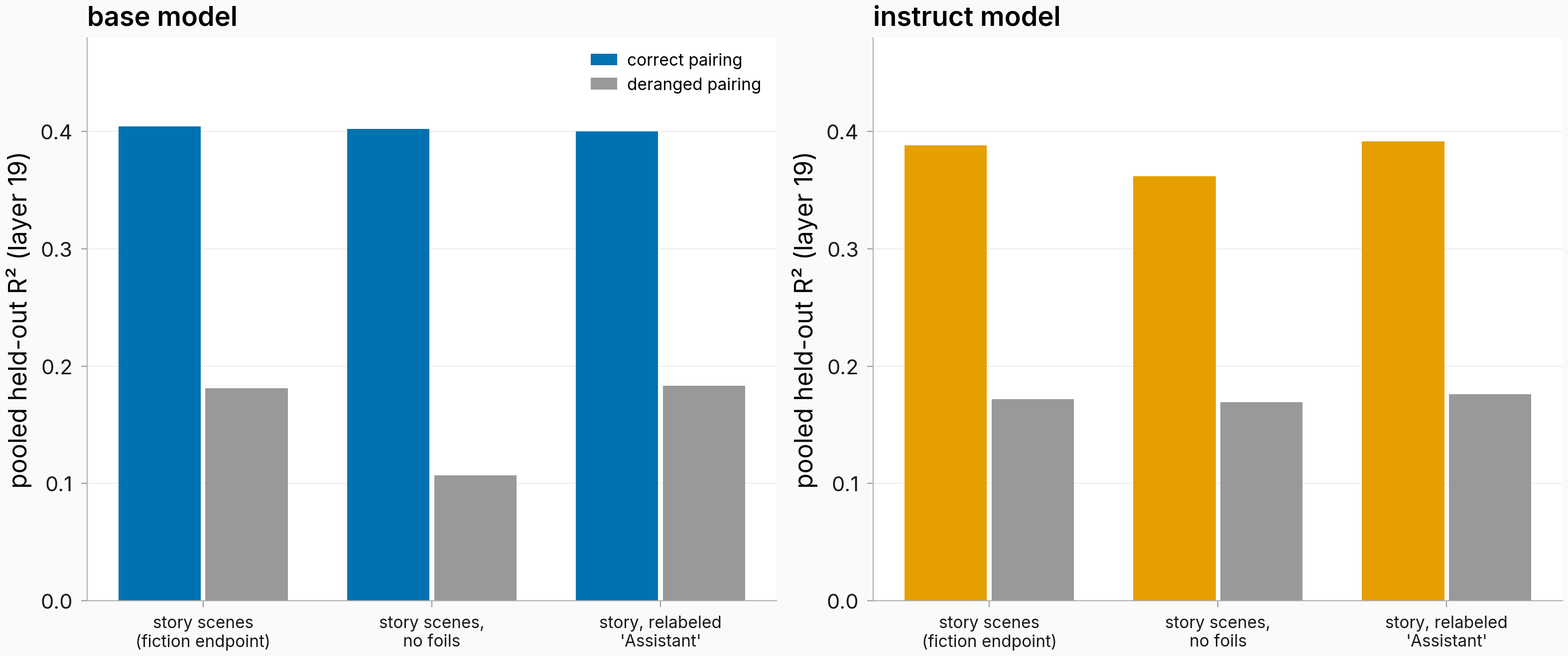
Figure. The map tracks the specific character. Correct pairing reads 0.36–0.40; deranged pairing reads 0.11–0.18; the paired delta is 0.19–0.30 (n = 6,065–7,183 rows) with 95% CIs no wider than ±0.007; the instruct no-foil cell is the smallest (0.193).
The fiction endpoint's specificity delta is 0.223 base (95% CI 0.218–0.229) and 0.216 instruct (0.212–0.221). Foil removal moves specificity in opposite directions per model: the no-foil cell is the largest of the six (0.295, base) and the smallest (0.193, instruct).
So the per-character content of the map is real in both models: the instruct fiction drop is a level shift while the specificity delta stays essentially unchanged (0.216 vs 0.223). This read also clears the binding rig gate: swap specificity must not invert in either model.
On story rungs the prefix alone carries the map; on Q&A rungs the prefix arm is inert by construction
What is plotted: prefix-arm vs context-arm held-out R² per cell (layer 19, full n); closed markers = Q&A rungs, open markers = story rungs (one point per persona); dashed diagonal = arms equal.
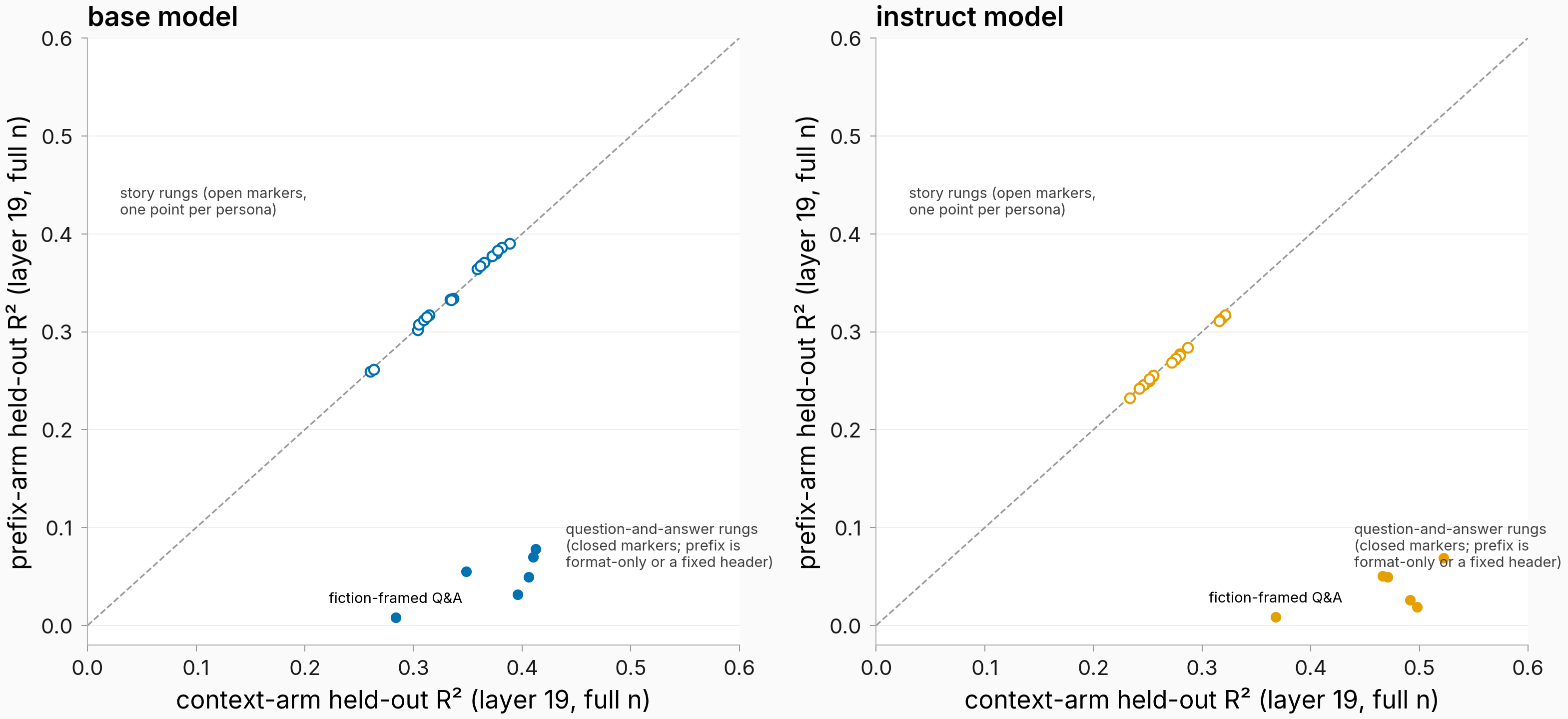
Figure. Two regimes. Story-rung prefixes (accumulated scene text) reach 0.23–0.39, matching their context arms; Q&A-rung prefixes read 0.008–0.078 against context arms of 0.28–0.52.
Both mapping arms ran everywhere per the standing rule. On Q&A rungs the prefix is empty or a fixed header (first-token fallback, flagged in the store), so its near-zero reads are the declared degenerate control. On story rungs the prefix (scene header + accumulated dialogue, excluding the final cue line) recovers essentially the full context-arm value, so the accumulated on-policy scene text carries the map; the frame alone contributes almost nothing (the fiction-framed Q&A rung, whose prefix is only the frame, reads 0.008).
The rung ordering is stable across all 28 layers; layer 19 is representative
What is plotted: held-out R² per layer (context arm, full n) for five representative rungs (story values = per-persona means), per model; dotted line = the frozen headline layer 19.
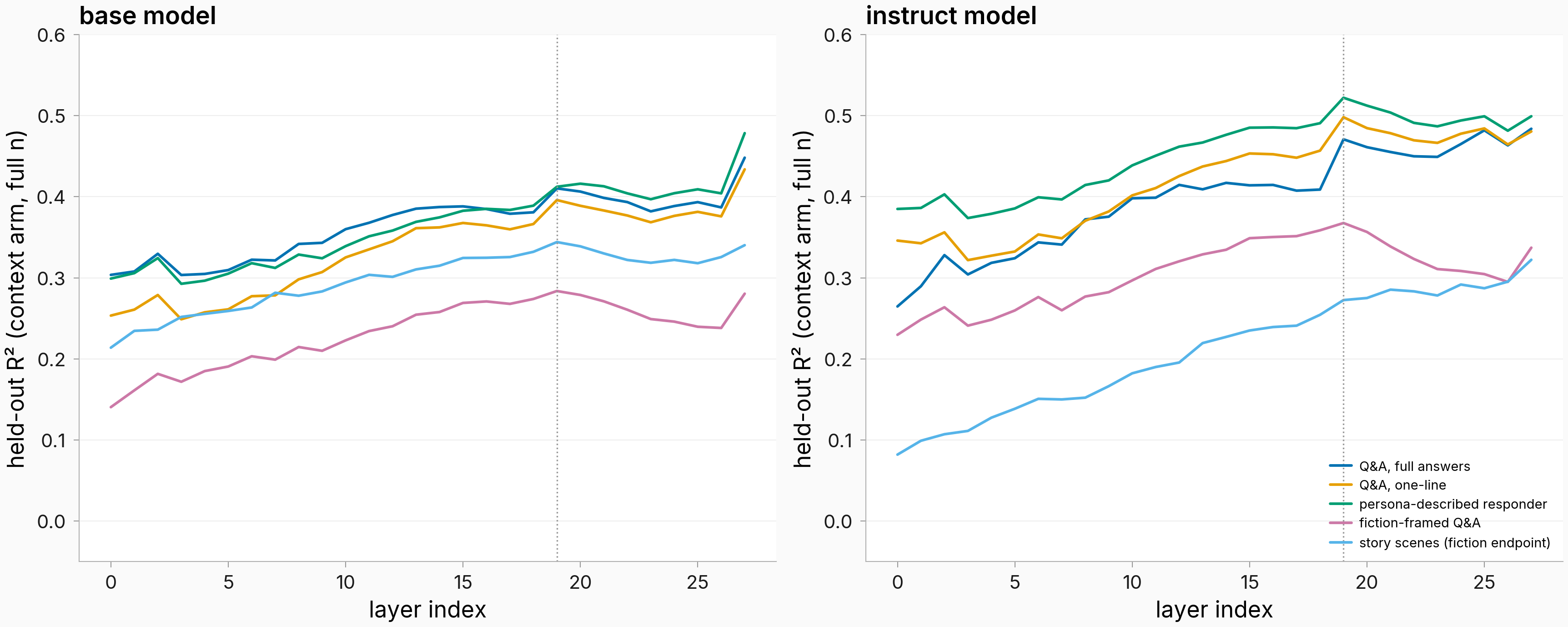
Figure. No layer rescues the instruct fiction map. Curves rise to a mid-late-layer plateau; the instruct story and fiction-framed rungs sit below every Q&A rung at every layer.
The headline pattern survives every layer choice: the base story curve tracks the Q&A curves within ~0.03–0.09 across the mid-late plateau, while the instruct story curve sits 0.15–0.26 below the two assistant-labeled Q&A curves at every layer (up to 0.30 below the persona-described rung). The leave-one-setting-out refits (within 0.03 of the grouped-fold headline everywhere) say the same for the fold structure.
A second generation seed replicates the instruct gap and its framing attribution but flips the base gap from null to positive
What is plotted: left — the gap (one-line Q&A minus fiction-endpoint per-persona mean) and the framing delta (persona-described minus fiction-framed Q&A) at matched n, layer 19, context arm, per model and seed, whiskers = 95% joint-draw CIs within each seed; right — the per-persona fiction-endpoint matched values behind each endpoint mean (circles = base, squares = instruct), whiskers = draw-mean 95% group-bootstrap CIs.
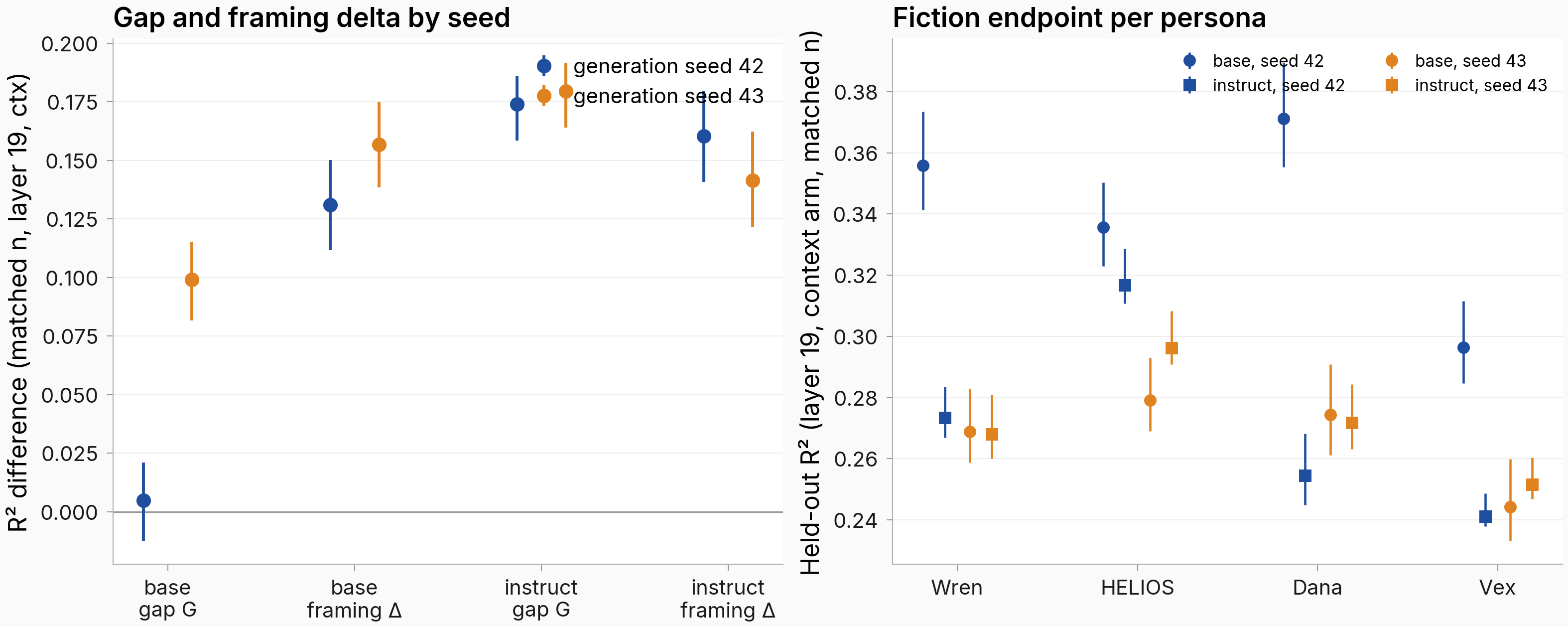
Figure. Instruct replicates; base does not. The instruct gap reads 0.174 then 0.179 across seeds and the framing delta 0.160 then 0.142; the base gap moves from 0.005 to 0.099 (cross-seed delta +0.094, 95% CI +0.071 to +0.118), driven by all four personas' endpoint values dropping together.
Regenerating the four gap-bearing rungs at generation seed 43 (everything else identical; prompt and sampling parity verified under Design) reproduces the instruct headline: gap 0.179 (95% CI 0.164–0.192) vs the committed 0.174, framing delta 0.142 vs 0.160, both cross-seed deltas indistinguishable from zero given the variance. The base null gap does not reproduce: 0.099 (95% CI 0.082–0.115) vs 0.005, well outside the reference CI. The base framing delta moves marginally (0.131 to 0.157, delta CI −0.001 to +0.052). Fiction framing remains the dominant single factor, and the instruct-gap-larger-than-base ordering holds, at both seeds.
The base model carries the seed sensitivity — the fiction endpoint falls most — and the seed-42 base rollouts contain a scene-level sampling collapse
What is plotted: held-out R² for the four re-run rungs (layer 19, context arm, matched n), seed 42 vs seed 43, panels = models; whiskers = draw-mean 95% CIs; white dots = per-draw values.
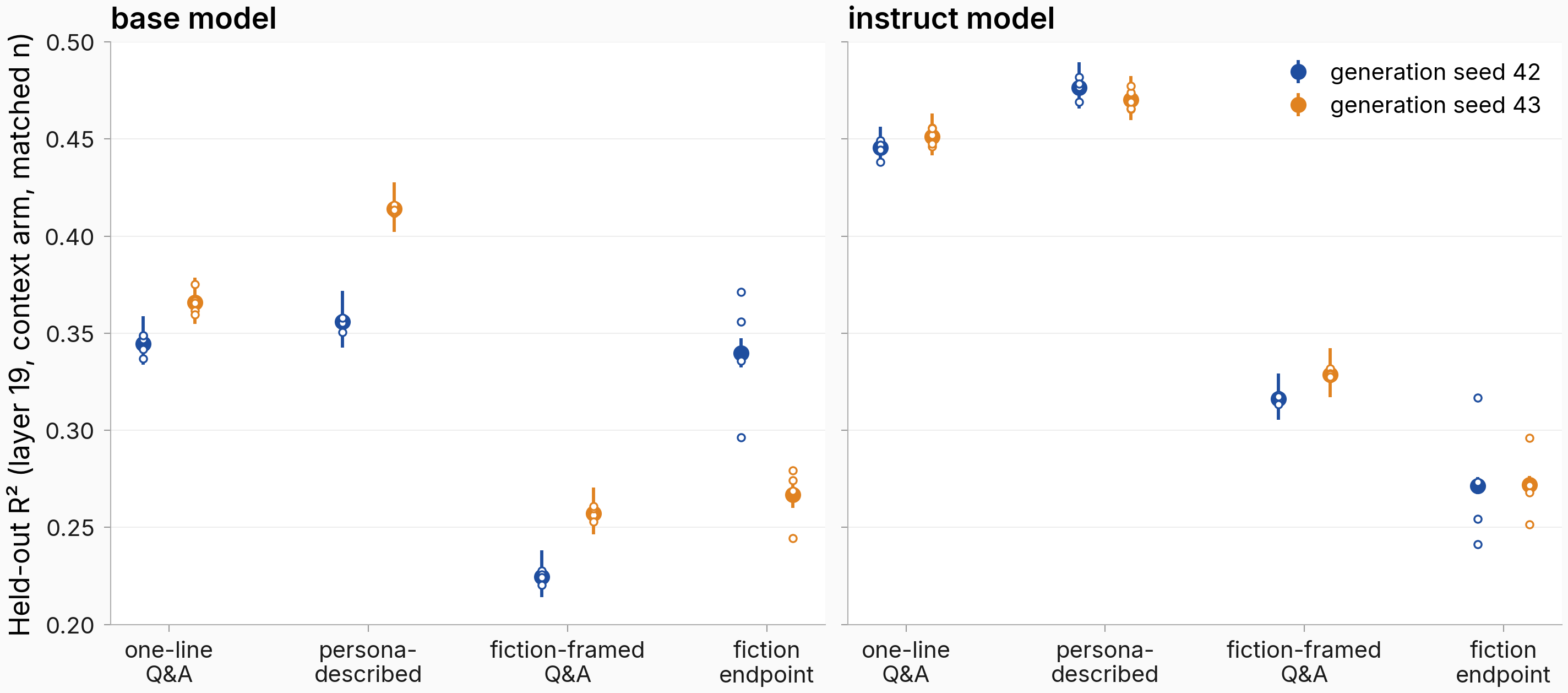
Figure. Only the base model moves across seeds; the fiction endpoint is the largest mover and the only rung moving down. Instruct rungs shift by at most 0.013 at matched n; base Q&A-side rungs rise 0.021–0.058 while the base fiction endpoint falls 0.073, erasing the dip-then-recover shape that produced the seed-42 null gap.
The move is not the matched-n recomputation: at full n every base endpoint persona drops (Wren 0.360→0.272, HELIOS 0.339→0.281, Dana 0.378→0.277, Vex 0.307→0.249), CI-disjoint on both mapping arms; base Q&A-side rungs rise 0.017–0.045, also CI-disjoint; instruct moves ≤ 0.021 on either arm. Rig health holds at seed 43 (wiring fresh-run PASS; bounds under Evaluation).
The seed-42 base endpoint rollouts carry the sampling collapse quantified under Data extraction (781 of 1,200 slot-4 lines exactly "I agree."). Vex, the least-collapsed persona, has the lowest seed-42 endpoint R² and the joint-smallest drop — correlational support that the collapse inflated the seed-42 read; direction unproven pending a conditional refit (a free follow-up). Either way the base rollout distribution is seed-unstable: single-rollout base reads, story rungs most of all, should not carry headlines (independent-run caveat under Data extraction).
A third generation run flips the base gap negative while the instruct gap stands apart
What is plotted: the assistant-vs-fiction gap (one-line Q&A minus fiction-endpoint per-persona mean; left) and the fiction-framing delta (persona-described minus fiction-framed Q&A; right) at matched n, layer 19, context arm, per generation seed — base at all three seeds, instruct at seeds 42–43 (not re-run this round); whiskers = 95% joint-draw CIs within each run.
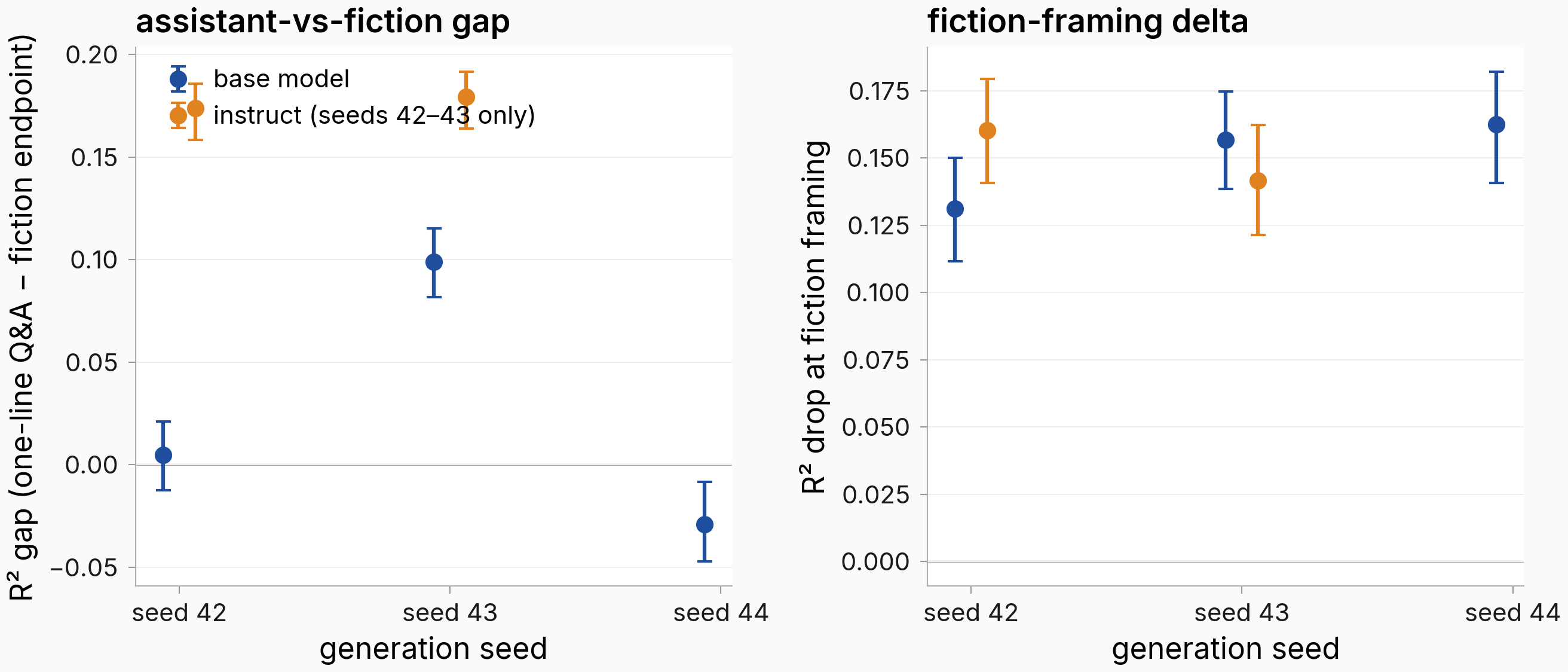
Figure. Three seeds, three base gaps. The base gap reads 0.005, 0.099, then −0.029 across generation seeds 42/43/44 (every pairwise cross-run delta CI excludes zero) while the instruct gap holds at 0.174–0.179; the base framing delta stays 0.131–0.162 throughout.
At seed 44 the base gap is −0.029 (95% CI −0.047 to −0.008): the fiction endpoint is slightly more predictable than one-line Q&A at matched n. The cross-run deltas — −0.034 (95% CI −0.060 to −0.008) vs seed 42, −0.128 (−0.154 to −0.102) vs seed 43 — both exclude zero: a third distinct read, not a modal seed-43 value. The flip may be collapse-conditional: the two null-or-negative gap runs (seeds 42 and 44) are the two ~14%-collapse runs, and collapse-inflated endpoints lower this gap; the built seed-42 conditional refit is unrun. The framing delta reads 0.162 (0.141–0.182), consistent with seed 43 (delta 0.006, 95% CI −0.022 to +0.033).
The run-to-run swing is concentrated in the base fiction endpoint, which rebounds to and above its first-run level
What is plotted: left — matched-n held-out R² for the four re-run base rungs per generation seed (one line per rung); right — full-n per-persona base fiction-endpoint R² per seed (95% group-bootstrap CIs, one labeled line per persona); layer 19, context arm.
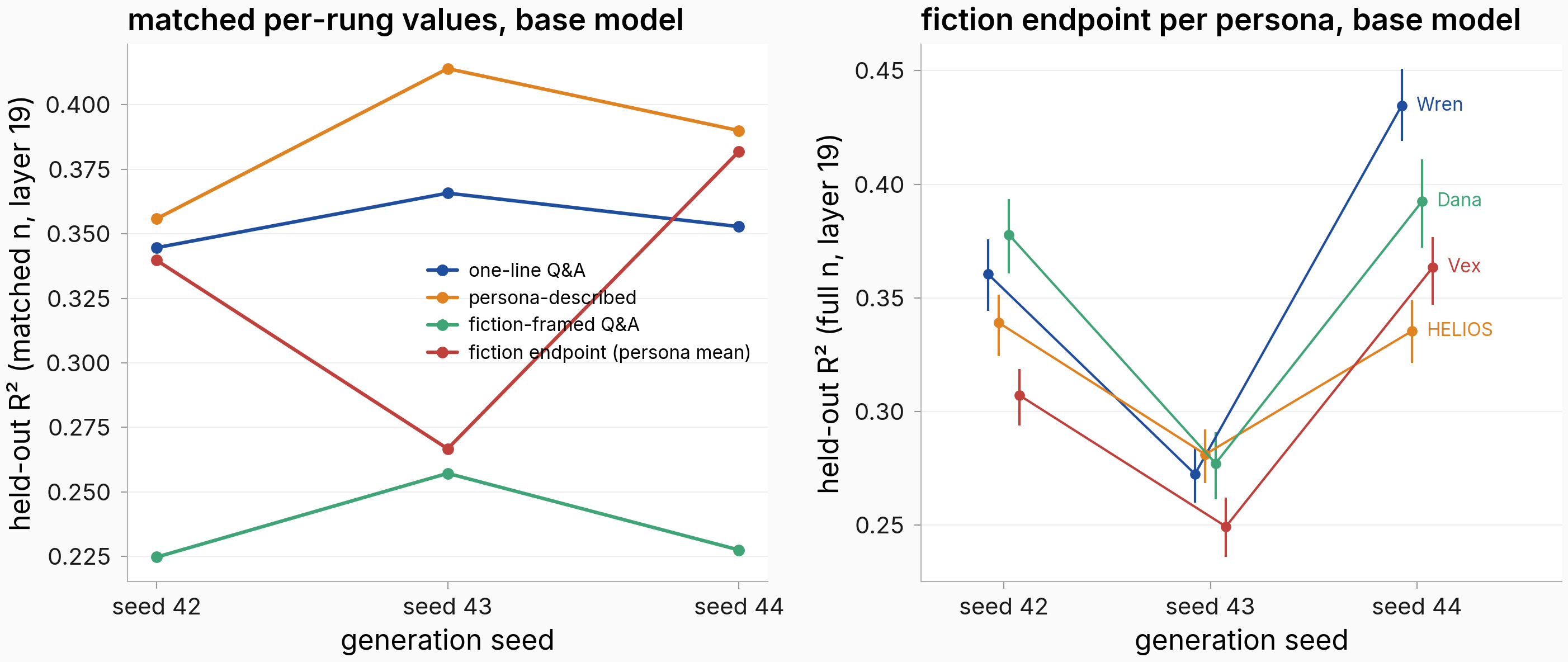
Figure. The endpoint bounces; the Q&A side barely moves. Base fiction-endpoint persona means read 0.346 → 0.270 → 0.382 across seeds at full n; every persona's seed-44 value is CI-disjoint from its seed-43 value on both mapping arms; Q&A-side rungs move at most 0.031 from seed 43 to seed 44.
All four personas rebound from seed 43 (Wren 0.272 → 0.435, Dana 0.277 → 0.393, Vex 0.249 → 0.363, HELIOS 0.281 → 0.335 at full n, moves of 0.054–0.162), three of them to or above their seed-42 values; the prefix arm mirrors the move. The three Q&A-side rungs shift far less between adjacent runs (one-line 0.396 / 0.416 / 0.410; persona-described 0.413 / 0.458 / 0.442; fiction-framed 0.284 / 0.301 / 0.270). So the single-rollout base fiction generation — not the fit, the folds, or the matched-n recomputation — carries the run instability, and the seed-43 across-the-board endpoint drop was itself one draw, not a trend.
The "I agree." collapse mode recurs at a new slot, and collapse rate tracks endpoint strength across runs
What is plotted: run-level fraction of base fiction-endpoint rollout lines under the 4-token keep floor (x) against the full-n per-persona-mean endpoint R² (y), one labeled point per generation seed; no fit line (three runs).
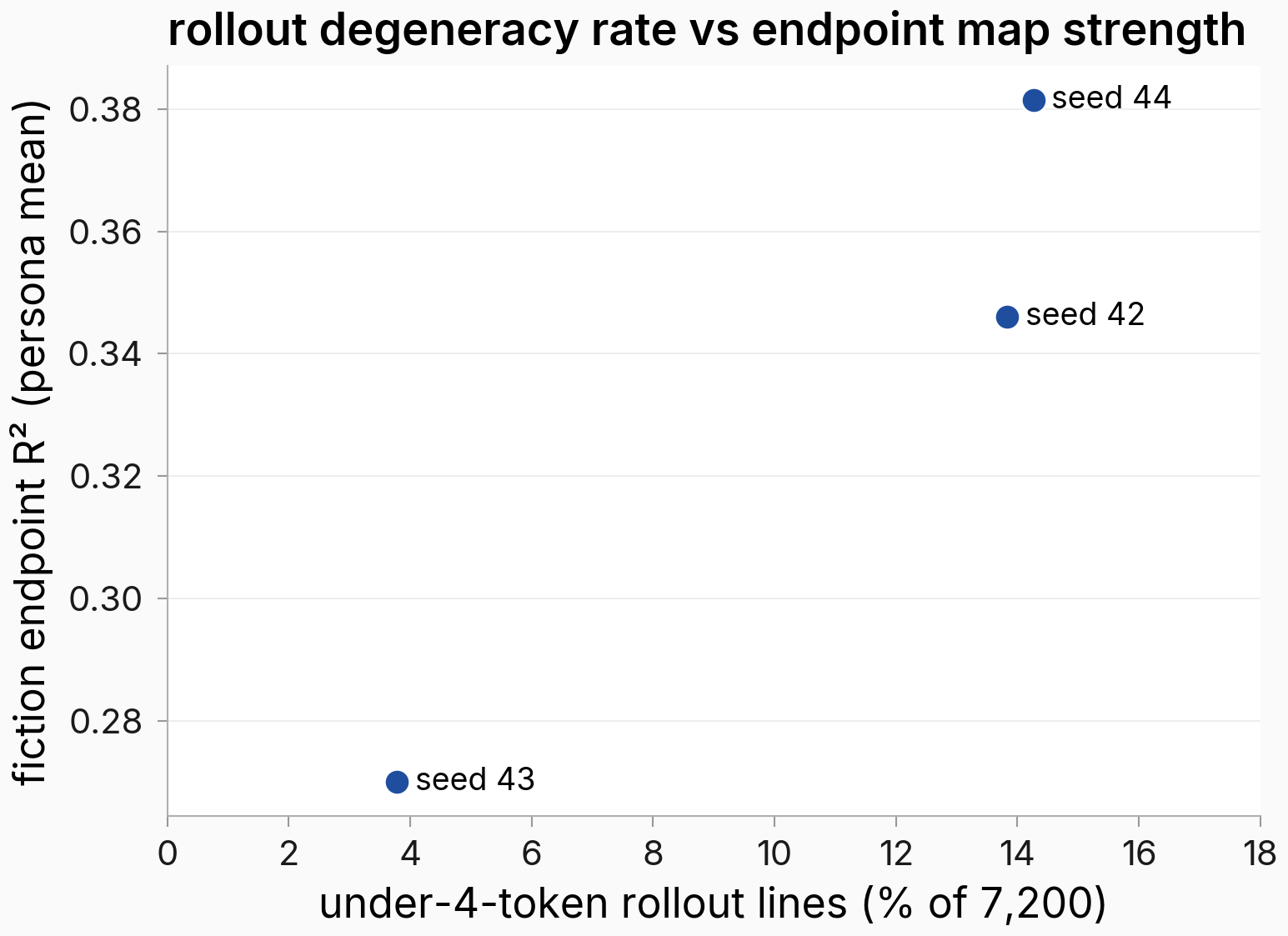
Figure. High-collapse runs are the strong-endpoint runs. Under-floor rates read 13.8% / 3.8% / 14.3% across seeds 42/43/44 against endpoint persona-means of 0.346 / 0.270 / 0.382; the seed-44 collapse concentrates at slot 2 (732 of 1,200 lines exactly "I agree.") where seed 42's sat at slot 4.
The degenerate mode is textual, not positional: the same "I agree." line dominates both high-collapse runs at different slots (781 slot-4 lines at seed 42, 732 slot-2 at seed 44; seed 43 has no dominant slot and 109 such lines total). Across the three runs, collapse rate and endpoint strength co-move — consistent with the round-2 read that surviving rows from partially collapsed scene trajectories fit more predictably — but the within-run per-persona ordering does not cooperate at seed 44 (HELIOS, the most-collapsed persona at 351 under-floor lines, has the lowest endpoint R²), so the association stays run-level and correlational at three runs. The direction-resolving collapse-conditional refit of the seed-42 store is built but unrun.
An on-policy 'Assistant' character label lifts the instruct fiction map above both same-run Wren controls, but leaves the base map inside the run-noise band
What is plotted: within-run paired label deltas at layer 19 — the Assistant-lead story cell minus the Wren-lead cell (generation seed 45, blue) and the same-run Wren seed-45 minus seed-46 replicate delta (orange) — per model; filled = context arm (headline), open = prefix arm; whiskers = 95% joint-draw CIs (1,000 draws), small circles = per-draw deltas; the base half is shaded at ±0.071, the pair-noise band from the 12 committed base endpoint cells.
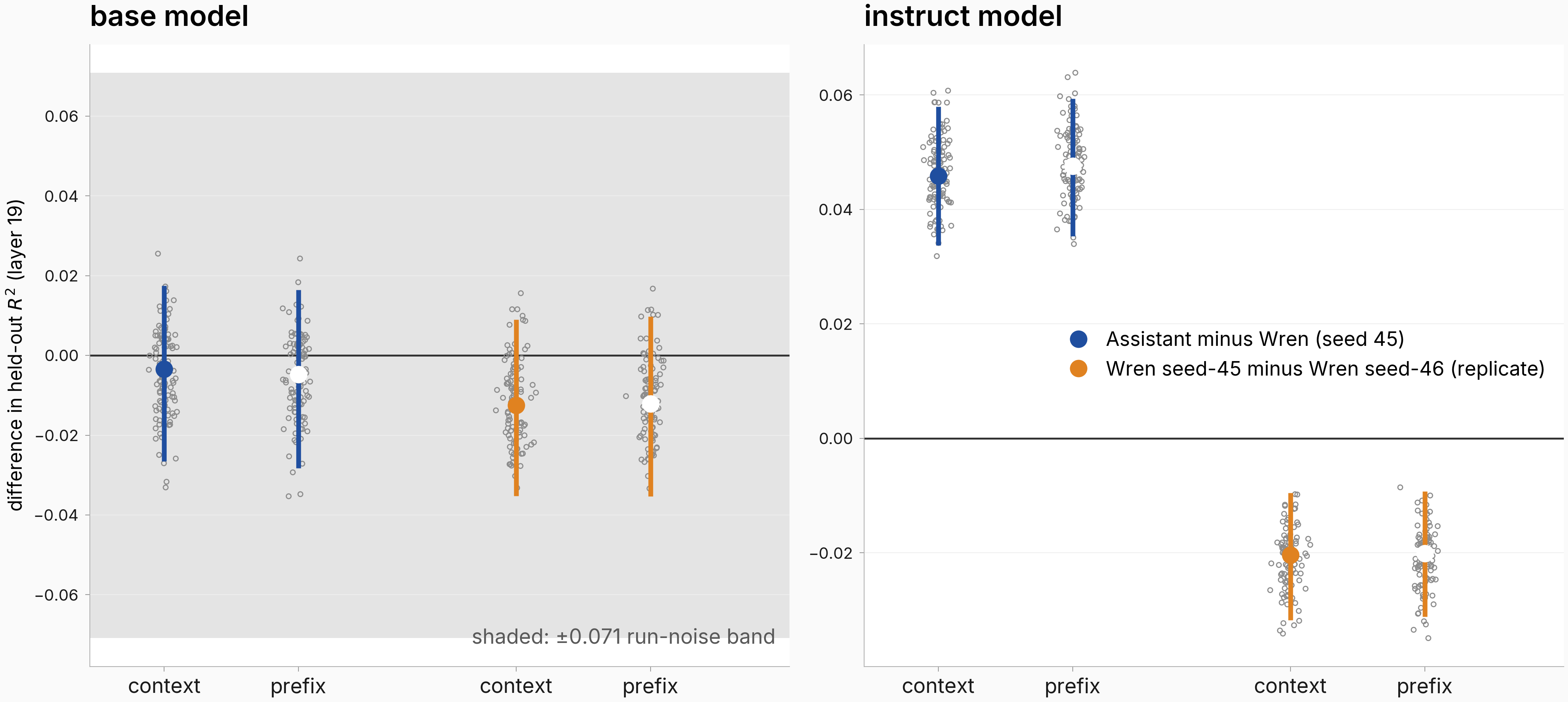
Figure. Label lifts the instruct map; base stays within run noise. Instruct: Assistant minus Wren reads +0.046 (CI +0.034 to +0.058), clear of zero; base reads −0.003, inside the shaded ±0.071 band and smaller than its own same-name replicate delta (−0.013).
Instruct meets the positive criterion (delta +0.046, CI excludes zero; prefix +0.048 and leave-one-setting-out +0.042 concur). The lift is ~15× the teacher-forced relabel bound (0.003), so it rides generated text. Two temperings: the second-Wren-control point delta is +0.025; the same-name replicate delta (−0.020, CI excludes zero) shows joint-draw CI understates cross-cell noise — so the lift is 1.2–2.2× demonstrated same-name movement, from one run. Base is bounded inside the run-noise band — a bound, not a zero. The band (±0.071) exceeds the instruct lift (+0.046), so the asymmetry is verdict-level only.
Same-run seed pairs are tight while independent runs swing — and the new cells sit inside the committed cross-run band
What is plotted: held-out layer-19 R² of the three new cells at matched n (1,397 base / 1,739 instruct; descriptive read), beside the committed fiction-endpoint persona cells from generation seeds 42–44 for base and 42–43 for instruct (the seed-44 instruct run was never made — the caveat carried in Takeaways); the dotted reference is the one-line Q&A anchor.
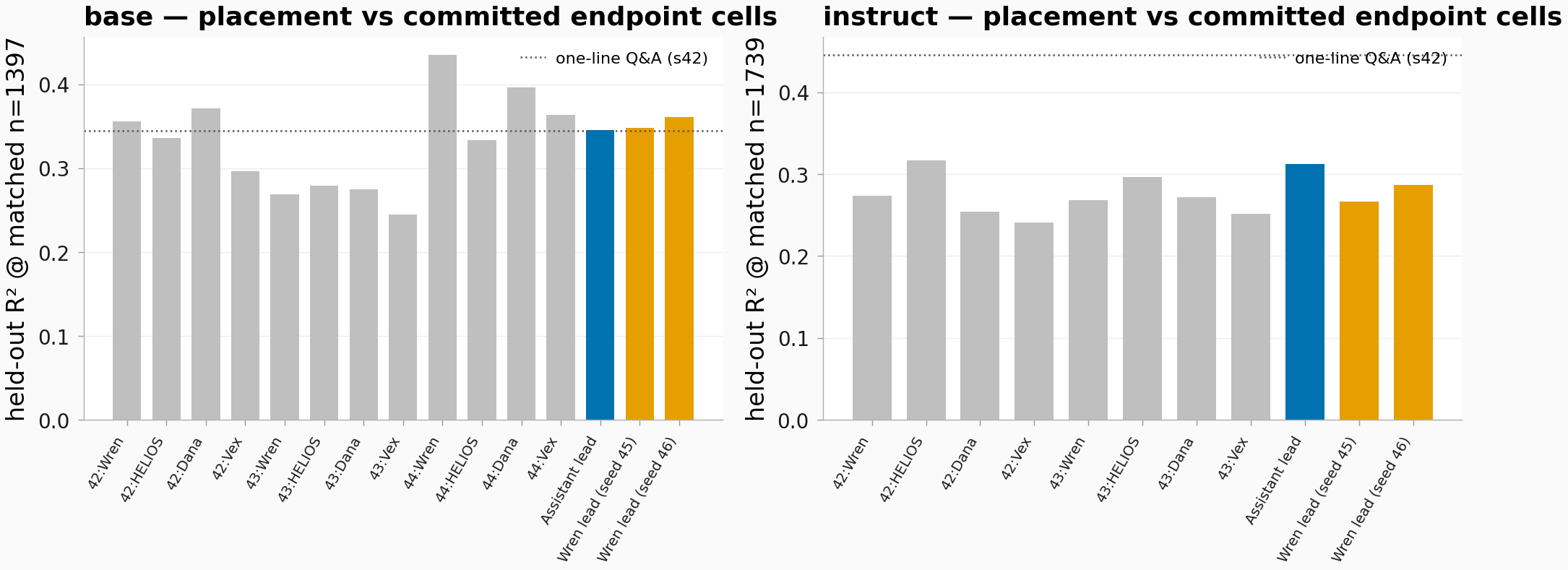
Figure. Run, not sampling seed, carries the base instability. The two new base Wren cells (0.348, 0.361) land mid-range of the committed 0.269–0.435 cross-run Wren spread and only 0.013 apart from each other.
The base Wren endpoint now has five reads across four independent runs: 0.356 / 0.269 / 0.435 (committed) and 0.348 / 0.361 (this round) — cross-run swings up to 0.166 — while the two same-run seeds differ by 0.013 (base) and 0.020 (instruct). With the run held fixed, a fresh sampling seed moves the endpoint by ~0.01–0.02, so the 0.08–0.17 swings attach to the run, not the seed (one replicate pair per model — suggestive). On instruct, the Assistant cell (0.313) reaches the committed persona-band ceiling (0.317) — the label lifts the fiction substrate to the top of the observed band.
The label rewrites the base model's text without moving its map; the instruct pair is text-matched while its map moves
What is plotted: distributions of generated line length in words for each of the three cells, per model (violin, median marked, per-cell means labeled), from the full 1,800-line rollout sets before keep-floor filtering.
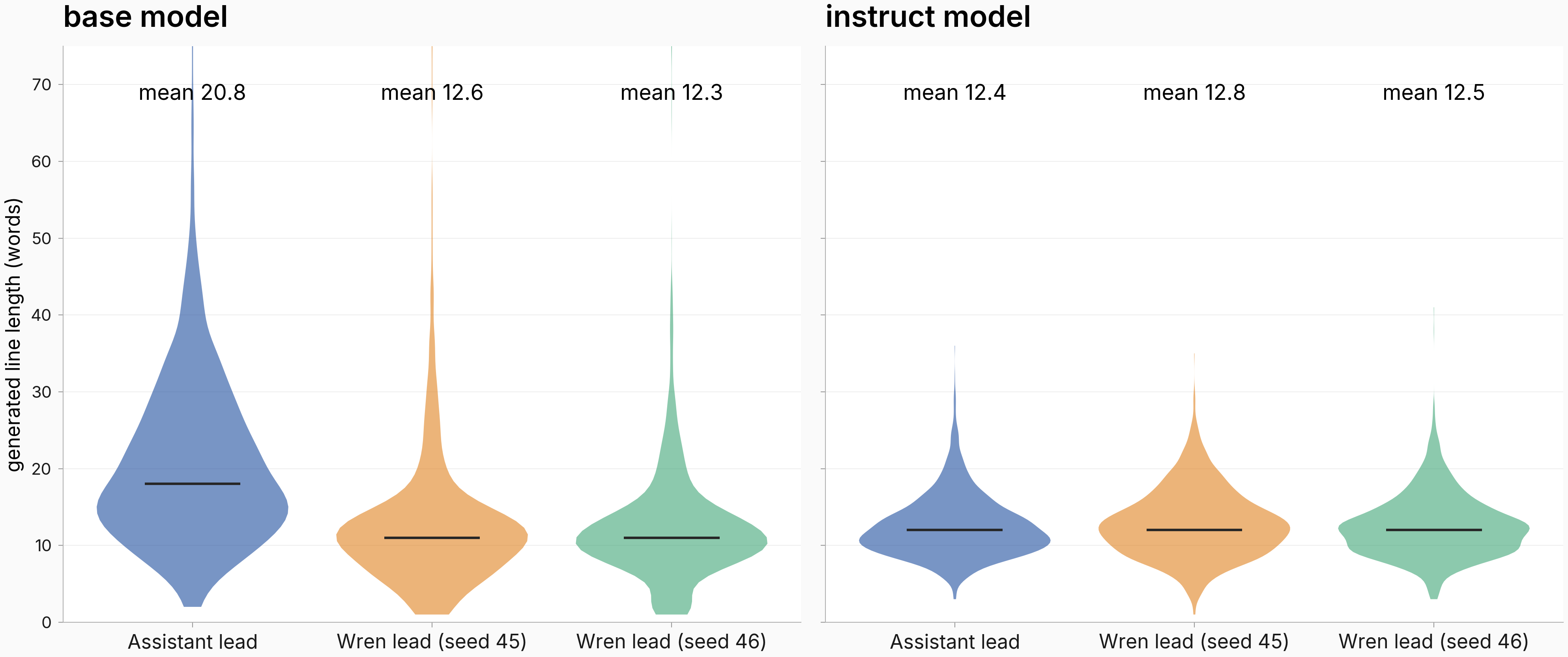
Figure. Text and map dissociate in base. Base Assistant lines average 20.8 words vs 12.6/12.3 for the two Wren cells; instruct lengths are matched (12.4 vs 12.8/12.5).
Base: 38% of Assistant completions open with a speaker label (0 in the other five cells) — the base model treats Assistant: as a dialogue-format token. Base Wren cells repeat one exact line at 24–24.7% of slot completions; the Assistant cell peaks at 4.7%. Despite this, the base map is −0.003; a refit excluding the 687 label-prefixed rows would bound whether sub-populations cancel (free-analysis follow-up 3, unrun). Degenerate rates: 0% base Assistant vs 3.8–4.3% base Wren; per-slot breakdown in collapse_slots.png @ 185a6bd8ee — seed-45 slot 1 (17.7%), seed-46 slot 0 (24.0%), Assistant: none. Instruct lengths match; the one proxy that differs (stage directions 0.6% vs 11.8%) also varies between the two same-name Wren cells (maps differ only 0.020) and does not track the label delta. Two-name scope: assistant-semantics vs generic name variance unsplit.
Repro: ~26 GPU-h total across 8 attempts, 2026-07-15→17 — GCP flex-start 2×A100-80 attempts 1–5 (~17 GPU-h realized; crash-persist partials under issue1335_partial/), then RunPod failover pod-1335 attempts 6–8 (fits-only relaunch, ~6.4 GPU-h). Final code SHA 149a890f8177f6b582263fc454b9353fd4efbd7a on branch issue-1335 (scripts/issue1335_{gen,render_rungs,extract_store,fit,figures}.py, scripts/issue1335_run.sh); crash-fix rounds r5–r11 en route: 429-resilient shard-upload verify (fb1acf80a1), seeded-wiring sidecars + gate2 all-skipped record (377f824b5f), GCV λ-degeneracy → inner-group-CV selection (da31ac154d), fit_cells ports + pin bump (408245a53b), EXDEV staging fix (e74296e460), cuSOLVER eigh CPU-fallback (d1922d2068), amended-gate recalibration (149a890f81). Eval JSONs: eval_results/issue_1335/ @ 4635f236de (branch), headline artifact ladder_summary.json (per-cell fits cells_*.json, matched-n matched_*.json, nulls, swap, wiring, leave-one-setting-out; note the per-cell metadata.issue field reads 931 — an inherited default from the shared fit core — the cell_id and paths are authoritative). Figures: figures/issue_1335/ @ 6035432732 (main, with .meta.json sidecars); endpoints_vs_committed regenerated round 3 @ cd045cf338 — fiction-instruct prior square re-plotted at the parent's committed-band midpoint (supersedes the 6035432732 copy; script scripts/issue1335_fig_endpoints.py @ branch 4fd9d43491). HF (verified live via list_repo_tree, dataset rev 08421fc22bbe): rollout text issue1335_ablation_ladder/raw_completions/ (22 rollout JSONLs across 8 stage folders) and 22 bf16 activation stores under analysis_tensors/. Plan: plans/plan.md v7 (amended §7 gates; λ-selection provenance recorded per fit JSON as lambda_selection: inner-group-cv).
- Reused prompts from #825:
issue825_userbase_map/raw_completions/track_s/@ HF revdeb7a452— fit: the strong endpoint's exact 5,000 prompts, making all Q&A rungs row-aligned with it. - Reused fit/datagen machinery from #1310:
issue1310_*.py+ vectorizedissue825_fit_cells.py@ branch tip0a0e9cfdde— fit: fiction-endpoint parity; throughput inspected (batched inner loop, device-parametrized, no in-loop Hub calls). - Read-only comparator cells from #825 (
cells_S1/S2/S2N.json) and #1310 v3 markers — consumed as committed reference values only; this run never re-adjudicates them. - Round-2 companion refits (fold granularity + language composition):
scripts/issue1335_refit_companions.py→ refits_r2_companions.json @a9dc85d6c2(branch) — 0 GPU-h: ~22 single-layer layer-19 closed-form ridge refits + 20 matched-n draws on the persisted bf16 stores (HF rev08421fc22bbe), ~25 min on VM CPU; reproduction anchors matched the committed cells within 1e-6 before any filtered/refolded read. Figure scriptscripts/issue1335_fig_robustness.py. - Round-3 free-analysis follow-up (row-filter refit):
scripts/issue1335_refit_r0_filters.py→ refits_r0_filters.json @d681f971cc(branch) — 0 GPU-h: ~6 single-layer layer-19 closed-form ridge refits on the persisted bf16 stores (HF rev08421fc22bbe), ~15 min on VM CPU; reproduction anchors matched the committed cells exactly (max residual 2.2e-16); the #825 filter-recipe provenance is recorded in the JSON. - Follow-up round
seed43-gap-rungs(2026-07-17, ~7.6 GPU-h realized on GCP 2×A100-80): round artifacts eval_results/issue_1335/seed43-gap-rungs/ (130 files: cells/matched/nulls/swap/wiring +seed_comparison.json) @ branch500479e6e7, run SHA4fc950e83e; figure scriptscripts/issue1335_fig_seed_compare.py@ branchba40717a85. Figures: figures/issue_1335/seed43-gap-rungs/ @ main6a6309125f4f(seed_compare_rungs+seed_compare_deltas, with.meta.jsonsidecars; raw URLs verified live). HF (prefix-scopedlist_repo_tree, verified live, dataset revd2aba5ea77e7): rollouts issue1335_ablation_ladder/seed43_gap_rungs/raw_completions/ (8 JSONLs, 4 stages × 2 models); stores under analysis_tensors/ (8 store dirs). - Follow-up round
seed44-base-rungs(2026-07-17→18, base model only, est. ~4 GPU-h, GCP attemptatt-20260717-224853; generation/capture SHAb573df3f9ffa858fec87f7d89130862127800f78embedded in the rollout rows — the relaunched fit lane resumed from stores captured at it — and fit/seed-comparison SHA46ca73b3b0be33a65594315b77a8583305100199): round artifacts eval_results/issue_1335/seed44-base-rungs/ (66 files: cells/matched/nulls/swap/wiring/leave-one-setting-out +seed_comparison.jsoncarrying the dual-reference cross-run reads and the collapse audit) @ branch7980346502; figure scriptscripts/issue1335_fig_seed44.py@ branch5393f3879c. Figures: figures/issue_1335/seed44-base-rungs/ @ branch5393f3879c(seed_gap_trajectory,seed_rungs_endpoint,collapse_vs_endpoint, with.meta.jsonsidecars; raw URLs verified live). HF (prefix-scopedlist_repo_tree, verified live, dataset rev7d27ca1b6561): rollouts issue1335_ablation_ladder/seed44_base_rungs/raw_completions/ (4 JSONLs, base only) and 4 bf16 stores under analysis_tensors/. The proposal's companion (a collapse-conditional refit of the committed seed-42 endpoint store) shipped as a driver mode in the round's code but was not executed — it remains an unrun free analysis. - Follow-up round
onpolicy-assistant-label(2026-07-18, ~6 GPU-h, GCE 4×A100-80 flex-start, 6-lane parallel dispatch): round artifacts eval_results/issue_1335/onpolicy-assistant-label/ (label_comparison.json+ per-cellcells_/nulls_/loso_/swap_/wiring_*.json); fit/driverscripts/issue1335_fit.py+scripts/issue1335_fig_label.pyat code SHA01ebb89738835c656f4b8a942a0d3afe4647be25. Figures: figures/issue_1335/onpolicy-assistant-label/ (hero_label_delta+answer_length_register, with.meta.jsonsidecars, @be61a85e;placement_panel+collapse_slots@695b33dfe4). HF (prefix-scopedlist_repo_tree, verified live, dataset rev53e014c4a530cfba76f1e5f2b29a1ae4841d46b3): rollouts and stores under issue1335_ablation_ladder/onpolicy_assistant_label/ ({raw_completions,analysis_tensors}/ — 6 rollout JSONLs + 6 store dirs).
Context: originating prompt (verbatim):
Run an issue to run ablations to figure out why the mapping exists for the assistant without chat template but doesn't for these story characters
Lineage: parent #1310 (per-character fiction map) — this task attributes the strength gap that result opened; grandparents #825 / #1092 (assistant map). Created 2026-07-15; run 2026-07-15 → 2026-07-17 (8 attempts: 5 GCP flex-start + 3 RunPod resume passes; the round-8 λ-selection diagnosis and fits-only relaunch are recorded in the plan's Amendment v4). Interpretation round 2 (2026-07-17): critique-driven revision — numeric corrections plus 0-GPU-h fold-granularity and language-composition companion refits on the persisted stores. Interpretation round 3 (2026-07-17): wording/number-consistency fixes — parent-lineage claim corrected to the cross-recipe reading, endpoints figure re-pinned at the parent's committed-band midpoint (0 GPU-h). Free-analysis follow-up round (2026-07-17): the row-filter candidate for the Q&A-endpoint discrepancy measured on the persisted stores and excluded (0 GPU-h). Same-issue follow-up round seed43-gap-rungs (2026-07-17, followup_label seed43-gap-rungs): seed-43 replication of the four gap-bearing rungs; the verbatim scope prompt is recorded in the epm:followup-scope v1 marker (2026-07-17T11:45:22Z). Same-issue follow-up round seed44-base-rungs (2026-07-17, followup_label seed44-base-rungs, proposer cheap-band round 2 of 2): base-only generation-seed-44 re-run of the same four rungs; the verbatim scope prompt is recorded in the epm:followup-scope v2 marker (2026-07-17T18:13:46Z). Same-issue follow-up round onpolicy-assistant-label (2026-07-18, followup_label onpolicy-assistant-label, user-initiated): on-policy generation as a character literally named 'Assistant' on the endpoint scenes, read against same-run Wren controls; verbatim origin prompt: "run it as much in parallel as possible"; scope prompt recorded in epm:followup-scope v3 marker (2026-07-18T07:19:59Z). Task kind: experiment; parent run single-seed (generation seed 42, fit seed 0); the seed43-gap-rungs round adds generation seed 43 on the four gap-bearing rungs, and the seed44-base-rungs round adds generation seed 44 on the same rungs, base model only; the onpolicy-assistant-label round adds seeds 45+46 on three label cells per model.