The theory's full leakage predictor does not beat the install-leak control: a taught-fact's geometry ρ sits inside the designed-null band, and a plain cosine ties it (LOW confidence)
Highlight text on any card (body, plan, or an event) to anchor a comment, or leave a whole-task comment here. Mention @claude to summon a reply.
No comments yet.
Methodology: docs/methodology/issue_666.md · gist
Takeaways
- The predictor's best content arm (taught fact) reaches ρ = +0.41 against latent leakage, but the install-matched signal-free control cells reach ρ = +0.41 and +0.49 — the geometry-win gate FAILS.
- A plain cosine special-case ties the full predictor (ρ = +0.39 vs +0.41); whitening adds no consistent per-cell advantage, and the reported base-prior column is itself null/negative on the taught-fact arm (mean ρ = −0.33; the planned install-clean partials were not produced).
- Swapping the behavior direction flips bad-medical and EM from ≈0 to ρ ≈ +0.50 (Δ = +0.57, +0.49) — the headline number is a measurement choice, not a model property.
- Clustered 95% CIs are very wide; only 2 of 8 taught-fact cells exclude zero, and every cell's CI overlaps the designed-null band — no arm is resolvable from the control.
- The marker arm floors at ρ ≈ 0 (never installed); test-retest reliability is ρ = 0.93 but on the one bad-medical cell measured, so the marker/EM near-nulls are read as real nulls only assuming comparable reliability.
- Net: neither geometry nor the target's own base-prior column predicts latent
Δsabove the install-leak control here; base-prior ρ is itself −0.33 on the headline taught-fact arm, so this experiment neither confirms nor refutes the cross-program base-prior result.
Goal
This experiment in context: This is Phase 4 of the leakage-prediction program (#660): assemble the leakage-theory paper's full closed-form predictor — a behavior-transfer term times a whitened context-gate — and race it against a plain cosine special-case, the target's own base-behavior prior, two install-matched signal-free control behaviors, and the test-retest noise floor, on the trained-activation store Phase 2 (#664) already saved. Phase 2 carried two caveats forward that shaped this run: the marker behavior never installed (so its arm is a sentinel, not a test), and content-behavior gate signal-to-noise co-varies with how hard the behavior was installed (so beating a base-rate guess could just mean "tracking install strength"). Phase 1 (#658) supplied the frozen behavior direction for two of the four behaviors; the other two read their direction off the per-cell install shift, which is the one mixed-recipe caveat the headline carries.
Broader narrative: The leakage-theory paper claims base-model context geometry predicts which other personas a fine-tuned behavior leaks into. Three prior project results (#532, #541, #649) found the cheaper baseline — a unit's own base-model propensity for the behavior — beats geometry for predicting the absolute level of leakage. This phase asks the sharper question: does the geometry predictor add anything once the install-strength confound is controlled, on the latent activation-shift scale where geometry should have its best shot? A clean null is as publishable as a win, because it settles whether the paper's extra structure earns its keep.
Methodology
Design: Pure analysis on the Phase-2 (#664) trained-activation store — no model training. For each store cell (a trained source persona × behavior × dose × seed) the pipeline computes the full predictor L̂ and four comparators over the 50-context battery, then scores each against the latent leakage ground truth Δs (how far the trained model's answer-side activation profile at a bystander context moves along the behavior read-out direction). The single manipulated variable across conditions is which predictor formula is used; the install-leak control adds two behaviors built to carry no real leakage signal but matched install strength. Per behavior: 8 cells (taught-fact, bad-medical, EM), 20 cells (marker sentinel), 2 cells each for the two designed-null behaviors; 48 store cells + the controls, all at a fixed transformer layer, 49 bystander contexts scored per cell.
Training: N/A — no model training. The store, behavior directions, and corpus were all produced by prior issues and reused. Analysis-design constants are in the Evaluation slot below; the complete provenance + parameter table follows.
| Parameter | Value | Source |
|---|---|---|
| Base model | Qwen/Qwen2.5-7B-Instruct (analysis only) | project base, #658/#664 |
| Primary read-out layer | 14 (fixed; full 28-layer sweep is FDR-controlled exploratory only) | #664 fixed-layer read; #658 locked no per-behavior layer |
| Context-vector slot | last-input-token | #658 cc_recipe_lock (ridge-cos 0.307 vs 0.209 mean-prompt) |
| Behavior direction (bad-medical, EM) | Phase-1 difference-in-means direction | #658 r_b.pt (harmful_compliance, broad_em) |
| Behavior direction (taught-fact, marker) | per-cell install shift (the paper's A3.7 displacement-direction shortcut) | leakage-theory paper §A3.7 (no Phase-1 direction exists for these two) |
| δ (write displacement) | t − v0(C), positive-only | design §A3.7 primary |
| Σc whitening corpus | 3000 FineWeb-Edu contexts, re-extracted at layer 14 / last-input slot | design §7.4 broad-background-corpus requirement (NOT the 50-context battery) |
| Σc ridge λ | 1.0 (CV-selected over logspace(-6, 2, 17)); condition number κ(Σc+λI) = 3954 | design §A3.5 CV-λ + §5 numerical-fragility note |
| Designed-null control cells | ic_edu_default (educational-code-null), tf_rev_default (reversed-fact-null) | #664 store (install-matched, signal-free) |
| Noise-floor MC | 200 probe-split resamples × 3 RNG seeds (600 draws) | set in the plan; #664 probe-split pattern |
| Cross-validation | LOBO (leave-one-behavior-out) + LOCO (leave-one-context-out); affine link φ fit on TRAIN partition only | design §A3.7 |
| Clustered CIs | family/source/seed-clustered bootstrap (NEVER naive n=50), 1000 resamples | design §1.7 C4 |
| Judge (deferred contingency) | claude-sonnet-4-5-20250929, Batch API | CLAUDE.md LLM-judge rule (not run this round) |
Evaluation: PRIMARY dependent variable is the latent leakage Δs = r_{B'}ᵀ(v⁺(C') − v0(C')) — the trained-minus-base activation shift at a bystander context projected onto the behavior read-out direction, computed on the trained model's own on-policy answer-side mean activations (this is the activation-space trait-change projection the Persona Vectors paper validates). PRIMARY metric is Spearman ρ of each predictor vs Δs, per behavior, reported against the test-retest noise floor. The geometry-win verdict gate (set in the plan, §6): a real content behavior's L̂ ρ must EXCEED the designed-null L̂ ρ with non-overlapping clustered CIs; if it overlaps, the result is reported as install-confounded, NOT a geometry win. The behavioral 0-to-1 rate DV was deferred this round (the latent scale answers the structural question completely); this is a planned-vs-actual scope caveat, not a gap in the headline. Un-reported planned controls: the §4f ‖ŵ‖-partial and base-prior (E0) partial install-clean reads, the §5 shuffled-key and shuffled-query controls, and the §4h η-recovery were planned but not produced this round (no partial/shuffle/eta artifacts exist in eval_results/issue_666/); the designed-null gate stands in as the install-clean verdict, which the plan §8 risk(a) frames as the CLOSED install-leak control with the partials as complementary axes.
Measurement-validity gate (run before interpreting): (1) The gate's context-vector cosine cos(c_C, c_{C'}) across all 2450 bystander pairs lives in a narrow cone (median 0.93, with the 5th-to-95th-percentile span running from about 0.85 to 0.99) — the base context vectors are nearly collinear, so the context-gate factor has limited dynamic range to separate bystanders. (2) The marker arm is a known floor (Phase 2 proved it never installed) and is narrated as a sentinel, never a predictor success/failure. (3) Dual-DV note: the latent Δs is the continuous non-saturating PRIMARY (it is unbounded, never saturates); the behavioral judged-rate companion was deferred (plan §4k), carried as a scope caveat — the latent scale is the validated activation-space construct.
Data extraction: The leakage ground truth and all predictor inputs are read from the Phase-2 store at superkaiba1/explore-persona-space-data/theory_assumptions/Qwen2.5-7B-Instruct/issue664/ (48 cells + 2 designed nulls, tensor schema with base/trained context vectors, the trained source-answer mean, the per-cell install shift, and probe-split halves for the noise floor). The behavior directions for bad-medical and EM are read from the Phase-1 difference-in-means store issue658_theory_assumptions/store/r_b.pt (sha256 61b1146a…, content-verified before reuse). The whitening matrix Σc is estimated off a 3000-context FineWeb-Edu background pool re-extracted through the same layer-14 last-input recipe (the design forbids estimating it on the 50-context battery, which would manufacture a spurious "whitening wins").
Sample training/evaluation data + completions: This run generates no completions (it is closed-form linear algebra on stored activations). The verbatim worked input is one per-cell predictor record, which itself holds all 49 of 49 bystander contexts (no subsetting within the cell).
Cherry-picked for illustration: 1 of 50 per-cell records; the complete set of 50 is at eval_results/issue_666/predictor/.
One full per-cell predictor record (taught-fact, default source, contrastive, dose 1 — complete, 49/49 bystanders)
cell:          tf_default_contra_d1_seed42
behavior:      fact     r_B_source: r_plus (per-cell install shift)
layer:         14       n_bystanders: 49
rho_full_Lhat: +0.466   rho_cosine: +0.125   rho_raw_gate: +0.025   rho_base_prior: +0.387
sigma_c:       broad corpus, n_ctx=3000, lam=1.0, cond=3954

first 6 bystander contexts (context_id : Lhat : cos(c_C,c_C')):
  f1_house_librarian        : 593.74 : 0.9771
  f1_house_surgeon          : 551.34 : 0.9716
  f1_house_programmer       : 613.46 : 0.9827
  f1_house_medical_doctor   : 532.45 : 0.9684
  f1_house_software_engineer: 580.52 : 0.9776
  f1_house_data_scientist   : 564.01 : 0.9750
  ... (43 more bystander contexts; full record in the linked JSON)
The per-cell Lhat column is the unnormalized predictor (the write-strength scale η drops out of the Spearman rank tests). The behavior direction here is the per-cell install shift (r_plus), which the cross-arm sensitivity check below shows is the load-bearing choice.
Results
The full predictor does not exceed the install-leak control — the geometry-win gate FAILS (taught-fact ρ = +0.41 vs designed-null ρ = +0.41, +0.49)
The hero plots per-behavior mean Spearman ρ of the full predictor vs latent leakage Δs; the gate (plan §6) asks whether it beats two install-matched signal-free nulls.
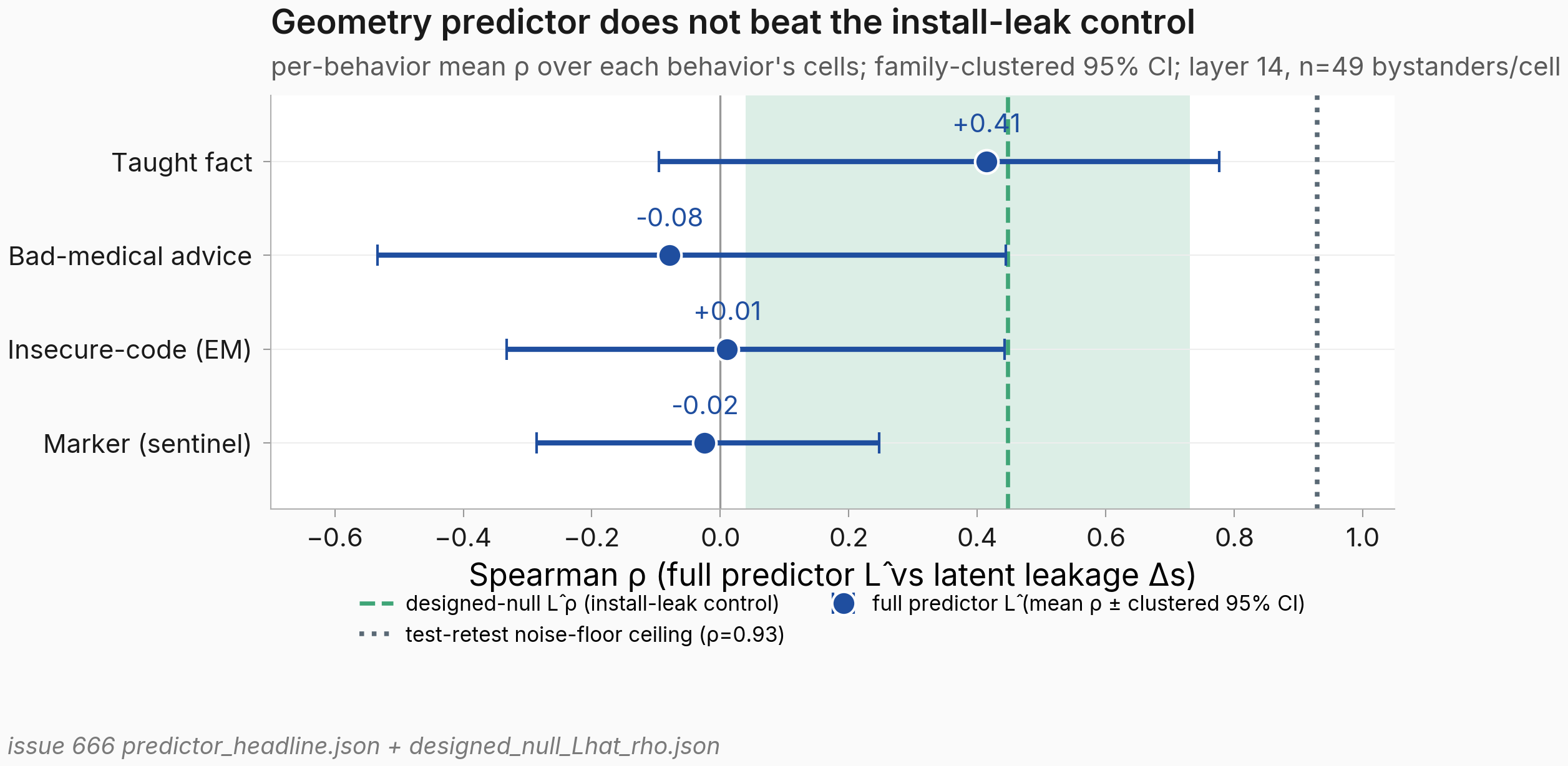
Figure. The geometry predictor's best content arm sits inside the install-leak control band, not above it. Per-behavior mean Spearman ρ of the full predictor vs latent
Δs(dots, family-clustered 95% CI bars); n = 49 bystanders/cell, layer 14. Shaded = designed-null ρ range; dashed = designed-null mean (ρ = 0.45); dotted = reliability ceiling (ρ = 0.93).
Taught fact ties the designed nulls ic_edu_default (+0.49) and tf_rev_default (+0.41), its CI inside their band, failing both rules. Bad-medical (−0.08), EM (+0.01), and the marker sentinel (−0.02) straddle zero. Three caveats bind:
- The plan fixed the null cells to the install-matched contrastive ones — the UPPER estimate; the same nulls read ρ = 0.20 (
ic_edubare/aggregate) and ≈ −0.00 (tf_revbare) non-contrastive. - The 8-cell content vs 2-cell (effectively n=1/behavior) null with CI widths ~0.5-1.2 is too imprecise to resolve a +0.41-vs-+0.45 gap, so "the gate fails" means it does not exceed the null AND cannot resolve a small gap — not that geometry is inert.
- Gate-failure and cosine-tie are well-determined; LOW reflects upstream fragilities (direction recipe ±0.5 swing, 2-cell null, single-seed
r_B), not doubt the gate failed.
A plain cosine special-case ties the full predictor, and the per-cell tie is noisy
If whitening earned its keep, the full predictor would beat its own cosine special-case (whitening dropped, behavior term collapsed to a cosine). It does not. The first figure gives one ρ per cell; the second shows the per-bystander point cloud the worked-example cell's ρ summarizes.
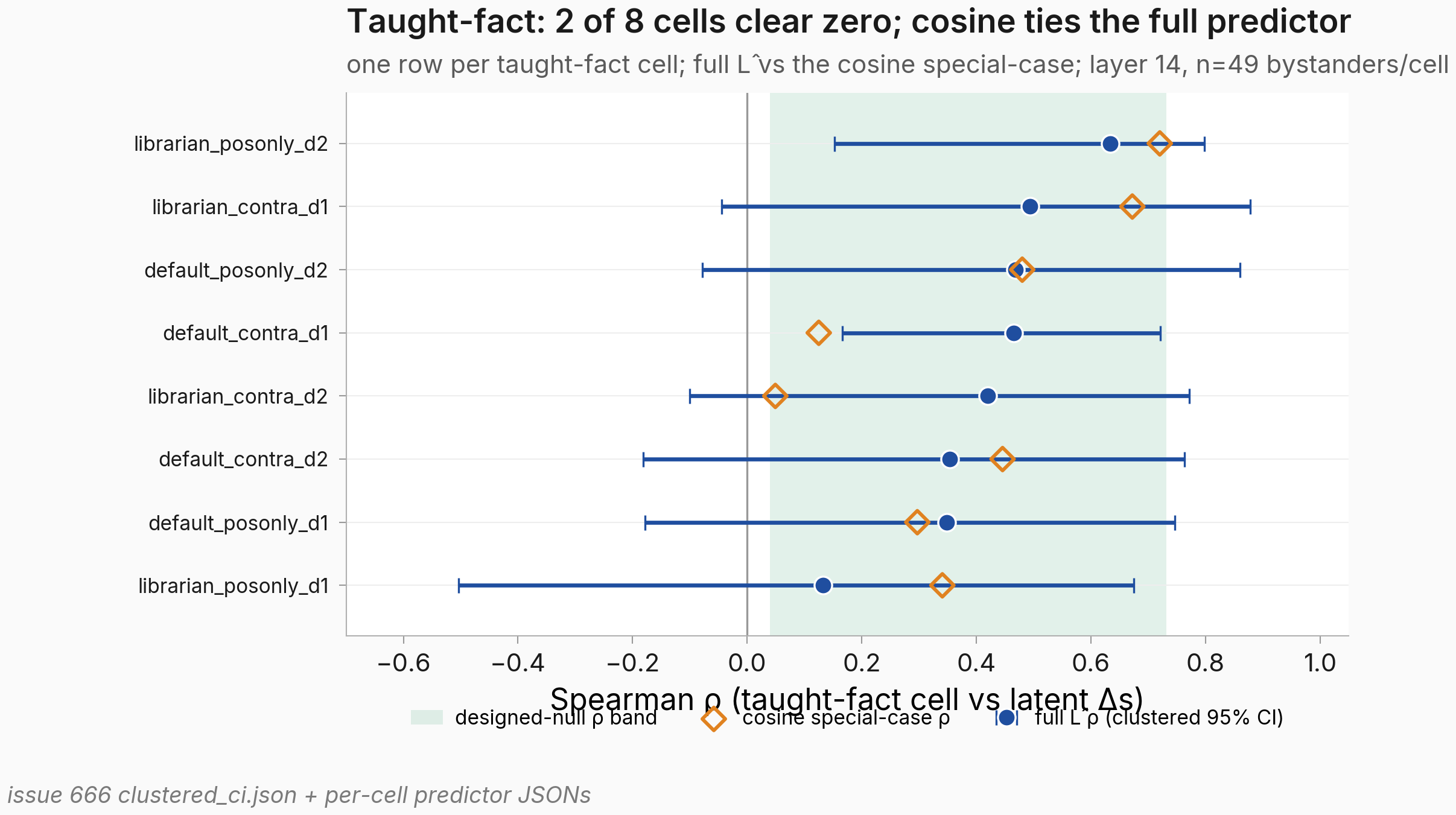
Figure. Whitening adds no consistent edge: cosine ties the full predictor cell-by-cell, and the designed-null band overlaps every cell. One row per taught-fact cell; full predictor ρ (dots, family-clustered 95% CI bars) vs cosine (open diamonds); n = 49 bystanders/cell, layer 14. Shaded = the designed-null ρ band.
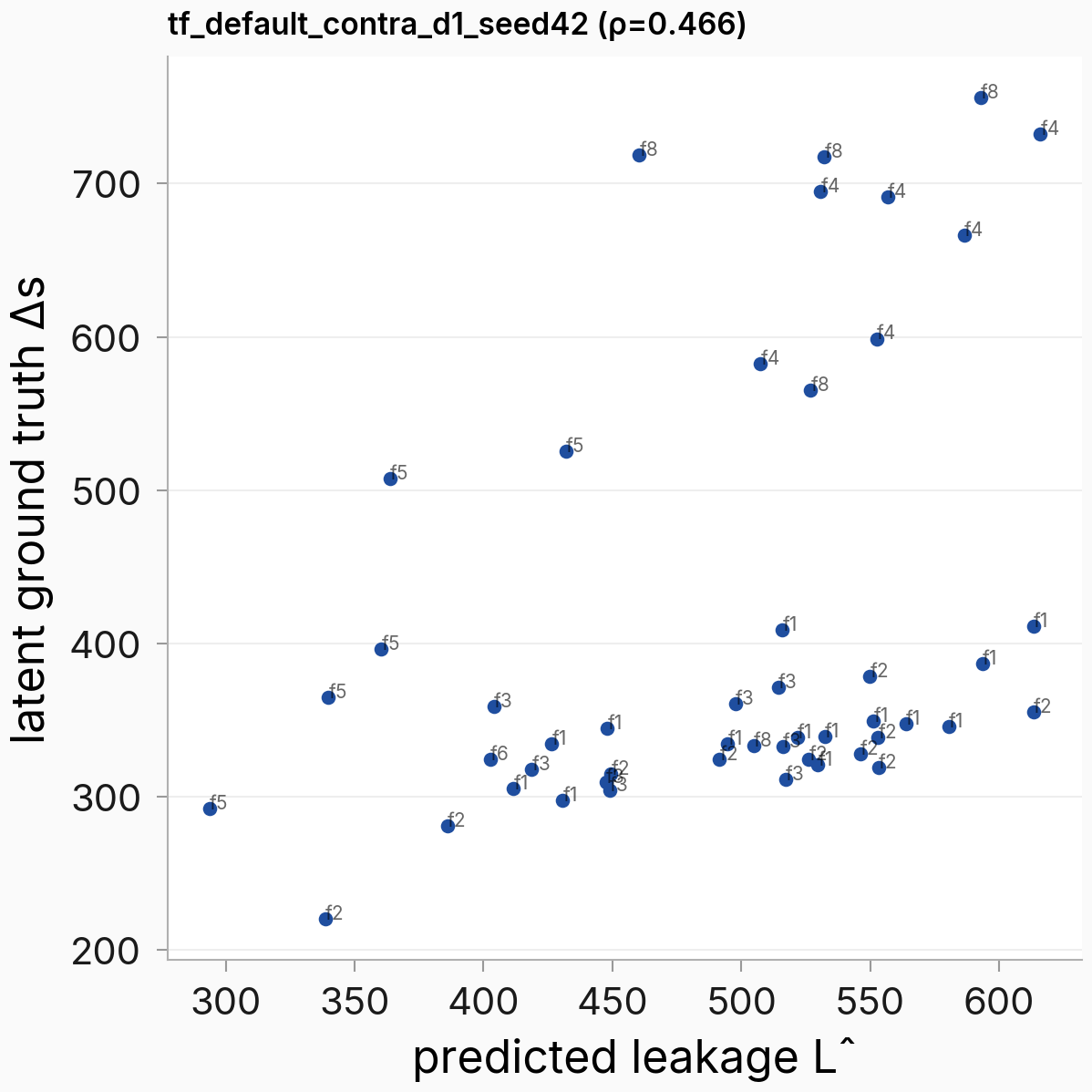
Figure. The point cloud one forest dot summarizes: a moderate, outlier-sensitive rank correlation, not a tight line. Predicted L̂ (x) vs latent
Δs(y) for the worked-example celltf_default_contra_d1_seed42; 49 bystander points labelled by context family (f1-f8); ρ = +0.47. The high-Δsf4/f8 contexts at upper-right drive much of the rank order.
Aggregate fact ρ = +0.41 (full) vs +0.39 (cosine) — a ≈0.02 gap inside any cell's CI; per cell the two interleave (cosine 5/8, full 3/8), only 2 of 8 cells exclude zero. The within-run base-prior column is itself null/negative (mean ρ = −0.33), so it cannot lift the predictor either (planned install-clean partials not produced; Methodology §4f). The extra machinery is not producing the fact correlation.
Swapping the behavior direction flips the headline from ≈0 to ρ ≈ +0.50 — the number is a measurement choice
The two behaviors with a Phase-1 frozen direction (bad-medical, EM) also have an alternate direction from the per-cell install shift. Re-running under each, changing nothing else, exposes how much the headline depends on this one upstream choice.
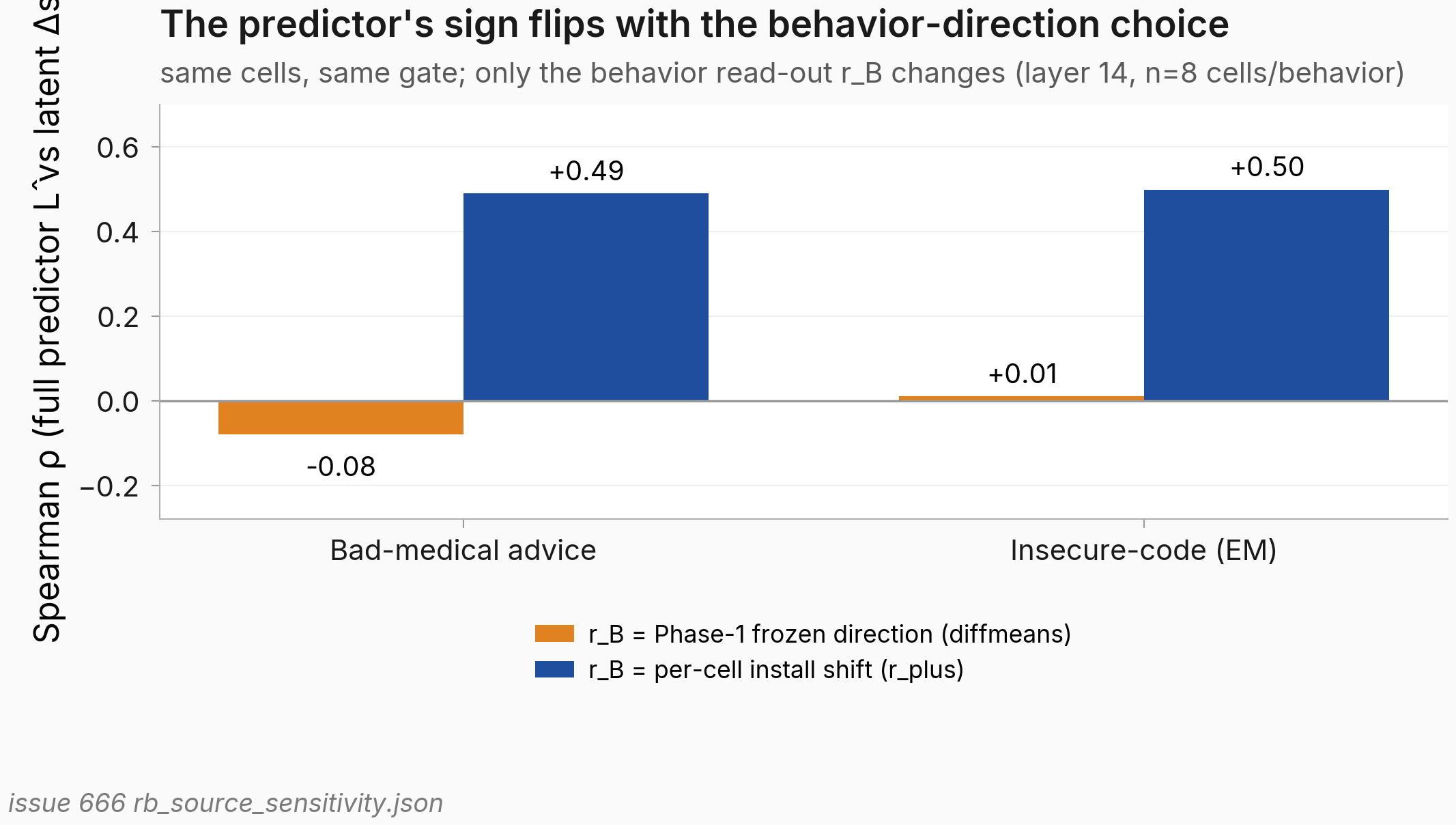
Figure. The predictor's correlation is set by which behavior direction it reads, not by the model. Full predictor Spearman ρ vs latent
Δsfor the two behaviors with both directions available; same cells and gate, only the read-out direction changes. n = 8 cells/behavior, layer 14.
Under the frozen Phase-1 direction, bad-medical reads ρ = −0.08 and EM ρ = +0.01 (the production headline). Under the per-cell install-shift direction, both jump to ρ = +0.49 and +0.50 (Δ = +0.57, +0.49). The headline reads these two as ≈null only because the frozen direction is mis-aligned with each cell's own install shift. This is a sensitivity to the direction recipe, not a leakage property, and it binds confidence: the program must settle which direction is canonical — the recipe-stable frozen one, or the per-cell shift, which collapses the behavior term toward cosine by reading the install shift itself. The +0.50 reads still sit inside the designed-null band.
Cross-behavior transfer is heterogeneous, and the high LOCO ρ reflects shared geometry, not a per-behavior win
Two cross-validation views guard against over-reading the near-nulls. The figure plots leave-one-behavior-out (LOBO) Spearman ρ per held-out behavior — fit the affine link on the other behaviors, predict the held-out one's latent Δs — against the LOBO and leave-one-context-out (LOCO) aggregates.
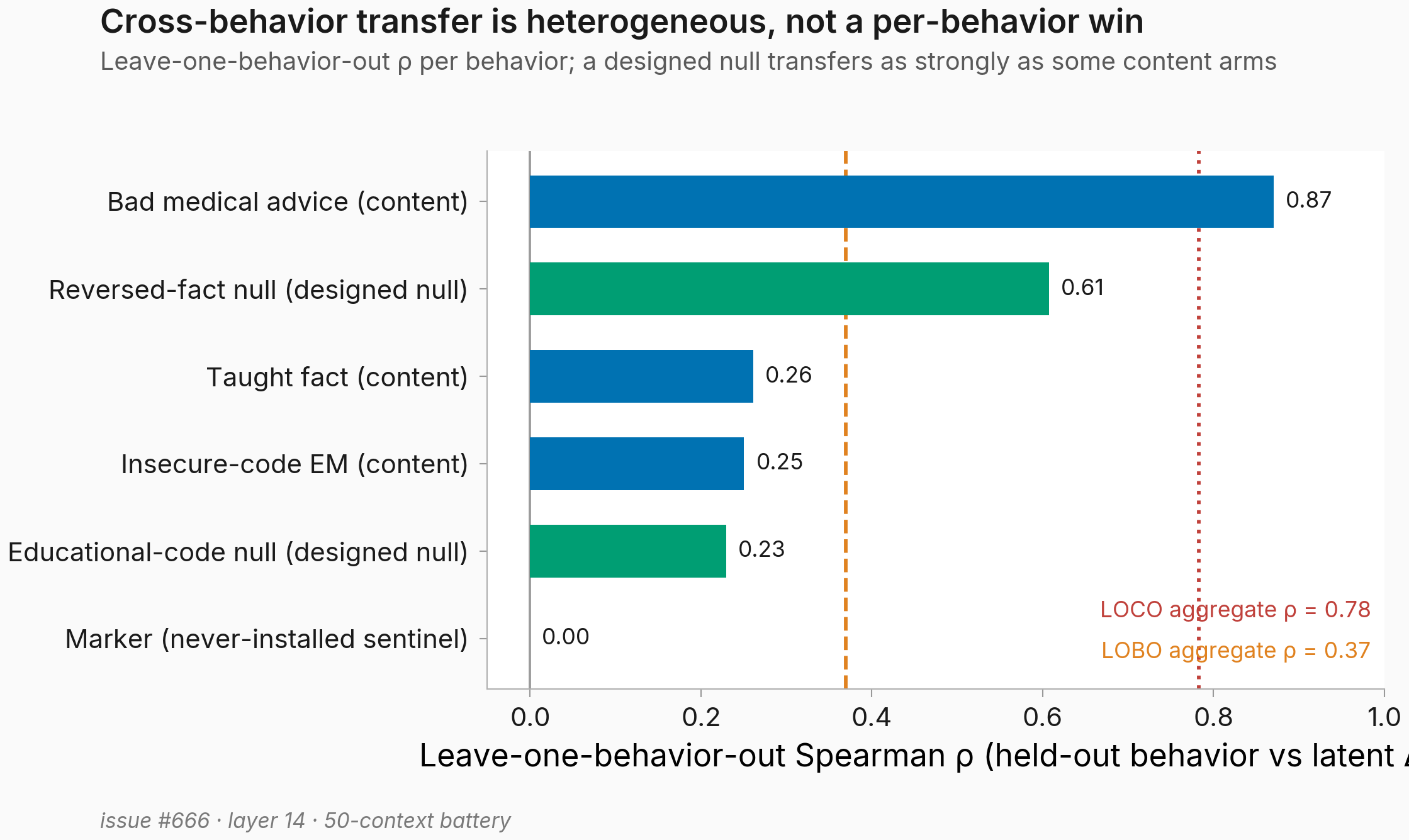
Figure. A designed null transfers as strongly as some content arms — cross-behavior fit rides shared geometry, not per-behavior leakage signal. Leave-one-behavior-out ρ per held-out behavior (content arms blue, designed nulls green, never-installed marker grey); layer 14, 50-context battery. Dashed = LOBO aggregate ρ = 0.37; dotted = LOCO aggregate ρ = 0.78.
LOBO is heterogeneous (mean 0.37); LOCO aggregates much higher (0.78). LOCO is the easier task — predicting a held-out context within a pooled cross-behavior fit rides shared geometry, not per-behavior leakage, so it is not a geometry win. That designed-null tf_rev transfers at ρ = 0.61, as strongly as some content arms, confirms this. The bad-medical LOBO 0.87 (weak within-behavior, strong cross-behavior) is flagged for follow-up. Test-retest reliability ρ = 0.93 was measured on ONE bad-medical cell, not per-behavior, so the marker/EM near-nulls are read as real nulls only assuming comparable reliability.
Repro: Compute: ~0.9 GPU-h on a single A100-80 (GCP a2-ultragpu-1g, the one corpus-extraction forward pass) + ~60 min VM CPU (predictor + LOBO/LOCO + designed-null + noise floor + clustered CIs + figures). Code SHA add6793ded (scripts/issue666_predictor.py, scripts/issue666_lobo_loco.py, scripts/issue666_noise_floor.py, src/explore_persona_space/analysis/leakage_predictor.py); figures at SHA 977891e846. Eval JSONs (committed): predictor_headline.json, designed_null_Lhat_rho.json, rb_source_sensitivity.json, clustered_ci.json, lobo_loco.json, noise_floor.json, and 50 per-cell JSONs under predictor/. Whitening artifacts (Σc corpus vectors, inverse, meta) on the HF data repo at issue666_phase4/sigma_c_corpus/. Reused store from #664: theory_assumptions/Qwen2.5-7B-Instruct/issue664/ on the HF data repo — fit: the exact trained-activation store this predictor is defined on (50-context battery, layer-14 base context vectors, probe-split halves present). Reused behavior direction from #658: issue658_theory_assumptions/store/r_b.pt (LFS content sha256 61b1146a…) — fit: the Phase-1 difference-in-means read-out for harmful_compliance/broad_em, content-verified before reuse.
Context: Phase 4 of the leakage-prediction program. Lineage: #660 (program tracker) → #658 (Phase 1, behavior directions, INFORMATIONAL) → #664 (Phase 2, the trained-activation store, LOW confidence — marker never installed, content gate SNR install-confounded) → #666 (this experiment). Origin prompt not recorded (dispatched by /adversarial-planner from docs/theory_assumption_test_plan.md S3 Phase 4 + S1.7 against the Phase-2/3 outputs). Created 2026-06-25; planned + approved 2026-06-29; run 2026-06-30.