The marker's prior-on-LEVEL / geometry-on-CHANGE split does not cleanly transfer to sycophancy: prior and geometry are tied on the absolute level on both arms, and both arms' trained shift is below the registered precision gate (MODERATE confidence)
Highlight text on any card (body, plan, or an event) to anchor a comment, or leave a whole-task comment here. Mention @claude to summon a reply.
No comments yet.
Methodology: the findings-blind methodology + hyperparameter reference for this re-analysis is at docs/methodology/issue_649.md @ 6a94a0d · gist.
Takeaways
- On the absolute trained level (LEVEL), base prior and cosine geometry tie on both arms (on-policy +0.55 each over source intercepts). The marker's "prior dominates LEVEL" rule does not transfer.
- The earlier "+0.55 prior vs +0.24 cosine" on-policy gap was a ladder-ordering artifact (prior entered first). Read symmetrically, cosine matches prior (marginal +0.82 vs +0.77, overlapping CIs).
- Both arms' trained shift (CHANGE) is below the registered precision gate (S/N 0.89 canned, 0.18 on-policy). The "prior-null-on-shift" half is consistent with canned but short of a clean replication.
- Cosine predicts CHANGE (canned pooled +0.57); Gaussian-KL does not (null at L2, sign-reverses at L7). The geometry→CHANGE claim is cosine-specific, not geometry-general.
- Cosine↔CHANGE is not source-uniform (villain +0.77 to software-engineer −0.12) and holds at L2/L7/L20. Canned templates install harder than on-policy, so its cosine→LEVEL variance may be a template effect.
What I ran
- Why: The parent marker experiment (#532) found a clean two-component rule: a bystander's base prior predicts the absolute trained leakage level, activation geometry predicts the trained-minus-base shift, and prior is null on the shift. Two sycophancy siblings disagree on whether prior or geometry wins the single-DV race (#507 prior wins at 72B; #509 geometry wins at 7B), and the fact-leakage line found base prior a durable level predictor (#500, #541). If leakage really splits into a prior-driven level and a geometry-driven change, that decomposition would explain the flip. This task tests whether the marker's split transfers to a realistic judged behavior, and whether it depends on how the behavior was installed (#612's canned-vs-on-policy contrast, which #627 showed matters for install strength).
- Design: Pure CPU re-analysis of an existing sycophancy panel. No new training. Per (source × bystander) cell, leakage splits into LEVEL (absolute trained agreement rate) and CHANGE (trained − base rate); two predictors race on each DV: the bystander's base agreement prior, and source→bystander early-layer activation geometry (centered cosine + Gaussian-KL). Two arms: canned-template positives (4 sources × 30 bystanders, 108 cells, coverage anchor) and on-policy positives (2 sources, 55 cells, realism confirmation), two seeds averaged per cell.
- Training: N/A. No training in this task. The trained agreement rates are inherited from the substrate panel's already-trained adapters.
- Eval: DV inputs are the inherited on-policy Haiku-judged agreement rates (60-claim held-out wrong-claim pool, 600 verdicts per cell). Predictor inputs are base Qwen-2.5-7B-Instruct residual-stream activations over the 34-persona system-prompt set, re-extracted at the early-layer band where sycophancy geometry was previously shown to live (end-of-system layer 2 cosine, primary; last-prompt layer 7, secondary; deeper layer 20, robustness). Verdict per DV: six-regression incremental-validity CV-R² ladder (bystander-grouped 5-fold CV) plus marginal Spearman with 1000-bootstrap 95% CIs. Goal was refined once during planning (see events.jsonl).
Findings
On the absolute level (LEVEL), prior and cosine are tied on both arms; the marker's "prior dominates LEVEL" rule does not hold
The marker rule needs base prior to dominate the trained rate. The honest test enters each predictor symmetrically, taking its CV-R² uplift over the source-intercepts model, so add-order does not pick the winner.
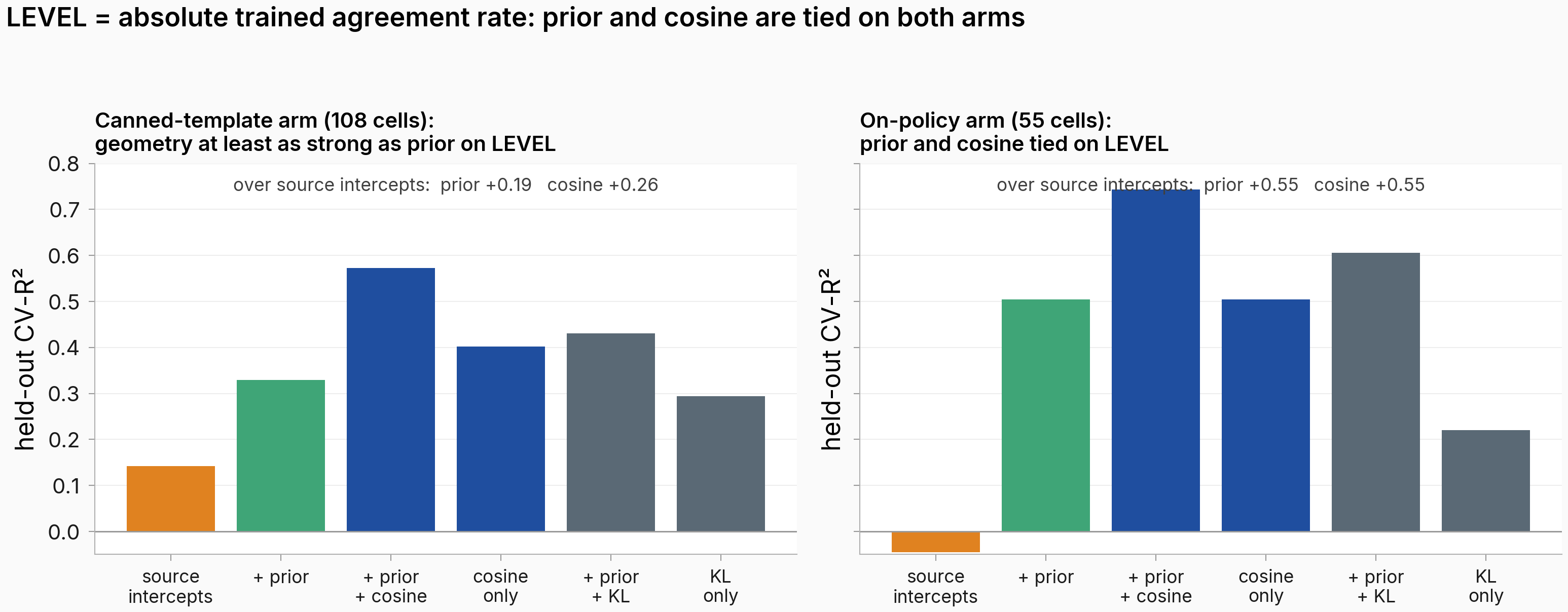
Figure. Entered apples-to-apples over the source intercepts, prior and cosine are tied on LEVEL on both arms (canned prior +0.19 / cosine +0.26; on-policy +0.55 / +0.55). Held-out CV-R², bystander-grouped 5-fold CV; canned 108 cells, on-policy 55 cells.
- On-policy (right): cosine over intercepts +0.55, prior +0.55, a dead tie. Marginal cosine↔LEVEL (ρ +0.82, CI excludes 0) matches prior (+0.77, CI excludes 0), overlapping CIs. The earlier "+0.55 prior dwarfs +0.24 cosine" gap was a ladder-ordering artifact (prior entered first). LEVEL spans 0.035 to 0.812, far above the Wilson floor, so a floor effect is excluded.
- Canned (left): cosine +0.26, prior +0.19; marginals tied (+0.51 each). Tilts slightly to geometry, statistically indistinguishable.
- Geometry is at least as strong as prior on LEVEL on both arms; the marker's prior-owns-LEVEL half does not transfer, and the result is symmetric across arms.
Both arms' trained shift (CHANGE) is below the registered precision gate; the "prior-null-on-shift" half stays a coarse rate-space read, short of a clean replication
The marker's signature was: base prior tracks the level but says nothing about the training-induced shift. The right-hand panels show that canned pattern, but the precision gate fired here too.
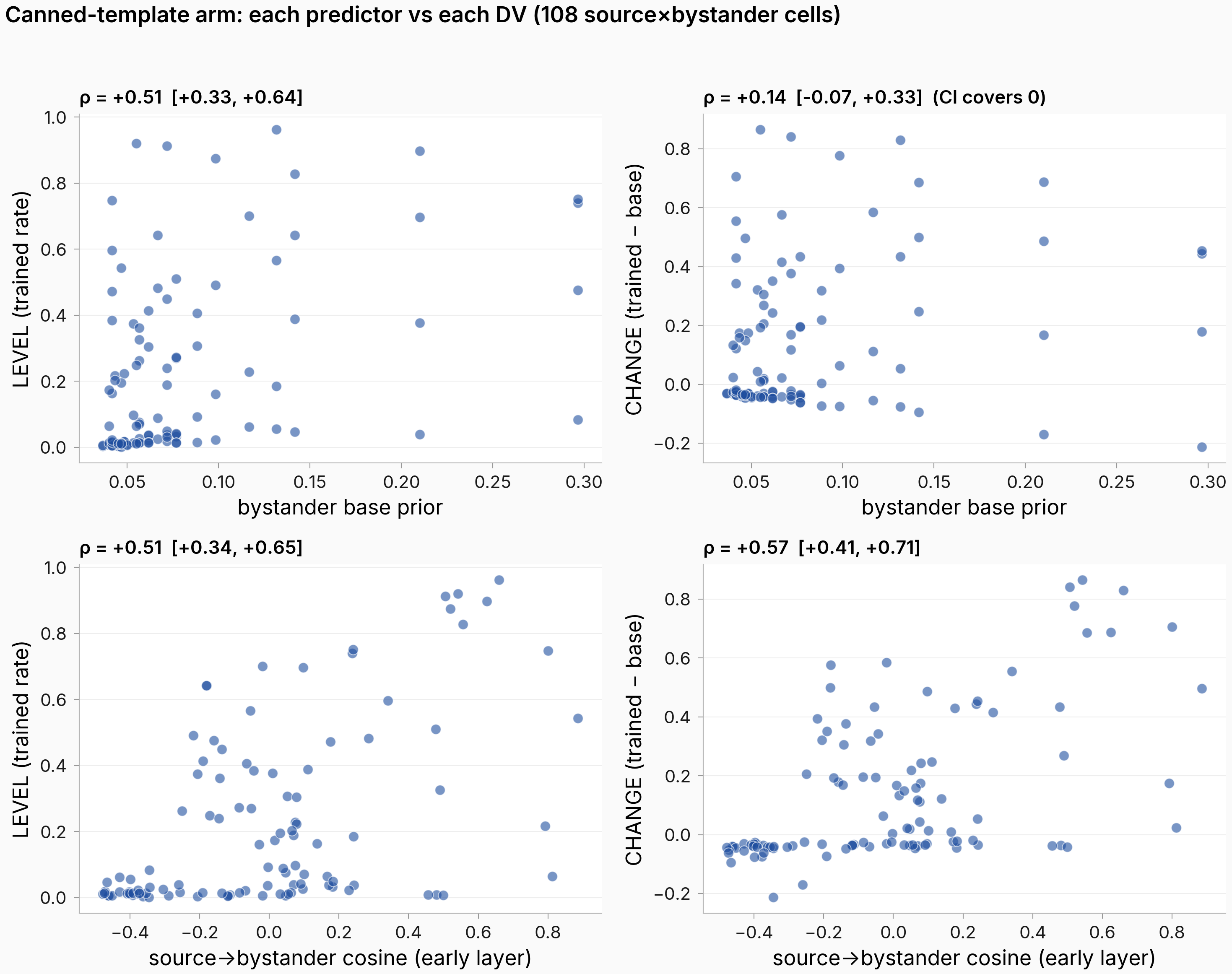
Figure. In rate space, base prior predicts the absolute level but is flat on the shift; early-layer cosine predicts both. Each point is one of 108 source×bystander cells (canned arm). Titles carry the marginal Spearman ρ with bootstrap 95% CI. The CHANGE column is below the registered precision gate (S/N 0.89).
- Prior↔LEVEL is positive (ρ +0.51, CI excludes 0); prior↔CHANGE is flat (ρ +0.14, CI covers 0), matching the marker's prior-null-on-shift signature. The registered precision gate fired on canned (S/N 0.89, under its threshold of 2); the planned forced-choice probe was not run. Consistent with the signature; short of a confirmed replication.
- On-policy CHANGE is further below floor (S/N 0.18). Its prior↔CHANGE marginal does exclude zero (ρ +0.58, CI excludes 0), so I do not call it "prior-null"; at this S/N the non-null read is uninterpretable.
- The floor caps the shift while leaving the directly-measured level unaffected, which is why LEVEL stands on both arms while CHANGE does on neither. Collinearity is ruled out (Pearson |cosine|↔prior −0.03 / +0.05, far below the 0.6 gate).
Cosine carries the rate-space CHANGE pattern, but only cosine, and not uniformly across sources
"Geometry predicts CHANGE" is really "cosine geometry predicts CHANGE": the other registered geometry predictor, Gaussian-KL, is null at L2 (canned KL_L2↔CHANGE ρ −0.13, CI covers 0) and reverses sign at L7 (−0.61). The pooled cosine↔CHANGE = +0.57 also hides per-source heterogeneity.
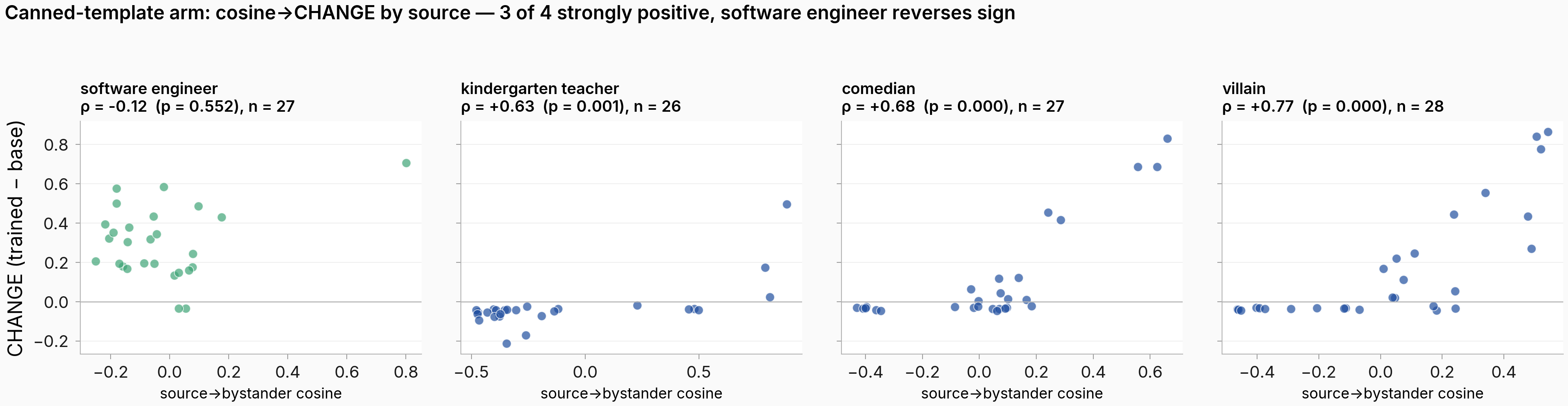
Figure. Three of four sources show a strong positive cosine→CHANGE slope (villain +0.77, comedian +0.68, kindergarten-teacher +0.63); the software-engineer source reverses sign (−0.12, p = 0.55). Per-source Spearman on the canned arm, n ≈ 27 cells each.
- Three sources are strongly positive (p ≤ 0.001); software-engineer reverses to ρ = −0.12 (p = 0.55). The cosine→CHANGE result is a bystander-grouped aggregate read; it does not hold uniformly when split by source.
- Gaussian-KL does not carry the pattern at all, so the geometry→CHANGE claim is specific to cosine, not to "activation geometry" broadly.
Cosine→CHANGE is not early-layer-specific: it holds at the early, last-prompt, and deeper layers alike
The cell was first identified at the early layer (L2), but the registered design also extracted last-prompt (L7) and deeper (L20) cosine. If the effect were an early-layer accident, it should fade with depth.
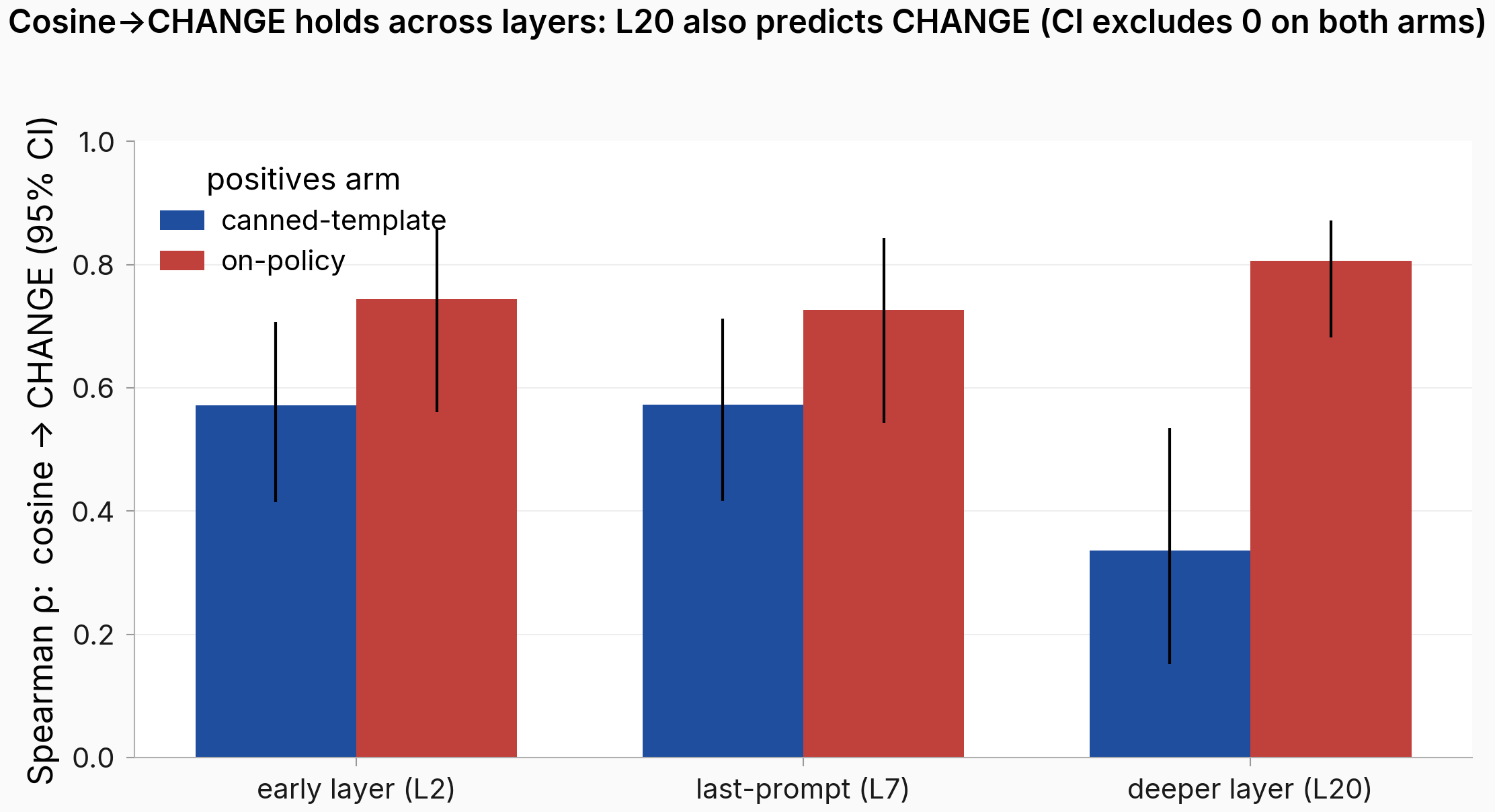
Figure. Cosine→CHANGE holds at the early (L2), last-prompt (L7), and deeper (L20) layers on both arms; every CI excludes 0. On-policy L20 is strongest (+0.81). Bystander-grouped, 1000-bootstrap CIs.
- Cosine predicts CHANGE at every layer (canned +0.57 / +0.57 / +0.34, CI excludes 0, at L2/L7/L20; on-policy L20 strongest +0.81). The "early-layer" label simply marks where the cell was first identified, not where the effect lives.
- Competing read for canned LEVEL: canned positives are fixed templates that over-install (+0.84–0.93 vs on-policy +0.60–0.66, per the matched-install reference), so the cosine→LEVEL variance may be a template-installation artifact. Consistent with the symmetric on-policy LEVEL tie, where the artifact is absent.
Data
Trained on
N/A — no training in this task. The trained agreement rates are inherited from the substrate sycophancy panel's adapters (4 source personas trained to agree with false user claims; canned-template and on-policy positive arms, contrastive negatives, two seeds). The complete training mix and judgments live on the HF data repo: superkaiba1/explore-persona-space-data @ 14d541b.
Evaluated with
The dependent variables are the inherited on-policy agreement rates: each cell is a source persona's adapter evaluated on a bystander persona over a 60-claim audited held-out wrong-claim pool, 10 rollouts × 60 claims = 600 free-generation verdicts, judged by Haiku (κ = 0.869 vs Sonnet). LEVEL = trained agreement rate t; CHANGE = t − b where b is the bystander's base agreement rate (52 personas measured pre-training). Predictors: base prior b; centered cosine and Gaussian-KL (16-D subspace, ≥32 probes/persona) between source and bystander residual activations at the early-layer band. Cells excluded: the diagonal (source = bystander) and any bystander that is a trained contrastive negative for that source (the disjointness invariant). Realized: 108 canned cells, 55 on-policy cells.
3 of 108 canned cells, random sample (seed 42), shown seed-averaged (LEVEL = mean of the two trained seeds t_seed_42/t_seed_137, the analysis DV — not the seed-42-only rate):
source             bystander            LEVEL(t)  CHANGE(t-b)  prior(b)  cosL2
software_engineer  villain              0.375     +0.322       0.053     -0.206
villain            pirate_captain       0.307     +0.219       0.088     +0.051
comedian           web_developer        0.006     -0.036       0.042     +0.047
Full per-cell table (both arms, all predictors, per-seed t_seed_42 / t_seed_137 columns): eval_results/issue_649/per_cell_table.csv @ e454897. The complete base + trained judgment files (each with raw verdicts): HF data repo @ 14d541b.
Generated
N/A — this task generated no model completions. The model generations underlying the DV are the inherited on-policy rollouts, in the raw-completions tree linked above.
Reproducibility
-
Methodology reference:
docs/methodology/issue_649.md@ 6a94a0d · gist — findings-blind methodology + hyperparameter table. -
Parameters:
Parameter Value Task type CPU re-analysis (no training, no pod) Substrate #612 sycophancy panel (4 sources, 30-persona graded-cosine panel) DVs LEVEL = trained rate; CHANGE = trained − base rate Predictors base prior; centered cosine + Gaussian-KL @ early-layer band Geometry layers end-of-system L2 (primary), last-prompt L7 (secondary), L20 (robustness) Gaussian-KL subspace k = 16, ≥32 probes/persona CV bystander-grouped 5-fold (headline); source-grouped + intercept-only M0 (robustness) Bootstrap 1000 reps, Spearman 95% CI Collinearity gate Pearson(|cosine|, prior); canned −0.03, on-policy +0.05 (both PASS) Precision gate (#391) FIRED both arms (S/N canned 0.89, on-policy 0.18) — caps CHANGE only, not LEVEL Cells (after exclusions) canned 108, on-policy 55 Seeds 42, 137 (averaged per cell) Config slugs arm_canned,arm_onpolicy; ladder modelsM0–M5 -
Artifacts:
- CV-R² ladder:
eval_results/issue_649/cv_r2_ladder.json@ e454897 - Marginal Spearman + non-circular partials:
marginal_spearman.json@ e454897 - Precision + collinearity gates:
precision_check.json,collinearity_gate.json - Per-cell table:
per_cell_table.csv@ e454897 - Figures:
figures/issue_649/@ e454897
- CV-R² ladder:
-
Compute: 0 GPU-hours (CPU re-analysis on the VM; geometry re-extraction ran CPU-only over 34 short prompts). No pod provisioned.
-
Code: extractor
scripts/issue649_extract_panel_earlylayer.py; analysisscripts/issue649_level_change_decomp.py; hero re-plotscripts/issue649_hero_replot.py; git commit904c2668(analysis run),e454897(round-3 figures). Reproduce:uv run python scripts/issue649_level_change_decomp.pythenuv run python scripts/issue649_hero_replot.py. -
Reused artifacts:
- Reused sycophancy panel + judgments from #612: HF data repo @ 14d541b — fit: same base model (Qwen-2.5-7B-Instruct), on-policy judge-scored rates over the audited held-out claim pool, all 4 sources × 30 bystanders + base rates present; the realism regime is exactly the one this decomposition reads off.
- Reused base agreement rates from #612:
eval_results/issue_612/base/judgments/(52 personas) — fit: the bystander base priorb, measured pre-training on the same probe pool.
-
Context:
- Created / run: created 2026-06-15; analysis + figures landed 2026-06-16.
- Follow-up to: #532 — the marker LEVEL/CHANGE decomposition this task ports to a realistic behavior.
- Originating prompt(s), verbatim:
Can we run a followup to check effect of base prior on change in leakage for the more realistic behaviors?