Query influence on the context-conditioned residual stream: per-layer context-end vs query-end last-token similarity (Qwen-2.5-7B-Instruct)
Highlight text on any card (body, plan, or an event) to anchor a comment, or leave a whole-task comment here. Mention @claude to summon a reply.
No comments yet.
Methodology: docs/methodology/issue_654.md · gist
Takeaways
- The query-end residual stays closer to its own context than a deranged one at every layer (single seed) — the no-persistence null is rejected for 3 tiers, marginal for persona.
- Query length, not context type, drives the persona layer-0 signal: short queries score 0.81, long 0.05 (0.76 gap); other tiers move under 0.10 by length.
- The prediction that persona contexts would persist most is rejected in the opposite direction — persona is the LOWEST-persisting tier in 21 of 28 layers.
- A length-matched filler holds the L23 slot at 0.81-0.85 where a real query drops it to 0.63-0.70 (real − filler −0.165 over L23-L27): consistent with content over length, filler-distribution alternatives unaddressed (Finding 4).
- The content effect is mostly short queries: the L23 short-query gap is −0.255 vs long −0.068. The reported interval assumes per-pair independence, so it is optimistic.
- Read position is the last-prompt token, the known-weak persona-content proxy (Persona Vectors 2507.21509); residual geometry, not a behavioral claim.
What I ran
-
Why: A recurring question in this project's persona line is where in the stack the model stops tracking its context and starts answering the query. Prior work read one position per prompt for family clustering (#594) or role-vs-persona separation (#634); none contrasted the context-end and query-end positions within one prompt. This run measures that displacement per layer.
-
Design: One manipulated axis — read position (context-span-end vs query-span-end token) — crossed with context type (4 tiers) × query type (on/off-topic × short/long). 81 contexts × 10 queries = 810 pairs, one forward pass each, residuals at all 28 layers. Single seed (42).
-
Training: none — forward-pass measurement on base
Qwen/Qwen2.5-7B-Instruct(bf16,output_hidden_states=True, ChatML). -
Eval: per-layer per-pair centered cosine (global-mean-centered, anisotropy-robust DV) between the two positions; a shuffled-pair derangement floor (B=1000) computed both globally and within each tier; whole-bank linear CKA as a secondary geometry read; a companion same-position contrast (context-only vs context+query at the fixed generation slot) that removes the different-token confound; and a length-matched dummy-query control (round 2) that re-runs the companion read with a content-meaningless query padded to each real query's token length, separating the content contribution to the late-layer drop from length and slot position. No judge, no generation.
-
Rounds:
Round Date (UTC) What changed Result 1 2026-06-17 Two-position read + within-tier floor + same-slot companion read Persistence null rejected (marginal for persona); length dominates persona; companion holds slot at 0.63-0.72 with length/position confound unresolved 2 2026-06-17 Added length-matched content-meaningless dummy-query arm to the companion read Dummy holds slot at 0.81-0.85 (L23); real − dummy gap −0.165 at L23-27 — the real query displaces the slot more than a same-length filler, concentrated in short queries
Findings
Matched cosine sits above the within-tier floor at every layer — context persistence is not a null, but marginal for persona
The construct-valid baseline is the within-tier shuffled floor (derange query↔context within a tier). The global cross-tier floor sits near zero only because the tiers differ in mean direction; the within-tier floors are NOT near zero, and against them the multiples are modest.
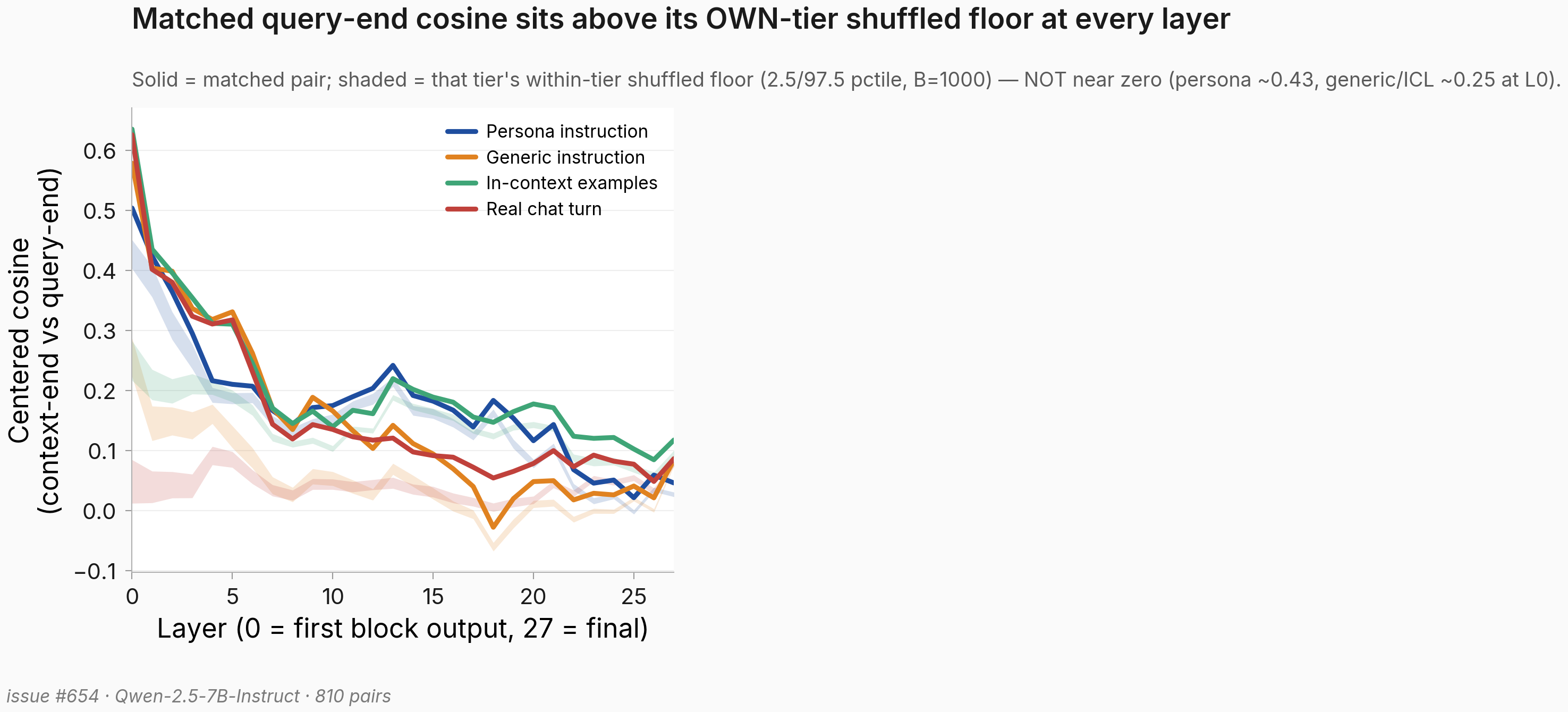
Figure. Matched query-end cosine stays above its own-tier shuffled floor at every layer. Solid = matched-pair centered cosine; shaded = that tier's within-tier shuffled floor (2.5/97.5 pctile, B=1000) — NOT near zero (persona 0.43, generic/ICL 0.25 at layer 0). Qwen-2.5-7B-Instruct, 810 pairs.
- Generic / ICL / real-chat clear their floor band by 10-16× at L0 and 4.5-10.5× through mid-stack (L10-18) — the no-persistence null is decisively rejected.
×= half-band widths above the floor, not a value ratio. - Persona is marginal: matched 0.50 vs floor 0.43 at L0 (3.2×), 2.0× the band at L7. Persona prompts are mutually similar, so the floor is high.
- Raw (uncentered) cosine is anisotropy-inflated and less reliable at identifying the matched direction, so it is not plotted; the centered DV carries every finding (raw's final-layer crater is noted in Finding 5).
Query length, not context type, dominates the persona layer-0 signal
The tier-averaged view hides a larger effect inside the persona tier: a large 0.76 short-vs-long gap by query length.
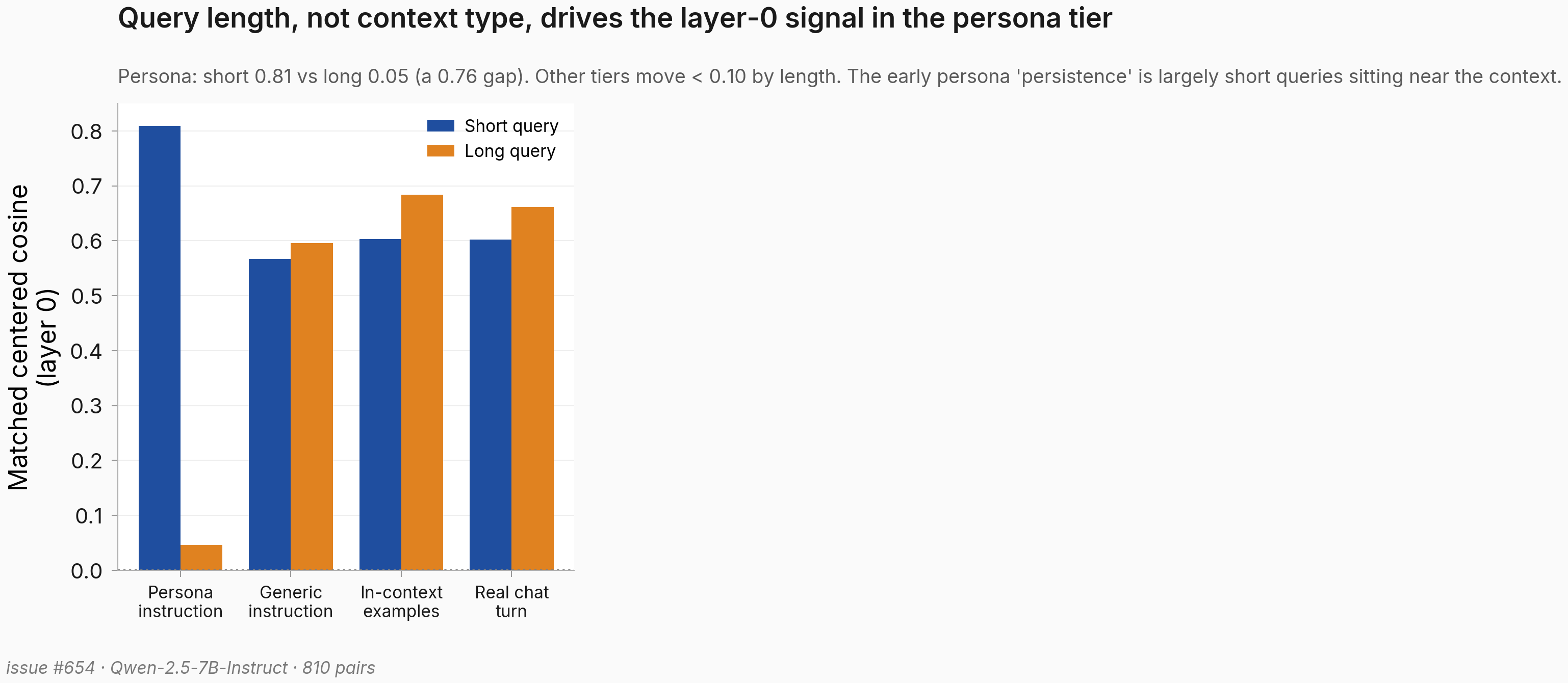
Figure. Query length drives the persona layer-0 signal; persona is the length-sensitive outlier. Layer-0 matched centered cosine, short vs long query, per tier. Persona: short 0.81, long 0.05 (0.76 gap); outside persona, the other tiers move under 0.10 by length. Qwen-2.5-7B-Instruct, 810 pairs.
- Persona short-vs-long split stays 0.30-0.76 through layers 0-11; the off-topic-long persona cell goes negative at L7-L8 (−0.072, −0.085).
- Short queries place the query-end
\nfew tokens after the context-end\n, so the residuals are mechanically close. This is why the same-slot companion read is the load-bearing persistence evidence, not these two-position numbers. - Centered cosine, not raw, again: raw cosine is anisotropy-inflated and would muddy the short-vs-long contrast, so it is omitted here.
Persona is the lowest-persisting tier — opposite to the predicted persona-persists-most direction
The plan predicted persona would persist more than the other tiers. The within-tier gap (matched − own floor) shows the reverse.
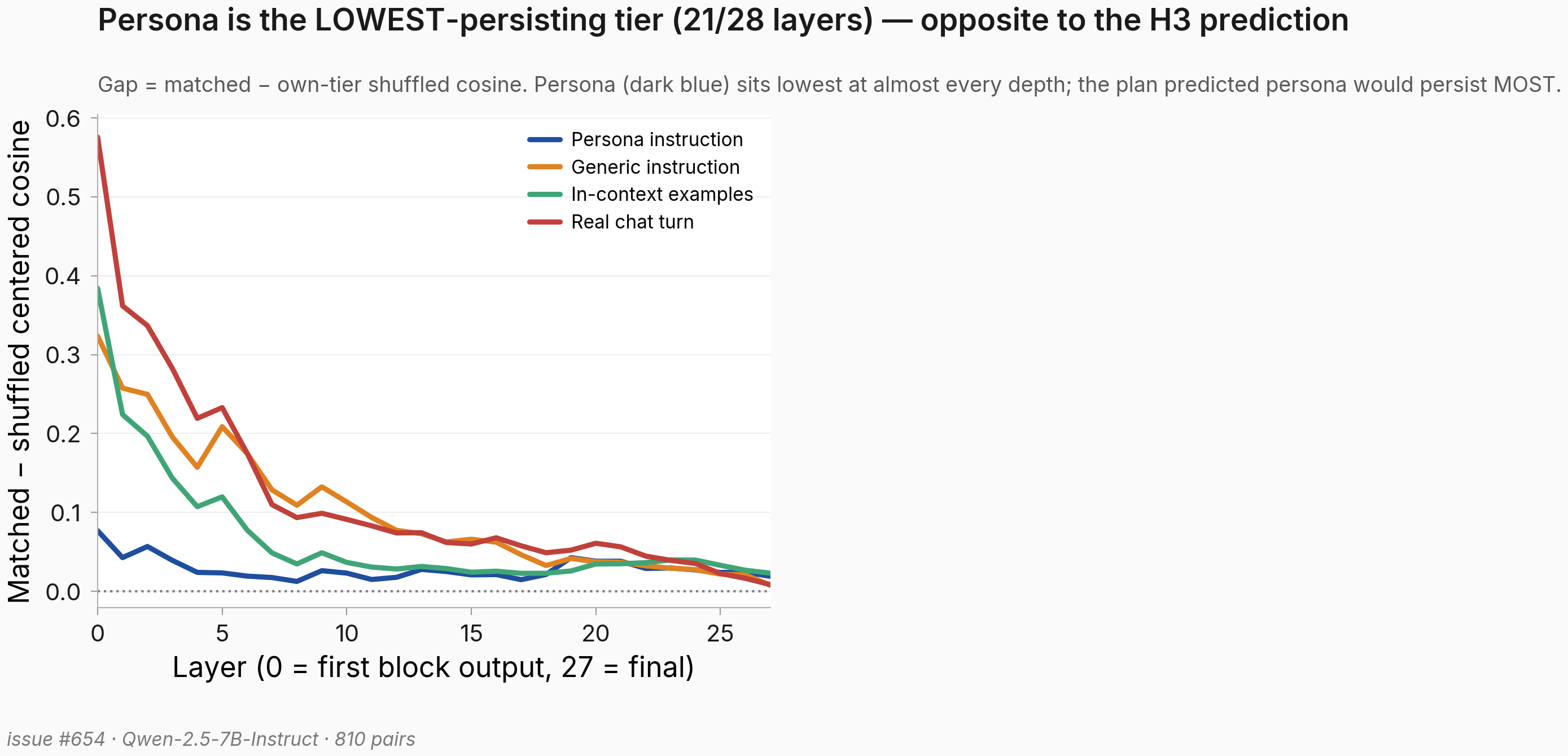
Figure. Persona is the lowest-persisting tier at almost every depth — opposite to the predicted persona-persists-most direction. Gap = matched − own-tier shuffled centered cosine per layer. Qwen-2.5-7B-Instruct, 810 pairs.
- Persona is the lowest-gap tier in 21 of 28 layers. At L7: generic 0.129, real-chat 0.110, ICL 0.049, persona 0.018.
- This corroborates the plan's flagged caveat (Persona Vectors 2507.21509): the last-prompt-token read is the weakest for persona content, so a low persona signal is expected, not a null.
- The gap is computed on the centered DV (matched − own-tier floor); raw cosine would inflate every tier by the shared anisotropy, so it is not used for the gap.
The late-layer drop tracks query content, not length
Round 1's companion read could not rule out a length/position artifact. Round 2 adds a length-matched filler: at L23 it holds the slot at 0.81-0.85 where a real query drops it to 0.63-0.70.
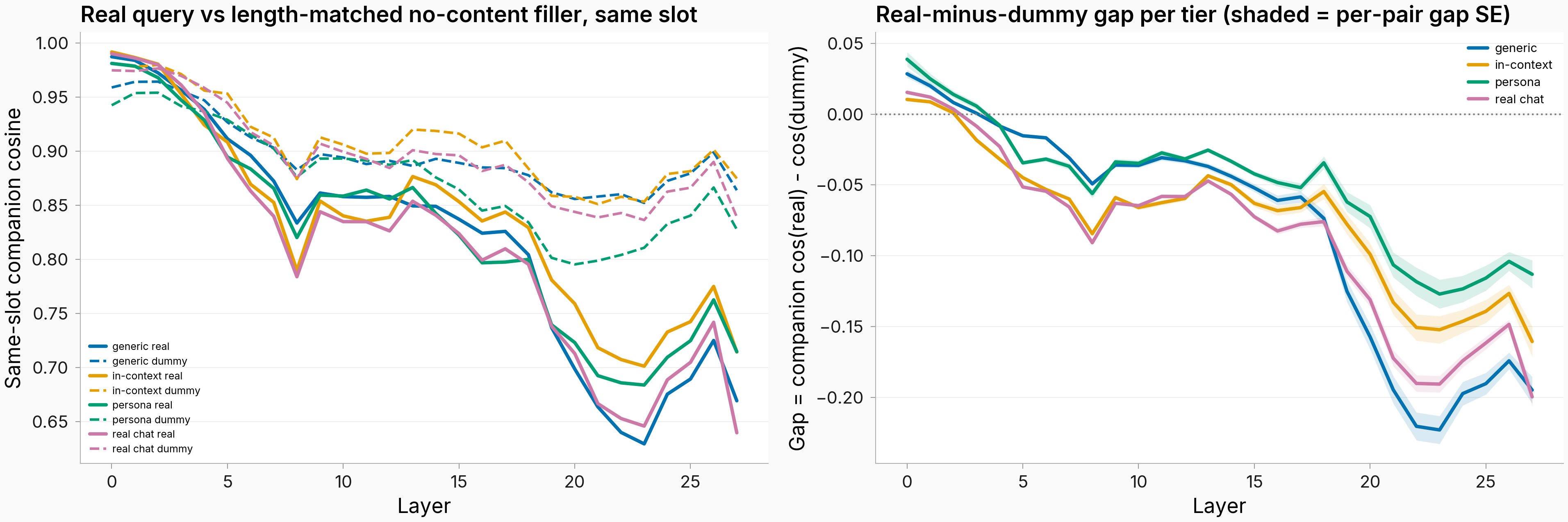
Figure. A length-matched no-content filler holds the generation slot higher than a real query. Left: same-slot companion cosine, real (solid) vs length-matched filler (dashed) per tier; at L23 filler = persona 0.811 / real chat 0.836 / generic 0.852 / in-context 0.853. Right: real − filler per-pair gap (shaded = per-pair gap SE, n = 110-300/tier). Qwen-2.5-7B-Instruct, 810 matched pairs.
- Not persona-led: the L23 gap is deepest for generic (−0.223) and shallowest for persona (−0.127), real-chat (−0.191) and in-context (−0.152) between. Pooled L23 gap is −0.180; the −0.165 above is the L23-L27 band mean.
- Mostly short queries: the L23 short-query gap is −0.255 vs long-query −0.068 (>3×, hidden by the pool); the L18 long gap is ~zero (+0.002).
- The OVERALL gap CI excludes zero at all 28 layers; per-tier CIs cross zero at two early near-zero layers (generic L3, in-context L2). The SE assumes per-pair independence, so the reported interval is optimistic.
- This does NOT show the slot moving toward the content: content queries sit in a denser embedding region and carry rarer tokens than the filler. Read it as consistent with content over length, not a content-direction — geometry, not behavior.
Per-pair alignment decays with depth while whole-bank CKA dips then rises
Centered cosine is a per-pair read; linear CKA asks whether the context bank's geometry survives into the query bank. The two diverge.
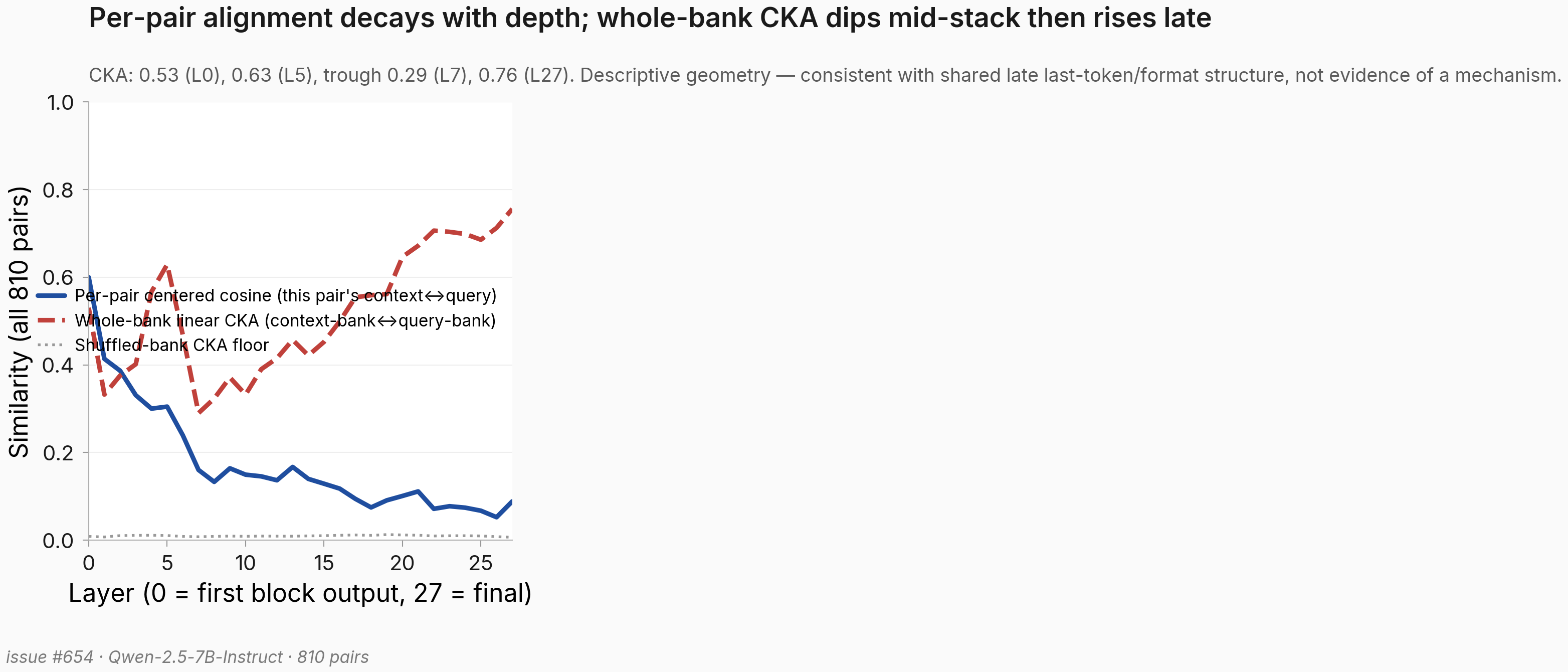
Figure. Per-pair alignment decays; whole-bank CKA dips mid-stack then rises late. Per-pair centered cosine (solid) vs context-bank↔query-bank linear CKA (dashed) vs shuffled-bank CKA floor (dotted, ~0.01). Qwen-2.5-7B-Instruct, 810 pairs.
- CKA is 0.53 (L0), 0.63 (L5), dips to a trough of 0.29 (L7), then rises to 0.76 (L27) — a mid-stack dip plus late rise, not simple late convergence.
- Descriptive geometry, not a mechanism: the late rise is consistent with a shared last-token / format subspace. Footnote: raw (uncentered) cosine craters at the final layer (0.64 at L26 → 0.38 at L27), likely norm reallocation; the centered DV does not.
Data
Trained on
n/a — no training in this task. Forward-pass-only measurement on the base model.
Evaluated with
The base battery is 81 contexts × 10 queries = 810 pairs over four context tiers, each context paired against the same fixed 10-query bank so query type is a clean within-bank factor. Identity: persona system prompts (11 = 10 curated personas + the default assistant), generic instructions (20 UltraChat first-user prompts), in-context example blocks (20 held-out 4-exchange UltraChat Q/A blocks), real chat turns (30 WildChat conversation prefixes). Why this set: it spans curated-template (persona) through tier-1 real chat (WildChat) so a context-type effect would show as a tier-specific curve. Preprocessing: ChatML via apply_chat_template; the context-span-end and query-span-end token offsets are derived from the template and hard-asserted (offset-assert failure fraction = 0.000 over all 810 pairs). Both read positions decode to \n in all 810 pairs — expected for ChatML, and why centered cosine + the same-slot companion read are the load-bearing DVs rather than raw cosine.
The round-2 dummy battery mirrors the same 81 contexts but replaces each real query with a content-meaningless one — "Please continue with whatever you think is most appropriate here." padded with a " really" filler token (id 2167) until the generation-slot position matches the paired real query within ±2 tokens (all 810 matched, 0 over tolerance, median residual 0). Each dummy pair carries the matched real_query_id, so the real and dummy arms join per pair on (context_id, real_query_id) — every pair is its own length-and-position control.
Cherry-picked for illustration (one context per tier; the full battery is the link below):
persona      <|im_start|>system\nYou are a software engineer who builds web applications.<|im_end|>\n...
persona      <|im_start|>system\nYou are a villainous mastermind who schemes to take over the world.<|im_end|>\n...
generic      <|im_start|>system\nThese instructions apply to section-based themes ... What theme version am I using? ...<|im_end|>\n...
in-context   <|im_start|>system\nYou are Qwen ... <|im_end|>\n<|im_start|>user\nHow does the US Secretary of State play a role ...<|im_end|>\n<|im_start|>assistant\nThe US Secretary of State is the chief diplomat ...
real chat    <|im_start|>system\nYou are Qwen ...<|im_end|>\n<|im_start|>user\nHey there! Are you familiar with reality shifting? ...
5 of the 10-query bank, verbatim:
The 10-query bank (cherry-picked: first 5 of 10; full bank in battery.json below)
q_ontopic_short_0   "What is the best way to learn a new language?"            (on-topic, short)
q_ontopic_short_1   "Can you explain how photosynthesis works?"                (on-topic, short)
q_ontopic_long_1    "Can you explain how photosynthesis works in detail, ...    (on-topic, long)
q_offtopic_short_0  "Who won the 1994 FIFA World Cup?"                          (off-topic, short)
q_offtopic_long_1   "I want to bake a three-layer chocolate birthday cake ...  (off-topic, long)
The matched dummy query (1 of 810 dummy pairs; all share the same dummy_base, varying only filler length):
One length-matched dummy pair, verbatim (cherry-picked; full dummy battery in battery_dummy.json below)
pair_id        persona_software_engineer__q_dummy_for_ontopic_short_0
real_query_id  q_ontopic_short_0   (matched real query: "What is the best way to learn a new language?")
dummy_text     "Please continue with whatever you think is most appropriate here."
target_query_end_idx 30   achieved_query_end_idx 30   length_residual_tokens 0
full_prompt    <|im_start|>system\nYou are a software engineer who builds web applications.<|im_end|>\n<|im_start|>user\nPlease continue with whatever you think is most appropriate here.<|im_end|>\n<|im_start|>assistant\n
Complete probe batteries (all 810 pairs + offsets + decoded spans): real battery.json, dummy battery_dummy.json, and extraction_manifest.json.
Generated
n/a — no model completions are generated. Each forward pass yields residual-stream vectors (28 layers × 3584 dims at the context-end, query-end, and generation-slot positions), not text. The model emits nothing to judge; every data point is a per-layer cosine or CKA scalar from these vectors. The real per-pair residual banks (810 pair files + 81 context-only companion files, fp32) are at analysis_tensors/, and the round-2 dummy banks (810 pair + 81 context-only) at analysis_tensors/dummy/.
Reproducibility
Parameters:
| Field | Value |
|---|---|
| Model | Qwen/Qwen2.5-7B-Instruct (base, no fine-tuning), bf16, output_hidden_states=True |
| num_hidden_layers / hidden_size | 28 / 3584 (asserted at runtime) |
| Read positions | context-span-end token, query-span-end token, assistant-generation slot (companion) |
| Centering | global_mean (per-bank, per-layer); within-tier + global shuffled floors both computed |
| Floor | shuffled-pair derangement, B=1000, seed 42 |
| CKA | linear CKA (Kornblith 2019, HSIC-Frobenius form), float64 |
| Pairs / forwards (real) | 810 (context, query) pairs; 891 forwards incl. 81 context-only companion reads |
| Dummy arm (round 2) | 810 length-matched content-meaningless pairs; dummy_base "Please continue…" + " really" filler (id 2167); all 810 within ±2 tokens of the matched real query-end (0 over tolerance); joined per pair on (context_id, real_query_id), 810/810 matched, 0 unmatched |
| Seed | 42 (single seed) |
Artifacts:
- Methodology reference: docs/methodology/issue_654.md · gist
- Per-layer displacement JSON + per-tier cells:
eval_results/issue_654/per_layer_displacement.json(+cells/), committed at SHA92ddfce6bbc78df8675b1747462b1ec1c74b7d6f. - Round-2 companion-gap JSON (per-layer per-tier real − dummy gap + per-pair SE + per-length breakdown + unmatched audit):
eval_results/issue_654/length-matched-dummy-query-control/companion_gap.json, committed at SHA3dc022aaf3092cf6b5af53422abba7f9d3c08577. - Real dual-position residual banks + manifest:
analysis_tensors/(HF data repo).list_repo_filesconfirms 892 files: 810 pair.pt+ 81 context-only.pt+ 1extraction_manifest.json. - Round-2 dummy residual banks:
analysis_tensors/dummy/(HF data repo).list_repo_filesconfirms 892 files: 810 pair.pt+ 81 context-only.pt+ 1extraction_manifest.json. - Probe batteries:
inputs/battery.json,inputs/battery_dummy.json. - Figures (blog style, PNG + PDF + meta):
figures/issue_654/{hero_displacement,query_length_split,gap_per_tier,companion,cosine_vs_cka}_blog.*at SHA994feb766d4cce377032697b269ca823029d631a; round-2figures/issue_654/query_content_vs_length_gap_blog.*at SHA86b6c65b5a4482efdaf69341c4295e0271f430bc.
Compute: GPU extraction (real: 891 forwards; dummy: 891 forwards, batch 1, 28 layers, 2-3 positions/forward) on 1× A100-80 (GCP a2-ultragpu-1g, lora-7b intent), ~0.4 GPU-h per arm. CPU metric phase (centered cosine + B=1000 derangement floors over 5 strata + float64 linear CKA over 810×3584 banks + the round-2 per-pair companion-gap join over both arms + figures) ~30 min off-pod. No judge / API cost.
Code:
scripts/issue654_build_battery.py(battery),scripts/issue654_extract.py(dual-position extraction),scripts/issue654_analyze.py(metrics +--companion-gapdummy-vs-real mode),scripts/issue654_hero_figs.py(blog figures),scripts/issue654_dispatch.sh(GCP dispatch).- New library:
src/explore_persona_space/analysis/probes.py::extract_dual_position_activations;representation_shift.py::linear_cka+cka_per_layer(+tests/test_linear_cka.py). - Reproduce the round-2 companion-gap analysis from the uploaded banks:
uv run python scripts/issue654_analyze.py --companion-gap \ --real-banks data/issue654/hf_snapshot/issue654_query_displacement/analysis_tensors \ --dummy-banks data/issue654/hf_snapshot/issue654_query_displacement/analysis_tensors/dummy \ --context-only data/issue654/hf_snapshot/issue654_query_displacement/analysis_tensors/context_only \ --out eval_results/issue_654/length-matched-dummy-query-control/ --figures --fig-dir figures/ - Git commit:
86b6c65b5a4482efdaf69341c4295e0271f430bc(branchissue-654).
Context:
- Created / run: task created 2026-06-16; round-1 results landed 2026-06-17; round-2 (length-matched dummy-query control) landed 2026-06-17 (UTC).
- Follow-up to: round 1 was a fresh direction (no parent), sibling-positioned against #594 (context-vector geometry, one read position) and #634 (role-vs-persona bank); first to contrast two within-prompt positions. Round 2 is a cheap-band same-issue follow-up auto-run on this same issue (label
length-matched-dummy-query-control), addressing the length/position confound flagged in round-1 Finding 4. - Originating prompt(s), verbatim:
check how similar activations are after the context vs after the user query (for a variety of contexts and user queries), ask clarifying questions