The 275-role behavior bank forms its own region, while the 26-role matched panel stays within the shuffled-label context-match null across Qwen-2.5-7B-Instruct layers (MODERATE confidence)
Highlight text on any card (body, plan, or an event) to anchor a comment, or leave a whole-task comment here. Mention @claude to summon a reply.
No comments yet.
Methodology: docs/methodology/issue_634.md · gist
Takeaways
- Behavior vectors do not sit near matching context: match rate peaks at 9 of 26 roles (0.346), layer 13, inside the shuffled-label null (0.385, p = 0.28; k=2/3/4 also null).
- 99.8% of behavior vectors have only other behaviors as their 4 nearest neighbors, so behavior directions occupy their own region of the joint space — the separation behind the null.
- The two vector sets pass the planned scale/variance gate at all 28 layers (variance ratio ≤ 1.55, median-norm ratio ≤ 1.22) — ruling out a gross scale mismatch only.
- k-NN family purity over the 27 labeled behaviors peaks 0.815 at layer 14 (null 0.444, p = 0.001 everywhere) — internal geometry on the labeled subset, not all 275.
- Scope is single-seed and panel-level: matched panel 26 of 275 roles (single seed, K=40 questions/role), labeled purity 27 of 275, not the planned 275-role denominator.
What I ran
- Why: #594 mapped where 50 context prompts live in Qwen-2.5-7B-Instruct's activations (contexts cluster by family at every depth) but deliberately skipped behavior vectors. The open question was whether a role's internal direction lands near the contexts that would elicit it (e.g., a storyteller role near narrative contexts).
- Design: one manipulated comparison. For each behavior role, is its nearest context vector in the planned matching family, tested against a shuffled-label permutation null across all 28 layers. Behavior side: 275 roles re-extracted at all 28 layers; a 26-role matched panel (9 character/persona, 5 behavior-directive, 4 output-format, 4 reword, 4 worked-example) carries the headline test. Context side: the parent context-vector atlas's 50-context, 7-family bank, reused verbatim.
- Training: none. The analysis reads existing and freshly-extracted activation tensors; no LoRA, no generation.
- Eval: primary DV = per-layer matched-family nearest-context-neighbor rate (centered cosine, k=1), tested vs B=1000 shuffled-label null, max-over-layers family-wise correction. Secondary DVs = behavior-alone k-NN family purity (k=4), own-region fraction (k=4), and a per-layer co-embeddability gate. Behavior directions are the mean of K=40 sampled extraction questions per role (coarser than the 240-question construct used elsewhere; carried as a caveat).
Findings
Behaviors do not sit near their matching context family beyond chance (0.346 vs null 0.385)
For each of the 26 matched-panel roles, the test asks whether its nearest context vector belongs to the frozen family, against a shuffled-label null at every layer.
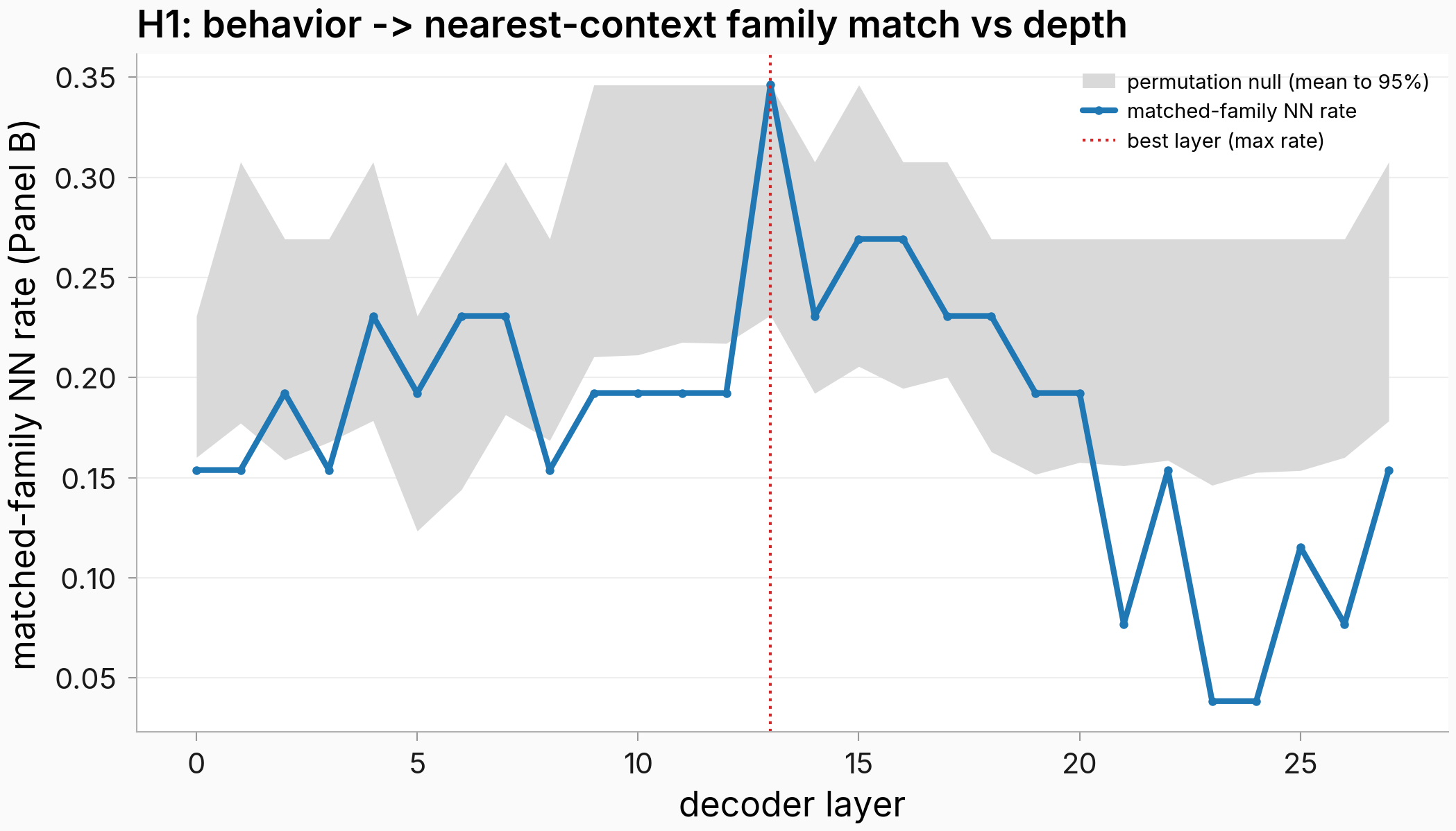
Figure. The observed match rate never leaves the null band. Blue = matched-family rate over 26 matched-panel roles; grey = shuffled-label null (mean to 95th pct), B=1000; red line at max-rate layer 13. The peak (0.346) sits just inside the band top (0.385); p = 0.28. The observed rate sits below the null mean on 15 of 28 layers (anti-enriched, esp. late layers 21-27).
- The planned floor was met (26 roles, 5 families, ≥2 each), so on this single seed / K=40 panel it is an adjudicated null, not an underpowered one.
- The context-only nearest neighbor is non-uniform:
format(25%),rephrase(21%),persona(20%) dominate, so the null reads "behaviors converge on a few dominant context families," not "behaviors point nowhere." - The residualized control (behavior-cloud PC removed) is more null still than the raw rate (0.192 vs null 0.231, p = 0.70, against raw 0.346 vs 0.385); a soft-k-NN re-run stays null across k=2/3/4 (p = 0.69/0.65/0.78).
- The read is "indistinguishable from null given the variance," not "no relationship on all 275 roles."
Behaviors form their own region, disjoint from context families (99.8% own-region)
Behaviors instead form a region of their own. The joint embedding shows behavior directions and context activations occupying separate regions of the shared space.

Figure. Behavior vectors (grey + black) cluster apart from the context-family centroids (colored). PCA top, UMAP bottom (n=15, min-dist 0.1, seed 42), quartile layers. Colored circles = the 7 context-family centroids; grey x = the 249 non-panel behavior vectors; near-black triangles = the 26 matched-panel behavior vectors. The behavior glyphs cluster into their own region, separate from the context circles.
At the match-rate best layer (13), 99.8% of behavior vectors have all 4 of their nearest joint-space neighbors as other behaviors; the fraction runs 99.5-100% across all 28 layers, with 16 of the 28 at exactly 1.0 (saturation, not just stability). The matched-family null is consistent with behaviors occupying a coherent region of their own that does not overlap the context families.
Behaviors cluster by their own axis (purity 0.815 over 27 of 275 roles)
Given the own-region separation, do the 27 labeled-subset behaviors have any coherent internal structure? Labeled k-NN family purity tests whether a behavior's neighbors share its role-type.
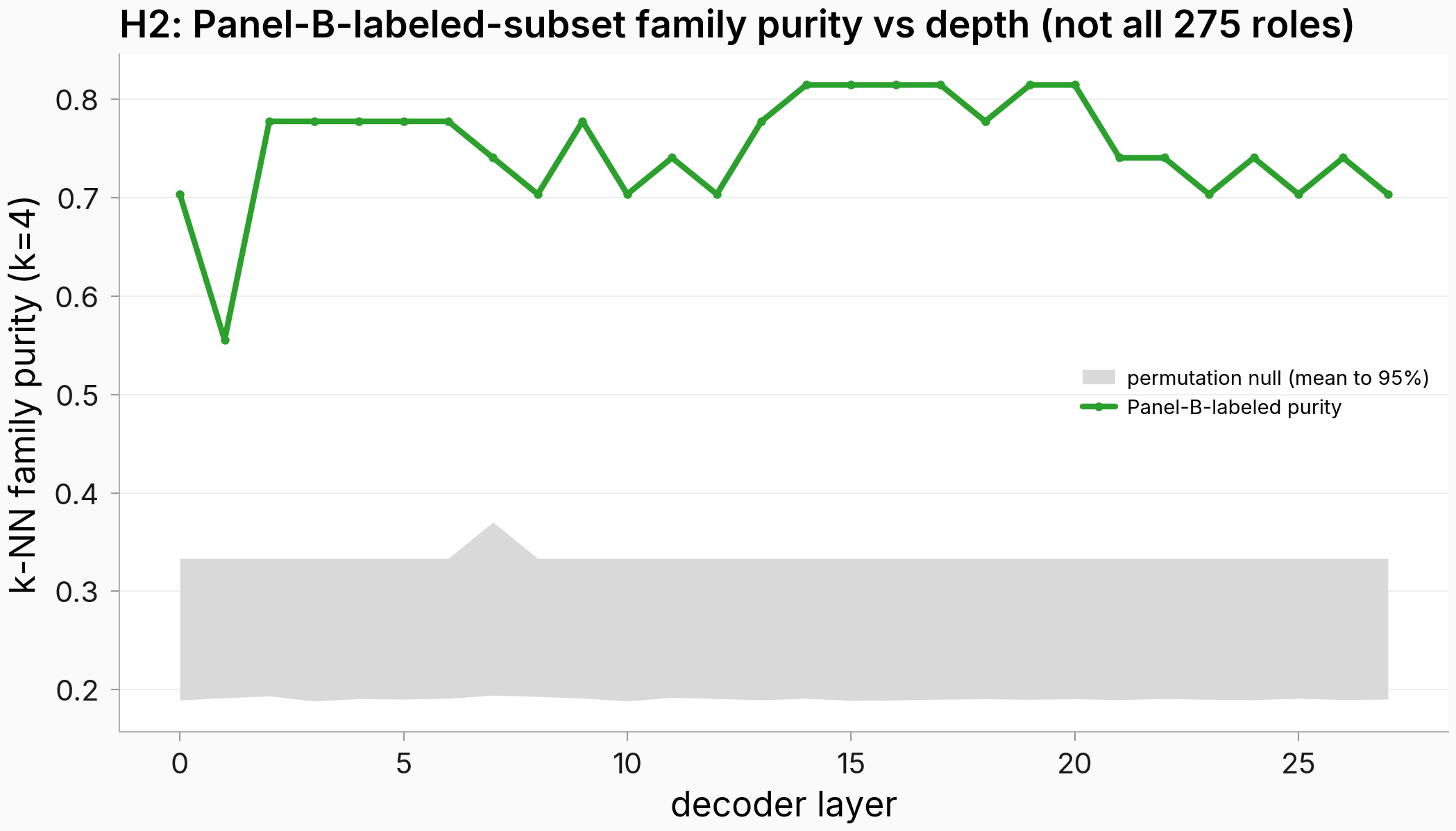
Figure. Behaviors cluster strongly by their own axis. Green = labeled purity (k=4) over 27 of 275 roles; grey = permutation null (mean to 95th pct). Peak 0.815 at layer 14 vs null 95th pct 0.444; p = 0.001. The figure title flags the 27-of-275 denominator.
- The positive holds, but on 27 of 275 roles, not the planned 275-role purity. No 275-role labeling source exists, so the denominator is the labeled subset (every mention is scoped to those 27).
- The signal is not a single peak: purity clears the permutation floor (p = 0.001) at all 28 layers, stronger than a one-layer spike.
- Whole-depth clearance has a second reading, though: a labeling or selection artifact over the 27 most-separable roles is not ruled out from this subset alone.
- Behaviors are differentiated by axis; they just do not align that structure with the context families.
The null is not a gross scale mismatch — the scale/variance gate passes at all 28 layers
A joint embedding can fake a null if one vector set dominates the other's scale. The gate checks per-layer variance and median-norm ratios; passing rules out a gross scale/norm mismatch behind the matched-family null, but it does not certify the joint map against extraction-method, pooling, or prompt-distribution artifacts.
![Co-embeddability gate: behavior/context variance ratio and median-norm ratio by layer, both riding 1.0-1.55, well inside the [1/3, 3] pass band marked by dotted lines at 0.33 and 3.0.](https://raw.githubusercontent.com/superkaiba/explore-persona-space/99da857eb8c8399a886c36fb97fa33c66ac65936/figures/issue_634/coembeddability_gate.png)
Figure. The two vector sets share a comparable scale at every layer. Blue = variance ratio, orange = median-norm ratio (behavior/context); dotted lines mark the [0.33, 3.0] pass band. 0 of 28 layers fail; the worst variance ratio is 1.55, the worst median-norm ratio 1.22, both at the final layer.
The gate addresses only gross scale/variance, so the matched-family null is geometric in that narrow sense; the exploratory cross-space alignment below shows how much coarse shape the two spaces do share.
Exploratory: the two spaces share coarse family shape mid-network but not enough to match neighbors
A diagnostic, not a planned test: family-centroid CKA and Procrustes alignment measure whether the behavior and context spaces share coarse structure at the family-centroid level.
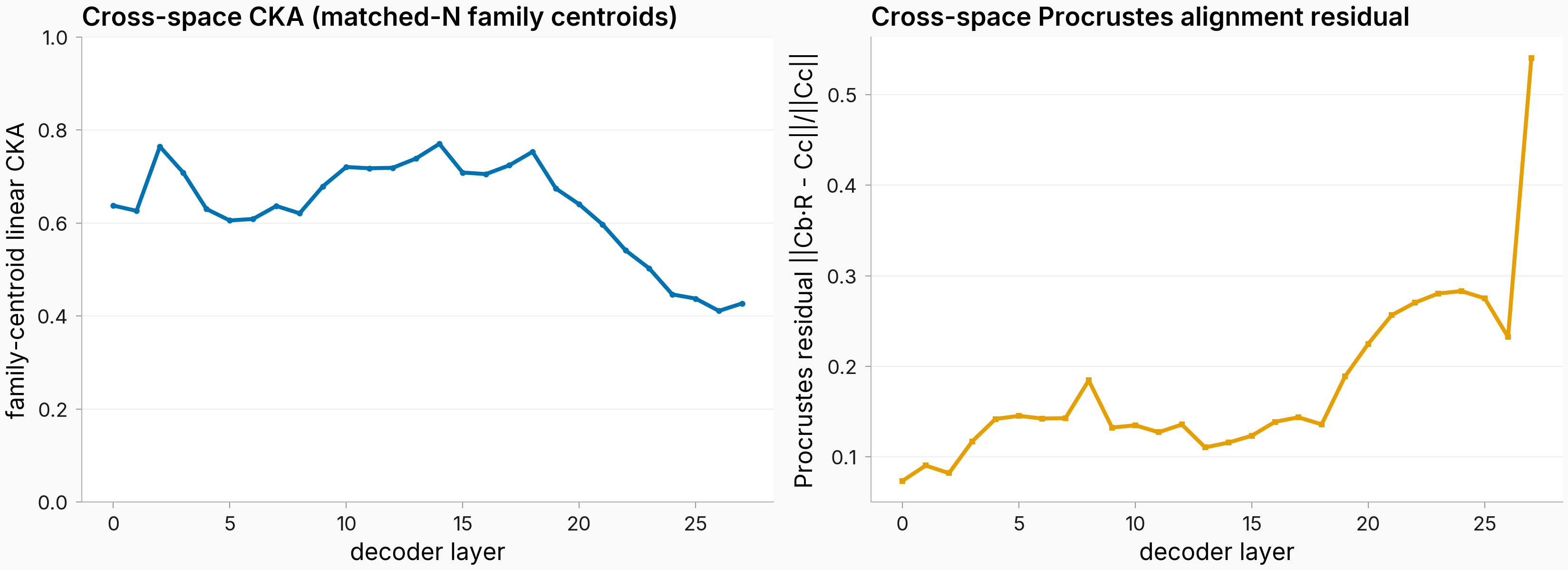
Figure. Exploratory. Left = family-centroid linear CKA (behavior vs context); right = raw Procrustes alignment residual. CKA peaks 0.770 at layer 14; the residual stays low mid-network (0.116 at layer 14) and spikes to 0.540 at layer 27. A diagnostic, not a planned test.
The two spaces share some coarse shape at the family-centroid level mid-network, but the late-layer residual spike and the matched-family null together say it is not enough for individual behaviors to find a matching context neighbor. N=5 shared family centroids (the intersection of behavior-family and context-family labels) enter the CKA/Procrustes computation; no permutation null or bootstrap was run on this exploratory pair.
Data
Trained on
n/a — no training in this task. The analysis reads pre-computed activation tensors: 275 behavior-vector roles re-extracted this run + the parent context-vector atlas's 50-context bank, both reused verbatim. No LoRA adapter, no training mix.
Evaluated with
The behavior bank is 275 assistant-axis roles (5 house system prompts each), read at the last input token of the assistant header across all 28 layers — the same read slot as the parent atlas's contexts. Each role direction is the mean over K=40 extraction questions sampled from the 240-question pool (seed 42), making it a slightly coarser estimate than the 240-question construct. The 26-role matched panel and its role→family map were frozen before any embedding, so the matched-family test could not be tuned after seeing the embeddings.
The complete frozen role-to-context-family map for the matched panel (not a sample); the machine-readable version is linked below.
All 26 matched-panel roles and their frozen context families (complete map, of 275 total roles)
| Family | Roles |
|---|---|
| persona (9) | detective, pirate, philosopher, warrior, rogue, hacker, bard, jester, sage |
| behavior-directive (5) | skeptic, contrarian, devils_advocate, perfectionist, pacifist |
| output-format (4) | summarizer, proofreader, editor, translator |
| instruction-reword (4) | tutor, interpreter, instructor, teacher |
| worked-example (4) | mathematician, programmer, debugger, analyst |
Full frozen map + per-layer nearest-neighbor table: panelB_nn_table.json. Per-layer metrics: per_layer_nn_purity.json.
Generated
n/a — no model generations. This is a geometry analysis: each role yields one fp32 direction vector per layer, not a completion. The 275-role behavior tensor (277 files: 275 per-role + mean + extraction manifest) is on HF: issue634_behavior_geometry/analysis_tensors/. The parent context bank reused as the matching target: issue594_context_geometry/analysis_tensors/.
Reproducibility
Methodology reference: docs/methodology/issue_634.md · gist
Parameters:
| Parameter | Value |
|---|---|
| Base model | Qwen/Qwen2.5-7B-Instruct |
| Read position | last input token under add_generation_prompt=True |
| Layers | all 28 decoder blocks |
| Hidden dim | 3584 |
| Behavior set (Panel A) | 275 |
| K (questions/role) | 40 of the 240 shared extraction questions |
| Panel B — H1 matched panel | 26 roles / 5 families |
| Panel B — H2 labeled purity subset | 27 roles / 6 families |
| Context bank (reused #594) | (50, 28, 3584), 7 families |
| k-NN purity k | 4 |
| Permutation null B | 1000, draws shared across layers; max-over-layers FWER |
| UMAP | n_neighbors ∈ {5,15,30} |
| t-SNE | perplexity ∈ {5,15,30} |
| PCA | random_state=42 |
| Cross-space fallback | family-centroid linear CKA + orthogonal Procrustes |
| Seed | 42 everywhere |
Artifacts:
- Behavior-vector tensor (275 roles × 28 layers × 3584, 277 files): issue634_behavior_geometry/analysis_tensors/
- Reused #594 context bank: issue594_context_geometry/analysis_tensors/ (from #594 — fit: same model, same last-input read slot, same 28 layers; the joint-embedding target)
- Eval JSONs (5):
eval_results/issue_634/ - Figures (6, inline + supplementary CKA/Procrustes + t-SNE):
figures/issue_634/ - WandB extraction run: issue634/r1awail2
Compute:
- Phase 1 extraction: ~33.5 min on 1× A100-80 (~0.6 GPU-h actual; the plan's ~11 GPU-h estimate was bandwidth-bound and conservative — the K=40 smoke-gate descope held).
- Phase 2 joint geometry: ~5 min, VM CPU.
- Pod: GCP
a2-ultragpu-1g, ephemeral.
Code:
-
Family map builder:
scripts/issue634_build_family_map.py -
Behavior-vector extraction:
scripts/issue634_extract_behavior_vectors.py -
Joint-geometry driver:
scripts/issue634_joint_geometry.py -
Git commit (results + figures):
99da857eb8c8399a886c36fb97fa33c66ac65936(branchissue-634) -
Reproduce:
git clone https://github.com/superkaiba/explore-persona-space.git
cd explore-persona-space
git checkout 99da857eb8c8399a886c36fb97fa33c66ac65936
uv sync
uv run python scripts/issue634_joint_geometry.py
Context:
- Created 2026-06-13; extraction + analysis run 2026-06-13/14.
- Follow-up to #594 — the context-vector atlas this task co-embeds behavior vectors against. The behavior half of an original two-part request whose context half ran as #594.
- Originating prompt(s), verbatim:
can you run this in the background: UMAP/PCA of diverse context vectors and behavior vectors to see if there is any structure