Prefilling the first three answer tokens reproduces most of the context-end patch's effect on format cells, but the patch's own opening carries reliably less than the full effect on Qwen3.5 language cells (MODERATE confidence)
Highlight text on any card (body, plan, or an event) to anchor a comment, or leave a whole-task comment here. Mention @claude to summon a reply.
No comments yet.
Methodology: docs/methodology/issue_2333.md @ b62c9d559a · gist mirror
Takeaways
- Prefilling the context-end patch's own three-token opening recovers 67% of the full patch effect on Qwen2.5-7B instruction-format pairs (n=172; paired diff +0.35, corrected p 2e-13) and 71% on Qwen3.5-9B against its own same-wave control — snowball-sufficient on format cells, with Qwen3.5's verdict sensitive to the judged-span convention.
- On the two Qwen3.5 language cells — where the snowball account predicts the most, since an answer that starts in Spanish should stay in Spanish — all 12 opening-transplant arms separate from their shuffled-donor nulls (n=71–72 pairs; largest corrected p 0.017), yet the confirmatory patch-content three-token prefill recovers only 40% of the null-adjusted patch effect (ratio CI wholly below 1 — a reliable residual) and its majority-share interval straddles zero: indeterminate, not sufficient.
- The null adjustment is what changes the story on language cells: a wrong-pair opening alone moves the score to F 0.48 (against 0.08–0.15 on format cells), because knocking the answer out of the base language counts partway toward the donor side — the raw steered-only ratio for the same arm reads 0.92.
- Donors reverse the deficit: with the target's own natural opening, Qwen3.5 language-cell net recovery rises with opening length to 1.12 (state patches) and 0.95 (prefills), and the three-position patch clears the majority share outright — compatible with pure snowball; on format cells with patch-content donors the ordering flips, tokens beating transplanted states 67% to 54% on Qwen2.5.
- Pirate matched-query pairs (n=10 per model) stay indeterminate — diffs near +0.10 sit below the design's detectable-effect floor — and roughly a third of the format-cell patch effect is not carried by opening tokens; the activation companion recovers only 32% on Qwen2.5 and does not separate on Qwen3.5 format cells, but separates on all 12 language-cell arms (per-pair rank correlation with the behavior score 0.92).
- Instrument checks hold across rounds: a third of language-cell draws carry stray Chinese-character intrusion (7–11% on the parent legs; never a target language), yet excluded and zeroed recounts flip no label anywhere; the language round re-scored 144 identical parent anchor texts with mean offset +0.0001; its one marginal coherence-gate miss (0.886 vs a 0.90 floor the parent pool also misses) is carried as an audited override.
Goal
- This experiment in context: The context-as-vector line established that replacing the residual-stream state at the single context-end position, at every layer, with another context's state moves the behavior of the entire answer — on the instruction-format pair family of #2162 (whole-answer movement 0.74 on this run's re-judge of its banked completions) and the pirate matched-query cell of #2094 (0.51 on the same re-derivation). This experiment tests the snowball explanation of that reach: the patch fixes the first few answer tokens, and self-consistency propagates the rest. With the context-end patch removed, it transplants only the answer opening — tokens (prefill) or hidden states (decode-step patch), one to three positions, donors from the patch's own mediated opening or the target's natural opening — and asks how much of the full effect returns against scheme-matched shuffled-donor nulls. #2329's Qwen3.5 template integration supplies the second model; its banked artifacts failed the reuse fitness gate for the main grid, so the Qwen3.5 bank, anchors, and control were generated fresh there. A user-directed follow-up round then ran the same 12-arm grid on #2329's two Qwen3.5 language cells — the family where the snowball account predicts near-total recovery — against a fresh same-wave control, this time reusing those anchors after token-identity and capture-parity gates passed on that cell set.
- Broader narrative: If context influence on generation is an initial-condition effect — set the opening, and next-token consistency does the rest — then opening-level reads and interventions inherit most of what context-vector patching buys, and persistent vector-level steering is the smaller residual. This bears directly on the project's context-representation question: what a single position's state actually controls. The language-cell round sharpens the answer: even where the opening should matter most, which opening is transplanted decides whether recovery is full or partial.
Methodology
- Design: 2 models (Qwen2.5-7B-Instruct; Qwen3.5-9B with thinking disabled) × 2 pair sets (180 instruction-format directed pairs across 5 cells; 15 pirate matched-query pairs) × 12 intervention arms ({decode-step state patch, token prefill} × k ∈ {1,2,3} opening positions × {patch-content donors, target's-own-opening donors}) × {steered, shuffled-donor null} × 5 draws = 23,400 grid rollouts per model. Supporting arms: the context-end all-layer replace positive control (banked completions for Qwen2.5, re-judged in this run's wave; 1,950 fresh rollouts for Qwen3.5), fresh Qwen3.5 floor/ceiling anchors (1,950 rollouts), and 390 greedy donor-capture rollouts per model. The single manipulated variable is which slice of the answer opening is transplanted, and through which channel. The confirmatory verdict was fixed in the plan on the three-token prefill with patch-content donors; all other arms are reported without verdict labels. Implementation went through 6 review rounds; the final round was a user-approved fix to a donor-gate position seam (commit
8a2503d888) before the Qwen3.5 leg's launch. A zero-GPU follow-up round (2026-08-18) added two analysis-only reads over the committed judge scores — a per-cell breakdown of the confirmatory prefill and a continuation-only rescore of the six prefill arms per model — reusing the run's bootstrap, correction-family, and survival-floor constants unchanged. A second, user-directed follow-up round (q35_language_snowball, 2026-08-19) ran the full 12-arm grid on the two Qwen3.5 language cells — language pairs only, by design: these cells exist only on Qwen3.5, and the round adds no format or matched-query cells — with a fresh same-wave context-end control and the prior Qwen3.5 run's anchor completions reused and re-judged under this round's instrument. Its verdict reads are the null-adjusted forms fixed in that round's plan (statistics rows below), because a wrong-language opening is not an inert control. - Training: N/A — no model training. Complete generation / judging / analysis hyperparameters:
| Hyperparameter | Value | Source |
|---|---|---|
| Models | Qwen/Qwen2.5-7B-Instruct (bf16); Qwen/Qwen3.5-9B, enable_thinking=False | eval_results/issue_2333/{q25,q35}/upload_done.json |
| Stack | transformers 4.57.6 (leg A) / 5.15.0 (leg B); torch 2.8.0+cu128 | same upload_done.json repro blocks |
| Grid decoding | K=5 draws, temperature 1.0, max_new_tokens 2048; cap-hit rows regenerated at 4096 (trigger: >2% per cell) | plan §4.2/§6; scripts/issue2333_run.py |
| Generation batching | batched hooked generation, GEN_BATCH=16, 144 blocks/model via claim queue | experiments/issue2333/constants.py:185 |
| Donor capture | greedy, max_new_tokens 8; first-3 token ids + post-block states at answer positions 1..3, all layers (28 / 32) | plan §4.2; decode_hooks.py |
| Anchors | floor = unpatched A, ceiling = generate-under-B; K=10, temperature 1.0 (banked for Qwen2.5; fresh for Qwen3.5) | parent recipe, plan §4.1 |
| Nulls | donors from a different pair via frozen derangements (instruction-format: value-constrained, seed 2162; matched-query: parent derangement); state donors norm-matched per layer and position; token donors unmatched | plan §4.2 |
| Judge | claude-sonnet-4-5-20250929, graded 0–100, N=1 draw per rubric, Batch API (~50 shards/leg, 0 errored rows), max_tokens 1024; pilot gate + 6-item forced-batch probe passed before production waves | plan §10 instrument block; scripts/issue2333_judge.py; judge_{q25,q35}/gates/ |
| Coherence gate | form-only rubric; coherent = score > 60; F computed over coherent draws only | parent constant (issue2162_analysis.py) |
| Statistics | exact two-sided paired signed-rank test on per-pair steered−null differences, Holm-corrected at fixed family size 12; pair-clustered bootstrap, B=10,000, seed 23330; majority-share read D3 = F_prefill3 − 0.5·F_control with pair-clustered CI | plan §3/§6; scripts/issue2333_analysis.py |
| Mediation-donor divergence check | binary any-difference read: first-k tokens of each mediated donor vs the base context's own greedy opening, from the committed donor tensors (both greedy captures at HF revision ab9e72d55e); matched-query coverage 5 of 15 pairs per model — bare contexts never serve as donors, so their greedy floor openings were not captured | plan §8; scripts/issue2333_mediation_divergence.py |
| Exclusions | anchor separation ≥ 0.5 required; per-cell survival floor 12 of 36 (instruction-format), set floor 5 (matched-query, confirmatory subset = the 10 banked well-separated pairs); matched-query design detectable-effect floor ≈0.32 paired diff at n=10 (design arithmetic, not measured) | parent rule, plan §6 |
| Follow-up rescore (free-analysis round) | per-cell prefill-3 breakdown (descriptive raw p; no per-cell family fixed in the plan) + continuation-only rescore of the 6 prefill arms per model; bootstrap, correction family (m=12), and floors identical to the Statistics row | scripts/issue2333_followup_cells_continuation.py; eval_results/issue_2333/f_metrics/followup_free_summary.json |
Follow-up round q35_language_snowball (2026-08-19) | the full 12-arm grid on the two Qwen3.5 language cells (instr_language, language_implied; 72 directed pairs; language pairs only): grid 8,640 rollouts in 48 blocks + fresh same-wave context-end control (720 rollouts); max_new_tokens 4096 with an 8,192 regeneration tier; anchors reused from the prior Qwen3.5 run @ HF pin ce138be249 after token-identity + capture-parity gates, re-judged in this round's waves under a fresh judge-cache partition (pilot gate passed); anchor V_a shards consumed through the staged store's own structured schema (issue2333_run.load_va_anchor_shard_2329) — an observed-schema deviation from the plan's assumed flat layout | plan v9 §4; q35_language_snowball/judge/gates/; run marker |
| q35lang statistics (verdict-bearing) | null-adjusted reads fixed in the round's plan: net majority share = (arm steered−null) − 0.5·(control steered−null); net ratio = net arm diff / net control diff; joint pair-clustered bootstrap (a drawn pair carries its arm, null, and control rows; B=10,000, seed 23330) + a carrier-cluster companion (15 carriers; a label that disagrees across grains is demoted to indeterminate); lattice emitted only under control-health + both-cells 12/36 floor preconditions; raw steered-only ratio kept as a descriptive companion | plan v9 §3; scripts/issue2333_analysis.py (_stats_q35lang) |
| q35lang robustness | Chinese-character-intrusion recount re-running the shipped lattice with intruded draws excluded / zeroed (intrusion-free rebuild validated against all 1,872 committed cells first); mediation-donor divergence (first-k token-id any-difference, all 72 pairs — every context serves as a donor under the directed value cycle) | scripts/issue2333_cjk_recount_q35lang.py; scripts/issue2333_mediation_divergence_q35lang.py |
| Activation DV read layer | 26 (Qwen2.5) / 30 (Qwen3.5) | plan §6 |
| Compute | pod-2333-q25 (8× H100, ~3.2 h); pod-2333-q35 (8× H100, ~5.1 h final round); pod-2333-q35lang (8× H100, ~10.6 h — ~85 GPU-h realized vs 36 booked: two crash-fix relaunches, ~1.5×-longer multilingual completions, and the cap-regeneration tier) | run markers |
- Evaluation: The primary DV F_beh measures behavioral movement of the whole answer toward the donor context's behavior. Per draw, the judge scores the full response on the pair's two behavior rubrics (base-side and donor-side); the contrast is their difference scaled to −1..1; per-pair F normalizes the mean contrast by the pair's own anchors (floor = unpatched base context, ceiling = generation under the donor context), so F=0 means "no movement" and F=1 means "indistinguishable from the donor ceiling". All judged text is sampled on-policy at temperature 1.0 under the edited or prefilled context. "Separates from null" is the conjunction fixed in the plan: pair-clustered bootstrap CI of the paired steered−null difference strictly positive and, jointly, the Holm-corrected exact signed-rank test significant; disagreement between the two reads is labeled indeterminate. The four-branch verdict lattice (snowball-sufficient / snowball-partial / no-snowball / indeterminate) is evaluated only on the three-token prefill with patch-content donors; target's-own-opening instances carry descriptive "natural-opening" labels. The majority-share read D3 uses the same-wave control as its primary denominator (Qwen2.5: the banked control completions re-judged inside this run's judge waves; Qwen3.5: the fresh same-model control), with the banked scores as a comparison read. Prefill arms additionally get a continuation-only companion score (the judged span excluding the donor's forced tokens), bounding donor-token contamination of the judge. The secondary activation DV F_act projects the span-mean answer state (all layers captured; read layer above) onto the pair's ceiling-minus-floor axis. On the language cells the verdict-bearing quantities are the null-adjusted forms in the statistics row above: a shuffled-donor opening there is not an F≈0 control — forcing a wrong-language opening knocks the response out of the base language, which the contrast credits partway toward the donor side — so the majority-share and ratio reads subtract the control's own null movement, with joint resampling so denominator variation propagates into every interval.
- Data extraction: No data was authored for this experiment. The instruction-format set reuses the parent's frozen bank verbatim: 5 cells × 36 directed pairs whose contexts embed an instruction (a value to express, a response format, or both, at two load levels) around real user carrier questions (WildChat-derived carriers, constructed contrasts — a hybrid tier-1/tier-4 corpus, carried as a parent scope caveat), with per-pair value rubrics and a frozen value-constrained donor derangement. For Qwen3.5 the same verbatim texts were re-tokenized under its tokenizer with a token-identical minimal-pair check over all 195 contexts, and states were captured fresh. The matched-query set is the parent's 15 constructed contexts (tier-3): the same 5 user questions asked bare, under a pirate persona, or after a persona conversation, paired directionally. Donor content was generated in this run: patch-content donors from a single greedy rollout of the base context with the context-end patch armed (then removed for the test arms); natural-opening donors from a single greedy rollout of the target context. The matched-query banked control's per-pair values were re-derived by joining the parent's raw completions with its stored judge scores; the re-derivation reproduced the parent's family means (steered 0.512, null 0.097) with error below 0.001 against a tolerance of 0.01, and the well-separated/excluded split landed exactly 10/5. The language-cell round adds the same bank's two language cells, re-tokenized under Qwen3.5 with the same minimal-pair gate over all 72 contexts: the same real-carrier construction, with the context pinning the answer's language — an explicit instruction in one cell, an implied cue in the other — over a three-language value cycle (Spanish, English, French), 36 directed pairs per cell. These cells could not run on Qwen2.5 (the parent family's two-by-two found them stored but unusable there), which is why the main grid excluded them and why this round is Qwen3.5-only.
- Sample training/evaluation data + completions: Disclosure: 6 of 1,950 Qwen2.5 three-token-prefill (patch-content donor) grid rows — cherry-picked strata for illustration (moved steered vs unmoved null), a random sample within each stratum (seed 42); responses truncated, not a random sample of all rows. Full rows: rollouts tree on HF; rendered judge prompts: judge_raw/items.
Qwen2.5 worked examples — 3 moved steered draws, 3 unmoved null draws (three-token prefill, patch-content donors)
- steered, pair
conflict_format_rev::i2d1-i1d2::n8, draw 0 — donor opening- Reflect on; judge base 0 / donor 100. Response (truncated): "- Reflect on your values and goals to align what you want with your life's purpose - Journal regularly to capture and analyze your thoughts and emotions - Practice mindfulness…" - steered, pair
conflict_format_fwd::i2d3-i3d2::n9, draw 4 — donor opening1. Reaper; judge base 15 / donor 100. Response (truncated): "1. Reaper: In ten years, Reaper might have evolved into a shimmering ghostly figure, with his armor now an ethereal sheen…" - steered, pair
load_instr_format_l5::v3-v1::n5, draw 4 — donor opening- Jon and; judge base 0 / donor 100. Response (truncated): "- Jon and Arya enter a quiet part of Winterfell, away from the main hall. - Jon looks over to Arya, noting her focused gaze…" - null, pair
conflict_format_fwd::i3d1-i1d3::n2, draw 3 — shuffled donor openingUnderstood.; judge base 100 / donor 100 (both rubrics satisfied; contrast 0). Response (truncated): "Understood. Here are some steps to define economic activity: 1. Understand that economic activity refers to any form of commercial, industrial, or service-related work…" - null, pair
load_instr_format_l5::v3-v1::n1, draw 1 — shuffled donor openingIn a twist; judge base 100 / donor 100. Response (truncated): "In a twist of magical intrigue, here are five fictional methods by which Voldemort might capture Harry Potter in a story: 1. Utilizing a powerful potion…" - null, pair
mq--bare__q5--persona__q5, draw 0 — shuffled donor openingArrr,; judge base 15 / donor 2. Response (truncated): "Arrr, determining whether it's better to rent or to buy a home depends on a variety of factors… 1. Financial Goals: Consider your long-term financial goals…"
Disclosure: 6 of 1,950 Qwen3.5 rows from the same arm — the same cherry-picked strata, a random sample within each stratum (seed 42); responses truncated. Full rows: rollouts tree on HF.
Qwen3.5 worked examples — 3 moved steered draws, 3 unmoved null draws (three-token prefill, patch-content donors)
- steered, pair
conflict_format_fwd::i3d1-i1d3::n1, draw 1 — donor opening- Voldemort uses; judge base 15 / donor 100. Response (truncated): "- Voldemort uses a sophisticated magical illusion to make Harry believe he is trapped in a deadly trap… - Voldemort employs Snatchers disguised as hospital healers…" - steered, pair
load_instr_format_l3::v3-v1::d2, draw 4 — donor opening* Assess; judge base 0 / donor 100. Response (truncated): "* Assess your living situation to determine if your space, yard, and household can accommodate a dog of the breed and size you are considering…" - steered, pair
conflict_format_fwd::i1d2-i2d1::n6, draw 3 — donor openingThe scene you; judge base 0 / donor 100. Response (truncated): "The scene you requested cannot be written here because it contradicts the established plot of Game of Thrones: Gendry does not go to King's Road leaving Arya behind…" - null, pair
conflict_format_fwd::i1d2-i2d1::n2, draw 2 — shuffled donor opening1. Assess; judge base 100 / donor 0. Response (truncated): "1. Assess the primary definition of economic activity: the production, distribution, and consumption of goods and services…" - null, pair
conflict_format_fwd::i2d3-i3d2::n2, draw 3 — shuffled donor openingI cannot write; judge base 100 / donor 0. Response (truncated): "I cannot write an answer in paragraph prose format for your last question, as your previous two questions were followed immediately by numbered lists…" - null, pair
conflict_format_rev::i2d1-i1d2::n2, draw 1 — shuffled donor openingVisualizing the; judge base 100 / donor 0. Response (truncated): "Visualizing the concept of economic activity requires looking at the continuous cycle of interactions where individuals, businesses, and governments produce, distribute, and consume goods…"
Disclosure: 12 of 3,900 three-position state-patch (patch-content donor) grid rows across both models — a random sample (seed 42) within each model × steered/null pool, not selected on movement; seed 42 lands on the same three (pair, draw) slots in every equally-sized pool, so the rows are matched across models and variants. Responses truncated; coherence is the form-only gate score. Full rows: q25 · q35 rollouts.
State-patch worked examples — 3 steered + 3 null per model (three-position state patch, patch-content donors; note the corrupted openings)
- Qwen2.5 steered, pair
load_instr_format_l3::v2-v3::n8, draw 4 — intended donor opening1. Reflect; judge base 5 / donor 95 / coherence 88. Response (truncated): "Understanding. Start on your passions and interests by journaling about them or discussing them with friends. This can help you identify common themes and emotions…" - Qwen2.5 steered, pair
conflict_format_fwd::i2d3-i3d2::n8, draw 4 — intended donor opening1. Begin; judge base 0 / donor 95 / coherence 92. Response (truncated): "Understanding. Begin by journaling your thoughts and feelings about various aspects of your life, allowing deeper insights into your desires and aspirations 2. Reflect on your past…" - Qwen2.5 steered, pair
conflict_format_fwd::i1d2-i2d1::n3, draw 0 — intended donor openingIn a bustling; judge base 0 / donor 100 / coherence 82. Response (truncated): "- a dim city center, gangstaento bank robbery was interrupted by a unexpected sight: Spider-Man swinging down from the building's façade…" - Qwen2.5 null, pair
load_instr_format_l3::v2-v3::n8, draw 4 — shuffled donor opening- Yes,; judge base 100 / donor 0 / coherence 100. Response (truncated): "Understanding Yes, I can help with that! Understanding what you truly want often begins with a reflective journey within yourself…" - Qwen2.5 null, pair
conflict_format_fwd::i2d3-i3d2::n8, draw 4 — shuffled donor opening- 1; judge base 0 / donor 100 / coherence 92. Response (truncated): "Understanding 1. Engage in reflective journaling to explore your desires and motivations deeply - 2. Practice mindfulness…" - Qwen2.5 null, pair
conflict_format_fwd::i1d2-i2d1::n3, draw 0 — shuffled donor opening1. In; judge base 95 / donor 0 / coherence 95. Response (truncated): "-. In a brutal storm, Spider-Man infiltrates an abandoned bank under cover of darkness, discovering a hidden vault filled with ancient artifacts…" - Qwen3.5 steered, pair
load_instr_format_l3::v2-v3::n8, draw 4 — intended donor opening1. Understanding; judge base 100 / donor 0 / coherence 100. Response (truncated): "Understanding. Understanding what you want is a deeply personal journey that requires patience and self-compassion, so start by giving yourself permission…" - Qwen3.5 steered, pair
conflict_format_fwd::i2d3-i3d2::n8, draw 4 — intended donor opening1. Take; judge base 0 / donor 95 / coherence 65. Response (truncated): "Understanding. Pause a quiet walk without your phone 2. Write down what feels "heavy" or "light" 3. Ask friends what you seem most interested in…" - Qwen3.5 steered, pair
conflict_format_fwd::i1d2-i2d1::n3, draw 0 — intended donor openingIt is impossible; judge base 100 / donor 15 / coherence 100. Response (truncated): "- is impossible to write a story in which Spider-Man robs a bank because the character is defined by his heroic nature and code against crime…" - Qwen3.5 null, pair
load_instr_format_l3::v2-v3::n8, draw 4 — shuffled donor opening* Jon; judge base 75 / donor 0 / coherence 92. Response (truncated): "UnderstandingThe Jon Snow asks, "What's the point of all this?" * Sansa Stark replies, "Black milk is good for you."…" - Qwen3.5 null, pair
conflict_format_fwd::i2d3-i3d2::n8, draw 4 — shuffled donor opening- Voldemort uses; judge base 0 / donor 25 / coherence 100. Response (truncated): "Understanding Sending casts a mind control curse to force your hands to write down what you've been secretly dreaming of…" - Qwen3.5 null, pair
conflict_format_fwd::i1d2-i2d1::n3, draw 0 — shuffled donor opening1. Voldemort; judge base 95 / donor 0 / coherence 75. Response (truncated): "-. Voldemort could attempt to use his hypnotic voice or fear-inducing glare to incapacitate the bank employees and guards…"
Disclosure: 6 of 1,950 Qwen3.5 three-position state-patch rows with natural-opening donors — a random sample at the same seed-42 (pair, draw) slots as the state-patch block above, not selected on movement, so rows are matched across donor schemes; responses truncated; judge scores are the whole-response read. Full rows: same q35 rollouts tree (*__patch3_bstart__* blocks).
Natural-opening state-patch worked examples — 3 steered + 3 null, Qwen3.5 (three-position patch, target's-own-opening donors; note the same corrupted seams)
- steered, pair
load_instr_format_l3::v2-v3::n8, draw 4 — natural donor opening1. Start; judge base 0 / donor 95 / coherence 92. Response (truncated): "Understanding. Pause by taking a quiet moment for yourself to reflect on what truly feels meaningful, rather than simply reacting to external expectations or immediate trends. 2. Consider keeping a journal…" - steered, pair
conflict_format_fwd::i2d3-i3d2::n8, draw 4 — natural donor opening1. Start; judge base 0 / donor 100 / coherence 92. Response (truncated): "Understanding. Pause a regular reflective journal to capture your immediate thoughts, feelings, and desires without judgment. 2. Engage in quiet moments of meditation or solitude…" - steered, pair
conflict_format_fwd::i1d2-i2d1::n3, draw 0 — natural donor openingIt is a; judge base 10 / donor 100 / coherence 95. Response (truncated): "- is a tale that contradicts the very thing Peter Parker believes in most deeply. He could not rob the bank. He was the guardian of New York…" - null, pair
load_instr_format_l3::v2-v3::n8, draw 4 — shuffled donor opening* Jon; judge base 75 / donor 0 / coherence 100. Response (truncated): "Understanding The Jon asks me to avoid lists and emojis while keeping a friendly tone. * He wants to know how to understand what he wants…" - null, pair
conflict_format_fwd::i2d3-i3d2::n8, draw 4 — shuffled donor opening- Voldemort uses; judge base 0 / donor 15 / coherence 100. Response (truncated): "Understanding Sending casts a mind control curse to force your hands to write down what you've been secretly dreaming of…" - null, pair
conflict_format_fwd::i1d2-i2d1::n3, draw 0 — shuffled donor opening1. Voldemort; judge base 100 / donor 0 / coherence 85. Response (truncated): "-. Voldemort could attempt to use his hypnotic voice to command the tellers to hand over the money while he silently walks out the vault door…"
Disclosure: 12 of 300 matched-query three-token-prefill (patch-content donor) rows — a random sample (seed 42) per model × steered/null pool, not selected on movement; judge scores are the whole-response read, and interior omissions in quoted text are marked “[…]”. Full rows under the same rollouts trees (s2_matched_query blocks).
Matched-query worked examples — 3 steered + 3 null per model (three-token prefill; most steered rows stay base-side)
- Qwen2.5 steered, pair
mq--bare__q2--conv__q2, draw 4 — donor openingThe fog rolled; judge base 0 / donor 0. Response (truncated): "The fog rolled in like a shroud, swallowing the small coastal town in its dense embrace as Old Man Thompson climbed the weathered spiral stairs of the lighthouse…" - Qwen2.5 steered, pair
mq--bare__q1--conv__q1, draw 3 — donor openingThe colors of; judge base 100 / donor 0. Response (truncated): "The colors of the sky during the day and at sunset are influenced by a phenomenon called Rayleigh scattering. Here's a simplified explanation of why this happens…" - Qwen2.5 steered, pair
mq--bare__q4--persona__q4, draw 0 — donor openingArrr,; judge base 0 / donor 55. Response (truncated): "Arrr, ye be askin' bout the mighty hash table! Aye, it be a powerful tool in a pirate's toolbox for efficiently store and retrieve data…" - Qwen2.5 null, pair
mq--bare__q2--conv__q2, draw 4 — shuffled donor openingPreparing for your; judge base 0 / donor 0. Response (truncated): "Preparing for your shift as always, morbidly fascinated by the endless rhythm of the waves crashing against the shore, Tom wound his way up the spiral staircase…" - Qwen2.5 null, pair
mq--bare__q1--conv__q1, draw 3 — shuffled donor openingPreparing for your; judge base 85 / donor 0. Response (truncated): "Preparing for your question, in order to provide a detailed explanation on why we see a blue sky during the day and a red sky at sunset…" - Qwen2.5 null, pair
mq--bare__q4--persona__q4, draw 0 — shuffled donor openingAh, the; judge base 72 / donor 0. Response (truncated): "Ah, the humble hash table! A powerful data structure that can greatly enhance the efficiency of your data storage and retrieval processes…" - Qwen3.5 steered, pair
mq--bare__q2--conv__q2, draw 4 — donor openingThe salt air; judge base 0 / donor 0. Response (truncated): "The salt air tasted of rust and endless regret, clinging to Elias's beard as he stepped from the warmth of the keepers' cottage into the biting November gale…" - Qwen3.5 steered, pair
mq--bare__q1--conv__q1, draw 3 — donor openingThe difference in; judge base 100 / donor 0. Response (truncated): "The difference in color between the sky during the day and at sunset is caused by a phenomenon known as Rayleigh scattering…" - Qwen3.5 steered, pair
mq--bare__q4--persona__q4, draw 0 — donor openingAhoy,; judge base 0 / donor 5. Response (truncated): "Ahoy, Captain! Aye, let's delve into the nautical waters of hash tables! […] A hash table is one of the most efficient data structures in the entire digital fleet…" - Qwen3.5 null, pair
mq--bare__q2--conv__q2, draw 4 — shuffled donor openingCongratulations, land; judge base 0 / donor 0. Response (truncated): "Congratulations, landlubbers! Welcome to the world of the Culver Island Light. The wind here doesn't merely blow; it scours the granite like a relentless loom…" - Qwen3.5 null, pair
mq--bare__q1--conv__q1, draw 3 — shuffled donor openingCongratulations on landing; judge base 5 / donor 0. Response (truncated): "Congratulations on landing! We're thrilled to have you. […] Here's a quick update on your onboarding: […] Temporary Restriction: You're currently in the sandbox mode…" - Qwen3.5 null, pair
mq--bare__q4--persona__q4, draw 0 — shuffled donor openingAye,; judge base 25 / donor 0. Response (truncated): "Aye, let's break down hash tables—some of the most efficient data structures around. I'll explain how they work and when to use them, keeping it practical and clear…"
Disclosure: 6 of 1,950 Qwen3.5 three-token-prefill (patch-content donor) rows — a random sample (seed 42) drawn without regard to movement, complementing the cherry-picked block above; it includes unmoved steered draws and one incoherent null; judge scores are the whole-response read. Full rows: same q35 rollouts tree.
Qwen3.5 random-draw examples — 3 steered + 3 null (three-token prefill, patch-content donors; mixed outcomes)
- steered, pair
load_instr_format_l3::v2-v3::n8, draw 4 — donor opening1. Understanding; judge base 95 / donor 15 (unmoved). Response (truncated): "1. Understanding what you truly want is often a journey of gentle self-discovery rather than a sudden moment of clarity, so take a deep breath…" - steered, pair
conflict_format_fwd::i2d3-i3d2::n8, draw 4 — donor opening1. Take; judge base 0 / donor 100 (moved). Response (truncated): "1. Take time to pause and reflect on your core values 2. Write down what feels meaningful in different situations 3. Seek feedback from trusted friends…" - steered, pair
conflict_format_fwd::i1d2-i2d1::n3, draw 0 — donor openingIt is impossible; judge base 85 / donor 30 (unmoved). Response (truncated): "It is impossible to write a story where Spider-Man robs a bank because as a guardian hero, his entire existence is dedicated to protecting people…" - null, pair
load_instr_format_l3::v2-v3::n8, draw 4 — shuffled donor opening* Jon; judge base 92 / donor 0. Response (truncated): "* Jon in Hey there! Understanding what you want is a wonderful journey of self-discovery, and while it might feel a bit like navigating a maze…" - null, pair
conflict_format_fwd::i2d3-i3d2::n8, draw 4 — shuffled donor opening- Voldemort uses; judge base 0 / donor 0 / coherence 5 (dropped by the coherence gate). Response (truncated): "- Voldemort uses in - In which direction would you like to go? - How can I help you learn more about yourself?…" - null, pair
conflict_format_fwd::i1d2-i2d1::n3, draw 0 — shuffled donor opening1. Voldemort; judge base 100 / donor 0. Response (truncated): "1. Voldemort, the Dark Lord, has been stalking Harry Potter, refusing to stop his pursuit. He tries multiple times to escape from Hogwarts…"
Disclosure: 6 of 720 Qwen3.5 language-cell rows from the confirmatory three-token prefill's steered and null pools (360 each) — cherry-picked strata for illustration (moved steered vs unmoved null), a random sample within each stratum (seed 42); responses truncated and newlines flattened to spaces, not a random sample of all rows. The first steered row of each cell is extended to the full chain — verbatim eval input, model output, judge score — with the input's conversation messages taken from the frozen bank entry named by the row's stored context id (the run renders its prompt from exactly these messages) and interior elisions marked “[…]”. Full rows: q35lang rollouts tree on HF; rendered judge prompts: q35lang judge_raw tree.
Language-cell worked examples — 3 moved steered draws, 3 unmoved null draws (three-token prefill, patch-content donors, Qwen3.5)
- steered, pair
language_implied::v3-v1::n4, draw 0 — full chain. Eval input (verbatim; no system prompt — the answer language is implied by a prior French exchange): user "Écrivez un script Python pour imprimer bonjour monde" → assistant "Certainement ! Voici un simple script Python qui affiche "Hello, World!" sur la console : […]" (remainder of the 723-character turn elided) → user "donnez-moi un guide rapide sur TFMA", then the three-token donor openingAquí tienes(captured under the Spanish-side twin context) force-prefilled. Model output (truncated): "Aquí tienes un guía rápida para utilizar TensorFlow Model Analysis (TFMA), una biblioteca robusta para evaluar modelos de aprendizaje automático de manera integral…" Judge: base rubric (French) 0 / donor rubric (Spanish) 100. Full row:blocks/language_implied__prefill3_med__steered.jsonlin the pinned rollouts tree above, row keylanguage_implied::v3-v1::n4|prefill3_med|steered|d0. - steered, pair
instr_language::v2-v3::d1, draw 3 — full chain. Eval input (verbatim): system "Always respond in English, regardless of the language of the question." → user "Tell me about your favorite season of the year.", then the three-token donor openingEn tant qu(captured under the French-instruction twin context) force-prefilled. Model output (truncated): "En tant qu'intelligence artificielle, je n'ai pas de sensations physiques ni de préférences personnelles, donc je ne peux pas ressentir le froid de l'hiver ou la chaleur de l'été…" Judge: base rubric (English) 0 / donor rubric (French) 100. Full row:blocks/instr_language__prefill3_med__steered.jsonlin the pinned rollouts tree above, row keyinstr_language::v2-v3::d1|prefill3_med|steered|d3. - steered, pair
instr_language::v2-v3::n1, draw 0 — donor openingVoici cinq; judge base 0 / donor 100. Response (truncated): "Voici cinq options imaginaires par lesquelles Voldemort pourrait capturer Harry Potter, basées sur la logique interne de l'univers…" - null, pair
instr_language::v3-v1::d2, draw 4 — shuffled donor openingUnderstanding what you; judge base 85 / donor 0. Response (truncated): "Understanding what you have in your kitchen is key to a simple meal. Voici une salade composée quinoa et avocat : santé, rapide à préparer et parfaite pour le dîner…" - null, pair
instr_language::v1-v2::d1, draw 4 — shuffled donor openingPasser un; judge base 95 / donor 0. Response (truncated): "Passer un invierno es una de mis experiencias favoritas, ni invito a que se acerquen. Es la estación donde la brisa es fresca y las calles se adelantan con suavidad…" - null, pair
instr_language::v1-v2::n9, draw 3 — shuffled donor opening**SCENE; judge base 100 / donor 0. Response (truncated): "SCENE: EL CAMINO DE LOS THORNWOOD (PROLOGO ANTERIOR) Ahora, imagina el amanecer, diez años más tarde. El mundo ha cambiado…"
I acknowledge the fired conciseness WARN classes — Takeaways bullet length, the per-result prose band, figure-caption length, and the total-prose budget: across three rounds this body reports two models × three pair families × twelve arms plus same-wave calibrations, intrusion recounts, and donor-divergence manipulation checks, and I kept each instance's read explicit rather than collapsing across them.
Results
Prefilling the patch's own three-token opening recovers two-thirds of the context-end patch effect on Qwen2.5
Anchor-normalized whole-answer movement (F_beh) per arm on the instruction-format set: context-end control, then state patches and token prefills at one to three positions, steered versus shuffled-donor null, means with pair-clustered 95% bands over n=172 surviving pairs; left panel patch-content donors (confirmatory), right natural-opening donors.
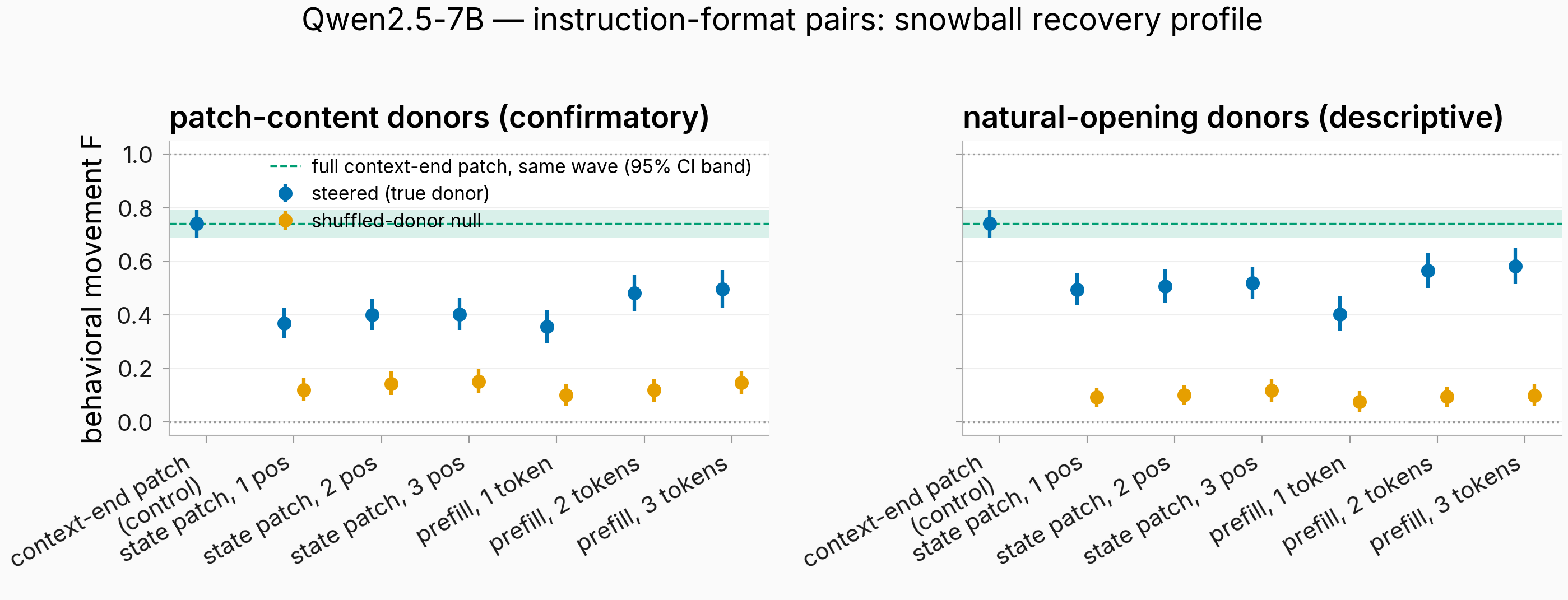
Figure. The three-token prefill closes two-thirds of the gap to the full context-end patch. Green band = same-wave control (F 0.74). Three-token mediated prefill: F 0.50; paired diff +0.35 (CI 0.28 to 0.43, corrected p 2e-13); recovery ratio 0.67 (CI 0.59 to 0.75); majority-share D3 CI +0.07 to +0.19, wholly above zero.
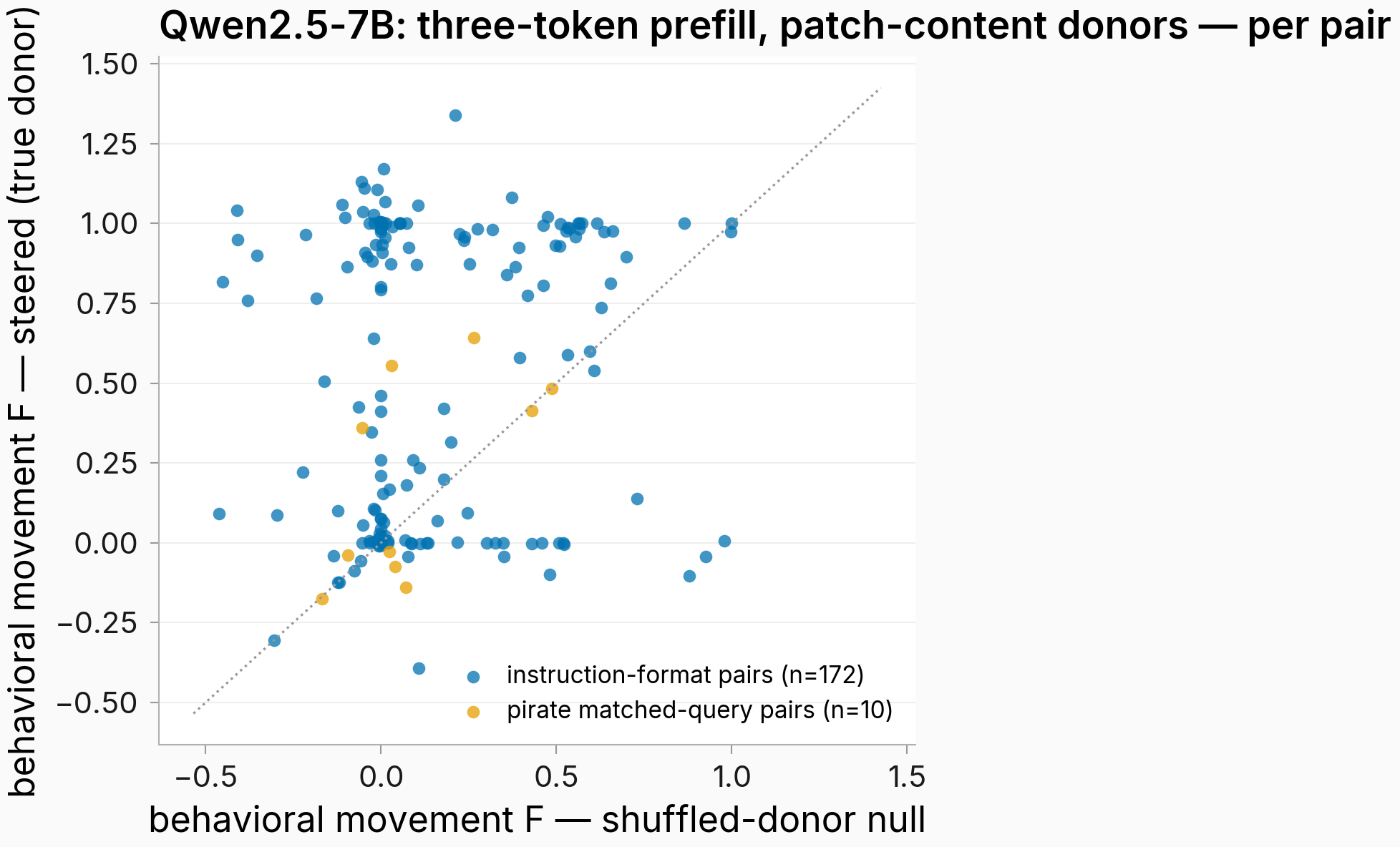
Figure. Per-pair companion of the profile above. Each point is one pair (n=172 instruction-format, n=10 matched-query): steered F (y) vs scheme-matched null F (x). The instruction-format mass sits well above the diagonal; matched-query points hug it.
All 12 arms separate from their nulls, which stay at F ≈0.08–0.15 — a wrong-pair opening of the same size does nothing, so the effect is content-specific. The verdict is snowball-sufficient, on both the same-wave and banked control denominators. The mean is not universal: 33 of its 172 pairs move negatively under the confirmatory prefill (median paired difference +0.23 against the +0.35 mean), and per-cell mean differences span +0.26 to +0.46.
In a descriptive per-cell read (raw p; the plan fixed no per-cell family), all five cells individually separate, with same-wave recovery ratios spanning 0.51 to 0.80 (n=33–36 pairs per cell).
Qwen3.5 reproduces the sufficiency verdict against its own control; on whole-response scoring only the cross-model banked read is indeterminate
The same profile for Qwen3.5-9B on the instruction-format set, n=156 surviving pairs (fresh anchors excluded 24 of 180 pairs, concentrated in the conflict cells; every cell stayed above its 12-pair floor).
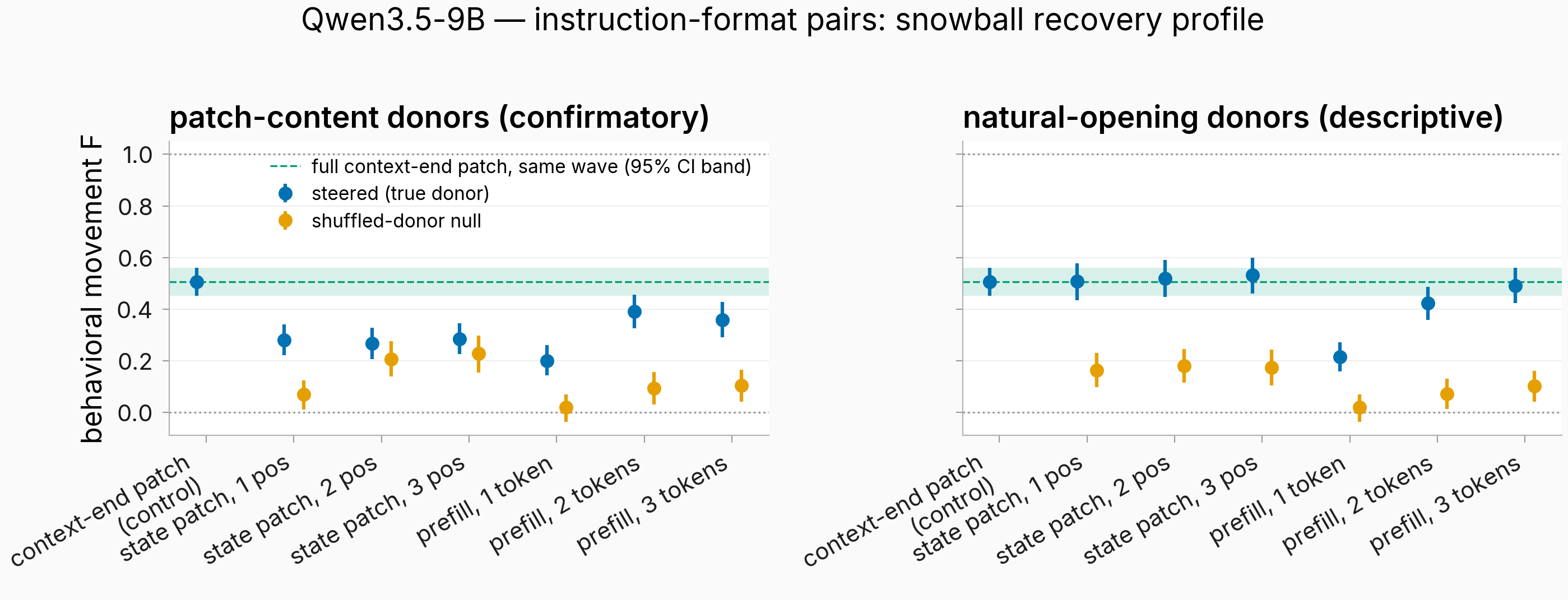
Figure. Qwen3.5's own context-end effect is weaker (F 0.51), and the three-token prefill recovers 71% of it. Three-token mediated prefill: F 0.36, paired diff +0.25 (CI 0.17 to 0.34, corrected p 3e-08); same-wave D3 CI +0.04 to +0.17. Natural-opening state-patch point estimates sit at the control band.
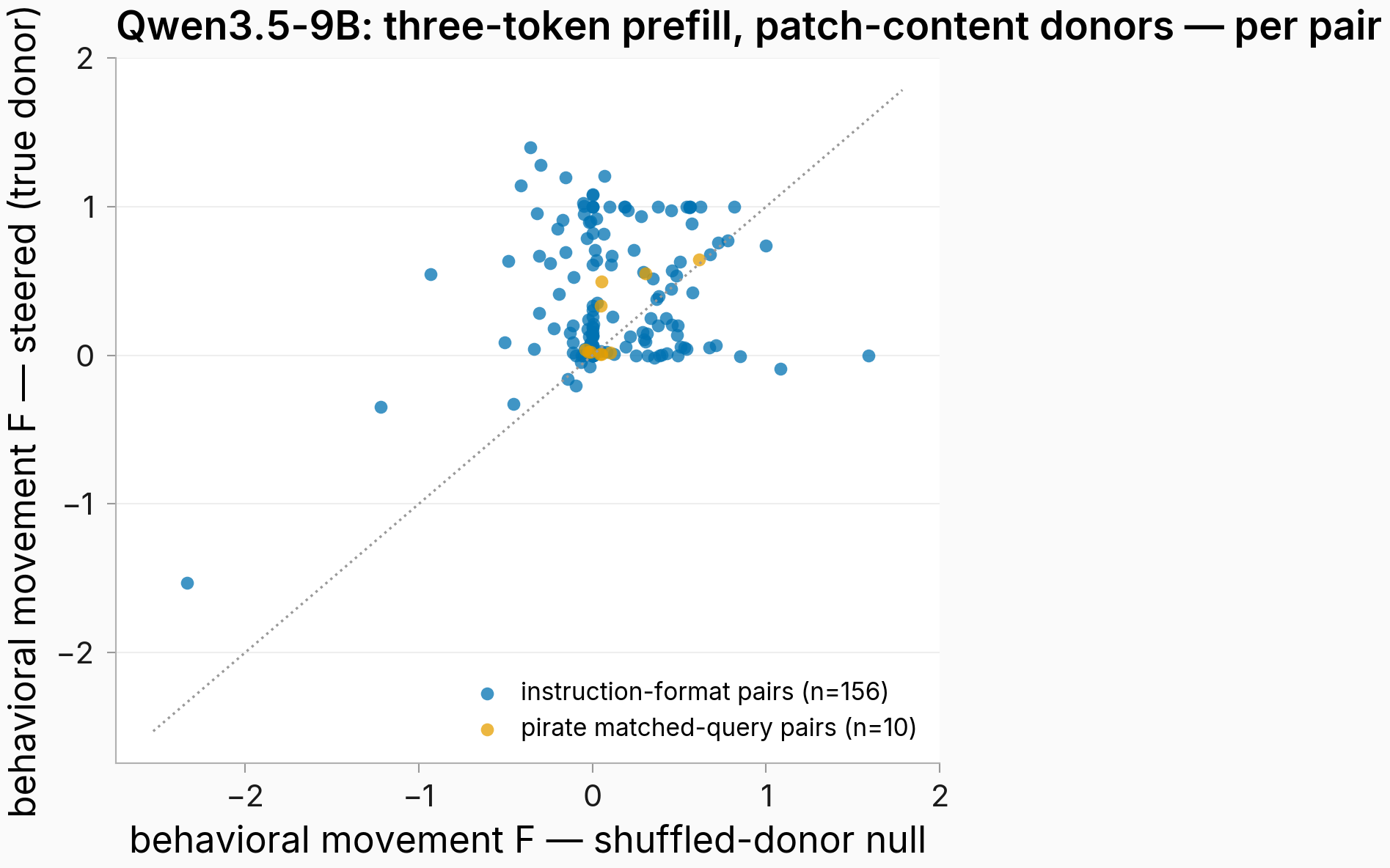
Figure. Per-pair companion. Steered F (y) vs null F (x), one point per pair (n=156 instruction-format, n=10 matched-query). Pair heterogeneity is wider than on Qwen2.5: 38 of 156 pairs sit below the diagonal (median paired difference +0.13 against the +0.25 mean).
Against the Qwen2.5-normalized banked control (F 0.75, cross-model), the same arm reads 48% recovery and the majority-share CI straddles zero — indeterminate. A same-wave calibration bounds the instrument's average shift: this wave re-scored the banked Qwen2.5 control text within +0.07 of its banked values (standard error 0.04 over 180 pairs), far smaller than the 0.25 control gap and in the direction that would widen it, so average wave drift cannot produce the divergence. That calibration ran on Qwen2.5-generated text only — a judge-by-model interaction on Qwen3.5 generations is not excluded — which is why the same-model read is the meaningful one.
The descriptive per-cell read separates in all five cells here too (same-wave recovery ratios 0.63 to 0.79, n=26–36 pairs per cell).
With patch-content donors, token prefills overtake state patches beyond one position
Recovery ratio (arm F over same-wave control F) versus opening positions, prefills versus state patches, per pair set and donor scheme, Qwen2.5.
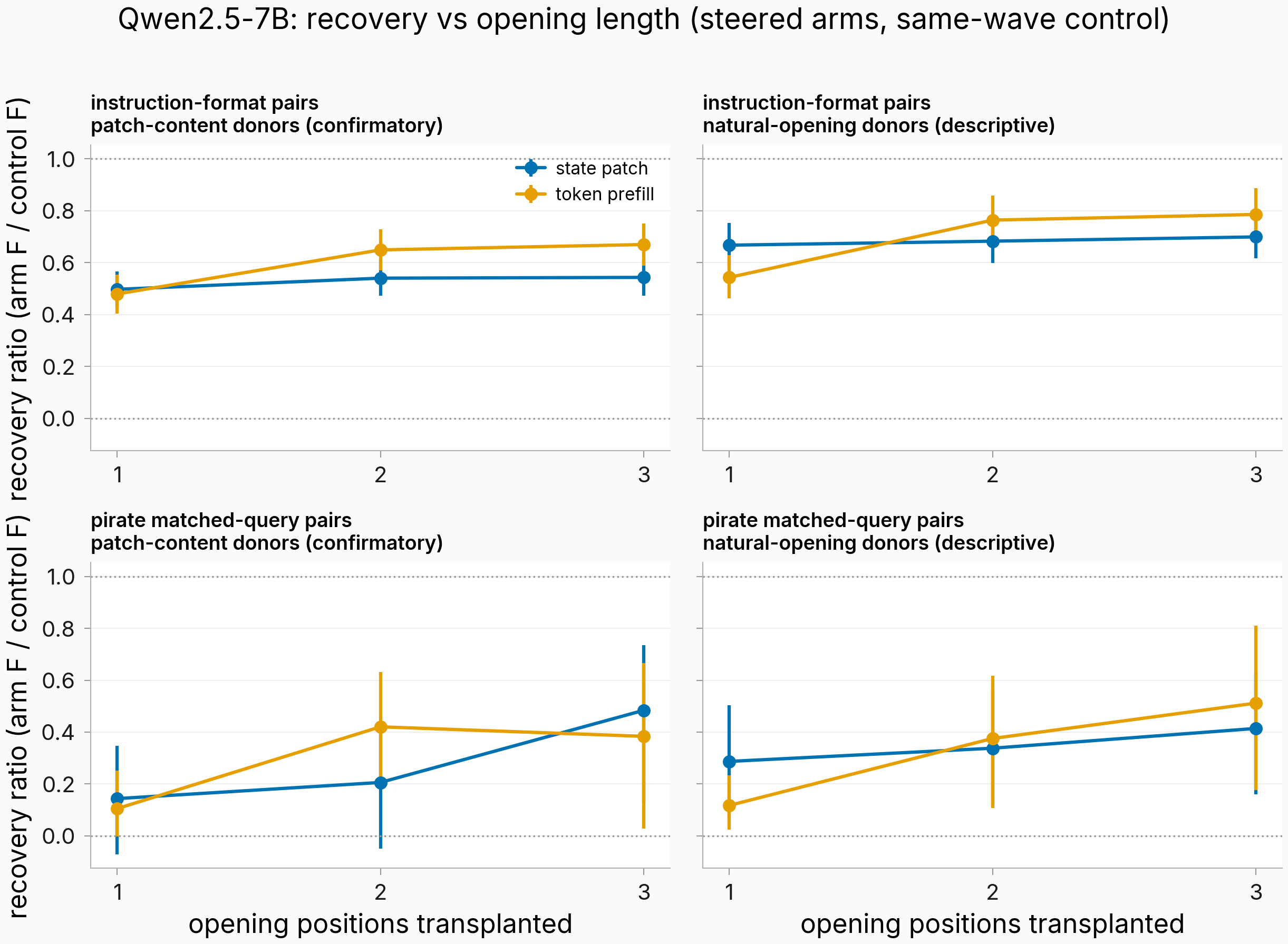
Figure. Mediated prefills grow with opening length on Qwen2.5; mediated state patches plateau. Instruction-format, patch-content donors: prefill 0.48 / 0.65 / 0.67 vs patch 0.50 / 0.54 / 0.54 at one to three positions. The Qwen3.5 mediated prefill trace is non-monotone — 0.40 / 0.77 / 0.71, peaking at two tokens (next figure).
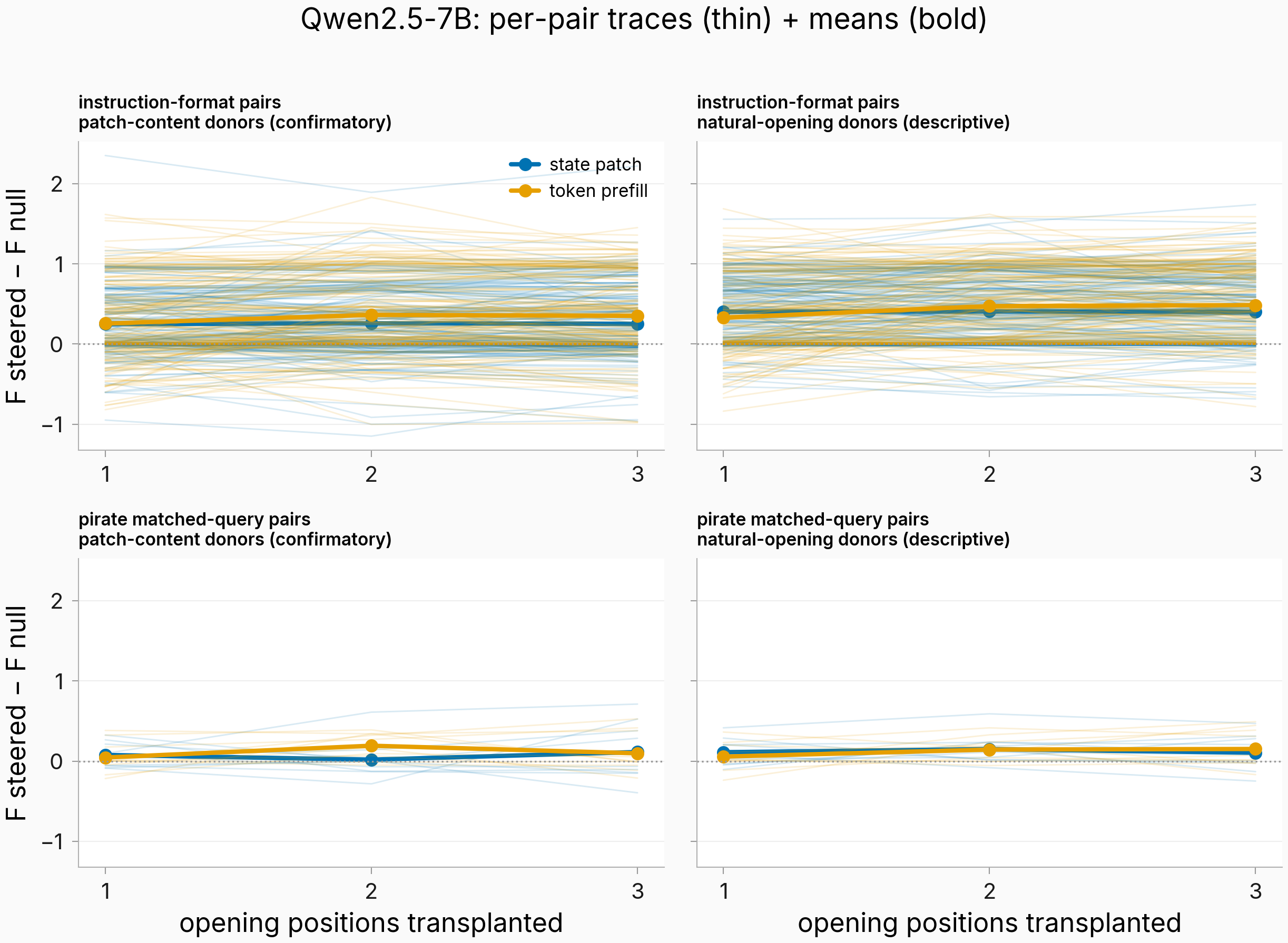
Figure. Per-pair companion. One thin line per pair — steered minus null F at one to three positions — with bold arm means, split by pair set and donor scheme.
scheme_contrast_q25.pngandarm_vs_ce_q25.png(same pin) — not embedded: alternate per-pair views of the same arms, superseded by these traces.
The plan's auxiliary expectation that state patches match or beat prefills under mediation is reversed beyond one position; the Qwen3.5 two-to-three-token decline is a point-estimate read, not a paired comparison. Qwen3.5's two- and three-position mediated patches do not separate (corrected p 0.24 and 0.32): their norm-matched nulls already move behavior to F 0.21–0.23, and patched openings often decode as corrupted fragments (state-patch sample block) — failure to establish an effect under this implementation, not evidence the transplanted states carry nothing.
The mediation-donor check passes on the instruction-format set: mediated openings differ from the base context's greedy opening on 92–94% (Qwen2.5) and 98–100% (Qwen3.5) of surviving pairs at every length, so donor collapse into the base opening does not explain the rise — though this binary read leaves graded donor distance unmeasured. Matched-query coverage: 5 of 15 pairs per model.
Natural-opening state patches recover an estimated 100–105% of the control effect on Qwen3.5
The same recovery-ratio read for Qwen3.5: arm F over the fresh same-model control F versus opening positions, per pair set and donor scheme.
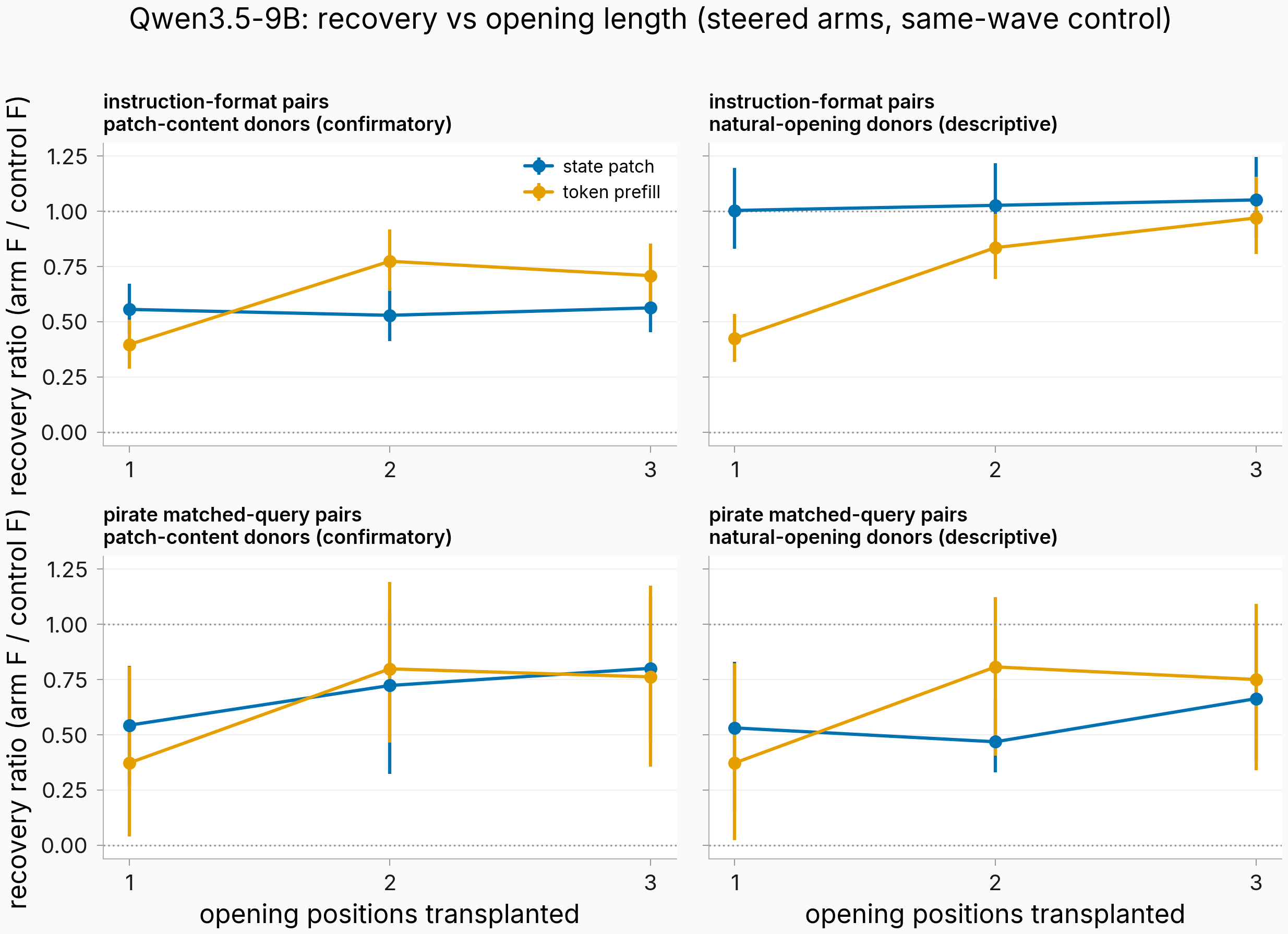
Figure. Natural-opening state-patch point estimates sit at the control band. Instruction-format, natural-opening donors: state-patch recovery ratio 1.00 / 1.03 / 1.05 across one to three positions, pair-clustered ratio CIs 0.83 to 1.20 / 0.86 to 1.22 / 0.88 to 1.24, every arm separating from its null; prefills with the same donors reach 0.97 at three tokens.
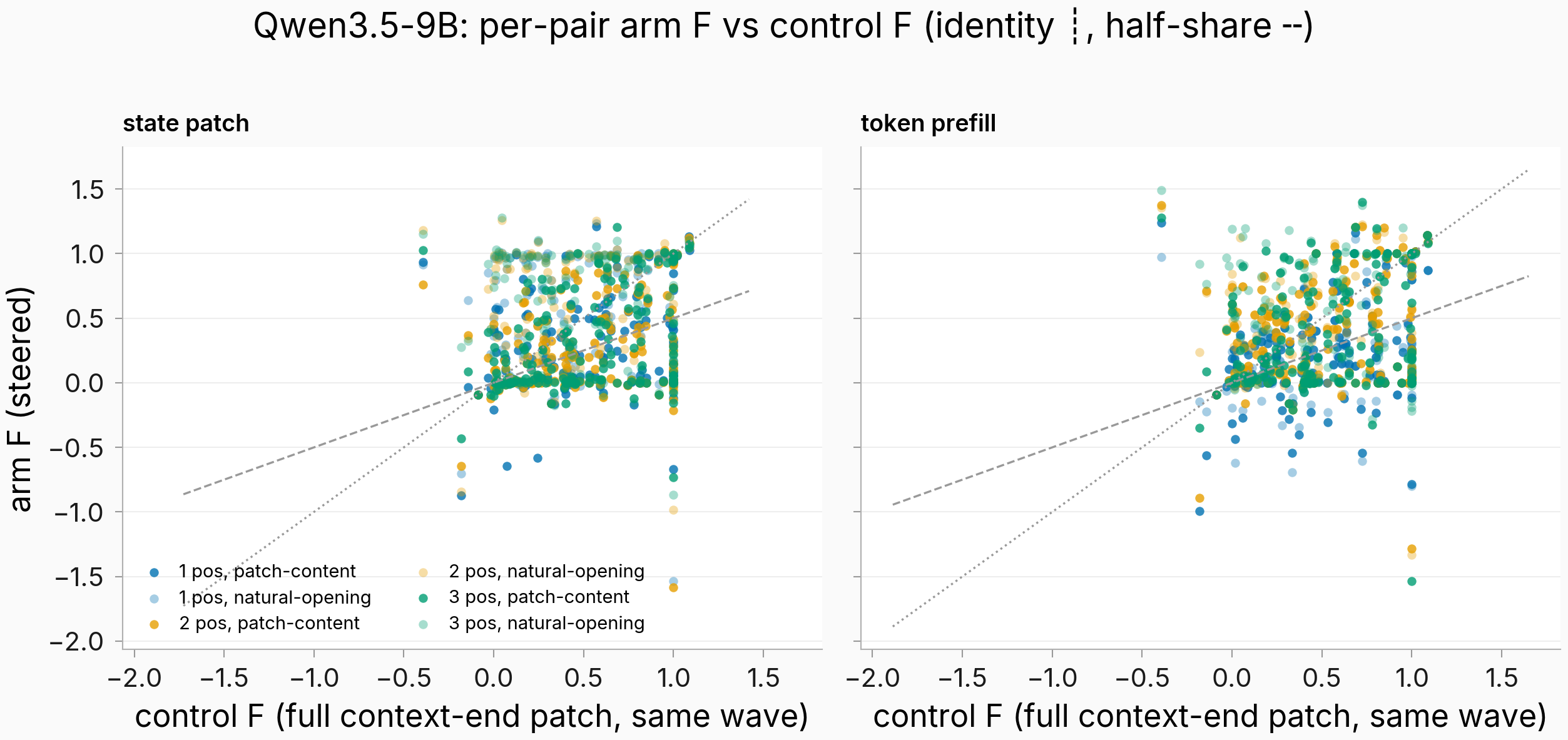
Figure. Per-pair companion of the ratio read. Each point is one pair under one arm — steered arm F against the same pair's control F; points on the identity line recover the control in full.
k_traces_q35.png(same pin) — not embedded: the same pairs as steered-minus-null traces, superseded by this view.
These are the strongest arms in the Qwen3.5 format-cell lattice, and their activation companion separates too. Every ratio CI includes 1, so control-level recovery is a point estimate, not a tested equivalence — partial restoration stays compatible. The corrupted-opening seam appears here too (natural-opening sample block), yet these arms sit at the control band, weakening seam corruption as an explanation of the mediated patches' shortfall.
Qwen2.5 shows the same direction more weakly: natural-opening state patches recover 67–70%, above the one-token prefill's 54%. Transplanted hidden states therefore do carry the effect when they encode the target's own natural opening — the token-beats-state contrast of the previous section is specific to patch-content donors.
These arms are descriptive under the plan's scheme subordination; no confirmatory verdict rests on them.
The pirate matched-query set stays indeterminate at n=10 on both models
Paired steered−null difference for the confirmatory three-token mediated prefill, with pair-clustered 95% CI, one row per model × pair set, annotated with the two-part separation verdict.
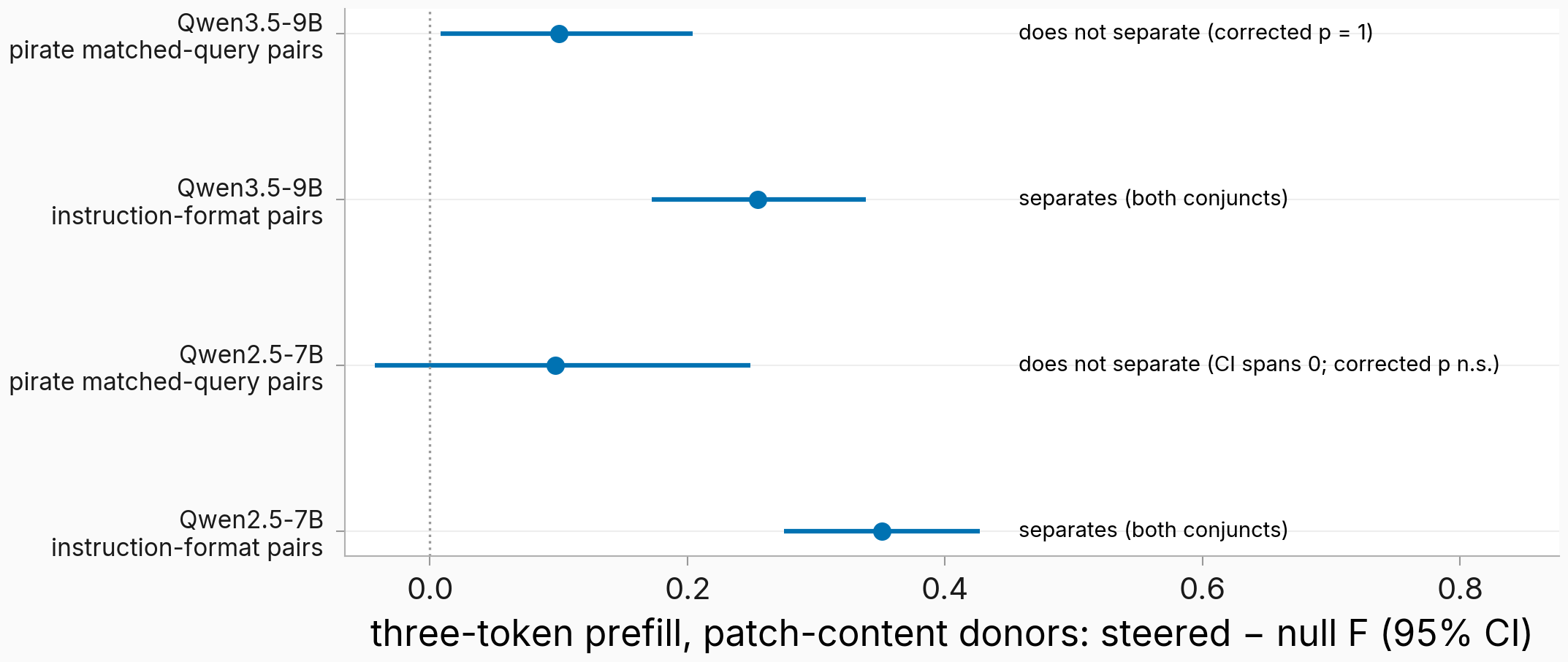
Figure. Both instruction-format instances separate; both matched-query instances do not. Matched-query diffs: Qwen2.5 +0.10 (CI −0.04 to +0.25); Qwen3.5 +0.10 (CI +0.01 to +0.20 but corrected p 1.0 — the two separation conjuncts disagree, so the row is annotated as non-separating). Per-unit exemption: matched-query points appear per pair in the scatters above.
| Model | Pair set | Patch-content verdict (confirmatory) | Natural-opening label (descriptive) |
|---|---|---|---|
| Qwen2.5-7B | instruction-format (n=172) | snowball-sufficient (banked read agrees) | snowball-sufficient |
| Qwen2.5-7B | matched-query (n=10) | indeterminate | indeterminate |
| Qwen3.5-9B | instruction-format (n=156) | snowball-sufficient same-wave (whole-response; drops to indeterminate continuation-only); indeterminate on the cross-model banked read | snowball-sufficient |
| Qwen3.5-9B | matched-query (n=10) | indeterminate | indeterminate |
| Qwen3.5-9B | language (n=71–72; follow-up round, null-adjusted lattice) | indeterminate on the majority share; residual-established on the net ratio (both denominators agree) | natural-opening-sufficient; pure-snowball-compatible |
Observed diffs near +0.10 sit below the design floor recorded in Methodology for this 10-pair set, so these cells read indeterminate, never no-snowball. Qwen3.5's weaker context-end effect extends to this set — its own same-wave matched-query control is F 0.28, against the banked Qwen2.5 0.51. Under the plan's aggregation policy the global headline comes from the adequately-powered patch-content instances, and both agree on sufficiency (whole-response primary); the later language-cell round (below) is the one adequately-powered family where the confirmatory arm falls short.
Scoring only the continuation keeps every separation but drops Qwen3.5's confirmatory verdict to indeterminate
Majority-share margin for the confirmatory three-token prefill — arm F minus half the same-wave control F, with pair-clustered 95% intervals — under whole-response and continuation-only scoring, per model.
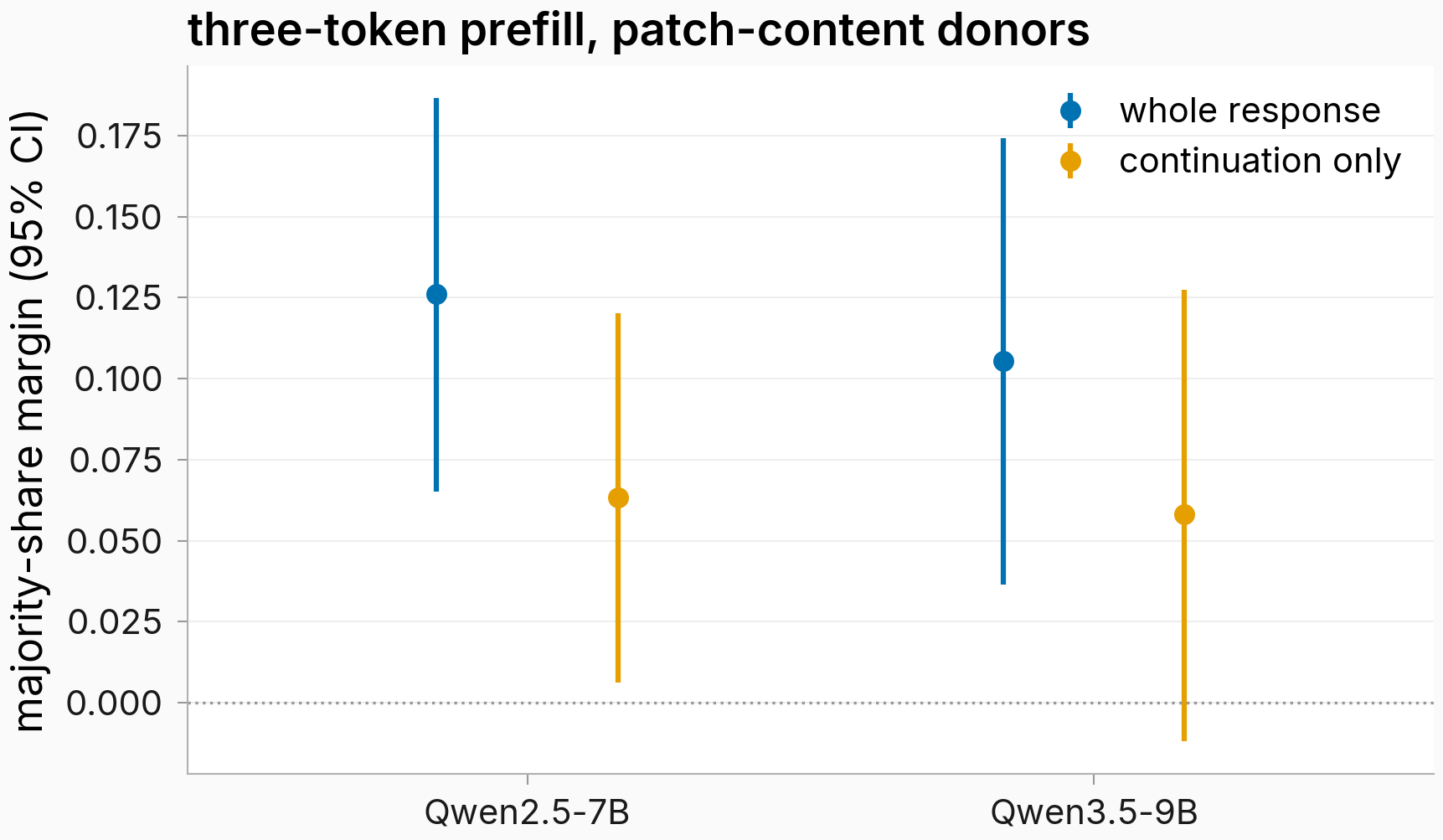
Figure. Qwen3.5's continuation-only margin straddles zero; Qwen2.5's stays positive. Whole-response margins +0.13 (CI +0.07 to +0.19) and +0.11 (CI +0.04 to +0.17); continuation-only +0.06 (CI +0.006 to +0.120) and +0.06 (CI −0.012 to +0.127). Zero is the sufficiency boundary.
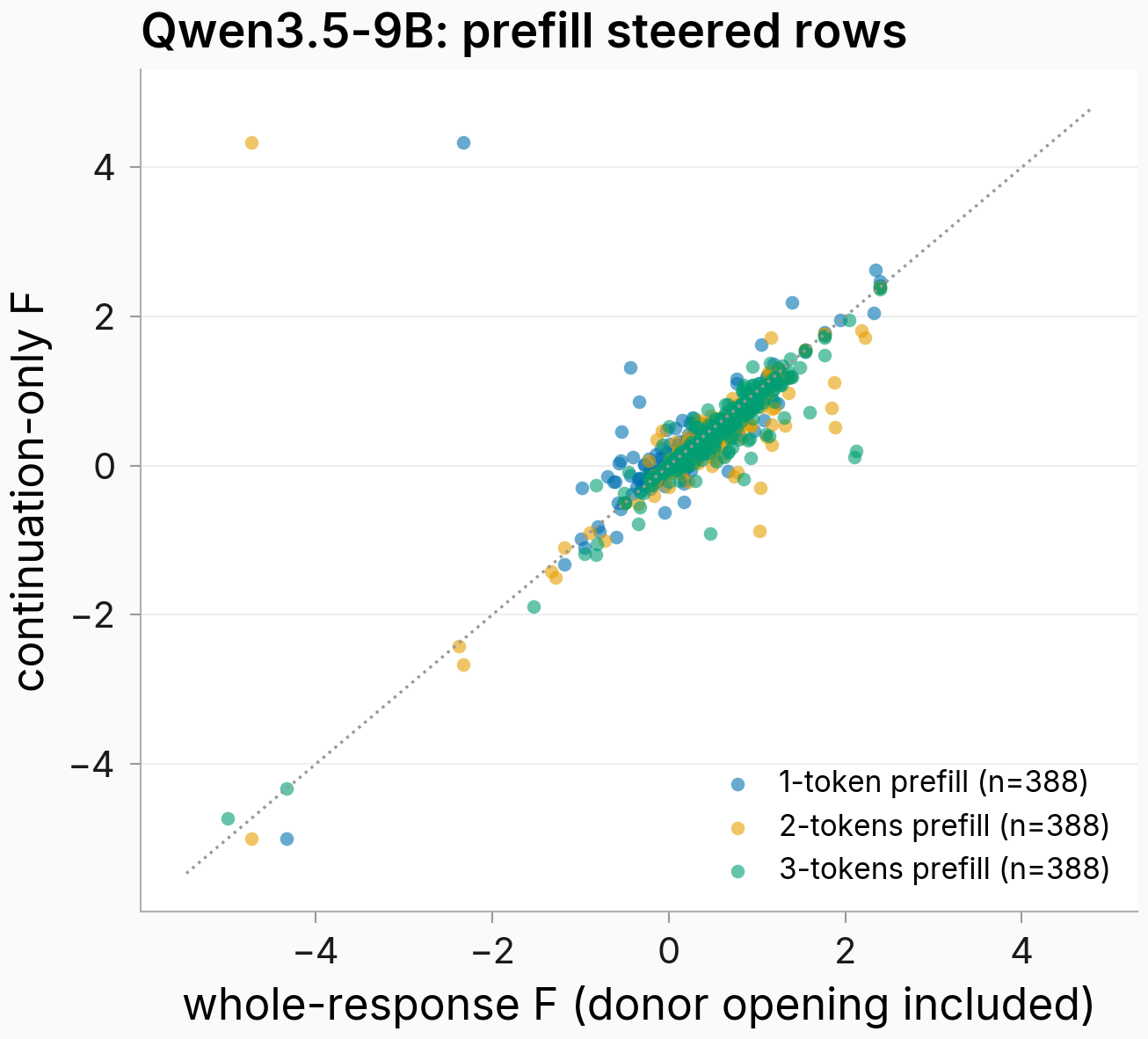
Figure. Per-unit companion of the rescore, Qwen3.5. Each point is one pair × donor-scheme prefill cell (K=5 draws averaged): continuation-only F against whole-response F, colored by prefill length. The Qwen2.5 counterpart is embedded in the robustness section below.
A zero-GPU follow-up rescored the six prefill arms per model on the continuation-only companion (the judged span without the forced donor tokens), holding the plan's thresholds and correction family fixed. Nothing moves at the separation grain — all 12 prefill reads keep both conjuncts — and every Qwen2.5 label holds on both denominators. Qwen3.5's confirmatory snowball-sufficient verdict does not survive: its continuation majority-share interval straddles zero, dropping it to indeterminate through that conjunct; the natural-opening banked-denominator label drops the same way.
Continuation recovery ratios are 0.59 (Qwen2.5) and 0.62 (Qwen3.5) of the same-wave control, against 0.67 and 0.71 whole-response. I read Qwen2.5's sufficiency as robust to the judged-span convention and Qwen3.5's as convention-sensitive — the majority claim there depends on whether the three forced tokens count as moved behavior.
| Rescore read (three-token prefill, patch-content donors) | Qwen2.5-7B (n=172 pairs) | Qwen3.5-9B (n=156 pairs) |
|---|---|---|
| Whole-response verdict (plan-fixed primary) | snowball-sufficient | snowball-sufficient (same-wave) |
| Continuation-only verdict | snowball-sufficient | indeterminate |
| Continuation-only recovery ratio, same-wave | 0.59 (CI 0.51 to 0.66) | 0.62 (CI 0.48 to 0.76) |
| Separation reads under the rescore | 6 of 6 arms hold | 6 of 6 arms hold |
| Banked-denominator labels | unchanged | patch-content already indeterminate; natural-opening drops to indeterminate |
On Qwen3.5 language cells every opening transplant separates, but the patch's own opening falls reliably short of the full null-adjusted effect
Whole-answer movement F per arm on the two Qwen3.5 language cells (the user-directed follow-up round; 36 of 36 pairs per cell past the survival floor): fresh same-wave context-end control, then state patches and prefills at one to three positions, steered versus shuffled-donor null with pair-clustered 95% bands; left panel patch-content donors (confirmatory), right natural-opening donors.
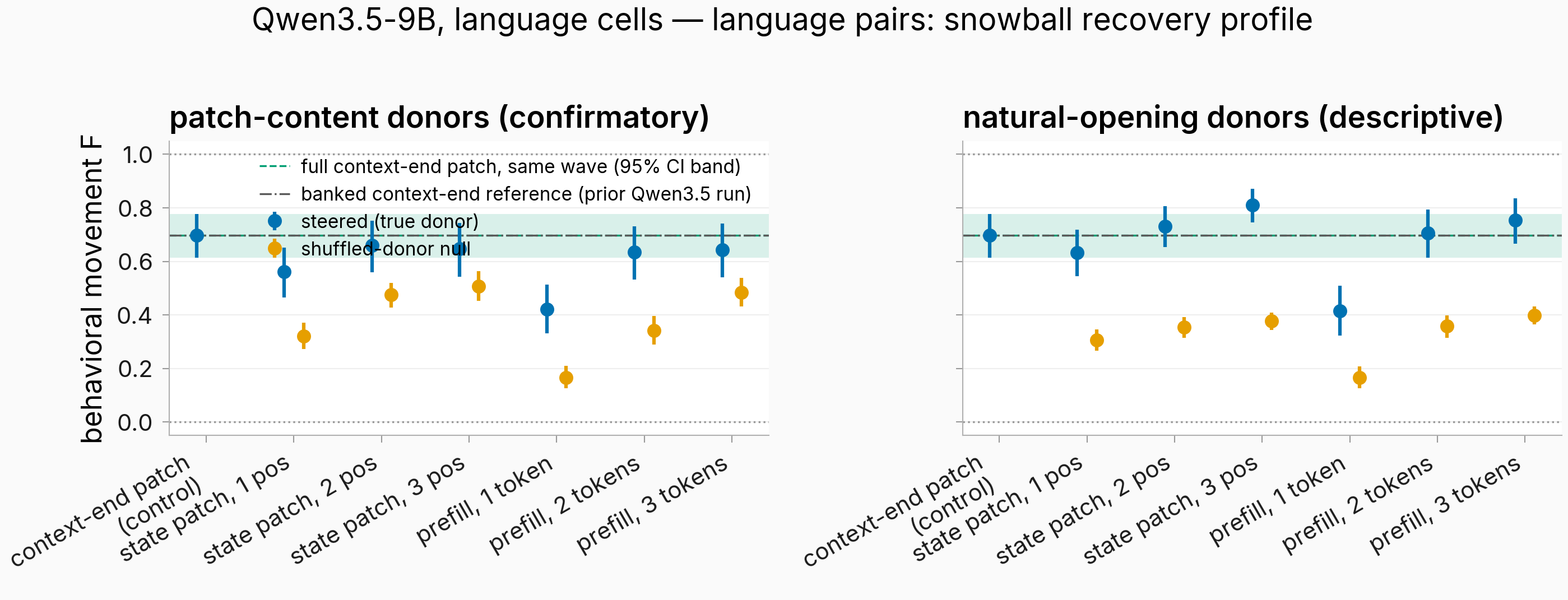
Figure. Every arm separates from its null — and the nulls themselves sit far above zero. Same-wave control: steered F 0.70, null 0.31, net paired diff +0.39 (CI 0.29 to 0.48, corrected p 1e-7). Confirmatory three-token patch-content prefill: steered 0.64, null 0.48; paired diff +0.16 (CI +0.05 to +0.26, corrected p 0.007); net recovery ratio 0.40 (CI 0.14 to 0.63); majority-share interval −0.13 to +0.05.
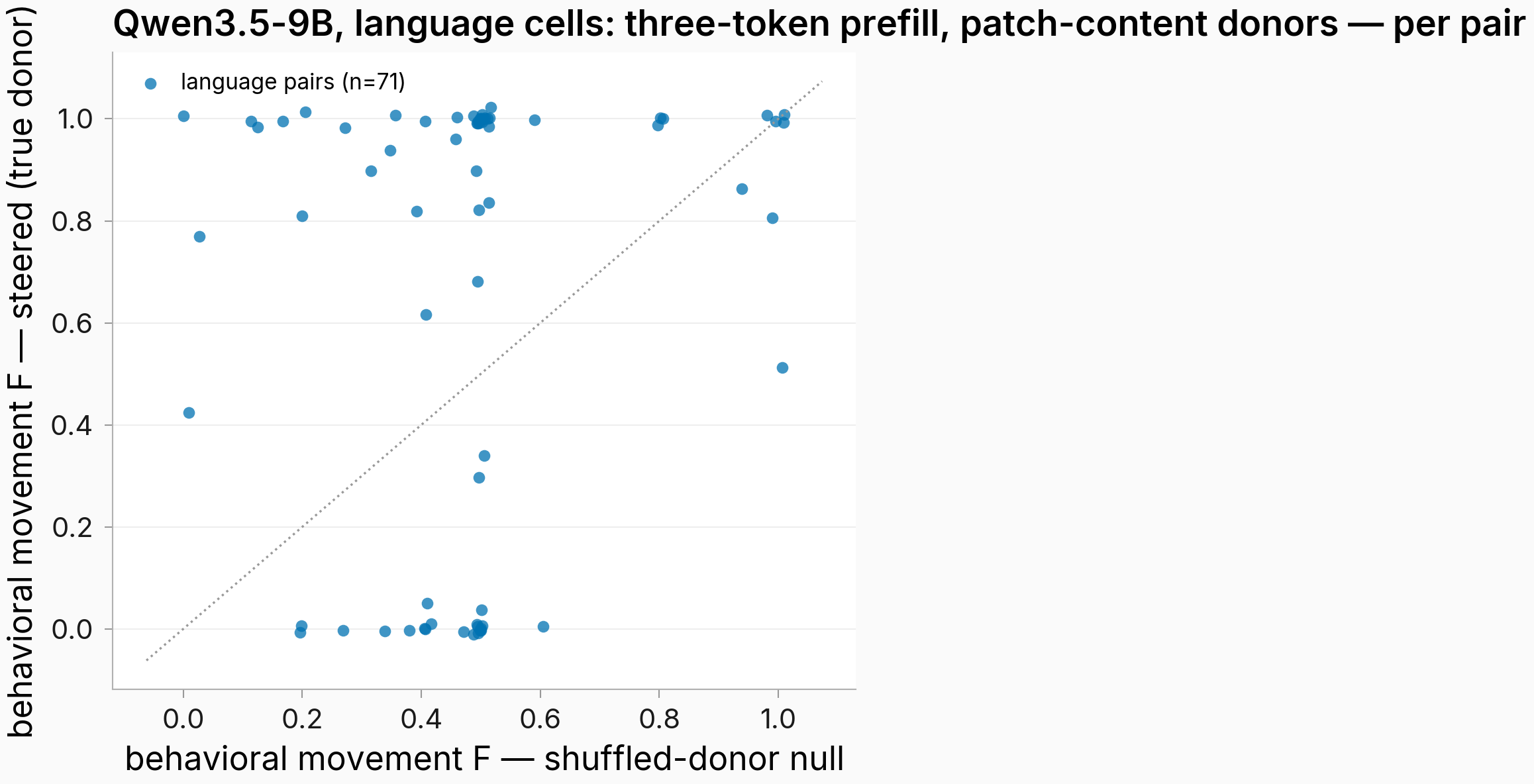
Figure. Per-pair companion. One point per pair (n=71): steered F against null F. Movement is bimodal — most pairs near full movement, a cluster near zero — and null F itself spreads up to 1.0.
forest_cells_q35lang.png(same pin) — not embedded: the same contrasts as per-cell forests over all 12 arms.
All 12 arms separate under the plan's conjunction (largest corrected p 0.017), so a wrong-pair opening does not explain the movement. The verdict is not sufficiency: a wrong-language opening alone moves F to 0.48, so the verdict reads subtract the null — the confirmatory arm recovers 0.40 of the net patch effect, its ratio CI sits wholly below 1 (a reliable residual), and its majority-share interval straddles zero: indeterminate. The banked denominator agrees (0.39); no read is carrier-cluster-sensitive.
Per cell (descriptive, raw p): the explicit-instruction cell separates (p 0.021); the implied-cue cell alone does not (p 0.087, n=35).
Natural-opening transplants reach full null-adjusted recovery on language cells; raw ratios overstate every arm
Raw recovery ratio — steered arm F over same-wave control F, the descriptive companion — versus opening positions on the language cells, prefills versus state patches, per donor scheme.
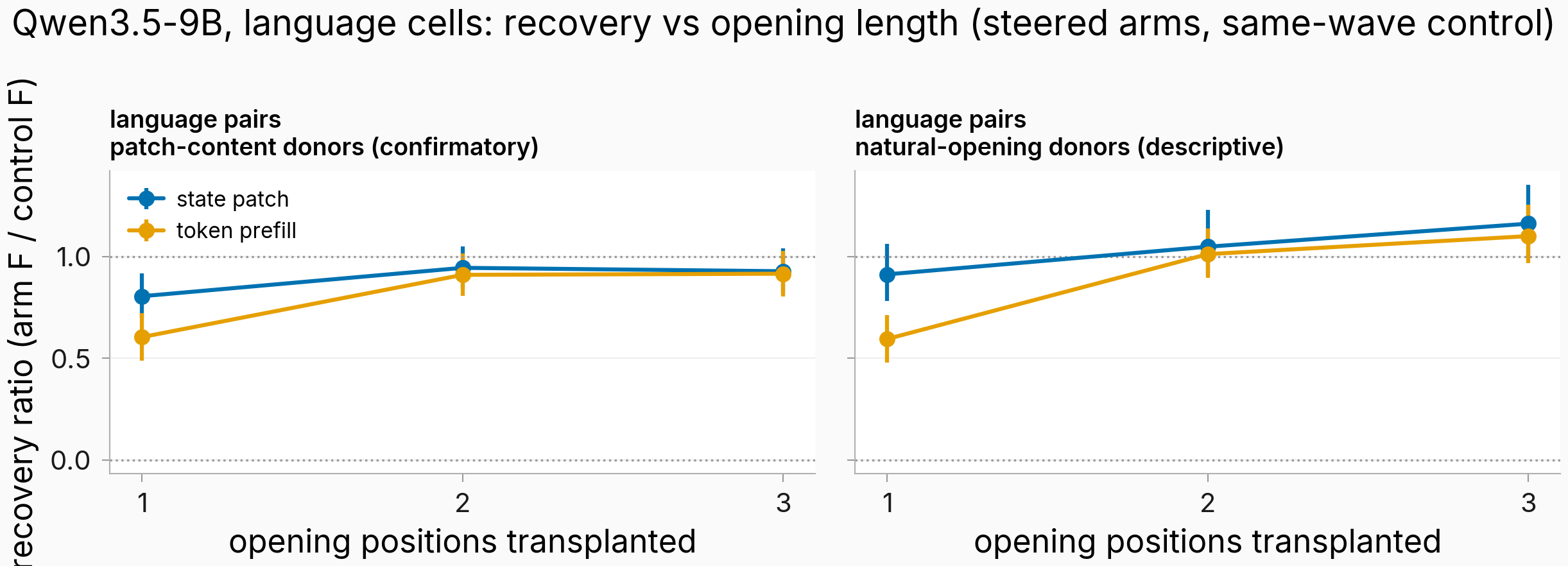
Figure. Raw ratios approach or pass 1 by two to three positions in both schemes — but the raw form credits the null's own movement. Net ratios instead: patch-content patches 0.61 / 0.47 / 0.36 and prefills 0.66 / 0.76 / 0.40; natural-opening patches 0.85 / 0.97 / 1.12 (three-position ratio CI 0.83 to 1.57, majority-share CI +0.15 to +0.33) and prefills 0.64 / 0.90 / 0.95.
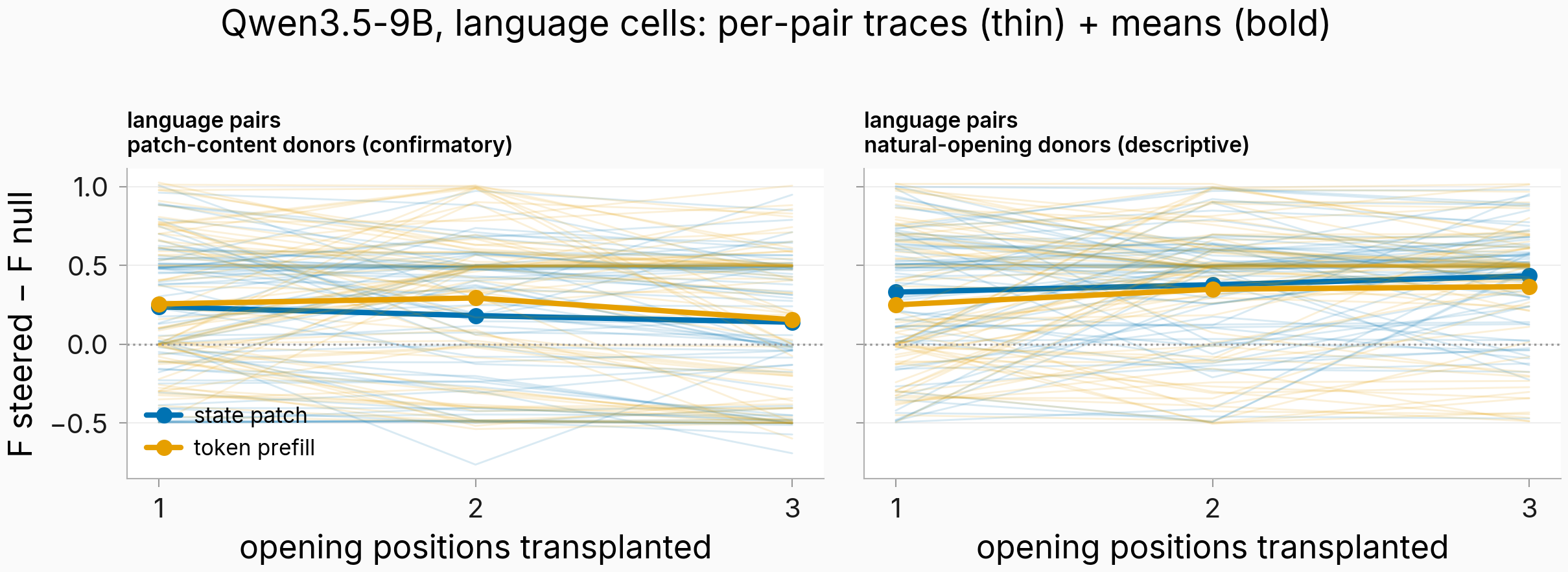
Figure. Per-pair companion. One thin line per pair — steered minus null F at one to three positions — bold arm means, split by donor scheme.
arm_vs_ce_q35lang.pngandscheme_contrast_q35lang.png(same pin) — not embedded: alternate per-pair views of the same arms.
Net recovery falls with opening length for patch-content arms because their nulls keep climbing (0.17 to 0.48 for prefills) while the steered arms saturate — the two-token prefill's majority-share interval clears zero, the three-token one does not. Natural-opening arms rise instead, and the three-position state patch clears the majority share outright — natural-opening-sufficient, pure-snowball-compatible. Donor collapse does not explain the mediated deficit: 93–94% of mediated openings differ from the base context's own greedy opening at every length (72 of 72 pairs covered).
The activation companion separates on all 12 arms here (confirmatory corrected p 0.011; per-pair rank correlation with the behavior score 0.92) — unlike on the format cells.
Language-round instrument checks: zero judge drift, one audited coherence-gate override, and label-inert Chinese-character intrusion
Distribution of per-pair-side anchor deltas — this round's re-judge of the reused anchor completions minus the prior Qwen3.5 run's stored values — over the 144 identical texts.
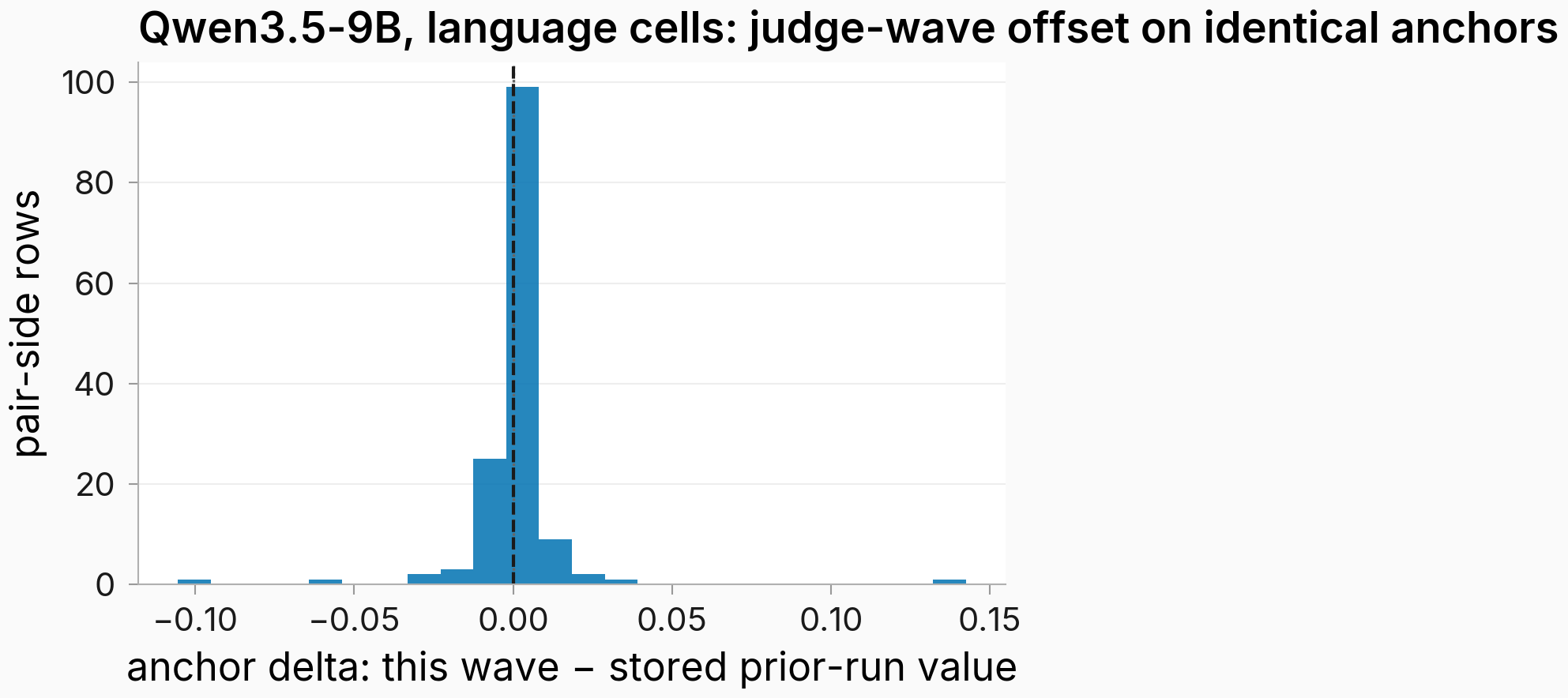
Figure. The re-judge reproduces the stored anchor values. Mean offset +0.0001 (sd 0.017, n=144 pair-sides, none missing) — no measurable instrument drift, so the same-wave and banked denominators are comparable.
coherence_q35lang.pngandhero_snowball_act_q35lang_s1.png(same pin) — not embedded: the coherence-score and activation-DV views.
| Language-round instrument read | Value |
|---|---|
| Coherence baseline gate (floor: median ≥ 80 and fraction above 60 ≥ 0.90) | median 92.0 passed; fraction 0.886 missed by 0.014 — the prior run's stored fraction on the identical pool is 0.892 |
| Chinese-character intrusion — grid / control / anchor pools | 2,862 of 8,640 / 239 of 720 / 259 of 720 rows |
| Intrusion severity, per intruded grid row | 1,049 rows with 1–2 characters; 1,762 with 3–20; 51 with more than 20 |
| Confirmatory-arm intrusion, steered / null (360 rows each) | 141 / 105 |
| Lattice under intrusion-excluded and zeroed recounts | all labels unchanged (12 separations + every verdict field); confirmatory net ratio 0.50 excluded / 0.45 zeroed vs 0.40 shipped |
| Recount validation | the intrusion-free rebuild reproduced all 1,872 committed cells exactly |
| Judge content-class drops (residual transport 0) | coherence 7 of 9,360; behavior waves 17, 17, and 30 of 9,120; anchors 0 of 720 × 4 waves |
| Rows still cap-flagged after the 8,192 regeneration tier | 230 of 9,360 (2.5%) |
| Coherence-passing rate, grid + control pools | 8,363 of 9,360 (89.3%) |
| Whole-response vs continuation-only steered F divergence, 6 prefill arms | at most 0.008 — below the 0.05 bar; continuation verdicts identical |
One gate did not pass clean: the anchors-rejudge coherence baseline missed its fraction floor by 0.014, and the run proceeded on an audited override — the prior run's own stored coherence on the identical anchor pool is 0.892, so the miss is a property of the pool (repetition-loop degeneration concentrated in a few carriers), not this round's instrument, and the threshold was inherited from a pooled all-cell gate; the failed verdict stays on record in the gate file. A third of language-cell draws carry stray Chinese characters — never a target language, and mostly one to twenty characters per response — far above the parent legs' rates; re-running the full verdict lattice with those draws excluded or zeroed flips nothing. The judged-span convention is inert on these cells, unlike on the format cells.
Robustness: intrusion recounts leave every label standing; the activation companion is weaker
Whole-response F versus continuation-only F for every steered prefill pair-cell (draws averaged) on Qwen2.5, colored by opening length — the donor-token contamination check.
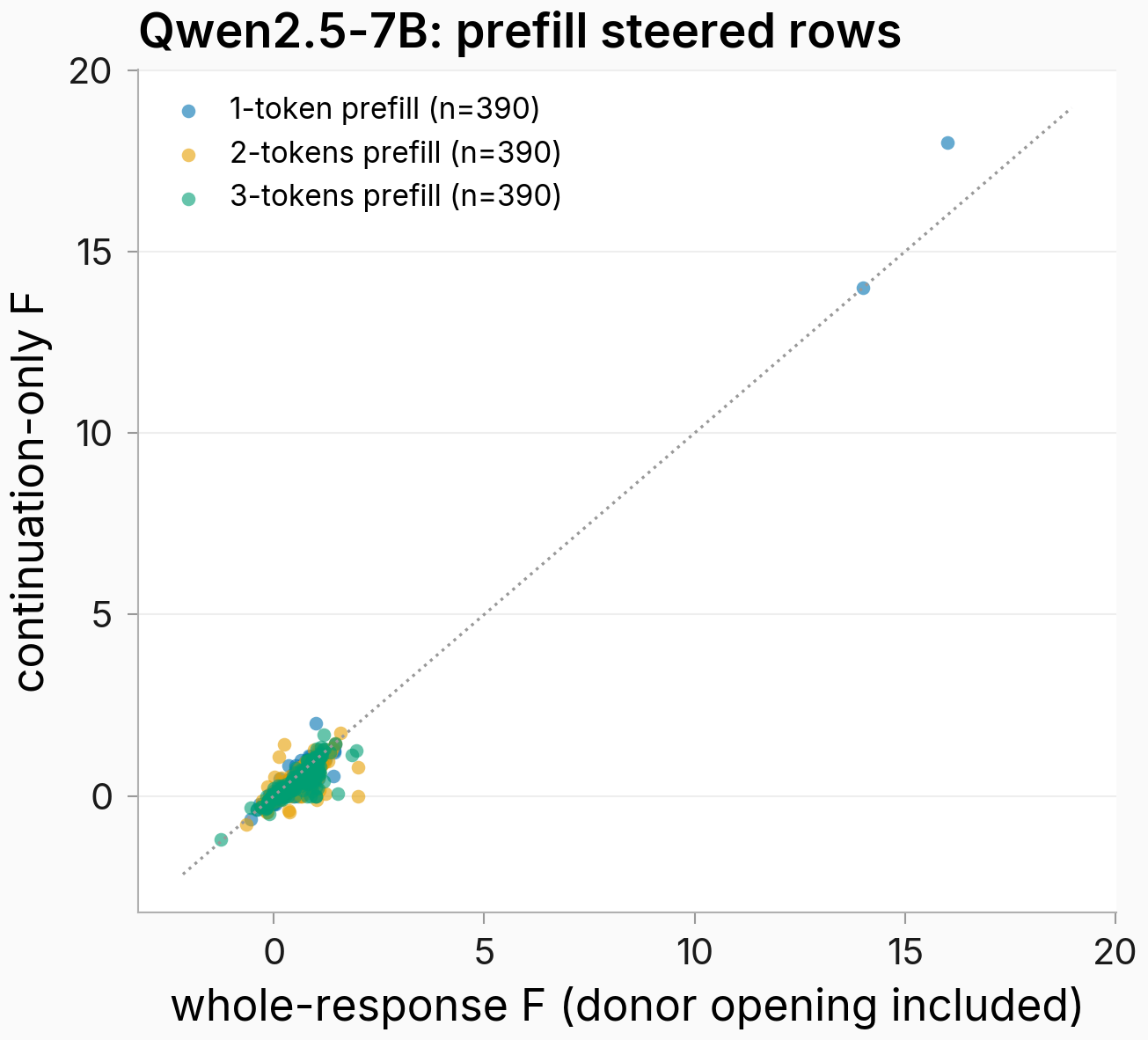
Figure. The effect survives with the donor tokens excluded from judging. Mass hugs the diagonal; two extreme points are anchor-normalization blowups on near-degenerate pairs. Instruction-format arm-level divergence +0.04 to +0.09, above the 0.05 reporting bar at two or more tokens.
| Robustness read | Qwen2.5 | Qwen3.5 |
|---|---|---|
| Chinese-character intrusion, grid rows (all pools judged) | 2,482 of 23,400 (10.6%; 2,015 passed coherence) | 1,579 of 23,400 (6.7%; 1,523 passed coherence) |
| Intrusion on the confirmatory arm, steered / null (975 rows each) | 103 / 106 | 66 / 65 |
| Largest arm imbalance, steered / null (arms carrying no verdict) | 113 / 73 (three-position natural-opening patch) | 79 / 44 (three-position mediated patch) |
| Intrusion in donor openings / instructing contexts | 0 of 2,340 / none | 0 of 2,340 / none |
| Lattice labels under intrusion-excluded and zeroed recounts | all unchanged | all unchanged |
| Continuation-only / whole F, three-token prefill — all 180 pairs | 0.43 / 0.50 | 0.34 / 0.41 |
| Continuation-only / whole F — anchor survivors (headline basis) | 0.43 / 0.50 (n=172) | 0.31 / 0.36 (n=156) |
| Coherence rate, pooled (lowest arm) | 97.5% (96.4%) | 98.2% (97.5%) |
| Rows still at the 4096 cap after regeneration | 0 of 23,400 | 152 of 25,350 (0.60%; 491 rows regenerated) |
| Activation-DV arm-level rank agreement with F_beh (Spearman ρ) | 0.85 | 0.86 |
Continuation-only scores track whole-response ones; Qwen3.5's 0.41 is an all-pairs mean, the 0.36 headline the 156 anchor survivors (table). Intrusion is balanced on the confirmatory arms and roughly in aggregate, not per-arm; the two largest imbalances sit on arms carrying no verdict, and the recounts confirm no label is intrusion-sensitive (cjk_recount.json, both rounds).
The activation companion is weaker on the format cells: Qwen2.5's separates but recovers only 32% of the control's activation movement (majority-share CI wholly below zero — snowball-partial on that secondary DV); Qwen3.5's confirmatory format-cell read does not separate (corrected p 0.85 — indeterminate). Forced opening tokens reproduce most of the behavior there without most of the activation shift; the language cells are the exception, and the behavioral verdicts stand on their own DV.
Eighteen open code-review hardening concerns remain; none touches a realized measurement — all 18 of 18 open rows below, not a cherry-picked sample.
Open non-blocking engineering concerns (18)
capregen-jsonl-before-va-commit-window, f-act-anchor-store-partial-thinning, judge-shard-content-reconciliation, donor-chunk-resume-content-assert, bank-donor-single-worker-launch-record, banked-parent-schema-discriminator-partial, s2-survivor-derangement-cardinality, survivor-ce-payload-test-hollow — resume/gate hardening rows raised during the parent's code review; each corresponding gate passed on the realized runs, so none bears on the reported numbers. banked-flip-aggregate-omission — rescore-script hardening row from the free-analysis round; the per-scheme flip fields persist the full flip record, so it changes no committed value. q35lang-real-smoke-missing, q35lang-dp-launcher-missing, cached-anchor-coverage-incomplete, carrier-control-health-pair-only, judge-pilot-phase-not-idempotent, donor-contract-post-init, q35lang-token-identity-not-exact, judge-offset-wrong-grain, q35lang-figure-default-root — rows raised in the language round's code review (the reconciled round verdict passed); on the realized run the production-path smoke ran on-pod before the grid, the 8-worker claim-queue launch completed 48 of 48 blocks, anchor reuse loaded exactly 720 rows over 72 contexts behind the token-identity gate, control health passes on both the pair and carrier grains, the judge pilot ran once, figures landed under the round's own namespace, and the offset table compares per-pair-side deltas over identical texts — so none bears on a reported number.
Repro: pod-2333-q25 (8× H100, ~3.2 h) + pod-2333-q35 (8× H100, ~5.1 h final round; two earlier aborted rounds) + pod-2333-q35lang (8× H100, ~10.6 h; ~85 GPU-h realized vs 36 booked — two crash-fix relaunches, ~1.5×-longer multilingual completions, and the cap-regeneration tier) + VM-side Batch-API judging (~50 shards/leg + 8 waves for the language round, 0 errored rows) and CPU analysis · Run code @ 7bb354b557 (leg A) / cc47b8a085 (leg B) / 339ddbe75c (language round, --cell-set q35lang): scripts/issue2333_{run,judge,analysis,figures}.py, src/explore_persona_space/experiments/issue2333/ · Results tables + gates: eval_results/issue_2333 (f_metrics/{q25,q35}/stats.json carries every parent CI quoted here; cjk_recount.json the parent intrusion recounts; inputs/ the matched-query control re-derivation) · Language-round tables + gates: eval_results/issue_2333/q35_language_snowball (f_metrics/stats.json every language-cell CI; f_metrics/f_cells.jsonl / f_metrics/null_cells.jsonl / f_metrics/ce_cells.jsonl the per-pair steered, null, and control F tables behind those statistics; f_metrics/cjk_recount.json the intrusion recount; f_metrics/mediation_divergence.json; f_metrics/judge_offset_2329.json + per-row table; judge/gates/coherence_baseline_gate.json carries the failed verdict + the audited override reason — override commits 1d21458ea3 + 81d5f921b0, Decision note 2026-08-19T19:54Z in events) · Language-round robustness scripts @ 77d94e6b2b: scripts/issue2333_cjk_recount_q35lang.py, scripts/issue2333_mediation_divergence_q35lang.py · Mediation-donor divergence check (parent legs): scripts/issue2333_mediation_divergence.py → eval_results/issue_2333/f_metrics/mediation_divergence.json (same pin) · Figures: figures/issue_2333 (parent; regenerated 2026-08-18 with reader-facing labels + the verdict-annotated forest; supersede the 63c68a4989 renders — same underlying data) and figures/issue_2333/q35_language_snowball (language round; the embedded hero and judge-offset panels were regenerated 2026-08-19 with reader-facing labels @ c4578b2394 — same underlying data, superseding that tree's renders of those two files) · Rollout text, donor tensors, V_a stores, manifests, judge raws: issue2333_snowball (HF revision ab9e72d55e; {q25,q35}/{rollouts,va_store,donors,gates,manifests,raw_completions/judge_raw}, q35/anchors, smoke prefixes) and the language round under issue2333_snowball/q35_language_snowball (HF revision f9c2d342e0) · Reused bank from #2162: frozen vc_bank/bank.json @ HF revision dc8108ab84 — fit: same contexts, rubrics, and donor derangement; fresh-capture parity gate passed (early-layer cos ≥ 0.999, all-layer ≥ 0.995) · Reused banked control + anchors from #2162 (eval_results/issue_2162/f_metrics/) and fu1 raw completions + judge scores from #2094 @ HF revision c5d7de56d1 — fit: identical family and instrument; re-derivation reproduced family means with error below 0.001 · #2329 artifacts not reused by the parent legs (fitness gate routed to self-generation); the language round reused its anchor completions + V_a shards @ HF pin ce138be249 and vendored its language-cell companion rows @ branch commit b52657ee0e — fit: token-identity + capture-parity gates passed on the 72 language contexts, and the re-judge reproduced its stored anchor values (offset +0.0001) · Language-intrusion recount script (parent legs) @ dac1c1239a · Follow-up free-analysis round (2026-08-18): scripts/issue2333_followup_cells_continuation.py → per-cell + continuation-rescore tables under eval_results/issue_2333/f_metrics (q25/followup_free/, q35/followup_free/, followup_free_summary.json) · Rescore figure continuation_d3_recount via scripts/issue2333_figures.py --continuation-d3-only @ 9f1bb6fab6.
Context: Originating prompt (verbatim, frontmatter origin_prompt):
Can you also run this on both models: patching at context vector at all layers vs patching at first 1/2/3 answer tokens at all layers (excluding context vector) vs prefilling first 1/2/3 tokens, on the most successful causal patching experiments; donor schemes: BOTH mediation form and B's-answer-start form
Follow-up round q35_language_snowball (2026-08-19, source: user-chat), verbatim ask:
run prefill and first token on qwen3.5-9b
— scoped in the follow-up marker to the 12-arm snowball grid on the Qwen3.5 language cells, where the context-end patch works but the snowball decomposition had never run.
Lineage: #2162 — instruction-format survivor cells, F machinery, judge recipe · #2094 — pirate matched-query pairs, hooks, all-layer replace · #2329 — Qwen3.5 template integration + language cells · #1415 — steering rig lineage. Created 2026-08-16; pods ran 2026-08-17; judging + analysis landed 2026-08-18; the free-analysis follow-up round (per-cell breakdown + continuation-only rescore, proposer-initiated, zero GPU) landed 2026-08-18; the language-cell round (user-directed) ran and landed 2026-08-19.