Context-end is the only single position where activation edits move behavior clear of the shuffled-donor null, and even its strongest patch falls well short of a full context swap (MODERATE confidence)
Highlight text on any card (body, plan, or an event) to anchor a comment, or leave a whole-task comment here. Mention @claude to summon a reply.
No comments yet.
Methodology: docs/methodology/issue_2094.md · gist mirror
Takeaways
- A grid-wide bootstrap screen on well-separated pairs finds 36 of 1,245 behavior cell families with the steered mean above the shuffled-donor null on fully disjoint 95% intervals; 21 sit in cap-hit-compromised cells — 15 in the multi-token controls, 6 at context-end joint-layer cells — and are untestable, and all 15 clean survivors are context-end edits — 14 matched-query (prefix transfer) and 1 cross — reading 0.18-0.63 of a full swap against nulls of -0.24 to 0.07.
- The largest clean effect is the full-state patch at all 28 layers of the context-end position: 0.63 of a full swap on the greedy grid and 0.51 under re-sampling (null 0.10); clean single-layer edits at layers 12-20 read 0.18-0.33. Independent re-sampling at temperature 1.0 (5 draws per pair) confirms 10 of 15 survivors on fully disjoint 95% intervals (steered 0.17-0.51, nulls -0.05 to 0.10); the other 5 stay steered-above with overlapping intervals. The screen is post hoc across 2,172 comparisons, the confirmation is post-selection, and the stage-1 winner cells stay null-overlapping (0.20-0.22; p = 0.15-0.16).
- Raw cell means of 0.85-2.39 (stage-1 winners; stage-2 confirmations 1.17-1.86) come from weakly-separated anchor pairs and collapse below 0.13 once pairs under 0.5 separation are excluded — a stratification chosen after seeing the results; at a 0.03-only exclusion the matched-query winner still reads 0.40. A final round traced the weak pairs to the conversation prefix (register absent from its own answers), re-formed them with a persistence-instructed replacement recovering 4 of 5, and all 17 comparable parent-clean reads reproduce their direction on the recovered pairs — a 4-pair robustness read; headline set unchanged.
- Prefix-end, second-to-last, and third-to-last slots yield zero null-separated behavior families anywhere on the grid, and the activation read agrees: nine clean disjoint activation families, all at context-end. A follow-up round shows chat-template tokens were what made the query span untestable — editing only the query's text tokens yields 14 of 70 clean family reads — the 8 query-rubric behavior reads separate at 0.68-0.95 of a full swap against elevated nulls of 0.22-0.56, all 14 at half dose or the mid-stack joint band — where the template-inclusive query span has zero and context-end has four.
- The edit-to-response map is far from linear: shift magnitude is flat in dose (mean log-log slope 0.00-0.06 by slot-layer family vs 1.0 for a linear map), a one-operator fit reaches held-out R-squared 0.084 at best, and banked-map transport cosines top out at 0.16.
- Single-position edits kept fluency (0.7% incoherent vs 2.0% unpatched); whole-span patches ran 93-97% incoherent. Removing the forced opening restored all-layer format transfer from 0/6 to 6/6, while layer 19 rose only to 1/6; task and subject transfer stayed 0/18 in both settings. The maximal all-layer edit is therefore an interpretable negative, while the layer-19 null is weak and does not show information absence. All 129 unforced answers reached EOS and all 30 self patches matched anchors exactly. No-forced-opening report
Goal
Test whether interventions at single context positions — the context-end and prefix-end summary states, with multi-token controls — causally move the answer representation and the generated behavior toward a target context, measured as a unified fraction-of-swap F at both levels across matched-query, matched-prefix, and cross pairs, with banked-map transport, linearity, and fragility reads alongside.
This experiment in context: the single-position steering conventions, the disjoint-baseline-halves activation read, and the injection-exactness gate come from #1415; the frozen context-end ridge maps are #779's, the prefix-end maps #1738's, and the layer-14-to-19 Jacobian #1776's — transport only, no refitting.
Broader narrative: the mapping line shows the context-end state predicts the answer representation well when read passively; this experiment asks the causal converse by editing that state in place. Behavior follows only at context-end and only partially — even the maximal all-layer patch falls well short of a full swap — the response is far from linear in the edit, and the maps do not transport: passive predictability does not imply full single-position causal control.
Methodology
Design: 15 contexts = 3 prefixes x 5 queries, verbatim in src/explore_persona_space/experiments/issue2094/bank.py — a plain default assistant, a strong pirate persona ("Captain Marrow"), and a constructed prior exchange (enthusiastic birthday-party planning) — giving 60 pairs: 30 matched-prefix (query transfer), 15 matched-query (prefix transfer), 15 stratified cross. Interventions install the pair difference (dose 0.5/1/2/4x) or the full target state (replace) at one position: context-end and prefix-end at all 28 single layers plus joint mid-stack (layers 14-20) and joint all-layer variants; second-to-last, third-to-last, last-three-joint, and query-span controls at joint mid-stack only. A prefix-centroid variant (query-averaged) runs at context-end on matched-query pairs. Every plotted cell has a norm-matched shuffled-donor null (seeded derangement, donor from a different pair). Floors and ceilings come from 10 unpatched temperature-1.0 draws per context; the grid is one greedy draw per cell (21,000 steered + 21,000 null); the 6 stage-1-best cells were re-measured at temperature 1.0 with 5 draws per pair, labeled post-selection. Matched-prefix pairs at prefix-end are degenerate by design (identical prefix states; 4,500 steered + 4,500 null rows flagged degenerate_self and excluded from aggregates). A follow-up analysis round on the existing rollouts (no new generation) added the grid-wide well-separated bootstrap recount, the banked-layer dose figure, and a corrected stage-1-vs-stage-2 join. A second, GPU-backed follow-up round (fu1_regen_confirm) executed the plan's cap-hit re-generation trigger — the 16 breached pooled cells re-generated in both arms with the run block otherwise verbatim and max_new_tokens raised from 1024 to 2048 (2,100 of the grid's 42,000 rollouts) — and independently re-measured the 15 surviving screen families at temperature 1.0 with 5 draws per pair, steered and shuffled-donor-null arms under the parent's seeded derangement; all follow-up generations are on-policy (greedy re-generation, temperature-1.0 confirmation draws). A third, user-requested follow-up round (fu2_span_slots) extended the intervention grid with three span slots on the same instrument — the final user turn's query text tokens with chat-template tokens excluded, the whole prefix span including template tokens, and the prefix content tokens only — at joint all-layer and joint mid-stack variants, the full dose ladder plus full-state patch, pair-difference edits with a norm-matched shuffled-donor null per cell: 30 families / 60 blocks / 2,400 greedy cells at max_new_tokens 2048 from the start, on a fresh pod whose state bank passed a capture-parity gate against the parent bank (early-layer minimum cosine 0.9999999, flattened all-layer read 1.0). Template tokens are identified structurally from the tokenized chat-template ids with boundary asserts, never by matching decoded text; prefix-span slots exclude matched-prefix pairs by design (identical prefixes make the pair delta zero). Edits right-align to the pair's minimum overlap within each span's own coordinate set (content tokens for the two text-only spans); the template-inclusive prefix span right-aligns within the full span, so across prefixes of unequal length the aligned offsets can pair template with content positions — a scope caveat the content-only span does not carry. Cap-hit is reporting-only in this round: compromised family reads are computed and labeled, never dropped or re-generated. A fourth, GPU-backed follow-up round (gpu2_mq_replacement_prefix, the final proposer cheap round) targeted the five matched-query pairs whose anchors never separated — all five pair the bare prefix with the constructed conversation prefix, whose unpatched completions carry none of its register. The round authored a replacement conversation prefix (conv2) by the parent's construction method — the same prior birthday-party exchange, now ending with the user asking that the excited party energy be kept up in every later answer; an instructed-persistence register, more instruction-like than the parent's implicit one, carried as a construction caveat — gated it on anchor separation before any grid spend (production judge instrument; pass required at least 4 of the 5 re-formed pairs at absolute separation 0.5 or more), then re-ran the parent's matched-query context-end arm on the 5 re-formed pairs: 30 layer variants by 5 doses (the four dose multiples plus the full-state patch), pair-difference edits, steered and shuffled-donor-null arms — 150 cell families, 1,500 greedy cells at max_new_tokens 2048, on a fresh pod whose state bank passed the capture-parity gate (early-layer minimum cosine 0.9999999, flattened all-layer read 1.0). Verdicts run under two labeled conventions: the parent's headline bar (at least 5 well-separated pairs), unreachable with 4 recovered pairs by construction, and the same logic at an explicit 3-pair floor reported as a small-n companion only. Data realism: constructed tier-3 bank, a recorded design decision (strong-contrast prefixes chosen so ceilings separate) carried as a scope caveat.
Training: N/A — no model training.
| Generation / eval parameter | Value | Source |
|---|---|---|
| Model | Qwen/Qwen2.5-7B-Instruct | run digest (epm:results reproducibility card) |
max_new_tokens | 1024 | run digest |
| Grid decoding | greedy (temperature 0.0), 1 draw | run digest |
| Anchor / stage-2 decoding | temperature 1.0, 10 / 5 draws, seed 42 | run digest |
| Layers captured | all 28; activation read layer 26 (span-mean answer vector) | plan §4.4 / f_cells.jsonl read_layer |
| Judge | claude-sonnet-4-5-20250929, graded 0-100, 1 draw per rubric, max_tokens 1024, Batch API | judge_summary.json instrument |
| Coherence gate | form-only rubric, coherent = score > 60 | plan §4.5 / coherence_baseline_gate.json |
| One-operator ridge fit | top-128-PC subspace, 240 observations per family, grouped folds by pair (10) and by context family (15) | l_fit_results.json |
| Bootstrap | pair-clustered, B = 10,000, seed 20941; same settings for the well-separated recount | bootstrap_cis.json, bootstrap_cis_wellsep.json |
| Bank / donor-derangement seed | 2094 | run digest |
Follow-up re-generation (round fu1_regen_confirm) | 16 breached cells, both arms, greedy, max_new_tokens 2048, run block otherwise verbatim | f_metrics/fu1/fu1_regen_swap.json |
Follow-up confirmation (round fu1_regen_confirm) | 15 survivor cells, temperature 1.0, 5 draws per pair (per-draw seeds), steered + shuffled-donor null | f_metrics/fu1/fu1_conf1_confirmation.json |
| Follow-up judge | production instrument unchanged, 18 Batch-API waves, 14,310 items, isolated work root | judge_fu1/judge_summary.json |
Follow-up grid (round fu2_span_slots) | 3 span slots x 2 joint layer variants x dose ladder + full-state patch, 30 families / 2,400 cells, greedy, max_new_tokens 2048 | scripts/issue2094_fu2.py + f_metrics/fu2/fu2_summary.json |
Follow-up verdict gate (round fu2_span_slots) | disjoint 95% pair-clustered bootstrap intervals (B = 10,000, seed 20941), at least 5 well-separated pairs, pooled steered cap-hit at most 2% | fu2_summary.json verdict_definition |
Follow-up judge (round fu2_span_slots) | production instrument unchanged, 9 Batch-API waves, 9,000 items, isolated work root | judge_fu2/judge_summary.json |
Follow-up gate (round gpu2_mq_replacement_prefix) | replacement-prefix anchors: 10 temperature-1.0 draws per context, production judge; pass = at least 4 of 5 re-formed pairs at absolute anchor separation 0.5 or more (realized 4 of 5) | f_metrics/gpu2/gpu2_anchor_stats.json |
Follow-up grid (round gpu2_mq_replacement_prefix) | context-end slot x 30 layer variants x 5 doses x pair-difference edits x steered/donor-null on the 5 re-formed pairs = 1,500 cells, greedy, max_new_tokens 2048 | f_metrics/gpu2/gpu2_summary.json |
Follow-up judge (round gpu2_mq_replacement_prefix) | production instrument unchanged, 3 Batch-API waves, 1,500 items each, isolated work root | judge_gpu2/judge_summary.json |
Evaluation: behavior F per draw = (judge contrast of the rollout minus the floor mean) / (ceiling mean minus floor mean); judge contrast = (score against descriptor B minus score against descriptor A)/100; matched-prefix pairs use query rubrics, matched-query pairs prefix rubrics, cross pairs both. Activation F = signed projection of the patched-minus-floor answer-state shift onto the ceiling-minus-floor axis, floor split into disjoint halves. All reported quantities use coherent draws only. "Well-separated" below means absolute anchor separation of at least 0.5 (judge-contrast units; maximum 2). Anchor separations on the prefix rubric: 5 of 15 matched-query and 3 of 15 cross pairs fall below 0.5, of which 3 and 2 sit at 0.03 or less, and one retained cross pair is inverted at -0.96 (its ceiling judged below its floor); all matched-prefix and cross query-rubric separations are at least 0.5. The plan specified per-pair separation reporting with no exclusion rule; the well-separated stratification in Results was chosen after seeing the data, not written into the plan. The grid-wide screen recounts the pair-clustered bootstrap under that restriction with the parent run's own batched implementation, exclusions, and gating: per cell family (setting x slot x layer variant x dose x edit-direction type x metric), steered and null means with 95% intervals over well-separated pairs — 2,172 steered-vs-null comparisons at five or more pairs (927 activation, 757 prefix-rubric, 488 query-rubric behavior). "Separates" in Results means fully disjoint 95% intervals with steered above (4 further behavior families are disjoint with steered below, all four at prefix-end); the weaker read — null mean outside the steered interval — fires on 223 prefix-rubric, 38 query-rubric, and 117 activation families in either direction and carries no claims. The screen is post hoc, with no multiplicity adjustment across families. 148,650 judge calls in 27 Batch-API waves: 25 content drops, 0 residual transport losses, 0 truncation drops; the judge pilot gate, the anchor coherence gate (median 100, 98% of draws above 60), and the injection-exactness gate (12 of 12 spot cells) all passed before production. Paired steered-vs-null p-values in Results are exact signed-rank tests over pairs; steered-vs-null interval comparisons use the pair-clustered bootstrap. Cell-level agreement between the two F levels: Spearman rho = 0.43-0.50 across 929 steered cell families (p < 1e-40), so the continuous activation companion tracks the judged behavioral read. Mechanical audits (script intrusion at non-Latin letter fraction > 0.05, repetition, empty output) ran on every arm: grid 214 of 21,000 steered vs 239 of 21,000 null flagged for script intrusion (repetition: 111 vs 96; none empty); anchors 7 of 150; stage-2 31 of 600 (both intrusion-only); intrusion-excluded recounts of every stage-2 cell shift coherence-gated means by at most 0.02, and the 15 surviving screen cells carry zero intrusion flags in either arm (225 rows each). The follow-up round's judge ran the production instrument unchanged in an isolated work root: 18 of 18 Batch-API waves complete, 14,310 judged items, 15 content drops (0.10%), zero truncation drops, zero residual transport losses. Re-generated rows were reduced under the parent conventions and substituted into the well-separated bootstrap; the 4,112 families untouched by the swap reproduce the parent artifact exactly, and the swapped cells' well-separated means move by at most 0.023 (median 0.000). Confirmation verdicts use the same pair-clustered bootstrap (B = 10,000, seed 20941) on each family's own rubric over well-separated pairs; 34 of 1,520 confirmation draws were incoherent-excluded, none judge-dropped. The re-generated cells' activation tensors were persisted but not re-analyzed; the parent artifact remains the activation record at those cells. The span follow-up round reuses the same instrument end to end and classifies each of its 170 family reads (70 query-text, 50 per prefix span; a family read = setting x span x layer variant x dose x metric) with the same pair-clustered bootstrap: clean separation means fully disjoint 95% intervals with steered above on well-separated pairs, at least 5 usable pairs, and pooled steered cap-hit of at most 2%; a separating family over that cap-hit bar is labeled compromised rather than dropped; a family where either arm lacks scoreable coherent pairs is not comparable; incoherent and judge-dropped draws are counted per family, never coerced (per-family quality counts in fu2_f_reads.json). Parent comparables are recounted from the parent grid's own well-separated bootstrap artifact restricted to the follow-up-comparable subset (query span and context-end, pair-difference edits, joint layer variants), carrying the earlier round's 1024-cap breach flags. The round's judge ran the production instrument unchanged in an isolated work root: 9 of 9 Batch-API waves complete, 9,000 items, 8,980 scored, 20 content drops (0.22%), zero truncation drops, zero residual transport losses. Script-intrusion audit over all 2,400 rollouts of the round: the four cells carrying the 14 clean query-text reads have zero intruded rows in either arm (0 of 480 rows), so intrusion-zeroed and intrusion-excluded recounts leave the clean set unchanged; pooled query-text intrusion (31 of 600 steered vs 13 of 600 null rows) concentrates in the cap-hit-compromised high-dose cells, and the prefix-span slots' small coherent pools carry at most one intruded row per arm. The replacement-prefix round's judge ran the production instrument unchanged in an isolated work root: 3 of 3 Batch-API waves complete, 1,500 of 1,500 items scored per rubric, zero content drops, zero truncation drops, zero residual transport losses; the new conversation-register rubric's de-facto pilot is the round's three anchor gate waves (100 of 100 scored each, all responses ending cleanly). The analysis leg reproduced the pod-side anchor gate verdict and every per-pair separation float-exact from the persisted judge scores before any grid read. Across the round's 1,500 rollouts the three incoherent rows are exactly the three cap-hit rows (0.2% pooled); the one compromised family cell is the mid-stack joint edit at dose 2x (2 of 5 steered rows at the cap). Parent comparables restrict to the like-for-like subset — matched-query, context-end, pair-difference edits, the round's 30 layer variants and 5 doses, 150 families per metric — under matched pair-clustered bootstrap settings (B = 10,000, seed 20941), with gap rank agreement quantified by Spearman rho (0.459 behavior, 0.426 activation over 150 families each).
Data extraction: per-context state vectors captured in one right-padded forward pass per context (positions read off token ids, never re-tokenized strings); answer vectors are span-means over the model's own completion at all 28 layers, in both the parent convention and the tail-inclusive pooling used for map transport (parity of each banked map's input convention with the injected slot recorded in eval_results/issue_2094/map_parity.json before any transport number). Every F table row carries pair, slot, layer variant, dose, coherence flag, cap-hit flag, and donor pair id.
Acknowledged conciseness overages (deliberate, WARN-tier): several Takeaways bullets exceed 30 words and nine Results blocks exceed 120 words — the denominator-artifact dissection, the non-linearity battery, the breach disclosures, the grid-wide screen's reconciliation, the follow-up round's dual stress test, the span round's verdict accounting, and the replacement-prefix round's dual-convention read each need the extra clauses to stay verifiable against the artifacts; total content prose runs over the 800-word budget for the same reason.
Sample training/evaluation data + completions: all sample blocks below are cherry-picked from the best-behavior stage-2 cell (matched-query, context-end, layer 19, dose 4x, prefix-centroid; temperature 1.0), selected as the highest and lowest per-draw behavior F on well-separated pairs — not a random sample; all 600 stage-2 rows: stage-2 rollouts @ pinned revision.
Cherry-picked: the three highest per-draw F ("firing") draws (not a random sample); all rows: same file.
Three high-F draws — the source register is lost; the target register is acquired only sometimes
Plain-assistant context, hash-table query, pirate-centroid edit (F = 0.58): "yarrrr! Matey, aye, let's biket'bout hash tables, fer be! A hash table is quite the nifty tool in yer book of technologies…" — genuine pirate-register acquisition.
Pirate context, party-conversation target, story query (F = 0.94): the draw answers entirely in Chinese (a ghost story about the lighthouse) — the high F comes from losing the pirate register, not from acquiring the target's enthusiastic register.
Pirate context, party-conversation target, rent-vs-buy query (F = 0.60): "MainForme! When it comes to picking 'twixt rentin' 'n buyin' a crib…" — pirate register partly diluted, target register absent.
Cherry-picked: the three lowest per-draw F ("non-firing") draws (not a random sample); all rows: same file.
Three low-F draws — the edit leaves the source register intact
Pirate context, party-conversation target, interview query (F = -0.41): "Certainly, lad, preparin' fer yer first job interview is like settin' sails for a stormy sea…" — fully pirate.
Pirate context, party-conversation target, hash-table query (F = -0.26): "Certainly, me boy. Ye've asked 'bout hash tables, an' well, they be like a magical treasure chest on me frigate!" — fully pirate.
Plain context, pirate target, story query (F = -0.35): "me (Qwen) am a large language model and do not have personal experiences, but I can craft a beautiful narrative for you…" — plain register with a trace of pirate grammar, scored non-pirate by the judge.
Cherry-picked from the follow-up confirmation round: the three highest and three lowest per-draw F at the largest confirmed cell (matched query, context-end, all-layer full-state patch; temperature 1.0) — not a random sample; all rows: confirmation rollouts @ pinned revision.
Follow-up confirmation draws at the all-layer patch — the same acquisition-vs-loss pattern as stage 2
Plain context, pirate target, hash-table query (F = 1.00): "Arrr, listen, ye fella! Ye be talkin' 'bout hash tables, fer sho'. Now a hash table, it be a mighty tool in the programmer's arsenal…" — genuine pirate-register acquisition.
Pirate context, party-conversation target, story query (F = 0.94): "The salty wind whispered secrets as it danced around the skeletal bones of the lighthouse…" — plain narrative; the high F comes from losing the pirate register, not acquiring the target's.
Pirate context, party-conversation target, story query (F = 0.94): "The salty tang of the Atlantic was always in his nose, even when he sat hunched over the ancient wooden desk in the lantern room…" — the same loss-not-acquisition pattern.
Pirate context, party-conversation target, hash-table query (F = -0.07): "Sure lassie, let me breakup this tech talk into a more shipboard friendly manner! Ahoy, ye scrub! A hash table is like a toolbox…" — fully pirate.
Plain context, pirate target, story query (F = -0.04): "Ainley Point, with its jagged cliffs and endless stretch of grey-tinted sea, was home to just one soul: Daniel Preston, the lighthouse keeper…" — plain register, no pirate.
Plain context, pirate target, story query (F = -0.04): "Ah, the whisper of wind through the tangle of pine needles, the steady pulse of the ocean's breath below…" — plain register, no pirate.
Cherry-picked from the span follow-up round: the three highest and three lowest per-draw query-rubric F among coherent steered draws at the strongest clean query-text cell (matched prefix, all 28 layers, half dose), plus one high-F shuffled-donor null draw — not a random sample; all rows: steered rollouts @ pinned revision and null rollouts @ same revision.
Query-text edits at half dose swap the answered query while the prefix register survives
Pirate prefix, sky-color query edited toward the lighthouse-story query (F = 1.05): "Twas a stormy night, an' the waves were as high as the keeper’s own hopes for a safe passage. He stood atop the stone walls of his solitary home…" — the target query is answered in the source prefix's register.
Pirate prefix, sky-color query edited toward the rent-vs-buy query (F = 1.02): "Ah, matey, that's a tricky question, better to be a captain of the high seas than a mere tenant on dry land! Rentin' or rentin'... well, it all depends on yer situation…"
Plain prefix, sky-color query edited toward the lighthouse-story query (F = 1.01): "In the misty embrace of the Atlantic, where the cold sea air whispered secrets and the waves sang lullabies to the night, stood the solitary beacon of Hope’s Rock Lighthouse…"
Party-planning prefix, interview query edited toward the rent-vs-buy query (F = 0.50, the cell's lowest coherent draw): "For a 7th birthday party, the decision between renting or buying a home depends on several factors…" — the target query arrives fused with the prefix topic.
Party-planning prefix, sky-color query edited toward the rent-vs-buy query (F = 0.52): "When deciding between renting or buying a home for your daughter's 7th birthday party, consider the following factors…"
Pirate prefix, sky-color query edited toward the hash-table query (F = 0.68): "Ahoy, me hearty! Aye, ye should use a hash function when ye need to quickly find information in a large collection of data…"
For contrast, a shuffled-donor null draw (pirate prefix, hash-table query, donor delta pointing at the same rent-vs-buy target, F = 1.02): "Ah, matey, that's a tricky question, like choosing between a plank or a cannonball. Rentin' a home is like havin' a ship without a crew…" — with only five queries in the bank, a wrong-pair donor often installs the same target query, which is what elevates the null.
Cherry-picked from the replacement-prefix round: the three highest and the lowest per-draw prefix-rubric F among the four recovered pairs' steered draws at the strongest small-n cell (matched query, context-end, mid-stack joint band, half dose; one greedy draw per pair), plus two shuffled-donor null draws — not a random sample; quotes are each draw's opening; the gate-excluded fifth pair's steered draw reads F = 0.000; all rows: steered rollouts @ pinned revision and null rollouts @ same revision.
Steered draws acquire the replacement prefix's exclamatory register; null draws stay plain
Interview query (F = 1.22): "OMG! Getting ready for your first job interview is super exciting and a bit nerve-wracking, but don’t worry—I’m here to help you nail it!"
Hash-table query (F = 1.10): "Oh, hash tables! They’re like magical boxes that can store and retrieve data super fast! Let’s dive into how they work…"
Sky-color query (F = 0.64): "Oh, that’s a great question! The colors of the sky during the day and at sunset are all about how light interacts with the Earth’s atmosphere."
Rent-vs-buy query (F = 0.16, the weakest recovered pair): "Oh, absolutely! Let’s break down the pros and cons of renting versus buying to help you decide…" — the opener acquires the register; the body stays plain.
Shuffled-donor null, hash-table query (F = -0.01): "Certainly! A hash table is a data structure that implements an associative array abstract data type…" — plain register.
Shuffled-donor null, interview query (F = 0.03): "Absolutely, preparing for your first job interview is a big step!" — plain register.
For reference, a generate-under-target ceiling draw (pirate context, hash-table query): "Ahoy there, lippy! To explain 'bout hash tables, ye need to know first that they're like a big ol' treasure chest…" — all 150 anchor draws: anchors @ pinned revision.
Results
Behavior barely moves at the stage-1-selected cells once anchors separate
The heatmap maps mean behavior F per steered cell (rows = slots, columns = steered layer, dose facets, one panel per setting).

Figure. Nearly every single-layer cell reads F near zero. Circles mark degenerate-by-design cells, x marks cells under 50% coherent; the saturated cells at joint variants and late context-end layers are the weak-anchor artifacts dissected in the next section.
On well-separated pairs the stage-1-selected best cells read 0.22 (cross, context-end layer 14, dose 4x; null 0.04; p = 0.16, n = 12) and 0.20 (matched query, context-end layer 14, full-state patch; null -0.02; p = 0.15, n = 10) — not separated from the shuffled-donor null at these cells, though the grid-wide screen in the final sections separates neighboring context-end cells cleanly.
The cross cell's well-separated mean replicates at stage 2 (0.22 greedy, 0.21 at temperature 1.0, 5 draws per pair). Both matched-prefix selections confirm at 0.02 or less: no query transfer at the selected cells. Script intrusion is arm-balanced, shifting no coherence-gated stage-2 cell mean by more than 0.02.
The 0.85-2.39 cell means come from weakly-separated anchor pairs and collapse when those pairs are excluded
The figure recounts the four largest stage-1 cells: all-pairs means beside well-separated-only means, steered and null, with per-pair points.

Figure. The 0.85-2.39 cell means collapse to 0.22 or less on well-separated pairs. Aggregate + per-pair companion pair: left, means with pair-clustered bootstrap error bars (B = 10,000; n = 10-15 pairs per bar); right, per-pair F — steered and null interleave.
Weak anchor denominators inflate cell means 30-200 fold at separations of 0.03 or less; every weakly-separated pair sits in the matched-query and cross prefix rubrics (counts in Methodology). Raw winner means reach 0.85-2.39 (nulls to 5.5).
The stratification was chosen after seeing the results — the plan called for per-pair reporting with no exclusion — and it is threshold-dependent: dropping only pairs at 0.03 or less leaves the matched-query winner at 0.40; the collapse to 0.006 needs the 0.5 bar (the cross winner collapses under either, 0.07). On well-separated pairs both stage-1 winners read below their own nulls (0.006 vs 0.051; 0.077 vs 0.176), and stage-2 confirmations collapse the same way — 1.86 to 0.12, 1.17 to 0.09.
One retained cross pair carries an inverted anchor (-0.96, ceiling judged below floor); excluding it moves the best cross cell from 0.22 to 0.24.
Activation-level movement is small at context-end and non-specific at prefix-end
The heatmap shows mean activation F per cell — the signed projection of the answer-state shift onto the ceiling-minus-floor axis at read layer 26 — in the same layout as the behavior heatmap.

Figure. Matched-query edits move the answer state at both end slots; only the context-end movement is pair-specific. Mean activation F per cell (disjoint floor halves; n = 15-30 pairs); matched-prefix and cross panels sit near zero; the saturated query-span cells are the fragility cells of the next section.
Matched-query context-end edits move the answer state by a small, real amount: 0.16 steered vs 0.09 null at the banked layer 14, dose 1x, with overlapping bootstrap intervals (0.09 to 0.23 vs 0.02 to 0.17); the largest single-layer excess anywhere on the all-pairs grid is 0.14 (layer 14, dose 2x, prefix-centroid). The prefix-end slot moves more in raw terms but fails specificity outright: its best raw cell (layer 26, full-state patch) reads 0.210 steered vs 0.209 null. Under the well-separated restriction the activation read separates cleanly at nine context-end cells — the all-layer patch (0.41 vs null 0.09) and mid-stack joint edit at half dose (0.27 vs 0.03) lead — 5 of the 9 at cells the behavior screen also keeps, the other 4 at neighboring context-end layers and doses.
The response to an injected edit is strongly non-linear, and banked maps do not transport
The figure shows the cosine between the realized answer-state shift and each banked map's predicted shift, per map and dose regime, steered vs shuffled-donor null, with per pair-dose points (tail-inclusive pooling for map parity).

Figure. Banked maps predict almost none of the realized shift. Bars are per-map means pooled over additive doses (left panel) and the full-state patch (right panel), steered vs null; points are pair-by-dose values. Pooled bars top 0.09; the best per-dose cell mean is 0.16 (context-end layer-14 map, dose 2x, prefix-centroid); the full-state context-map null matches its steered bar.
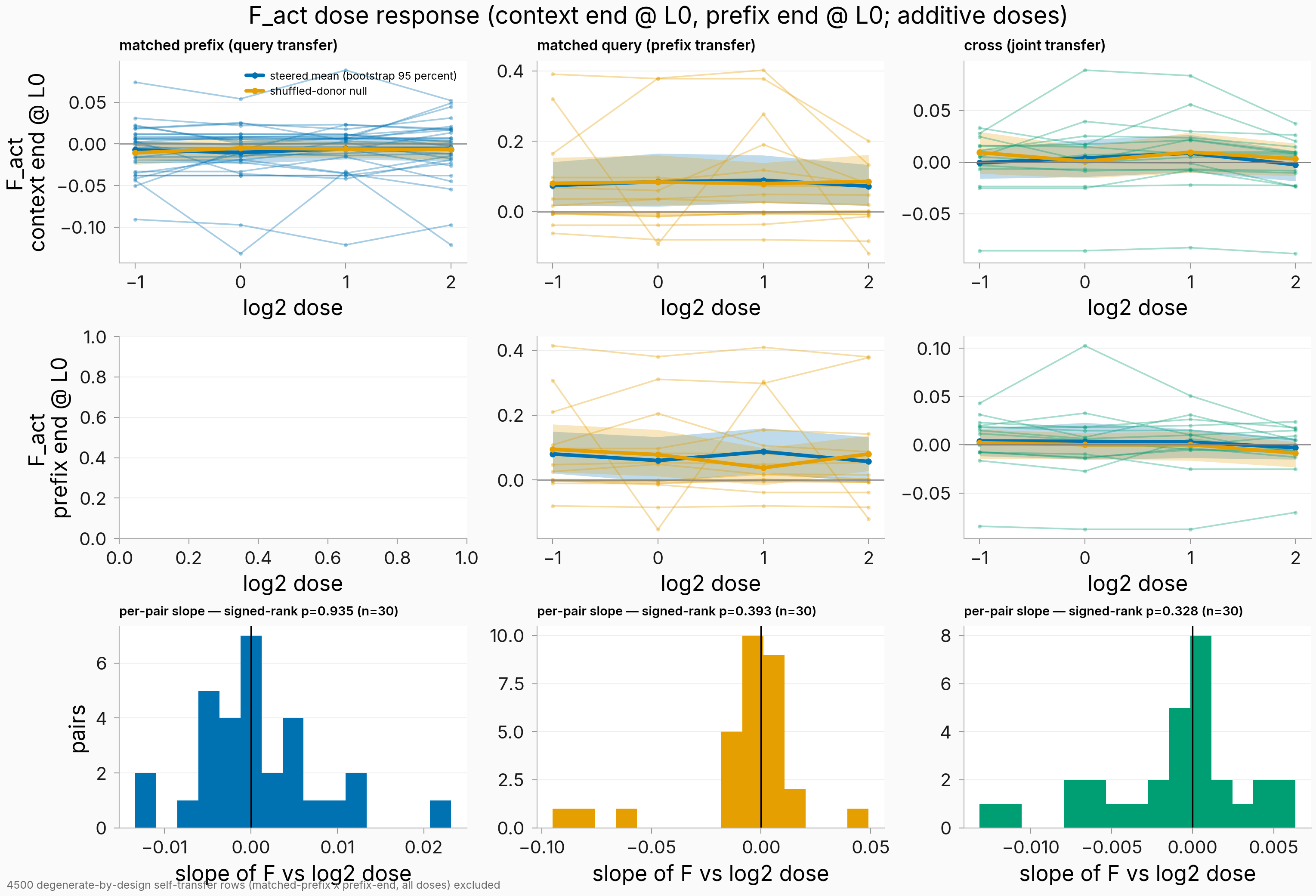
The realized shift's magnitude barely grows over an 8x dose range (mean log-log slope 0.00-0.06 by slot-layer family vs 1.0 for a linear map; the prefix-end families are fully dose-insensitive, slope 0.00 with median adjacent-dose cosine 1.00) and its direction drifts across doses at context-end (median adjacent-dose cosine 0.62 at layer 14; median split-half reliability 0.93, so the drift is not noise). The one-operator fit explains at most 8.4% of held-out response variance (2.3% family-held-out) and does not align with the banked map at layer 14 (Procrustes cosine 0.256 vs rotation-null 97.5th percentile 0.293). The additivity spot-check is weak where informative (cosine 0.17-0.88); its reported 1.000 comes from a combo whose three rollouts were the same greedy completion — insensitivity, not additivity.
Single-position edits are safe; multi-position mid-stack edits break fluency non-specifically
The heatmaps show excess incoherence per cell (incoherent fraction minus the 2.0% unpatched anchor baseline) for steered and null arms, with the steered cap-hit fraction as a companion panel.

Figure. Both arms stay coherent everywhere except query-span and last-three joint mid-stack cells. Excess incoherence per slot x layer-variant x dose (n = 60-75 rollouts per cell arm), plus the steered cap-hit fraction.
Steered incoherence totals 0.7% (149 of 21,000) against the 2.0% unpatched baseline — single-position edits, full-state patches included, essentially never break fluency. The fragile cells are the multi-position controls at joint mid-stack layers: query-span at dose 4x reaches 80% incoherent (null 77%) and 73% cap-hit — generic disruption the wrong-pair null reproduces. Sixteen steered cells breached the plan's 2% cap-hit re-generation threshold: the query-span and last-three families (13-46% pooled by slot and setting over doses and arms; 5-73% per cell; last-three matched-prefix, 0.3%, did not breach) and the context-end joint-stack cells (2.7-6.7%) — the same cells that saturate the behavior heatmap — so their F values are untestable rather than transfer evidence, though several truncated query-span rollouts visibly moved query content while destroying fluency, the only sighting of query transfer in the grid.
A grid-wide screen on well-separated pairs finds null-separated transfer only at context-end
The figure shows behavior F dose response at the two banked layers (14 and 19) on well-separated pairs: steered vs shuffled-donor null means with pair-clustered bootstrap bands (pair-difference edits), per-pair traces behind, one column per setting, context-end and prefix-end rows.

Figure. The steered band clears the null only in the matched-query column at context-end. Dose response on well-separated pairs (n = 10-12 pairs per band; bands: pair-clustered bootstrap, B = 10,000); matched-prefix by prefix-end panels are degenerate by design.
Grid-wide, 36 of 1,245 behavior cell families read steered above null with fully disjoint 95% intervals, but 21 sit in the cap-hit-breached cells of the previous section, leaving 15 clean survivors — all context-end, 14 matched-query and 1 cross, all on the prefix rubric. Clean single layers 12-20 read 0.18-0.33 (nulls -0.24 to -0.00), the mid-stack joint edit at half dose 0.43, and the all-layer full-state patch 0.63 vs null -0.05 (n = 10 pairs).
Prefix-end and the single-token controls: zero. The screen is post hoc and unadjusted; each cell is one greedy draw per pair; the next section re-measures all 15 independently; the surviving cells carry zero intrusion flags.
Executing the cap-hit re-generation trigger changes nothing, and 10 of the 15 surviving families confirm under independent re-sampling
The forest plot shows, per surviving family, the steered and shuffled-donor-null mean behavior F at temperature 1.0 with pair-clustered bootstrap 95% intervals and the per-pair means behind each interval; filled steered markers are the 10 families whose intervals are fully disjoint.

Figure. Every steered mean sits above its shuffled-donor null; 10 of 15 families separate on fully disjoint intervals. Steered and null means with pair-clustered bootstrap 95% intervals per family (B = 10,000; n = 10-12 well-separated pairs, 5 temperature-1.0 draws per pair), per-pair means behind; families ordered by steered mean.
Re-generating the 16 breached cells at a 2048-token cap leaves every one over the 2% trigger (residual steered cap-hit 2.7-72%): the long generations are genuine behavior of those cells, and substituting the re-generated rows changes nothing — 4,112 untouched families reproduce the parent read exactly, swap deltas stay within 0.023, and the clean set holds at 15. The confirmed families span single layers 13-17, both mid-stack joint variants, and the all-layer patch (0.51 vs null 0.10); 20 of 65 breached-cell families read separated at 2048 but stay excluded per the trigger. The confirmation is post-selection — a robustness read, not an unbiased estimate.
Excluding template tokens makes the query span measurable; whole-prefix patches collapse coherence in both arms
The figure shows the 14 clean query-text family reads: steered and shuffled-donor null means with pair-clustered 95% intervals, per-pair reads behind, marker shape by read metric; the verdict-class composition per span is linked, not embedded.

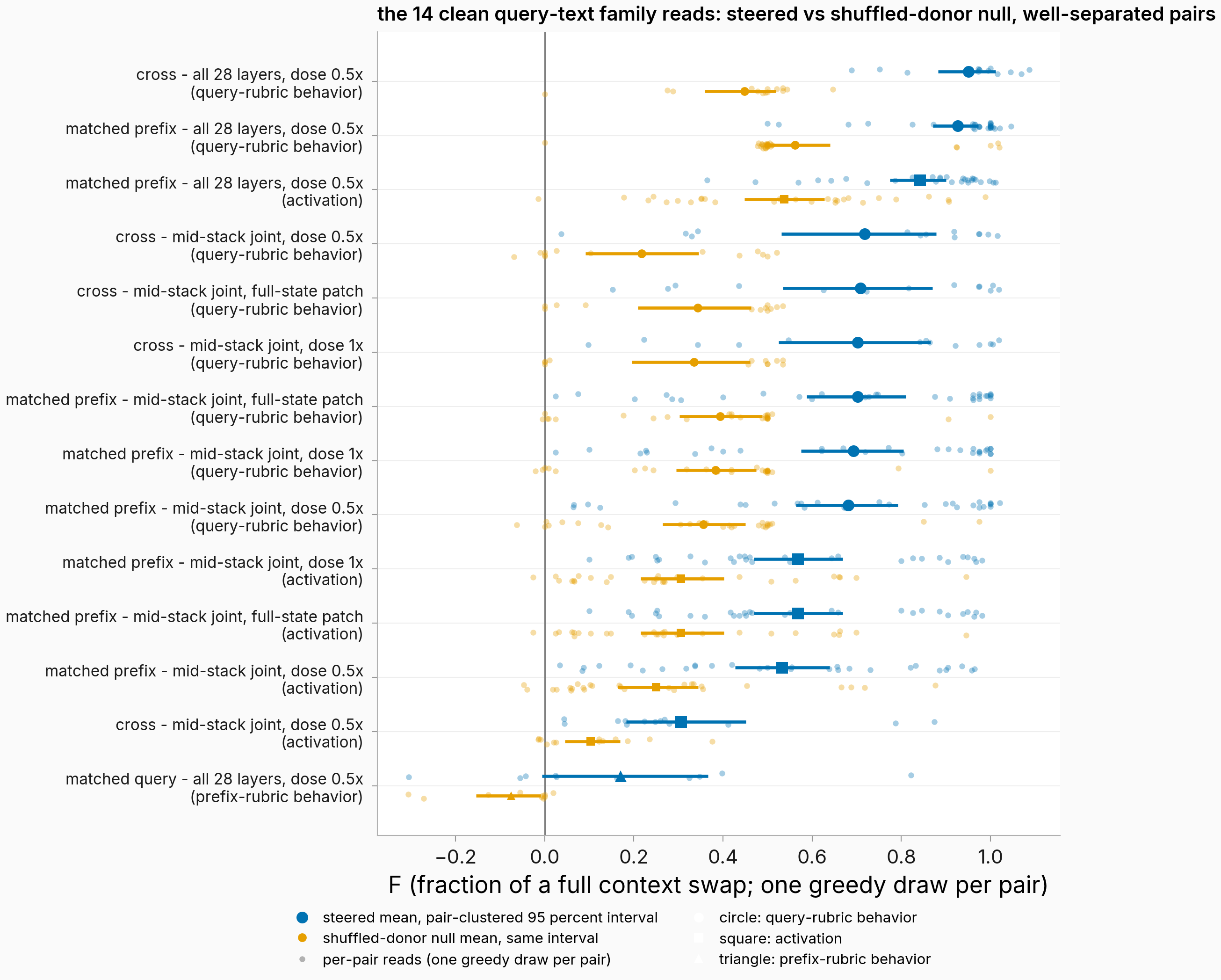
Figure. Every clean query-text read separates from its null on disjoint 95% intervals. Steered means run 0.17-0.95 of a full swap against nulls of -0.08 to 0.56 over all 14 reads, each at half dose or the mid-stack joint band; 10-29 usable well-separated pairs per read (8 circles query-rubric behavior, 5 squares activation, 1 triangle prefix-rubric).
Query-text edits yield 14 of 70 clean reads (27 counting cap-compromised); the 8 query-rubric behavior reads run 0.68-0.95 of a full swap against elevated nulls of 0.22-0.56. A shuffled donor still installs query text, often sharing the target from the 5-query bank, so the separation shows the injected delta directing which query the completion answers — content-directed transfer, not generic disruption. Pair-specificity beyond that stays unresolved: a matched-target wrong-pair null was not run.
Whole-prefix patches yield zero clean reads: 42 of 50 template-inclusive reads are not comparable (93% of steered and 97% of null completions incoherent), and content-only prefix patches retain majority coherence at half dose but never separate. These are one-greedy-draw screen reads, post hoc, not confirmation-grade; the four clean cells carry zero script-intrusion flags in either arm.
A replacement conversation prefix recovers four of the five weak matched-query pairs, and the parent's clean reads reproduce their direction on them
The scatter plots each matched-query context-end family's steered-minus-null mean F gap on the parent grid (10 well-separated pairs) against its gap on the 4 pairs recovered by the persistence-instructed replacement prefix, per metric (150 families each); the parent's clean-separating families are filled and labeled.

Figure. Every parent-clean family reproduces its gap direction on the recovered pairs, and grid-mean gaps match. Steered-minus-null mean F per family, parent grid (x axis) vs replacement-prefix re-run (y axis); 150 families per panel, one greedy draw per pair (parent grid at a 1024-token cap, re-run at 2048); filled markers are the parent's clean-separating families; the dashed line is identity.
The five weak matched-query pairs shared the conversation prefix, whose register does not carry into its own unpatched answers (0.22 vs 74.86 of 100 on the two rubrics), so their ceilings never separated. The replacement prefix recovers four (anchor separations 0.51-1.02); the fifth stays at 0.004 — unresolved, with the query side the surviving suspect.
On the recovered pairs all 17 comparable parent-clean reads reproduce their direction, grid-mean gaps match (behavior 0.109 vs 0.109; activation 0.036 vs 0.041), and family gap ranks agree moderately (rank correlation 0.46 and 0.43). Four pairs cannot meet the five-pair headline bar; under the labeled three-pair floor, 19 behavior and 6 activation reads separate cleanly, with one cap-hit-compromised cell. The 15-family headline is unchanged.
Repro: pod run at code SHA cf7f2254ce (grid + anchors, 1x H100, 42,000 rollouts, cap-hit 0.69%; stage-2 pod pod-2094-s2, 600 + 18 rollouts, cap-hit 0); off-pod analysis + figures at 5552c3e3c7…9d252d52c3 on branch issue-2094; follow-up analysis round (grid-wide well-separated bootstrap, banked-layer dose figure, corrected stage-1-vs-stage-2 join) at 267387d2c9, code-review PASS, no new generation. GPU-backed follow-up round fu1_regen_confirm (proposer cheap band, ~2.5 GPU-h realized on pod-2094-fu1, 1x H100): driver scripts/issue2094_fu1.py at c507e825a4, judge outputs (18 waves) at fd8eef2ecd, swap + confirmation tables at c0ae38c896 (eval_results/issue_2094/f_metrics/fu1/fu1_regen_swap.json, fu1_wellsep_bootstrap_regen.json, fu1_conf1_confirmation.json; judge work root eval_results/issue_2094/judge_fu1/), confirmation forest figure via scripts/issue2094_fu1_fig.py at 99448919d1, code-review PASS x2 (driver + analysis). User-requested follow-up round fu2_span_slots (~2.4 GPU-h realized on pod-2094-fu2, 1x H100): driver scripts/issue2094_fu2.py at 76686b33b3 plus bank-integrity hot-fix 2087a6fcc8, judge outputs (9 waves) at b03264994b, per-cell F reads + verdict table at 7d85517af5 (eval_results/issue_2094/f_metrics/fu2/ — fu2_cells.jsonl, fu2_null_cells.jsonl, fu2_f_reads.json, fu2_summary.json; judge work root eval_results/issue_2094/judge_fu2/), fold figures via scripts/issue2094_fu2_fig.py at 30e2d438e9 (clean-read forest added to the same script at 493ed29a25 in the review round), code-review PASS x2 (driver + analysis); linked-not-embedded (deliberate): coherence-by-dose per span, steered vs null, verdict composition per span. HF span-round artifacts @ 06ddddb7c1352d58917f4710cb0670bfc6024a22 (verified live via list_repo_tree): issue2094_singlepos/raw_completions/fu2_span_slots/rollouts (pinned tree, 60 shards), issue2094_singlepos/analysis_tensors/fu2_span_slots/ (va, bank incl. the fresh state bank + capture-parity report, manifests), issue2094_singlepos/raw_completions/judge_raw_fu2. Final proposer-cheap-band round gpu2_mq_replacement_prefix (~1.4 GPU-h realized on pod-2094-gpu2, 1x H100): replacement-prefix bank + anchor-gate + matched-query re-run driver scripts/issue2094_gpu2.py and bank builder scripts/issue2094_gpu2_bank.py at e66d3c3694, judge outputs (3 waves) at 6a8cb4b710, anchor stats + per-cell reads + parent comparison at 74828e7b06 (eval_results/issue_2094/f_metrics/gpu2/ — gpu2_anchor_stats.json, gpu2_cells.jsonl, gpu2_null_cells.jsonl, gpu2_f_reads.json, gpu2_summary.json, diagnosis.json; judge work root eval_results/issue_2094/judge_gpu2/), parent-vs-re-run gap scatter via scripts/issue2094_gpu2_fig.py at d84c87d6cf, code-review PASS x2 (driver, analysis), upload-verification PASS (v5, full-set hash-identical). HF gpu2 artifacts @ 99f5fdbce0ac3828b2882450451f4e9410d6ac7b (verified live via list_repo_tree): issue2094_singlepos/raw_completions/gpu2_mq_replacement/ (pinned tree, 300 rollout shards + replacement-prefix anchors + judge-gate telemetry), issue2094_singlepos/analysis_tensors/gpu2_mq_replacement/ (state bank + capture-parity report, per-block manifests, activation tensors), issue2094_singlepos/raw_completions/judge_raw_gpu2. Figures: figures/issue_2094/ (18 run figures + result_sep_stratified_fbeh via scripts/issue2094_sep_stratified_fig.py + the analysis round's two + fu1_conf1_forest); linked-not-embedded (deliberate): per-pair anchor separations, activation dose curves, stage-1 vs stage-2 selected-cell scatter (re-rendered in the follow-up round; the run's original render mis-joined the stage-1 cells and drew a fallback axis). Eval tables: eval_results/issue_2094/ (f_metrics/f_cells.jsonl, null_cells.jsonl, anchors.jsonl, bootstrap_cis.json, bootstrap_cis_wellsep.json; linearity/, transport/, fragility/, judge/, gates/, best_cells.json, map_parity.json; f_metrics/fu1/, judge_fu1/). HF (verified live via list_repo_tree): issue2094_singlepos — raw_completions/{grid,anchors,stage2,stage2_additivity,judge_raw} @ cfedd60af9e061e9efa42a1573ebeab9ec790eca (880 grid shards) plus analysis tensors (va_store, vc_bank, stage-2 stores); follow-up round artifacts @ ce5a712423fb9bd8c3c4bda91c4886d28865d643 — issue2094_singlepos/raw_completions/fu1_regen_confirm/regen (44 shards), issue2094_singlepos/raw_completions/fu1_regen_confirm/conf1 (30 files), issue2094_singlepos/analysis_tensors/fu1_regen_confirm/ (74 tensors + manifests), issue2094_singlepos/raw_completions/judge_raw_fu1. Reused artifacts: ridge maps from #779 (issue779_monitoring/n1m_readout/weights/{L14,L19,L26}/ridge.pt @ cfedd60af9e061e9efa42a1573ebeab9ec790eca) and #1738 (issue1738_multiturn/analysis_tensors/weights/{L14,L19,L26}/prefix_ridge.pt @ cfedd60af9e061e9efa42a1573ebeab9ec790eca) — fit: transport-only frozen instruments, input-convention parity recorded in map_parity.json; Jacobian J_last.pt from #1776. All behavioral reads are on-policy generations (greedy grid; temperature-1.0 anchors, stage-2, and confirmation draws; greedy re-generation); no teacher forcing. Known deviations (all recorded in the run digest): per-position add realization of multi-position replace doses; retokenized cap-hit basis; the null installs the donor's target state (not a difference) at replace cells; matched-prefix prefix-end degeneracy.



Context: originating prompt (verbatim): "start in background with happy coder and setup periodic monitoring of it (design finalized in chat 2026-08-05: unified F metric, crossed 3-prefix x 5-query bank, 3 settings, slot grid incl. prefix-end injection, greedy 1-draw grid + K=10 anchors, coherence>60 gating, fragility map, banked-map-only transport, stage-2 best-cell confirmation at temp 1.0 K=5)". Design finalized interactively in chat 2026-08-05; run 2026-08-06 (grid pod ~4 h; judge waves + stage-2 same day); free-analysis follow-up round folded 2026-08-06. GPU-backed follow-up round fu1_regen_confirm (proposer cheap band, auto-run) executed and folded 2026-08-06: the plan's cap-hit re-generation trigger executed at a 2048 cap plus independent re-measurement of the 15 surviving families. Third same-issue follow-up round fu2_span_slots (source: user-chat) run 2026-08-07 and folded the same day; originating prompt (verbatim): "can you run: - query only (without template tokens) - prefix only (both with and without template tokens) all layers + middle band". Fourth same-issue follow-up round gpu2_mq_replacement_prefix (source: follow-up proposer, cheap GPU band — the final cheap round) run and folded 2026-08-07: the five weak-anchor matched-query pairs diagnosed as conversation-prefix-attributable, re-formed with a replacement prefix behind a pre-spend anchor-separation gate, and the parent matched-query context-end arm re-run on them. Lineage: steering conventions from #1415; banked maps #779/#1738; Jacobian #1776.
Natural task/subject follow-up (2026-09-05): The user-requested corrected run used three tasks crossed with three subjects, a paper-matched layer-19 single-position intervention, a separate all-28-layer treatment, greeting-matched prompts, an identical forced assistant opening, complete greedy answers, and frozen-key content-only annotations. The all-layer-defined positive format gate failed; therefore the observed zero donor transfer is a failure to establish causal sufficiency under this constrained intervention, not evidence that the state lacks task or subject information. Generation commit 0c9d97ea8746; hardened analysis through 13eb5c55436; small results at 853292d641d6. Full qualitative report · Independent methodology audit. Annotation deviation: the planned Claude reader returned HTTP 401, so the unchanged frozen packets were read by isolated no-tool gpt-6-astra Codex CLI sessions; the report discloses this.
No-forced-opening ablation (2026-09-05): The same 15-prompt bank, 129-row census, pinned Qwen2.5-7B-Instruct revision, layer-19/all-layer patch sites, greedy decoding, and blinded label schema were rerun with no logits processor and no forced answer tokens. The all-layer exact-pipeline format control passed at 6/6 blind (5/6 structural), but the layer-19 format control failed at 1/6 blind (0/6 structural); donor task and donor subject transfer were each 0/18 at both settings, with recipient form/subject retained in every row. Generation commit 4a5d5b67b09; aggregate report commit 2848e24173b; complete 189-file bundle pinned at HF revision eab88755d33f1d4aeeaccfe600e78728278bdb60. Qualitative report and forced-opening comparison. All 129 generations reached EOS; all 129 blind labels were frozen-key/content-only with clean leakage and tool-event audits. The direct Anthropic reader still returned HTTP 401, so isolated no-tool gpt-6-astra Codex CLI sessions were used under the declared protocol deviation.
Broad natural task/subject/joint follow-up (2026-09-07): The no-forced-opening experiment was expanded to four controlled natural 2×2 blocks spanning eight tasks and eight non-location subjects, with all 48 directed task-only, subject-only, and joint swaps at layer 19 and all 28 layers, plus 22 unpatched anchors, 44 self-patches, and 12 exact-pipeline format controls. All 174 generations reached EOS; self-patches matched anchors 22/22 in each setting; all rows received frozen-key content-only annotations with clean replay, leakage, and tool-use audits. Donor task transfer, donor subject transfer, and either component of joint transfer were each 0/16 at both settings; every joint row retained both recipient identities. The semantic rows are therefore a broad descriptive null. The preregistered manipulation check failed, however: donor format was 1/6 at layer 19 and 3/6 across all layers by the blind reader, and 0/6 structurally in both settings. The formal verdict is inconclusive_pipeline_control_failed, not evidence that task or subject information is absent: one final-token state was replaced while the remaining recipient KV cache stayed intact. Compact report commit 786c39c9634; complete 228-file bundle pinned at HF revision 0416e7203d2d92c737e009dbe2505f5511cebaaf. Qualitative report.