SFT rewrites the OLMo-2 context→answer activation map; DPO mostly preserves it and RLVR leaves it essentially unchanged (MODERATE confidence)
Highlight text on any card (body, plan, or an event) to anchor a comment, or leave a whole-task comment here. Mention @claude to summon a reply.
No comments yet.
Takeaways
- base→SFT aligned retention is 0.472 (CI 0.39–0.55); SFT→DPO 0.874; DPO→RLVR 0.991 — a monotone gradient. One answer-cloud constant closes most of the base→SFT gap (statistic-level, not mechanistic; causal probe null).
- Median aligned retention across all 6 adjacent transitions is 0.893, clearing the 0.8 persistence bar (+0.093 margin, CI excludes zero) despite the SFT rewrite.
- Post-training raises single-turn diagonal R² 0.329 → 0.375 through the answer text, not the representation: at fixed answer text, map quality declines with post-training depth on both corpora.
- Paired per-row length control keeps the base→SFT text gain (+0.05, CI above zero) but shrinks SFT→DPO to +0.009: the DPO/RLVR text advantage is substantially answer-length-driven.
- The operator change shrinks ~5.6× in magnitude from SFT to RLVR yet is never a low-rank edit: effective rank 1,193–1,660 of 4,096, and the predicted rank ordering reverses.
- Multi-turn diagonals decline under post-training (0.360 → 0.313), but every checkpoint was captured under the plain render and the measured render penalty exceeds that decline — confidence capped.
Goal
- This experiment in context: The context→answer activation map — a linear read from a context's pooled hidden state to the pooled hidden state of the model's own answer — was established on Qwen-2.5-7B base and instruct in #722, #779, and #1092, shown transportable across the base→instruct boundary under a general-linear reparameterization in #825, and given direction-aware operator-comparison conventions in #1345. This run asks where along a post-training chain the map changes, on the only fully open four-stage chain (OLMo-2-1124-7B base → SFT → DPO → Instruct, the last trained with reinforcement learning from verifiable rewards, RLVR): within-stage fit quality on a 4×4 activation-checkpoint × answer-text-source grid, cross-stage transferability, per-context-class movement, and the weight-space operator delta per stage.
- Broader narrative: Which post-training stage reshapes internal context→answer structure bears on the leakage-prediction line (
docs/open_questions.mdanchorsregime-rl-vs-sft,identity-contextual-vs-base,leak-predictor): if pre-fine-tuning context geometry predicts fine-tuning-induced leakage, the stage that rewrites that geometry is where prediction should degrade — and here nearly all rewriting happens at SFT.
Methodology
Design: Four checkpoints of one fully open post-training chain: allenai/OLMo-2-1124-7B (base), -SFT, -DPO, -Instruct (the RLVR stage; the chain's RLHF stage is realized as DPO — a checkpoint-availability fact of the release). Two real-user corpora built from lmsys/lmsys-chat-1m (English, exact-string deduplicated, formatted-token budget ≤ 3,072 under the longest render): a single-turn corpus (16,000 generic first-turn queries + 1,200 math/code-screened rows + 500 GSM8K + 300 MBPP marked strata = 18,000 rows) and a multi-turn corpus (16,000 conversations, one unique prefix per row). Each checkpoint generated one on-policy answer per context under its own native render (chat template for SFT/DPO/RLVR; plain User:/Assistant: for base, which has no chat template), plus n = 2 repeat generations on a pinned 1,000-context subset for a sampling-reliability ceiling. Teacher-forced capture then ran every (activation checkpoint m × answer source s) cell — a 4×4 grid × 2 corpora — under one shared plain-text render (User: {q}\nAssistant: {a}), so serialization is uniform across the m axis; a 2,000-context native-render subset plus a pilot flip rule cover the render choice (see the render-confound result section). Per row and layer the capture stores the mean context state u and the mean answer-token state w; ridge and MLP maps u→w are fit per cell with cluster-grouped 6-fold cross-validation (k-means k = 40 clusters on MiniLM embeddings; identical fold assignment across all cells of a corpus). Grid analyses run on the four-source unflagged intersection (16,391 single-turn / 15,363 multi-turn rows, both above the 8,192 = 2d target). Cross-stage transfer evaluates each stage's map on every other stage's pairs — direct, general-linear-aligned, orthogonal-aligned, and fixed-answer-text — against shuffled-correspondence and spectrum-matched nulls, held out per fold; the operator battery reads the ridge primal weights. Both mapping arms run: context arm (both corpora) and prefix arm (multi-turn corpus). A zero-GPU follow-up round added per-transition retention CIs and a paired per-row answer-length control (details under Data extraction:); a second zero-GPU round added the isolating correction-ladder rungs between direct and two-sided-aligned transfer, plus a full-sample geometry diagnostic of the optimal constant correction (both detailed in the correction-ladder result section); a third round tested that geometry causally, with a residual-stream intervention adding the preimage vector at context-token positions of the base model and a five-seed norm-matched random null band (~4 min GPU total across two ephemeral 1× H100 pods; detailed in the final result section). Rig provenance: the first full fit pass ran on stores corrupted by a capture-phase row-order scramble (length-sorted batch outputs saved under unsorted row ids, scrambling the context↔answer pairing for every non-first source cell); it produced a spurious family null and a designed sanity halt, the capture was fixed (commit 3064d4de84), all stores were regenerated, and every number in this body comes from the full 549-unit re-run on repaired stores.
Training: N/A — no model training. Analysis-design constants:
| Parameter | Value | Source |
|---|---|---|
| Checkpoints | allenai/OLMo-2-1124-7B{,-SFT,-DPO,-Instruct}, revisions pinned (footer) | plan §10; arXiv 2501.00656 |
| Generation | vLLM 0.11.0, temperature 1.0, top_p 0.95, max_tokens 1,024, n = 1, seed 42 (+ seeds 43/44 on the reliability subset) | #779 protocol (issue779_collect.py:558) |
| Degeneracy filters | truncation = hit the 1,024-token cap; repetition = any 8-gram repeated ≥ 8 times | plan §4 (pilot-tuned) |
| Capture layers | 17 of 32: every 2nd layer + the final layer | plan §11 (storage-driven; pilot-verified interior peak) |
| Summaries | u = mean over full-prompt tokens; w = mean over answer tokens; prefix arm p = mean over prefix tokens; fp16 store | #779 recipe |
| Ridge | GCV over λ ∈ logspace(−2, 4, 13), standardize-X / center-Y, Gram/dual eigh, float64 | fit_h.py defaults (#823 grid; #779 protocol) |
| MLP | 1×512 GELU, AdamW lr 1e-3, weight decay 1e-4, ≤ 300 epochs early-stop, PCA-64 head, seed 42 | issue658_fit_predictors.py:111-114 via fit_h.mlp_fit_predict |
| Folds | cluster-grouped 6-fold, seed 42; marked strata assigned whole-stratum | #825 (conversation-grouped 6-fold) |
| Headline layer | layer* = 31 = argmax of mean diagonal out-of-fold R² across the four checkpoints (context arm); one shared frozen layer for all compared cells | plan §4 (selection-fair) |
| Bootstrap | 1,000 cluster-grouped draws from persisted per-context squared-error components | #825 |
| Retention bars | persistence 0.8 / half-rewrite 0.5, on the median over the 6 adjacent transitions | #825 anchors |
| Rotation null | 50 draws | issue1345_common.N_ROTATION_COSINE_DRAWS |
| Length control (follow-up) | paired same-rows: both answers inside the shared p10 length band (46–254 generated tokens); variants |Δlen| ≤ {8, 16, 32} tokens + band-only; marginal matched variant n = 4,526/column; seed 20260801 | scripts/issue1902_followup_9ater.py |
Evaluation: The dependent variable is pooled group-fold out-of-fold R² ("map quality" Q) per (activation checkpoint, answer source, layer, fitter, arm) cell, computed on held-out clusters only. Retention ρ(i→j) = general-linear-aligned held-out R² of stage i's map on stage j's pairs ÷ stage j's own diagonal R², with alignments fitted on train folds only and the answer-side alignment fitted on same-answer-text pairs so it cannot absorb the answer-distribution change. Every fitted cell reports the identity+learned-bias baseline and kNN retrieval (acc@{1, 5, 10}, euclidean + cosine, chance = k/n_pool ≈ 4e-4 at pool ≈ 2.7k). Uncertainty is a 1,000-draw cluster-grouped bootstrap; the frozen-at-layer* CI convention is used throughout (selection-inherited CIs, re-selecting the layer per draw, differ by ≤ 0.005 in every diagonal cell). Nulls: shuffled-pairing (fit floor, −0.037 to −0.069 vs observed 0.27–0.41), shuffled-correspondence alignment refit, and a spectrum-matched random operator. Sampling-reliability ceilings (design-aligned split-half over the n = 2 repeat generations, 914 surviving contexts, Spearman–Brown): base 0.72, SFT 0.92, DPO 0.97, RLVR 0.97 — the base diagonal is markedly more sampling-noise-limited than the post-trained ones. No LLM-judged DV exists in this design (activation-space R² throughout), so the dual-DV requirement is N/A; the language-intrusion audit is N/A (non-Qwen evaluated model). Rig gates all passed on the repaired run: per-source unflagged survival 94.4–99.2%; minimum per-fold n_tr 12,717 > d = 4,096 (well-posed fits); mean diagonal Q at layer* 0.344–0.349, above the 0.15 sanity floor and > 5× the shuffled-pairing null; bf16 batched-vs-batch-1 equivalence (early-layer cosine ≥ 0.99994); slow-vs-fast ridge parity ≤ 1.8e-14 maximum relative difference on 3 production-shape slices. Scope limits carried by every result: n = 1 rollout per context per source (the reliability ceilings quantify the cost); one model family; the RLHF stage realized as DPO; the transfer and operator batteries are single-turn context-arm at layer 31 only. Per-context reconstruction cosine is higher for base (~0.88 vs ~0.82) even where base R² is lower — cosine is direction-only and insensitive to the magnitude miscalibration R² penalizes, so it does not contradict the diagonal result. Presentation note (acknowledged conciseness WARNs): this body carries 13 result sections — 11 planned instruments plus two inline follow-up rounds — so several per-result blocks and the total-prose budget deliberately exceed the soft caps, and three secondary views (the MLP grid, retrieval accuracy, CKA curves) are deliberately linked rather than embedded to keep one figure per result.
Data extraction: Tier-1 real-user data (LMSYS single-turn queries and multi-turn conversations) plus tier-2 marked benchmark strata (GSM8K, MBPP). Filters: English (the LMSYS language field), non-empty first-turn query (single-turn) / at least one completed user–assistant exchange before a final user query (multi-turn), exact-string dedup, formatted-token budget ≤ 3,072. Flagged generations are reported and excluded from the four-source intersection, never silently dropped: truncation 2.2–5.2% of 18,000 rows per source (DPO highest at 930), repetition-flagged ≤ 0.64% (base single-turn, 116). Teacher-forcing inputs are built by token-id concatenation with offset-mapping span boundaries (straddling tokens excluded at the prefix boundary, included at the context boundary). The follow-up length control joins each row's generated-answer token count from the generation shards to the persisted per-context squared-error components (Pearson ≥ 0.99998 against capture-side counts in all four sources), then reads the answer-text axis on the same rows with both answers inside a shared length band, optionally with a per-row length gap cap.
Sample training/evaluation data + completions: Four unflagged rows quoted verbatim from the on-policy generation shards — one query (row single_10476) across the base, SFT, and DPO answer sources, showing the length/style contrast that drives the answer-text grid axis, plus one RLVR row — benign rows chosen for display under the content-hygiene policy (the corpus is unscreened real user text); full shards with all rows: HF issue1902_stage_map/raw_completions/gen/.
Example 1 — base checkpoint, single-turn row single_10476 (cluster 23), generated under the plain render; capture then teacher-forces User: {query}\nAssistant: {answer} at every checkpoint. Cherry-picked benign row (not a random sample — content-hygiene policy); all rows: full shards on HF.
Example 1 — base checkpoint, row single_10476 (verbatim)
Query: can you freeze watermelons?
base answer (63 tokens, unflagged): Yes, you can freeze watermelons. However, it's important to note that freezing a watermelon may alter its taste and texture, and it might not be as tasty as freshly cut watermelon. If you're planning to use it for a specific recipe, you might want to consider other options.
Example 2 — SFT checkpoint, the SAME row single_10476, generated under its chat template, captured under the shared plain render. Cherry-picked benign row (not a random sample — content-hygiene policy); all rows: full shards on HF.
Example 2 — SFT checkpoint, row single_10476 (verbatim)
Query: can you freeze watermelons?
SFT answer (69 tokens, unflagged): Yes, you can freeze watermelons. However, it's important to note that this might change the texture and taste of the watermelon. Additionally, make sure to freeze watermelons in a way that prevents ice from forming in unexpected places, which can cause structural damage. You should also consider any potential risks related to food safety.
Example 3 — DPO checkpoint, the SAME row single_10476, generated under its chat template, captured under the shared plain render — the long structured answer style typical of the DPO source (median 387 generated tokens vs base 55). Cherry-picked benign row (not a random sample — content-hygiene policy); all rows: full shards on HF.
Example 3 — DPO checkpoint, row single_10476 (verbatim)
Query: can you freeze watermelons?
DPO answer (455 tokens, unflagged): Yes, you can freeze watermelons. However, it's important to follow proper steps to ensure they freeze correctly without becoming mushy or contaminated. Here are the steps to properly freeze watermelons:
- Preparation:
- Select fresh, ripe watermelons with a firm, intact rind.
- Wash the watermelons thoroughly to remove any dirt or debris on the surface.
- Slice the watermelons into small chunks or balls, as smaller pieces freeze faster and more evenly.
- Remove the seeds if you prefer them to be seedless in the frozen state.
- Blanching (Optional but Recommended):
- Blanching helps preserve the flavor, color, and texture of the watermelon when frozen.
- Boil water in a pot and then submerge the sliced watermelon for about 2 minutes. This step helps deactivate enzymes and slows down nutrient loss.
- After blanching, immediately transfer the watermelon pieces to a bowl of ice water to stop the cooking process and preserve the bright color.
- Freezing:
- Spread the blanched (or unblanched) watermelon pieces on a baking sheet or silicone mat in a single layer. This step prevents them from clumping together and helps them freeze quickly and evenly.
- Place the baking sheet in the freezer until the watermelon pieces are completely frozen, usually within 2 to 4 hours.
- Once frozen, transfer the pieces to airtight containers or zipper-lock bags.
- Storage:
- Label the containers with the date and use the frozen watermelon within 3 to 4 months for best quality.
- Ensure the containers are leak-proof to avoid freezer burn, which can cause the watermelon to become dry and tasteless.
When you're ready to use the frozen watermelon, simply thaw it in the refrigerator or under cold running water, depending on your preference and the intended use (e.g., blending, drinking as a smoothie, or incorporating into a recipe). When frozen properly, watermelon maintains a good texture and flavor, making it a refreshing addition to many dishes and drinks during warmer months or as a year-round treat.
Example 4 — RLVR checkpoint (Instruct), single-turn row single_02253 (cluster 35), generated under its chat template, captured under the shared plain render. Cherry-picked benign row (not a random sample — content-hygiene policy); all rows: full shards on HF.
Example 4 — RLVR checkpoint, row single_02253 (verbatim)
Query: what is the natural logarithm of the constant e
RLVR answer (91 tokens, unflagged): The natural logarithm of the constant e is defined as ln(e). By definition, the natural logarithm of a number is the power to which e must be raised to obtain that number. Since e is the base of the natural logarithm (ln), when we take the natural logarithm of e, we get: ln(e) = 1. This is because: e^1 = e. So, ln(e) = 1.
Results
SFT rewrites the map, DPO mostly preserves it, RLVR leaves it essentially unchanged
What is plotted: general-linear-aligned retention per adjacent stage pair (held out per fold; single-turn corpus, context arm, layer 31), with six labeled per-fold retention points on each bar, next to both matched nulls, with the 0.8 persistence and 0.5 half-rewrite reference lines.

Figure. Retention rises monotonically along the chain. Aligned retention per adjacent transition — six labeled fold points per bar — vs shuffled-correspondence and spectrum-matched nulls (both negative); reference lines at 0.8 and 0.5. base→SFT 0.472, SFT→DPO 0.874, DPO→RLVR 0.991.
The median over all 6 adjacent transitions is 0.893, clearing the 0.8 persistence bar (margin +0.093; 1,000-draw cluster-bootstrap CI +0.075 to +0.108). Per-transition CIs from the follow-up round sharpen the gradient:
| transition | retention | 95% CI |
|---|---|---|
| base→SFT | 0.472 | 0.392–0.548 |
| SFT→base | 0.623 | 0.540–0.705 |
| SFT→DPO | 0.874 | 0.851–0.898 |
| DPO→SFT | 0.912 | 0.884–0.940 |
| DPO→RLVR | 0.991 | 0.982–1.000 |
| RLVR→DPO | 1.007 | 0.998–1.016 |
Both base↔SFT CIs sit entirely below the 0.8 bar; both DPO↔RLVR CIs touch or include 1.0. Recovering the base map gets harder deeper in the chain (DPO→base 0.423, RLVR→base 0.442, vs forward base→DPO 0.537 and base→RLVR 0.544). Per-fold base→SFT retention spans 0.39–0.55 across all 6 folds — consistent, not one bad fold.
The rewrite is localized to the base boundary and is representation-side, not answer-text-side
What is plotted: the four 4×4 stage-transfer matrices — direct, general-linear-aligned, orthogonal-aligned, fixed-answer-text — each cell the held-out R² of the row stage's map evaluated on the column stage's pairs (single-turn context arm, layer 31).

Figure. Transfer fails only across the base boundary. Direct base→DPO transfer is −0.57 and fixed answer text does not rescue it (−0.285); DPO↔RLVR direct transfer recovers 98–100% of native quality (0.369 vs 0.375; 0.380 vs 0.380).
Direct DPO↔RLVR transfer, with no alignment at all, recovers 98–100% of native quality — RLVR leaves the map essentially untouched. Across the base boundary, direct transfer is strongly negative and holding the answer text fixed does not rescue it: the failure is representation-side, not answer-distribution-side. Both matched nulls collapse (shuffled-correspondence −0.046 to −0.108; spectrum-matched −0.13 to −0.39), so the recovered retentions are not alignment-capacity artifacts.
Post-training makes its own single-turn answers more predictable — an answer-text effect, not a representation gain
What is plotted: diagonal map quality per stage — ridge with cluster-bootstrap CIs, MLP, identity+learned-bias baseline, shuffled-pairing null band — for three panels: single-turn context arm, multi-turn context arm, multi-turn prefix arm.

Figure. Single-turn diagonals rise, multi-turn diagonals fall. Ridge out-of-fold R² at layer 31 — single-turn: 0.329 → 0.366 → 0.380 → 0.375; multi-turn context: 0.360 → 0.323 → 0.318 → 0.313; multi-turn prefix: 0.325 → 0.280 → 0.274 → 0.270.
On the grid, the base→SFT single-turn diagonal gain of +0.038 decomposes into an answer-text effect of +0.048 and a representation effect of −0.011. At fixed answer text, single-turn quality declines with depth in both text columns (base text 0.329 → 0.280; SFT text 0.377 → 0.354).
MLP tracks ridge with a constant ~0.05–0.07 deficit — no nonlinear headroom at this corpus size. Identity+bias explains ≤ +0.04 on single-turn but up to +0.30 on the multi-turn base cell, where the fitted map's increment over it is much smaller. Cosine retrieval acc@1 separates base (0.251) from post-trained (0.441–0.474) but does not track the R² ordering among post-trained stages (retrieval figure).

The stage ordering holds at fold grain
What is plotted: the unaggregated per-fold out-of-fold R² (6 labeled cluster-grouped folds per cell) behind each diagonal mean, same three panels.

Figure. The stage ordering holds at fold grain with overlapping spreads. Six folds per cell; bars mark fold means. The multi-turn base-over-post-trained gap and the single-turn base-to-DPO rise are visible in the fold means, not driven by one fold.
Fold spreads overlap across adjacent stages, so single-transition diagonal contrasts lean on the paired cluster-bootstrap CIs rather than fold separation; at cluster grain, 38 of the 40 multi-turn clusters move negative from base to SFT.
The text axis dominates single-turn grid variance; the representation axis dominates multi-turn
What is plotted: the 4×4 map-quality heatmaps (activation checkpoint × answer source), ridge at layer 31, three panels (single-turn context, multi-turn context, multi-turn prefix); the range decomposition below compares the R² range across answer sources vs across checkpoints.

Figure. The dominant grid axis flips by corpus. Every checkpoint's activations predict DPO/RLVR answer text best and base text worst (columns); for fixed text, quality decays with post-training depth on multi-turn in every column (rows).
| cell | range over answer sources | range over checkpoints | difference (95% CI) |
|---|---|---|---|
| ridge, single-turn context | 0.087 | 0.026 | +0.062 (+0.040 to +0.077) |
| ridge, multi-turn context | 0.036 | 0.078 | −0.042 (−0.050 to −0.034) |
| ridge, multi-turn prefix | 0.028 | 0.078 | −0.050 (−0.058 to −0.041) |
| MLP, single-turn context | 0.093 | 0.044 | +0.049 (+0.021 to +0.074) |
| MLP, multi-turn prefix | 0.026 | 0.084 | −0.058 (−0.065 to −0.051) |
The plan's prediction (text range above representation range) holds only on the single-turn corpus. Each axis carries a confound: the text axis differs strongly in answer length (median generated tokens: base 55, SFT 153, DPO 387, RLVR 349 — addressed by the paired length control next), and the representation axis is exposed to the render confound (final section). The MLP grid shows the same pattern (MLP heatmaps).

Paired length control keeps the base→SFT text gain; the DPO text advantage is substantially length-driven
What is plotted: the follow-up round's paired same-rows answer-text-axis ΔR² per adjacent transition under per-row length matching, four variants (per-row length gap ≤ 8/16/32 tokens, or band-only), 95% cluster-bootstrap CIs.
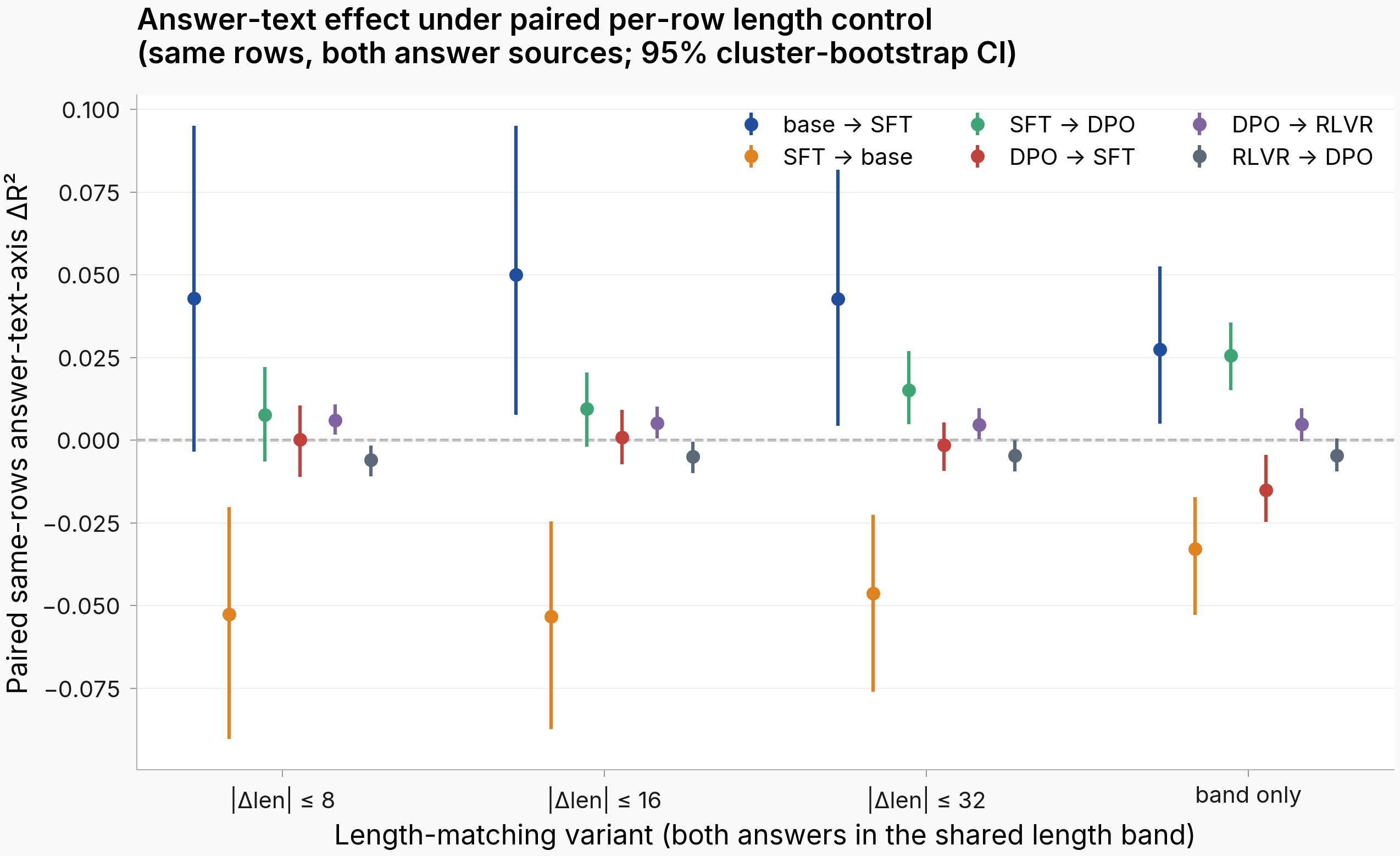
Figure. Length matching preserves the base→SFT text gain and shrinks SFT→DPO. base→SFT +0.050 at gap ≤ 16 (n = 801; CI excludes zero at gap ≤ 16, ≤ 32, and band-only; spans zero at gap ≤ 8, n = 463); the mirrored SFT→base read (−0.053) excludes zero at every variant.
Longer answers give lower-variance targets (w is a mean over answer tokens), so the unmatched column contrasts are length-exposed. On the same rows, length-matched, the base→SFT text gain survives (+0.027 to +0.050 across variants; the mirror SFT→base at −0.033 to −0.053 excludes zero everywhere).
SFT→DPO shrinks from +0.031 unmatched to +0.009 at gap ≤ 16 (CI spans zero), rebounding to +0.026 band-only where a 46-token mean gap remains — substantially length-driven. DPO↔RLVR text deltas stay within ±0.006. A marginal per-column matching variant flips base→SFT to −0.017, but its two column subsets share only 30.6% of rows — row composition, not a text effect — so the paired design is the primary read.
Class contrasts are small and mixed: RLVR slightly reduces predictability on its own math stratum
What is plotted: the three planned class contrasts plus an informational code-stratum (MBPP) contrast, with 95% cluster-bootstrap CIs (context arm, layer 31).

Figure. All three planned contrasts are small. DPO→RLVR on the GSM8K stratum ΔQ = −0.021 (n = 497); base→SFT generic single-turn +0.036 (n = 14,534); SFT→DPO multi-turn −0.005, indistinguishable from null given the variance (n = 15,363).
RLVR slightly reduces linear predictability on its own verifiable-reward-adjacent math stratum (−0.021, CI −0.026 to −0.016) — opposite the sharpening prior — while code (MBPP, n = 298) moves +0.016. Both benchmark strata are far more predictable than generic real-user text at every stage (Q ≈ 0.55–0.57 vs 0.33–0.41).
The largest per-cluster movement: SFT installs stereotyped responses on template prompt families
What is plotted: per-cluster ΔQ of the global map for all 40 single-turn clusters per adjacent transition, every point labeled; panel titles carry each transition's most-moved cluster and its selection-symmetric max-cluster permutation p (1,000 permutations).

Figure. base→SFT has extreme standout clusters; the multi-turn declines are broad. base→SFT most-moved cluster 32, ΔQ +0.396, p < 0.001; multi-turn base→SFT and DPO→RLVR have no standout (max-cluster p = 0.398 / 0.413).
The base→SFT standouts — clusters 32, 5, and 38 (+0.40/+0.34/+0.14), one near-duplicate provocation-template family, and cluster 21 (+0.15), an instruction-injection template family — show SFT installing a stereotyped safe response, making the answer state nearly deterministic given the context. Row-id anchors: cluster 32 = 215 rows (e.g. single_00034, single_00098, single_00145), cluster 21 = 77 rows (e.g. single_00140, single_00574); queries + all four answers per row are in the pinned corpus and generation shards. SFT→DPO has standouts on both corpora (multi-turn cluster 25 at −0.049, p < 0.001; single-turn cluster 2, an article-writing template family, at −0.092, p = 0.027) and cluster 2 recovers at DPO→RLVR (+0.100, p < 0.001) — DPO dents this family's predictability, RLVR restores it.
The single-turn layer peak moves mid-network after SFT; multi-turn peaks stay at the final layer
What is plotted: diagonal out-of-fold R² across the 17 captured layers per stage, both corpora and arms.

Figure. A corpus-specific peak shift. Single-turn: base peaks at the final layer (0.329, with a mid-network value 0.305 at layer 18); SFT/DPO/RLVR peak at layer 18 (0.387/0.411/0.405). Multi-turn: all four stages peak at layer 31 in both arms.
At layer 18 the post-trained single-turn advantage is roughly double its layer-31 value (SFT−base +0.081 vs +0.037). The frozen shared layer 31 keeps every contrast selection-fair; single-turn headline values therefore mildly understate the post-trained checkpoints' own-best quality (by ~0.02–0.03).
The operator change shrinks ~5.6× in magnitude along the chain but is never a low-rank edit
What is plotted: per-transition ΔW singular-value spectra, effective rank against shuffled-refit and spectrum-matched nulls, and direction-aware (Procrustes-aligned) vs spectrum-only operator cosines — ridge primal weights at layer 31, n = 16,391.

Figure. Magnitude shrinks, rank never does. ΔW top singular value 3.31 → 1.79 → 0.59 along base→SFT, SFT→DPO, DPO→RLVR; effective rank 1,193–1,660 of d = 4,096; direction-aware cosine 0.614 → 0.848 → 0.940 (50-draw rotation null ≈ 0).
| transition | ΔW top singular value | effective rank | spectrum-matched null rank | direction-aware cosine | spectrum-only cosine |
|---|---|---|---|---|---|
| base→SFT | 3.31 | 1,193 | 1,547 | 0.614 | 0.994 |
| SFT→DPO | 1.79 | 1,354 | 1,645 | 0.848 | 0.999 |
| DPO→RLVR | 0.59 | 1,660 | 1,657 | 0.940 | 1.000 |
The magnitude gradient matches the transfer gradient, but the low-rank-edit prediction fails twice: effective rank is never remotely low, and the predicted rank ordering reverses. The base→SFT ΔW is large and directionally structured (rank well below its spectrum-matched null); the DPO→RLVR ΔW is tiny and directionally noise-shaped (rank ≈ its null).
Spectrum-only cosine is ≈ 1 for every pair — rotation-invariant and uninformative here. Reading the raw ΔW is licensed by basis stability (mean adjacent context-summary CKA 0.905 at layer 31; CKA curves).

The multi-turn decline is bounded by an unresolved render confound
What is plotted: native- vs plain-render diagonal out-of-fold R² on the 2,000-context single-turn robustness subset, with labeled per-fold values per bar. The read is estimator-degenerate (per-fold n_tr ≈ 1,666 < d = 4,096; absolute R² deeply negative for both renders) and the figure carries that caveat.

Figure. Native beats plain on a degenerate scale. Fold-mean native−plain is +0.10 to +0.13 for all three post-trained sources (labeled fold points per bar); per-fold deltas span −0.10 to +0.32 with 17 of 18 folds positive.
All checkpoints were captured under the shared plain render — native only for base — and both measured render reads (the pilot plain-to-native quality ratio of 0.73 at n = 472, and the degenerate subset above) exceed the multi-turn decline (~10% relative) and the fixed-text row decays (~0.04–0.09) that the representation-side claims rest on. No multi-turn render read exists, so those claims are bounded by, not cleared of, this confound.
The transfer and retention reads are much less exposed: general-linear alignment absorbs coordinate shifts. Remaining scope limits are listed at the end of Evaluation: in the Methodology.
An answer-cloud constant mostly closes the base→SFT rewrite; context-side corrections worsen it
What is plotted: per-rung retention (pooled held-out mode R² over the target's own pooled diagonal R²) for each adjacent transition, single-turn context arm, layer 31, 6 cluster-grouped folds. Rungs add free parameters left to right and differ in fit supervision, tabulated below.

Figure. Answer-side corrections rescue base→SFT; context-side ones do not. base→SFT: direct −0.36, context-mean offset −0.60, context reparameterization −0.74, answer-mean offset 0.43, answer rotation 0.76 (target-pair-fitted) — above the cloud-fitted two-sided general-linear 0.47. SFT→DPO reaches 0.81 with a constant and 0.87 with a gain; DPO→RLVR is 0.98–0.99 everywhere. Per-fold values for all 30 points are in the committed JSON.
In this accounting the rewrite sits in the answer activation cloud, not the answer text (consistent with the fixed-answer-text transfer): context-side corrections leave base→SFT below direct transfer; an answer-cloud constant recovers most of the gap.
| ladder rung | correction applied to the source map's predictions | fitted on | base→SFT | SFT→DPO | DPO→RLVR |
|---|---|---|---|---|---|
| direct | none | — | −0.357 | 0.602 | 0.983 |
| context-mean offset | subtract the context-cloud mean shift before the map | context clouds | −0.603 | 0.339 | 0.980 |
| answer-mean offset | add the answer-cloud mean shift | answer clouds | 0.432 | 0.711 | 0.988 |
| bias refit | add the mean prediction residual | target pairs | 0.562 | 0.813 | 0.989 |
| gain + bias ("scale alpha" in the figure) | scalar rescale about the mean, plus bias | target pairs | 0.604 | 0.872 | 0.976 |
| answer rotation ("rot ans only") | orthogonal rotation of the predictions, plus bias | target pairs | 0.759 | 0.878 | 0.989 |
| context reparameterization ("gl ctx only") | ridge remap of target contexts into source coordinates | context clouds | −0.742 | 0.283 | 0.980 |
| answer reparameterization ("gl ans only") | ridge remap of source answers into target coordinates | same-answer-text pairs | 0.471 | 0.850 | 0.991 |
| two-sided orthogonal | rotations on both sides | clouds + same-text pairs | 0.360 | 0.811 | 0.990 |
| two-sided general-linear | ridge remaps on both sides | clouds + same-text pairs | 0.472 | 0.874 | 0.991 |
Constant corrections are interconvertible through the map, so the rungs identify which cloud statistic carries the correction, not a mechanistic side: the context rung hurts because the correction it applies is weakly anti-aligned with the needed one, and most of it is map-reachable from a modest context-side vector. The check is in-sample, base→SFT only; the context-side rotation twin has no closed form (not run).
| geometry read (base→SFT) | value |
|---|---|
| cos(answer-cloud mean shift, optimal constant correction) | 0.94 |
| cos(context-cloud mean shift, answer-cloud mean shift), raw vectors | 0.91 |
| cos(correction the context-mean-offset rung applies, optimal constant) | −0.18 |
| cos(context shift carried through the map, answer-cloud mean shift) | 0.50 |
| optimal-constant energy reachable through map directions σ ≥ σ_max/10 | 76%, from a context-side vector 0.34× the target context-cloud radius |
| … σ ≥ σ_max/100, then all directions | 96% at 1.45× radius, 100% at 305× radius (implausible) |
| regime | full-sample, in-sample, no folds; standardized primal ridge at λ = 10,000 (median per-fold value), n = 16,391, d = 4,096; in-sample bias-refit R² 0.275 vs the ladder's pooled held-out 0.206 |
A context-side intervention with the preimage vector does not move answer states beyond a matched random null
What is plotted: per-arm cosine between the mean layer-31 pooled answer-state shift (vs the unsteered baseline) and two fixed targets — the optimal constant correction c* and the base→SFT answer-cloud mean shift Δy — the five-seed random arms drawn as clouds with min–max bands. Arms, recipe and scope are tabulated below.

Figure. Both preimage arms fall inside their matched random null bands. cos(mean answer-state shift, target) per arm, n = 256. Preimage L16 +0.252 c* / +0.285 Δy vs the L16 null band mean +0.286 / +0.316; preimage L24 +0.041 / +0.057 vs band mean +0.080 / +0.103; L28 ≈ 0; rig sanity +0.941 / +1.000.
The rig-sanity arm reproduces Δy exactly, validating hooks, pooling and readout, so the bands are a trustworthy scale. Neither preimage arm exceeds its band — both sit inside it, below its mean — so the probe gives no evidence the preimage reachability is a causal pathway under additive context-position injection: the preimage direction is indistinguishable from a matched random one. The layer-16 alignment is generic: random and preimage-directed norm-7.44 perturbations alike shift mean answer states ~0.3 along Δy, itself notable — Δy sits near a dominant perturbation-response direction of the answer cloud.
| arm (n = 256 each) | intervention | cos vs c* | cos vs Δy | ‖mean shift‖ |
|---|---|---|---|---|
| rig sanity | add Δy at answer positions, layer 31 | 0.941 | 1.0000 (norm ratio 1.0002) | 18.05 |
| preimage L16 | add v_pre at context positions, layer 16 | 0.252 | 0.285 | 19.95 |
| random null ×5, L16 | seeded norm-matched vectors, layer 16 | 0.286 [0.201, 0.365] | 0.316 [0.235, 0.411] | 17.07–21.90 |
| preimage L24 | add v_pre at context positions, layer 24 | 0.041 | 0.057 | 8.90 |
| random null ×5, L24 | seeded norm-matched vectors, layer 24 | 0.080 [0.006, 0.133] | 0.103 [0.014, 0.162] | 8.97–10.15 |
| random null ×1, L24 | the initial leg's single-seed null, superseded by the ×5 band | 0.091 | 0.109 | 9.11 |
| preimage L28 | add v_pre at context positions, layer 28 | −0.005 | 0.002 | 5.00 |
| per-unit view | the DV is a cosine of the pooled mean shift, not a mean of per-row cosines, so its per-unit decomposition is the five individually plotted null draws per layer; per-row cosine deciles for every arm are in the committed JSON | |||
| scope | OLMo-2-1124-7B base; teacher-forced over each row's own fixed base greedy answer under the parent capture's plain render; 256 fixed-seed random intersection rows (seed 1902); all arms scored against the same committed c*/Δy (matched targets); ‖v_pre‖ = ‖v_rand‖ = 7.44, ‖c*‖ = 15.88, ‖Δy‖ = 18.05, map-predicted reachable magnitude 13.85 (in-sample diagnostic); one injection norm, additive intervention at three layers, base→SFT only |
Repro: Compute: Anthropic-fellows SLURM lane (charmander, 4× H200) — job 16569 (on-policy generation + first capture pass), jobs 16587 + 17182 (repaired capture + all 549 fit/transfer/operator units; ~12 h + 1.5 h resume); figures and the zero-GPU follow-ups ran on the VM (CPU); the intervention probe + its null-band leg used ~4 min of GPU across two ephemeral 1× H100 RunPod pods (2026-08-04). Code, all pinned at 79a103c381: scripts/issue1902_corpus.py, scripts/issue1902_run.py + scripts/issue1902_dispatch.sh, scripts/issue1902_fits.py, scripts/issue1902_figures.py, follow-up scripts/issue1902_followup_9ater.py + scripts/issue1902_fig_9ater.py. Capture row-order fix 3064d4de84; results commits 8f6456d855 (fits/transfer/operator JSONs), e7fa88bd12 + 9fab63fa7e (figures), 0a0a07778c + 7d731349ab (follow-up JSONs), db07e4ca50 (follow-up figure), 79a103c381 (review-round figure re-render: plain-English panel titles + labeled per-fold retention/render points), aa7d5c867a (correction-ladder round: rung JSON, figure, and its driver script), a582c4711c (preimage geometry diagnostic: JSON record + script), and the intervention-probe round 23e2205beb + 14584a7d76 (probe scripts, steer_probe.json, figure) with its null-band leg 07568b1511 + 813beac116 (seeded-null arm spec, extended JSON, re-rendered figure). Rig-bug provenance: the pre-fix designed-halt records are kept as forensic artifacts — gate_reports/ holds the scrambled-store sanity halt (base 0.385, SFT/DPO/RLVR ≈ −0.03) and a pre-fix capture-cost halt; neither is a science read. Artifacts: eval_results/issue_1902/ (fits/grid_cells.json, transfer/transfer_matrix.json, clusters/delta_qc.json, operator/operator_battery.json, followup_9ater/), figures figures/issue_1902/; correction-ladder round eval_results/issue_1902/followup_ladder/ (ladder_modes.json, preimage_check.json) with driver scripts/issue1902_ladder_followup.py + diagnostic scripts/issue1902_preimage_check.py; intervention-probe round scripts/issue1902_steer_vectors.py + scripts/issue1902_steer_probe.py with steer_probe.json and its raw per-arm shift arrays + steering vectors on the HF data repo @ issue1902_stage_map/steer_probe/ (6 input + 18 output files, listing verified live at write time); HF data repo @ issue1902_stage_map (corpus/, raw_completions/gen/, analysis_tensors/issue1902_store/, eval_results_mirror/ — listing verified live at write time). Model revisions pinned in revision_pins.json. Reused code: ridge/MLP fit helpers from #779 (fit_h.py — fit: parity gate re-run at production shape this run), transfer/alignment + matched-null recipes from #825 (fit: same map construct, alignment refit here), operator-comparison conventions from #1345 (fit: direction-aware vs spectrum-only reads with matched nulls).
Context: created 2026-07-30 from user chat; corpus + generation + capture 2026-07-31 – 2026-08-01; fits landed 2026-08-01 (every number is from the post-fix 549-unit re-run); zero-GPU follow-up round (per-transition retention CIs + paired length control, followup_label: 9ater-free-analysis) run 2026-08-02 UTC and folded in. User-directed inline correction-ladder round (followup_label: ladder_modes) run 2026-08-02 UTC and its preimage-feasibility geometry diagnostic run 2026-08-04 UTC; both folded into this body 2026-08-04. A user-directed inline causal probe of that geometry (followup_label: steer_probe) — the residual-stream intervention plus its five-seed null-band completion leg — ran 2026-08-04 UTC and was folded in 2026-08-04/05. Lineage: extends the context→answer-map line (#722, #779, #1092, #825, #1345) from Qwen-2.5-7B to a four-stage open post-training chain. Originating prompt, verbatim:
Devise a plan for this: ## Motivation - We have found that our context -> answer map is present in the base model and the instruct model - We want to see how each phase of post training affects the mapping - By phases of post training we mean, SFT, RLHF, RLVR - For this we want a model that has base, post SFT, post RLHF, and post RLVR checkpoints ideally - Then we want to train our mapping (linear=ridge regression and nonlinear=MLP) on each checkpoint: with both on-policy text from that checkpoint and text from the other checkpoints - We can probably start with 10k DIVERSE and generic context -> answers - We want to see how: The R^2 evolves; if any stage makes the mapping better at predicting certain contexts - If the mapping is transferrable from base -> post SFT -> post RLHF -> post RLVR: look at the different kinds of mapping transfer and characterize on both context and answer side - Can we characterize the exact change to the mapping after each stage in terms of subspaces/SAE features