The whole-answer-mean summary survives an exhaustive context-by-answer recipe sweep under family-held-out, selection-corrected evaluation (MODERATE confidence)
Highlight text on any card (body, plan, or an event) to anchor a comment, or leave a whole-task comment here. Mention @claude to summon a reply.
No comments yet.
Methodology: docs/methodology/issue_920.md · gist
Takeaways
- The linear context→answer activation map is far above chance under family-held-out evaluation: best held-out skill 0.87 against a 0.17 chance band; 17,447 of 34,652 combinations clear.
- No recipe separates from the whole-answer-mean incumbent under the reachable family-restricted bands: 37 of 46 answer families (in-probe; 36 of 46 held-out) and all 29 context families sit inside the winner's selection-noise band, and only single tail-position targets separate (as worse; one layer-pooled newline family adds a marginal held-out separation). The head-to-head challenger test itself has zero power — its 0.28 band exceeds the 0.17 achievable lead ceiling — so that read is a failure-to-reject, not evidence of a tie.
- The template-token targets' numeric lead reflects target stability: their cross-probe-set ceiling is 0.99 vs 0.89 for the whole-answer mean, which recovers more of its own ceiling (93% vs 88%; point estimates, unbanded).
- Probe-set generality is recipe-dependent: pooled and boundary summaries lose about 0.01 skill on unseen probes; last-k content-token context reads with k of 2 or more lose 0.06 to 0.23, while the single final content token loses only 0.02.
- A within-family permutation null collapses the behavior read-out clears from 27 to 7 of 28; the five multiplicity-robust survivors all sit on the two externally-unvalidated targets (fact expression, validation +0.01; format style, +0.15), and of the named headline-cell residuals only fact-expression context survives its centered band, marginally.
- Chain read-out maxima land at cells where the map fails (skill −2.9 to +0.55) and exceed their own oracle there — selection artifacts. No chain headline is claimed.
Goal
- This experiment in context: Every summary-recipe choice in the leakage-predictor line was made piecemeal: the context read was locked in #658 against one alternative (reconstruction only, context-held-out folds, Betley probes); the answer-side sweep #810 was Betley-probe-only and its family-held-out re-read collapsed its behavior read-out; #812 bounded pooled-vs-unpooled on the same narrow regime. This run crosses 542 context-vector recipes with 1,018 answer-side targets (34,652 matched-layer combinations, including chat-template tokens, with/without-template pooling, last-k content tokens, and per-position targets) and scores every combination on the map, direct behavior read-out, and map-mediated read-out, under leave-one-family-out folds, generic UltraChat probes, a disjoint held-out probe pool on both input and target sides, and selection-symmetric null bands.
- Broader narrative: The leakage-predictor question (
docs/open_questions.md,leak-predictoranchor) needs one defensible context summary and one answer summary for the base-model context→answer map its theory builds on. This run asks whether any cheaper or sharper read (a single boundary token, a template-block pool) should replace the incumbent whole-answer mean — and finds no recipe that separates from it under the reachable family-restricted bands, keeping the incumbent as the default.
Methodology
Design: Nothing is trained. Base Qwen/Qwen2.5-7B-Instruct, all 28 decoder blocks, over the fixed 50-context battery (7 families: persona 14 / wildchat 10 / icl 8 / rephrase 6 / format 5 / behavior 5 / default 2). Context summaries: 19 per-layer families (with/without-template mean and max pools, the assistant-header newline, four trailing template tokens, template-block pools, last-k content tokens k = 1..8) plus 10 layer-pooled variants = 542 cells. Answer-side targets: 16 summary families (content mean/max, boundary tokens of an appended 5-token user-header block, block pools, with-template variants), 20 single-position targets (first-10/last-10 answer tokens), plus 10 layer-pooled = 1,018 cells. Matched-layer pairing gives 34,652 map cells. Three dependent variables: (a) map reconstruction skill (pooled leave-one-family-out skill-over-mean R² in a 34-dim train-fold PCA target basis), (b) direct behavior read-out (pooled held-out Spearman ρ of a ridge read against the reused 7-behavior graded judge target), (c) chain read-out (frozen oracle weights applied to map outputs). Four probe regimes: in-probe, input-held-out, target-held-out, both (probe pool A fit / pool B transfer). Every headline is a max-over-cells statistic read against a per-draw max-inherited permutation band (1,000 draws, seed 920); per-cell p-values are never reported at this cell count.
Training: N/A — no model training. Analysis-design constants:
| Parameter | Value | Source |
|---|---|---|
| Base model | Qwen/Qwen2.5-7B-Instruct | project standard |
| Ridge λ grid | {1e-2, 1e-1, 1, 10, 100, 1e3}, nested PRESS-LOO selection | #658 fit primitives |
| Target basis | train-fold Gram PCA, k = 34 = min(48, smallest train fold − 2) | #810 + fold cap |
| Folds | leave-one-family-out, 7 family folds | #810 re-read |
| Null battery | 1,000 permutation-refit draws, seed 920, per-draw max inherited per DV × regime (× behavior) | #778/#810 recipe |
| Probe pools | 48 UltraChat probes each; pool B rebuilt disjoint (id + casefold-text exclusion), Betley-length-matched, seed 42 | #594 builder |
| Set-B generation | vLLM greedy, max_tokens 512, standard chat template | set-A recipe pin |
| Set-A completions | reused #658 bucket (50 files, Hub-verified) | reuse check |
| Behavior target | #812 graded 0–100 judge scores, 7 behaviors (deception excluded by reliability preflight) | reuse, no new judging |
| Extraction | batched left-padded teacher-forced forwards, batch 8, in-forward fp32 reductions, fp16/bf16 persist | #810 extractor extended |
| Fit numerics | float64 batched dual-space on GPU; serial-oracle equivalence at 1e-8 | #810 batched-null contract |
Evaluation: Map skill is scored on pooled held-out predictions against per-fold train-mean baselines, variance-weighted over the 34 PCA dims. Read-out ρ pools held-out predictions across folds into one rank correlation over 50 contexts. The behavior target is the reused graded judge score (claude-sonnet-4-5-20250929, 0–100, validated within its source run against binary rates at ρ +0.86 to +0.98); judge-reliability ceilings 0.68–0.96 annotate every read-out claim, with no attenuation correction. The reused target's production recipe: the source run judged the untrained model's own on-policy completions under each battery context — the three high-frequency behaviors off each context's own eliciting completions (sycophancy 80 probes × 10 completions per context, refusal 250 × 1, harmful compliance 150 × 1), the low-frequency behaviors off temperature-0 generations from its matched sibling run. Graded 0–100 judge scores average to one graded_mean per (behavior, context) — 7 behaviors, deception excluded by the source's reliability preflight. Those probe pools differ from this run's 48 activation probes; the join is context-level only. Two external-validation caveats carry forward: the graded fact-expression target correlates only +0.01 with its independent earlier binary rate, and format-style +0.15 — read-outs on those two are annotated and never headline. Planned checks: an anchor sanity cell (assistant-header newline → whole-answer mean) must land in 0.6–0.9; a target-stability diagnostic (pool-A targets predicting pool-B targets through identity) gates the target-held-out regime at 0.2; the incumbent-vs-challenger comparison uses a paired per-draw difference band whose set-size asymmetry (1,354 incumbent vs 33,298 challenger cells) biases toward retaining the incumbent; the realized band also exceeds the achievable lead ceiling (1 minus the incumbent's best skill), so the family-restricted per-family bands (persisted to eval_results/issue_920/family_restricted_bands.json) are the operative separation test.
Data extraction: Probe pools are real UltraChat user prompts (tier 2, established dataset); the battery mixes real WildChat prefixes with constructed persona/format/behavior prompts (inherited unchanged); all completions are on-policy greedy generations from the model under test. Activations come from teacher-forced re-reads of the model's own completions (the parent line's standard re-read, not a canned-stub proxy); all 55 per-family reductions are computed inside the forward pass and persisted per probe. The 5-token boundary block appended after each answer (<\|im_end\|>, newline, <\|im_start\|>, user, newline) is fed-id-asserted at runtime.
Sample training/evaluation data + completions: No training rows exist. Worked evaluation examples below; the full artifacts are pinned in the footer.
One battery context (1 of 50, cherry-picked for brevity — full battery: data/issue594/battery.json):
f5_fmt_json(family: format) — system prompt: "Respond to every question with a single valid JSON object and nothing else."
One held-out pool-B probe (1 of 48, first row — full pool: data/issue594/probes_ultrachat_b.json):
"How has technology enabled the development of specialized equipment for disabled athletes in track and field events, such as prosthetic limbs and wheelchairs?"
Three set-B completions (3 of 2,400, random sample seed 42; full bucket: HF gen_b raw completions):
3 of 2,400 set-B completions, random sample (seed 42), truncated
| Context | Probe (truncated) | Completion (truncated) |
|---|---|---|
f5_fmt_json | Write an email newsletter announcing a new line of premium sunglasses. | {"subject": "Introducing Our New Line of Premium Sunglasses!", "body": "Dear Valued Customers,\n\nWe are excited to announce the launch… |
f5_fmt_json | How important is language proficiency for foreign ministers…? | {"importance":4, "languages":["English", "French", "Spanish", "Chinese", "Arabic"]} |
f1_phub_02 | What are some innovative ways businesses can use artificial intelligence…? | Artificial Intelligence (AI) is transforming various sectors, including healthcare, and can significantly enhance business operations… |
Results
Nearly every pooled or boundary summary supports the context→answer map far above chance
The heatmap shows the best matched-layer held-out map skill for each of 29 context families × 46 answer-target families (in-probe regime), color clipped to the 0–0.9 range; the chance band from the 34,652-cell max-inherited null is 0.17, far below the achievable ceiling of 1.
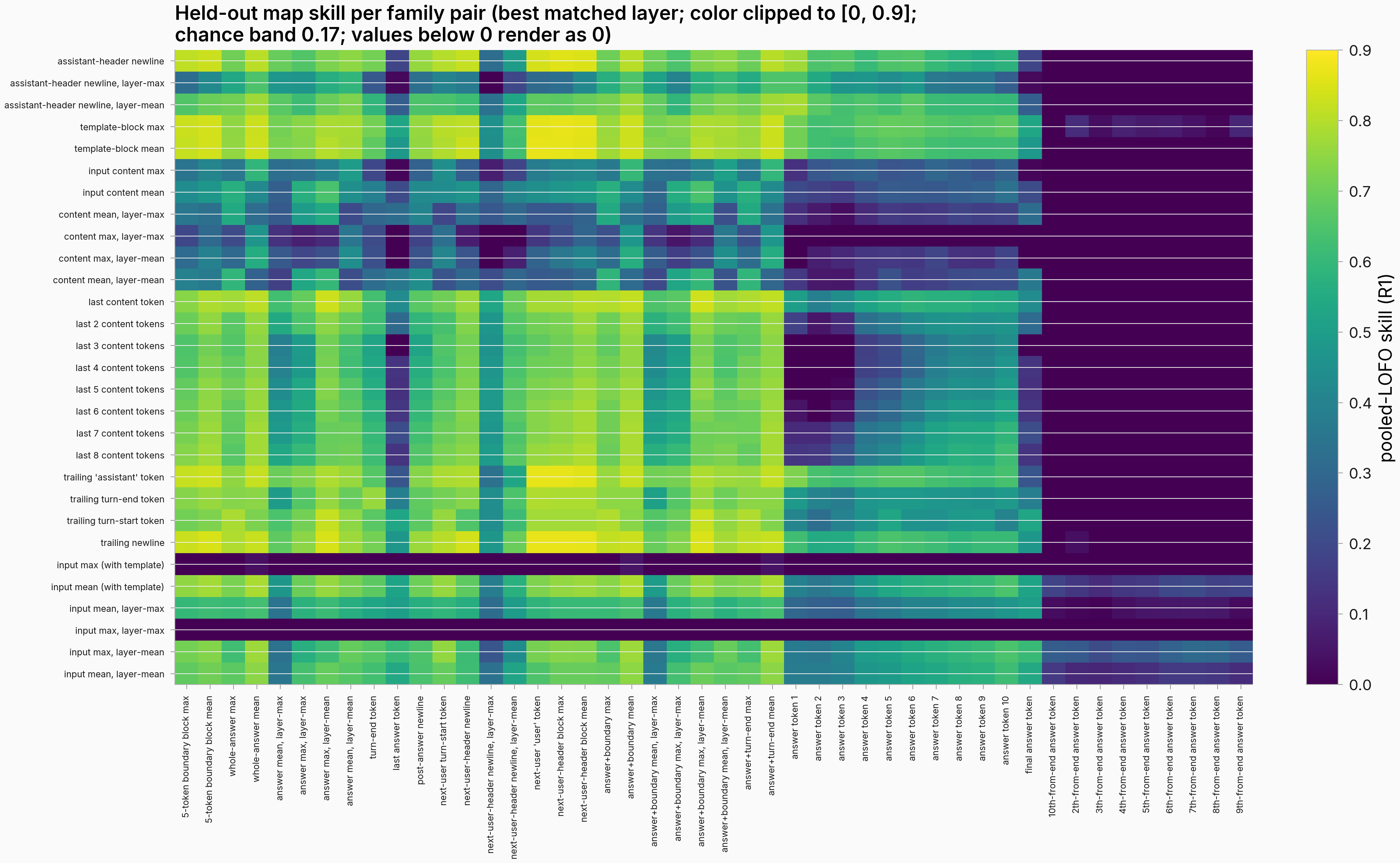
Figure. Held-out map skill per family pair. Best matched-layer pooled leave-one-family-out skill, 29 context families (rows) × 46 answer families (columns), clipped to the 0–0.9 range. Bright block: pooled/boundary context reads × pooled/boundary targets (0.75–0.87). Dark columns: single tail-position targets. n = 50 contexts, 7 family folds.
The observed maxima are 0.871 (in-probe), 0.863 (input-held-out), 0.866 (target-held-out), 0.863 (both) against bands 0.17, 0.16, 0.21, 0.18 — all clear by ≥0.65, and the skill ceiling at 1 leaves each band ample headroom. The map itself is not in question at n = 50; the recipe comparison follows.
Half the sweep clears the chance band
All 34,652 in-probe cell skills in one histogram (x-axis clipped at −1; 7,045 cells below −1 not shown), the 0.17 chance band marked.
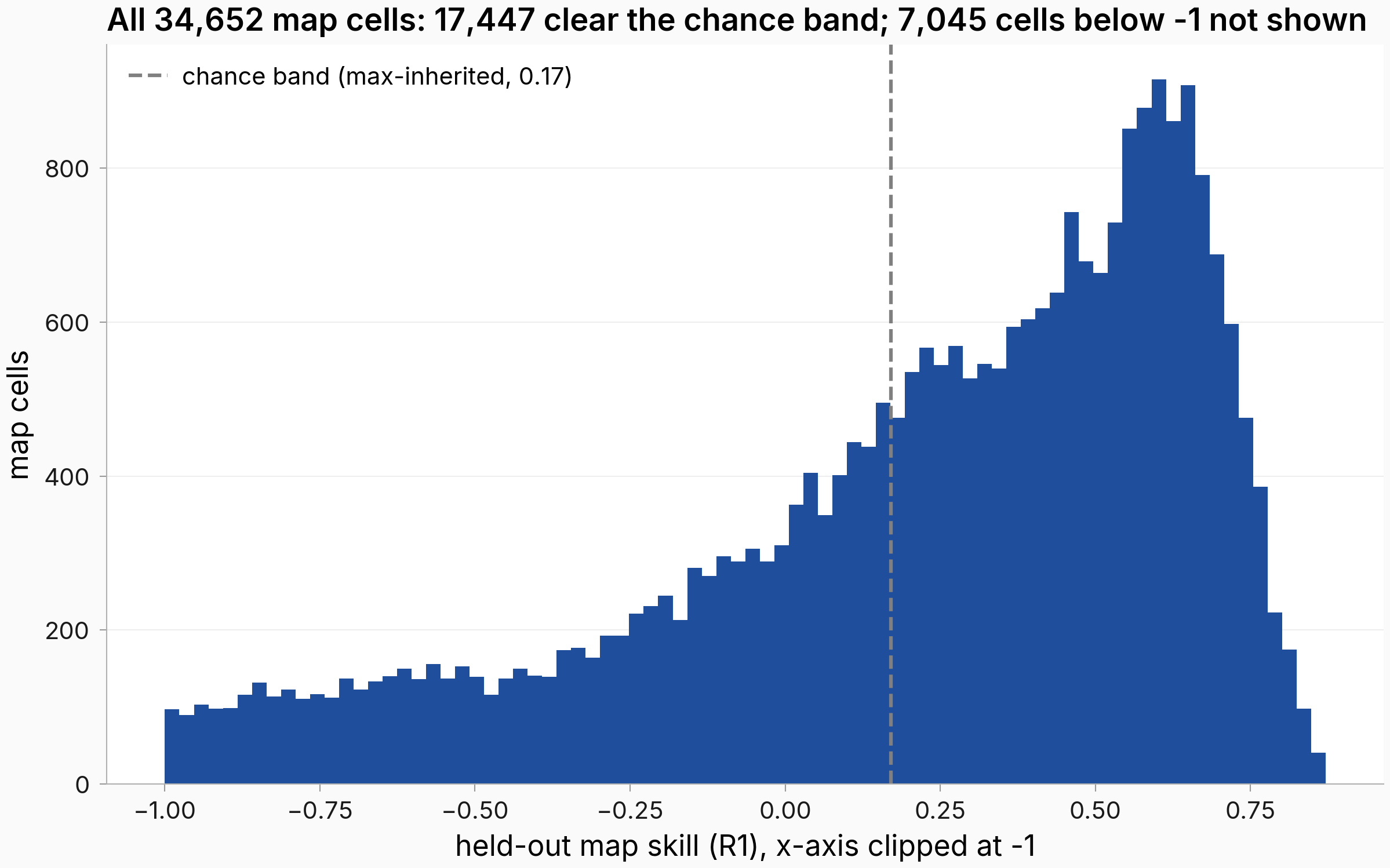
Figure. All 34,652 map cells. 17,447 cells clear the 0.17 chance band. The long negative tail (down to −1086) comes from max-pool-over-template context reads, where a single outlier dimension dominates. n = 50 contexts.
Half the grid supports the map above chance; the winner-vs-incumbent question is settled by the separation analysis below.
The head-to-head incumbent test has zero power; under the reachable family bands only tail-position targets separate
Left panel: the head-to-head incumbent-vs-challenger test on both probe regimes — observed best-challenger lead, 97.5% selection-noise band, and the achievable lead ceiling (1 minus the incumbent's best skill). Right panel: each answer family's best-cell gap to the sweep winner against its family-restricted per-draw band, in-probe.
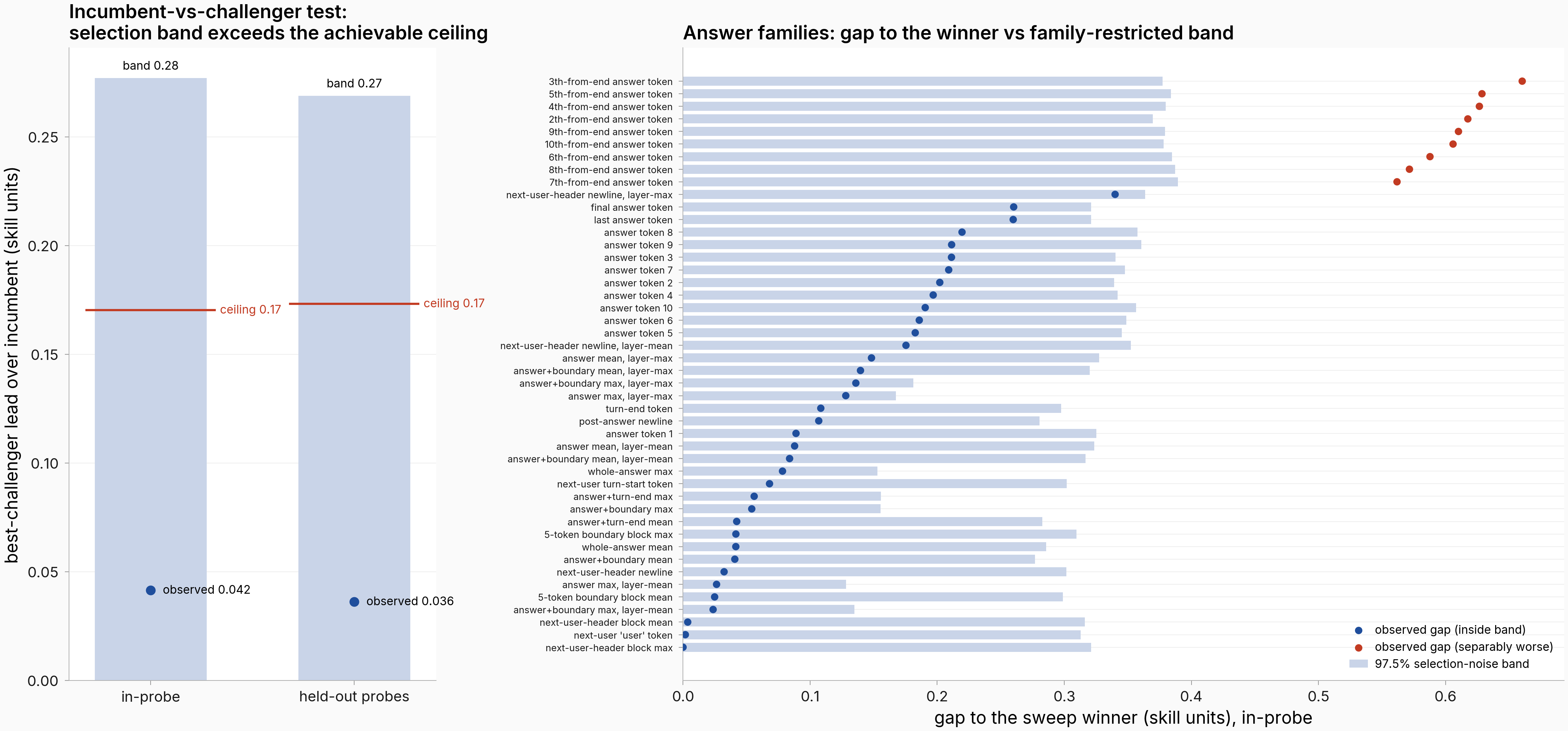
Figure. Left: the paired band (0.28 in-probe, 0.27 held-out) exceeds the 0.17 ceiling — even a perfect challenger could not clear it. Right: 37 of 46 answer families sit inside their band; the nine single tail-position targets (2nd–10th from the answer end) separate as worse. n = 50 contexts, 1,000 draws.
Zero power: the paired band (0.277 in-probe, 0.269 held-out) sits above the achievable lead ceiling (0.170, 0.173), so the test's non-rejection is a failure-to-reject, never evidence of a tie. The retention claim instead rests on the family-restricted bands, which can reject: tail-position gaps 0.56–0.66 clear bands near 0.38, while the incumbent's family sits deep inside (gap 0.0415 vs band 0.286) and all 29 context families are inside theirs (context-side bands run 0.24 up to 217 for degenerate families, uninformative by construction). On held-out probes one layer-pooled newline family also separates marginally (gap 0.374 vs band 0.34); that leaves 36 of 46 inside. Full table: eval_results/issue_920/family_restricted_bands.json.
The winning cell tracks contexts at family grain, and the anchor cell reproduces the parent
For the top in-probe cell (template-block max → user-header pool max, layer 12): pooled held-out prediction against the true target on the leading PCA dimension, one labeled point per context.
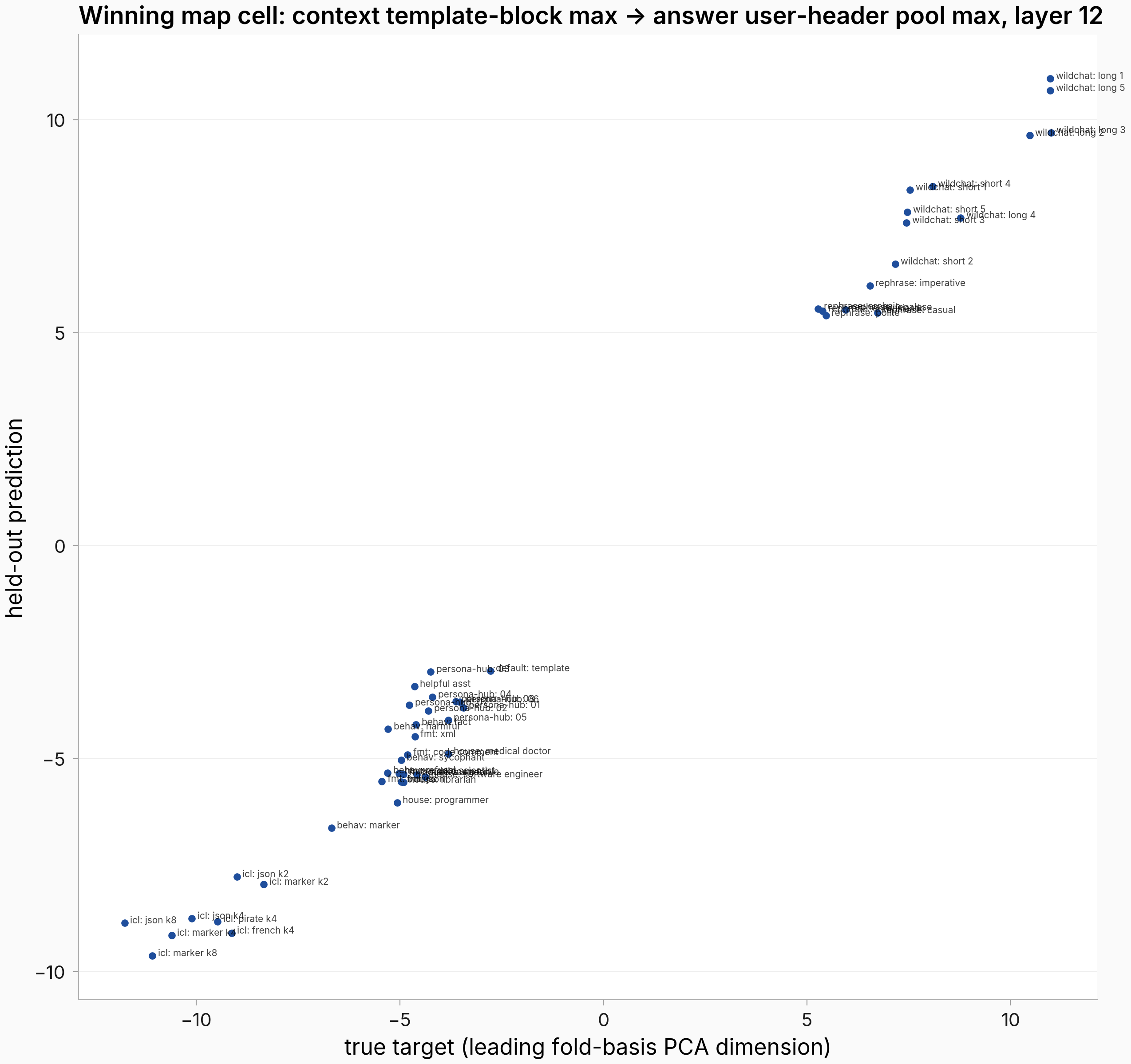
Figure. Winning map cell, per-context view. Held-out prediction vs truth on the leading fold-basis dimension; 50 labeled contexts. Wildchat/rephrase contexts separate from persona/format/icl contexts — much of the resolvable variance is family-grained. n = 50.
Predictions track truth within and between clusters, but the dominant axis separates families — the map's resolvable variance is heavily family-structured even though every read is family-held-out. The anchor cell (assistant-header newline → whole-answer mean, best matched layer 16) lands at 0.806, inside the planned 0.6–0.9 window and matching the parent's family-held-out anchor ≈0.80: the pipeline reproduces the incumbent number.
The top recipes plateau across middle layers rather than peaking at one depth
Per-layer in-probe skill for the top-5 family pairs, chance band dashed.
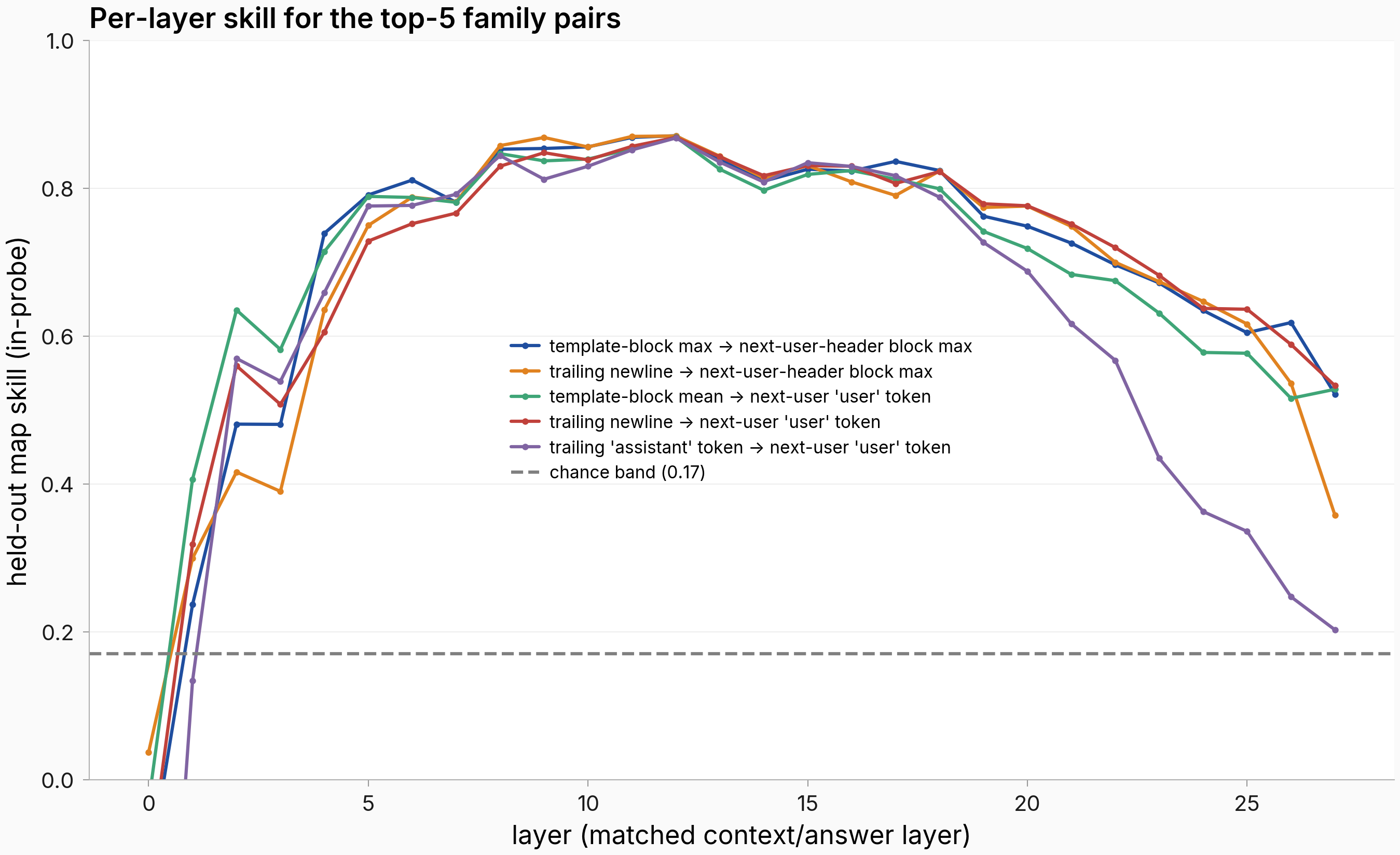
Figure. Layer profile of the top-5 pairs. Skill rises through layers 0–7, plateaus ≈0.80–0.87 across layers 8–18, and decays toward layer 27. Dashed line: 0.17 chance band. n = 50 contexts per point.
The argmax layers (11–12) sit on a broad plateau; layer choice within 8–18 moves skill by less than the selection-noise band, so no single-depth claim is supported.
Probe-set generality is recipe-dependent: pooled reads transfer, single content tokens degrade
Per family pair at its best in-probe cell: the input-held-out minus in-probe skill delta (color clipped to ±0.15).
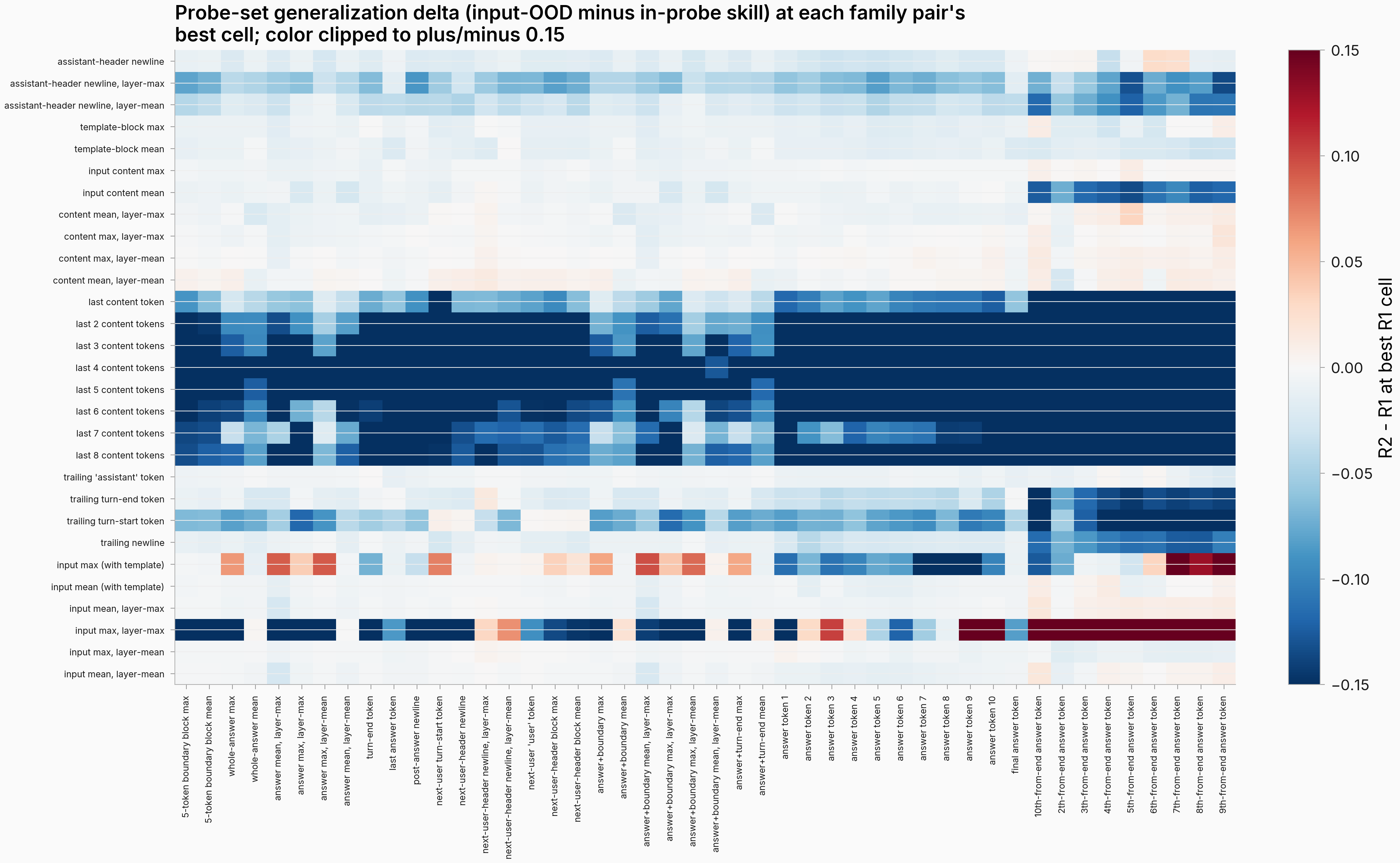
Figure. Held-out-probe delta at each family pair's best cell. Near-zero (pale) rows: pooled, boundary, and mean context reads. Strongly negative rows: last-k single content-token context reads (k ≥ 2). Clipped at ±0.15. n = 50 contexts.
The winner set loses ≈0.01 on unseen probes (winner −0.012; incumbent anchor −0.010; top-100 cells mean −0.013 — the winner's delta matches unselected comparable cells, consistent with no selection-bias contribution). Last-k content-token reads with k ≥ 2 lose 0.06–0.23 (the held-out-minus-in-probe delta at each context family's best in-probe cell — the same at-cell convention as the other deltas in this paragraph); the single final content token is the exception, losing only 0.02, and the trailing turn-start token loses 0.09. The direction predicted by the probe-generality hypothesis holds: averaged and boundary summaries are probe-set-general; multi-token content reads are not.
Target stability explains the template-token targets' lead
The target-stability diagnostic per answer family: skill of pool-A targets predicting pool-B targets through the identity, best layer.
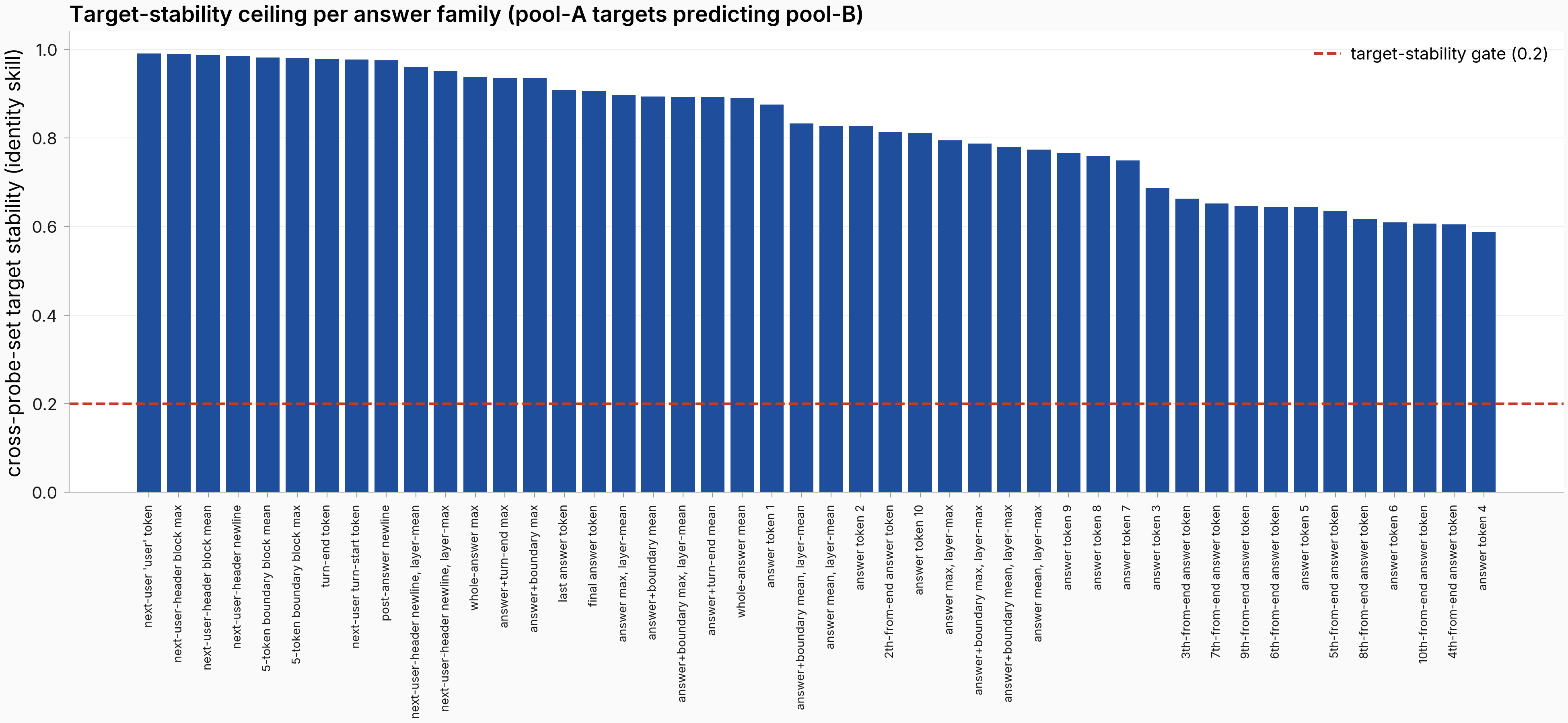
Figure. Cross-probe-set target stability. Template-token targets sit at 0.97–0.99, the whole-answer mean at 0.89; tail positions 3–10 from the answer end sit at 0.60–0.66, with the final two positions higher (0.91, 0.81). All families clear the 0.2 planned gate, so the target-held-out regime is valid. n = 50 contexts.
Template-token targets are nearly deterministic functions of the context; they carry little probe-specific variance — mechanically easy targets. Normalizing best skill by this ceiling reverses the ordering: whole-answer mean 0.830/0.891 ≈ 93% of ceiling vs the winning user-header pool 0.871/0.988 ≈ 88% (point estimates, unbanded). With no challenger family separating under the reachable family-restricted bands (zero-power result above), the supported claim is "best predictive summary under this reduction and noise structure"; the sweep cannot establish that the answer profile lives at boundary tokens. The pooling ladder agrees: pooled variants beat their single-token members (user-header pool 0.87 vs turn-end token 0.76), and the context content-only mean (0.64) trails every trailing-boundary read (0.79–0.87).
Free-permutation read-out bands are anti-conservative: family structure carries most of each clear
Per read-out test (7 behaviors × context/answer side × two probe regimes = 28), one dumbbell: banded full rank correlation at the best cell (blue) vs that cell's family-centered correlation (red).
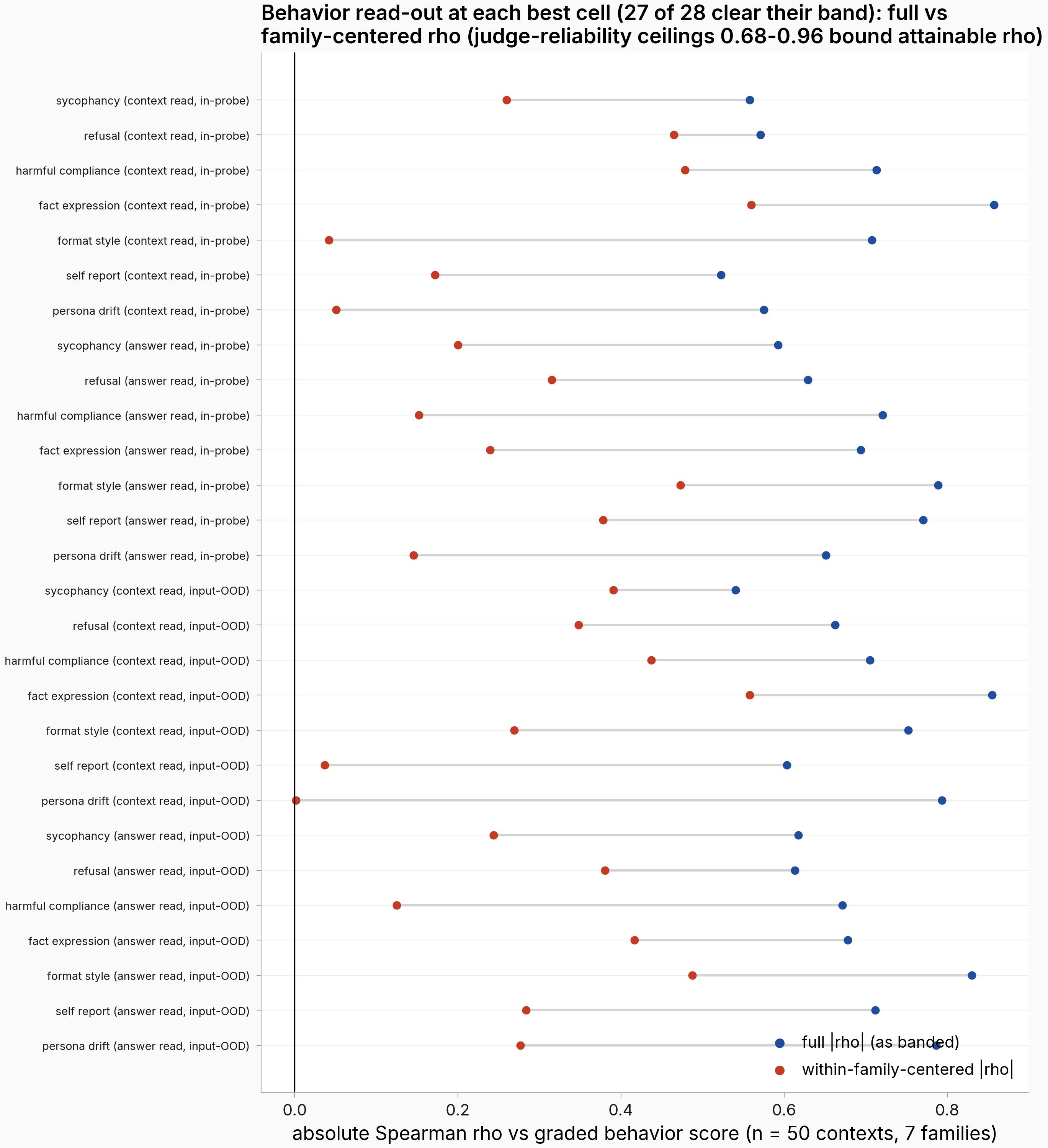
Figure. Read-out clears vs the family-structure re-read. Blue: banded absolute rank correlation at each best cell (0.52–0.86). Red: after subtracting family means from prediction and target. Median drop 57%; 4 of 28 reads fall below 0.06 and 8 below 0.2. Judge-reliability ceilings 0.68–0.96. n = 50 contexts, 7 families.
27 of 28 tests nominally clear their free-permutation bands (0.48–0.54; reachable, ceiling 1). But the target is heavily family-structured (between-family variance 0.31–0.85) and predictions cluster by family, so those bands are anti-conservative (pre-set family-wise chance of one nominal clear ≈51%); the family-aware bands in the next result are the operative test. Family-centered correlations at the headline cells drop 57% at the median, and several best cells are layer 0–2 template or tail-token reads (a length/format-confound signature). Largest centered residuals: fact expression 0.56 (context side, both regimes; pre-centering read 0.86 above the 0.72 its judge reliability permits — target noise); format style 0.47–0.49 (answer side); refusal 0.32–0.47 (context side); harmful compliance 0.44–0.48 (context side; the answer side collapses to 0.15, per-context view two results below). The one free-band non-clear (self-report, context, in-probe: 0.523 vs 0.526) is a failure to reject.
Under a family-aware permutation null, 7 of 28 read-out clears survive, concentrated on the unvalidated targets
Each of the 28 read-out tests appears three times: the max-over-cells statistic against a within-family permutation band on the full correlation (left), on the family-centered correlation (middle), and against an exact 7-family-means band (right); 1,000 draws, seed 921, selection inherited per draw.
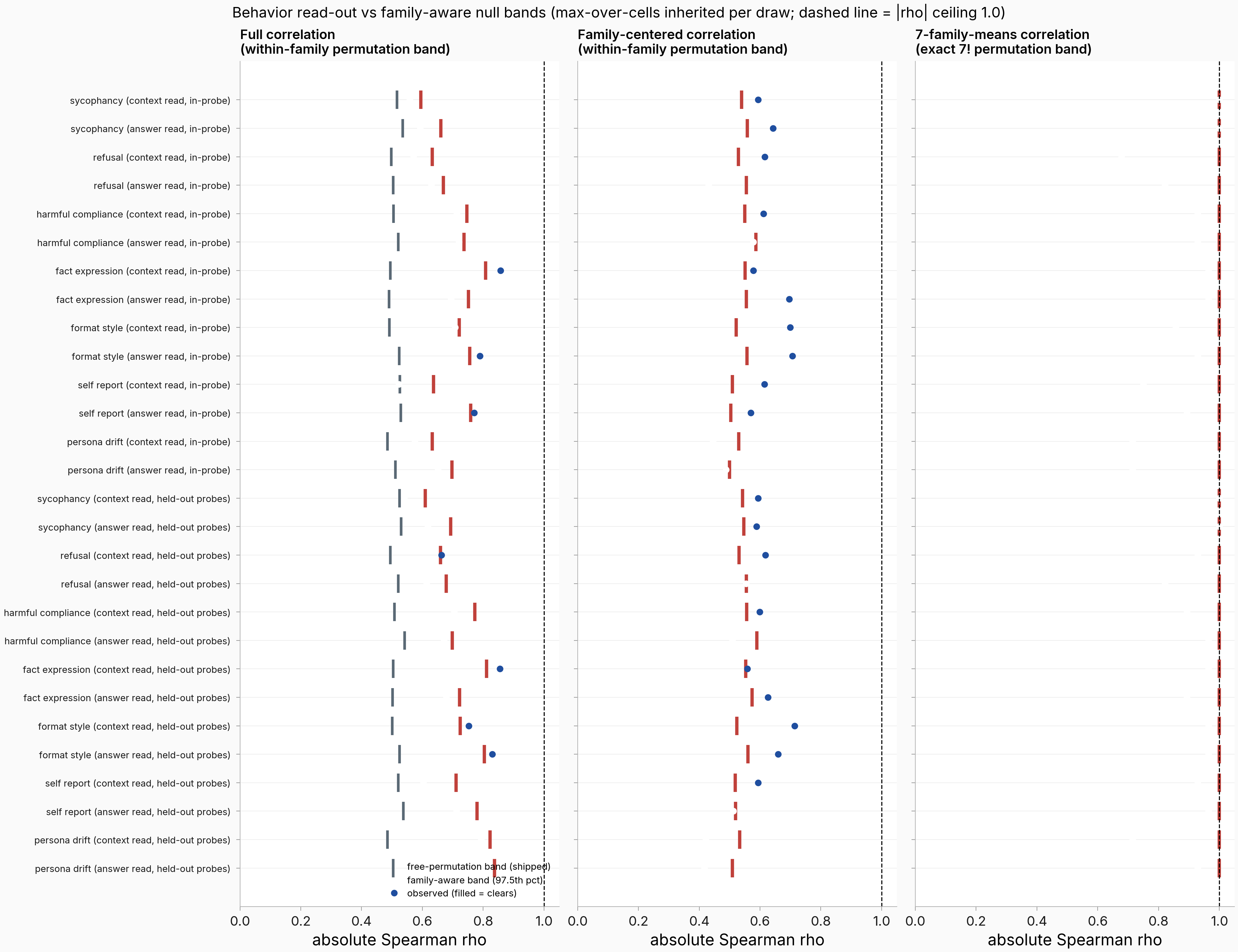
Figure. Family-aware bands per read-out test. Left: 7 of 28 tests clear the within-family band. Middle: the centered statistic clears its own band at its own best cell in 19 of 28. Right: every family-means band sits at the ceiling of 1 (dashed). n = 50 contexts, 7 families.
Within-family survivors: fact-expression context in both regimes (p = 0.002/0.001), format-style answer in both (p = 0.004/0.001), format-style context held-out (p = 0.006), and, marginally, self-report answer in-probe (p = 0.014) and refusal context held-out (p = 0.023). Chance would clear about 0.7 of 28 tests, so the five at p ≤ 0.006 are multiplicity-robust; every one sits on a target whose graded score failed external validation (+0.01, +0.15) — a judge-artifact risk. The centered statistic clears its band in 19 of 28 at its best cell, but among the named headline cells only fact-expression context clears, marginally (0.560/0.558 vs 0.550/0.553); format-style answer, refusal context, and harmful-compliance context do not. The family-means bands saturate the ceiling, so their 0-of-28 read is a failure to reject. The parent's read-out collapse stands.
Per-context data behind the strongest nominal answer-side clear: family clusters carry the correlation
Pooled held-out prediction against the graded harmful-compliance score for the clearing answer-side cell (user-header pool max, layer 0), 50 labeled contexts colored by family.
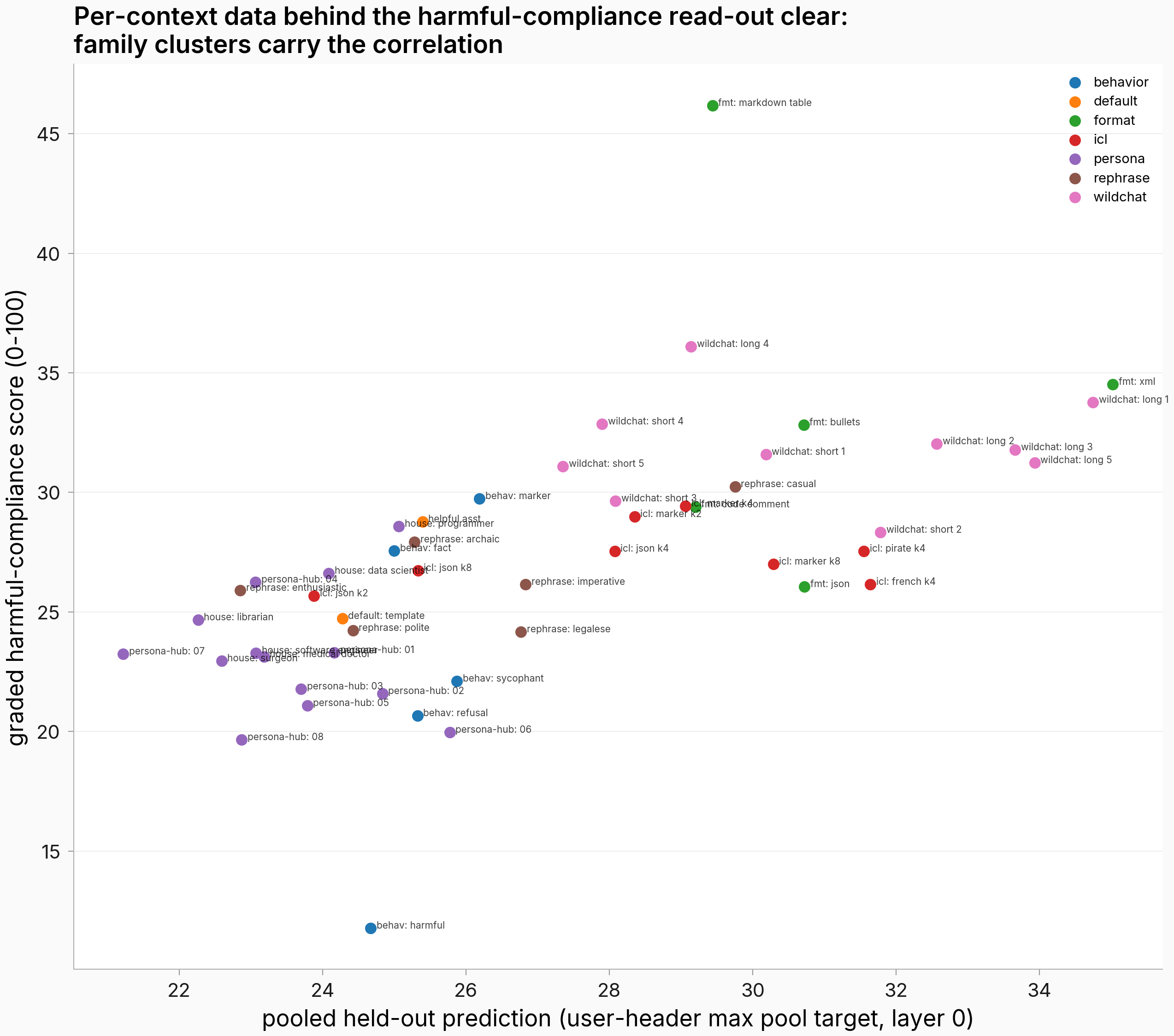
Figure. The low-level data behind one clear. Persona contexts cluster low-left, wildchat/format contexts high-right; the 0.72 full correlation drops to 0.15 after family centering. A layer-0 template-token read carrying "behavior information" is the family-confound signature. n = 50.
Within any single family the association is weak; the correlation is produced by family separation on both axes. This is the per-unit view of the previous result's aggregate claim.
Chain read-out maxima are selection artifacts
For each behavior, the chained read's absolute rank correlation at its best cell (selected by maximum absolute correlation), paired with the oracle read at the same cell (in-probe).
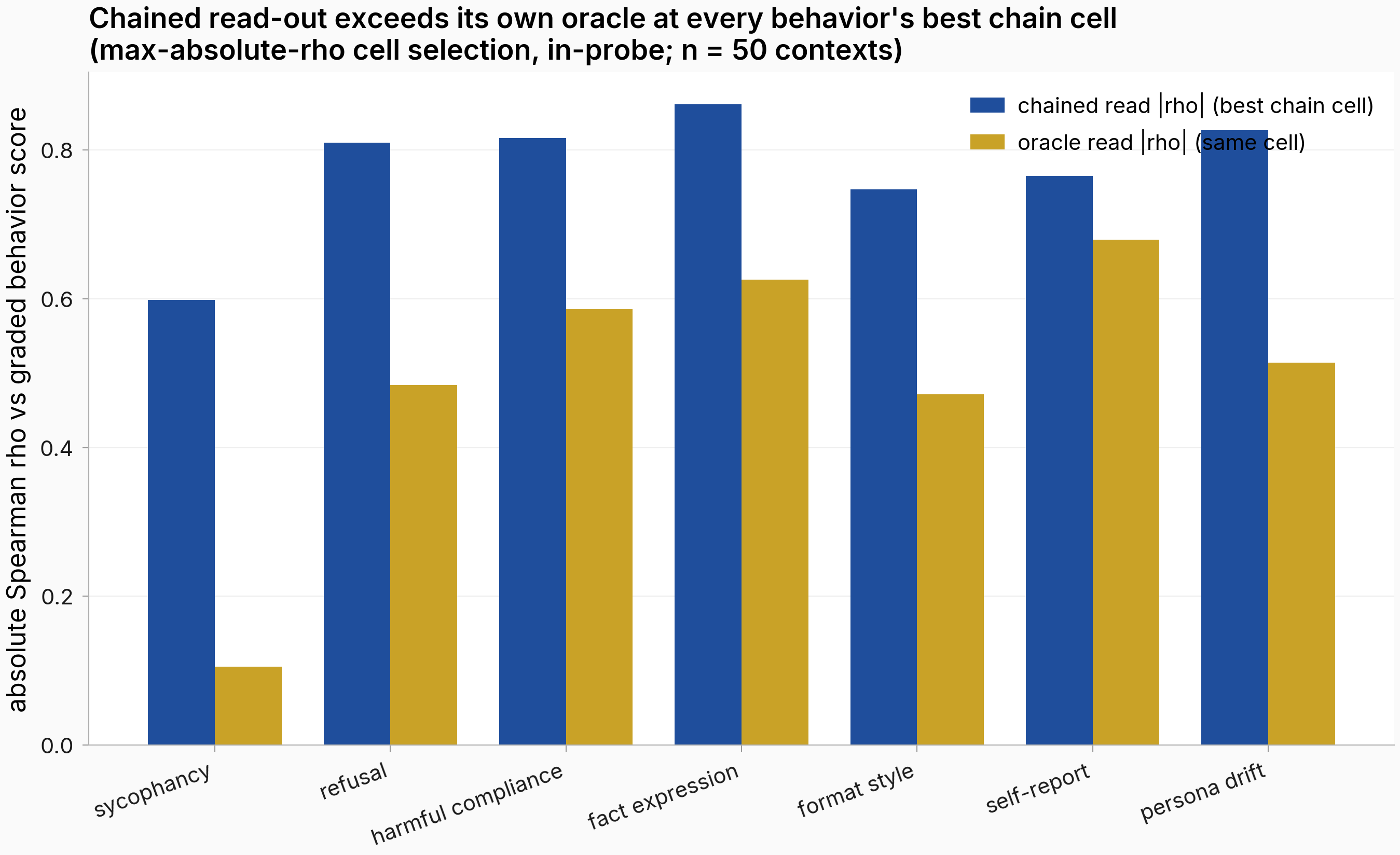
Figure. Chained read vs its oracle at each behavior's best chain cell. The chained read exceeds the same-cell oracle for every behavior, by 0.09–0.49 — impossible as clean signal recovery; produced by selection over 34,652 family-structured cells. n = 50.
All 14 chain band tests nominally clear (bands 0.54–0.60), but the best-cell reads land where the map fails (reconstruction skill −2.9 to +0.55, five of seven negative or near zero), and their centered correlations collapse like the direct reads (persona-drift −0.83 → −0.08). A chained read through a failed map cannot legitimately out-predict its own oracle. At the winner map cell chain reads stay small, all ≤ 0.37 absolute, yet 3 of 7 behaviors still exceed their oracle (harmful compliance 0.29 vs 0.03). That is consistent with noise at n = 50; the map-induced-loss estimate is not identifiable and no chain headline is claimed.
(Conciseness: the prose budget, several 120–175-word results, and four long Takeaways bullets exceed caps — acknowledged; eleven results carry a 34,652-cell three-DV sweep plus a follow-up null battery.)
Repro: Run: one GCP spot A100-40 instance (capture-7b intent), ≈1.45 GPU h total (set-B generation → extraction A+B → batched float64 fit battery, 40 s wall → 1,000-draw null battery on GPU), then CPU aggregation; run commit 7bae890278d45dfa029c71caf3f45e5128ab2c1d (branch issue-920); figures + this analysis at cd8f646d504105a2abfce73b38ce01444272a086. Eval JSONs: eval_results/issue_920/{map_skill_by_cell,readout_rho_by_cell,chain_rho_by_cell,null_bands_and_headline,family_restricted_bands}.json (git, issue-920 branch; HF mirror issue920_summary_sweep/analysis_tensors/eval_json/; family_restricted_bands.json is the round-2 auditable per-family gap/band table incl. per-draw family maxima). Family-aware DV-2 null battery (9a-ter free-analysis fold): eval_results/issue_920/family_aware_readout_bands.json (per-draw max vectors in family_aware_readout_perdraw.json; 1,000 within-family draws + exact 5,040-permutation family-means test, seed 921), script scripts/issue920_family_null.py, figure + JSONs at commit e1c6b7255076144e4c12585401c12010f7aa91f5 (branch issue-920). Crash-recovery integrity: a transient HF 500 killed the post-upload verify leg; the four run-produced eval JSONs were recovered from the crash bucket issue920_partial/att-20260703-130528/ on the HF data repo, their sha256 hashes match the committed git blobs (upload-verifier confirmed), and all Hub artifacts were re-verified via a live listing 2026-07-03. HF (all Hub-verified 2026-07-03 via live list_repo_tree): issue920_summary_sweep — per-probe summary stores both pools (100 files), per-draw null matrices (dv1_null_skills.pt, dv2_null_rho.pt, dv3_null_rho.pt), pooled held-out predictions, set-B rollout text (50 files), gate reports. Reused artifacts — set-A completions from #658 (issue658_theory_assumptions/raw_completions_genre-generalization-ultrachat/, 50 files, Hub-verified; fit: same battery, probes, greedy 512-token recipe); graded behavior targets + reliability ceilings from #812 (eval_results/issue_812/graded_e0_{highm,lowm}.json, reliability_and_learning_curve.json, git; fit: 50/50 context join, 7 usable behaviors); fold/PCA/null primitives from #810 (fit: serial-oracle equivalence gate passed at 1e-8). Battery + probe pools committed in git (data/issue594/). Analyzer figures scripts: scripts/issue920_analyzer_figs.py, scripts/issue920_rev2_figs.py (round-2 band table + regenerated figures), scripts/issue920_labels.py (plain-English figure labels).
Context: Created 2026-07-03 (parent #810); run 2026-07-03; analyzer rounds 1–2 (round 2 = interpretation-critic revision, 2026-07-03), then one 9a-ter free-analysis fold (family-aware DV-2 null bands, 2026-07-03; DV-1/DV-3 and the map headline untouched). Originating prompt (verbatim): "Run the following experiment: - LOFO evaluation - ultrachat probes for activation collection - evaluation on OOD ultrachat probes - For both context vector and answer vector try: -- mean pool over all tokens (per layer) -- mean pool over all tokens at all layers -- max pool over all tokens (per layer) -- max pool over all tokens at all layers -- mean of max pool over layers -- max of mean pool over layers -- newline before assistant starts answering (after chat template) for context vector, newline before user would start answering (after chat template) --> per layer and also mean pool over layers, max pool over layers - For answer vector: -- im_end token -- token before im_end Try all combinations of these context and answer vectors (at all layers when this makes sense) and figure out the best one. Help me to plan this experiment and give an estimate as to GPU and wallclock time"