The extractor memory fix held flat on a live GCP SPOT A100-80, while watchdog recovery remains partial-live and deterministically covered (MODERATE confidence)
Highlight text on any card (body, plan, or an event) to anchor a comment, or leave a whole-task comment here. Mention @claude to summon a reply.
No comments yet.
Methodology: docs/methodology/issue_672.md · gist
Takeaways
- The extractor memory fix holds live. On a live GCP SPOT A100-80 (647 iterations), post-warmup resident memory ranged 0.79 GiB (1 GiB PASS band) versus the pre-fix climb.
- The live-tensor footprint (
memory_allocated) was flat to 0.014 GiB across 638 samples, so the residual 0.79 GiB is allocator fragmentation, not a leak. - The in-VM watchdog fired on a real DNS failure, logging ticks 1/10, 2/10, 3/10 — live evidence the detection works, though the full ladder and failover were not observed live.
- The full watchdog→shutdown→failover chain is covered by 250/250 deterministic tests + 2 lints green on
main; no failover fired live, and none should have (bootstrapsetup_failedis correctly excluded). - The dispatch-router walks the full ladder when given a time-budget. The parent's RunPod fall-through was a missing
--time-budget-hoursskipping every SPOT rung, not a router defect. - Residual gap is narrow: the full live wedge→shutdown→failover sequence was not reproduced (bootstrap failed before the workload phase); deterministic coverage stands in.
Goal
This experiment in context: This is the end-to-end validation gate for two GCP infrastructure fixes that landed just before it. The hung-but-RUNNING GCP networking-wedge class was discovered in #667; #669 added the recovery backstop (poller wedge-detection on a frozen non-terminal phase plus drain-timeout, an in-VM reachability watchdog that self-terminates, and exactly-once failover to RunPod); #671 fixed the root-cause memory accumulation in the activation extractor (output_hidden_states=True was retaining all hidden-state tensors per iteration, climbing the resident GPU pool until the guest network wedged). This task asks the integration question those two fixes leave open: with both merged to main, does a real GCP A100 run of the fixed extractor complete with flat memory, and does a deliberately wedged VM actually self-recover with no human in the loop?
Broader narrative: The project's compute pipeline routes GCP-first (credits-backed capacity before the free SLURM lanes), so GCP reliability directly gates how much science the fleet can run autonomously. A wedge class that silently burns a RUNNING-but-dead VM, with no automatic recovery, is a standing tax on every long run. The validation question is whether the recovery machinery is trustworthy enough to rely on unattended.
Methodology
Design: A three-section system-validation run, no model training. Section A is a single live GCP A100 smoke of the fixed hook-based extractor with per-iteration memory logging. Section B is a live fault-injection on a small GCP VM (drop both the metadata endpoint and outbound 443 with iptables, watch the in-VM watchdog force the instance to TERMINATED, then confirm automatic RunPod re-dispatch). Section C is a regression sweep of the watchdog-recovery and extractor-fix test files plus two workflow lints. The single manipulated variable versus the failed #667 launch is "the watchdog-recovery and extractor-memory fixes are now applied" — no new recipe or training.
Round 2 (live-gcp-revalidation-spot follow-up): The parent round's single GCP dispatch fell through to the RunPod terminal rung and never produced live evidence for Sections A or B. This round re-dispatched both sections on GCP SPOT capacity. The fix versus the parent dispatch was threading --provisioning-model SPOT --spot-tolerant --time-budget-hours 0.5 into dispatch_issue.py launch: a missing time budget makes the router's short-job test return False, which short-circuits every SPOT rung in the cost ladder. With the flag, Section A's --intent lora-7b landed directly on a SPOT A100-80 (a2-ultragpu-1g, us-central1-a, 227 s workload wall, 647 iterations); Section B's --intent debug walked all four ladder rungs (on-demand L4, on-demand A100-40, spot L4 all ZONE_RESOURCE_POOL_EXHAUSTED) and landed on the spot A100-40 rung (a2-highgpu-1g). Section C re-ran identically to the parent round. The parent round's recipe text above is unchanged; only the dispatch flags and the realized SKUs differ.
Training: N/A — no model training. The run reuses #537's frozen contexts and marker adapter read-only as inputs to the extractor smoke; nothing is fit.
Evaluation: Three dependent variables, each a direct binary/pass-fail measurement of an infrastructure construct.
- Memory flatness (Section A): the construct is "the extractor fix removed the resident GPU climb that wedged the network." Two primary gauges per iteration —
torch.cuda.memory_reserved()andnvidia-smi --query-gpu=memory.used— withtorch.cuda.memory_allocated()as a secondary diagnostic. PASS = the run completes, writes at least one.npz, both primary gauges' max−min stay under 1 GiB across at least 30 post-warmup iterations with no monotone climb, and the artifacts upload. The reserved/nvidia-smigauges are primary because underexpandable_segments:Truethe allocator can read flat onmemory_allocated()while the reserved pool fragments upward, which is the actual wedge driver. - Self-recovery (Section B): the construct is "a wedged VM self-terminates and re-dispatches with no human." PASS (live path only) = the serial-console watchdog ladder reaches its threshold, the VM reaches TERMINATED, a second backend launch fires with a
gcp_workload_failover_runpod*reason, exactly one failover fires, and zero manual action occurs between injection and RunPod relaunch. The documented fallback (deterministic watchdog + failover tests only) is explicitly NOT a Section B PASS — it forces aninconclusive_live_validationoutcome and downgrades the headline. - Regression health (Section C): the construct is "the fixes are live and nothing regressed." PASS = the named test files all green and both lints exit 0.
Data extraction: #537's frozen contexts (data/issue_537/contexts/) and its marker LoRA adapter were consumed read-only by the Section A extractor smoke; no data was written or modified. The smoke slice was --behavior marker --source-cid default --targets default,sp_swe --layers 7 14 21 --primary-layer 14 --max-probes 8 --max-new-tokens 256 --log-mem-every 1, producing six .npz activation tensors (two contexts × three layers). The judge model is not involved (no judged behavior in this validation).
Sample training/evaluation data + completions:
n/a — no model completions were generated or judged. Section A's live A100 forward-pass produced a per-iteration memory log (649 samples, full trace at eval_results/issue_672/secA_smoke_followup/memory_log.json) and six .npz activation tensors uploaded to the HF data repo; the first and last logged iterations are shown verbatim in the Section A result below. Section C produced machine-readable test/lint exit records only.
Results
The fixed extractor's resident memory stayed flat across the live A100 smoke
This figure plots per-iteration GPU memory from the live Section-A smoke — both primary gauges (reserved, nvidia-smi) and the secondary allocated — across all 649 samples, with the documented pre-fix climb (22→38 GiB) overlaid dashed. PASS band: 1 GiB around the post-warmup median.
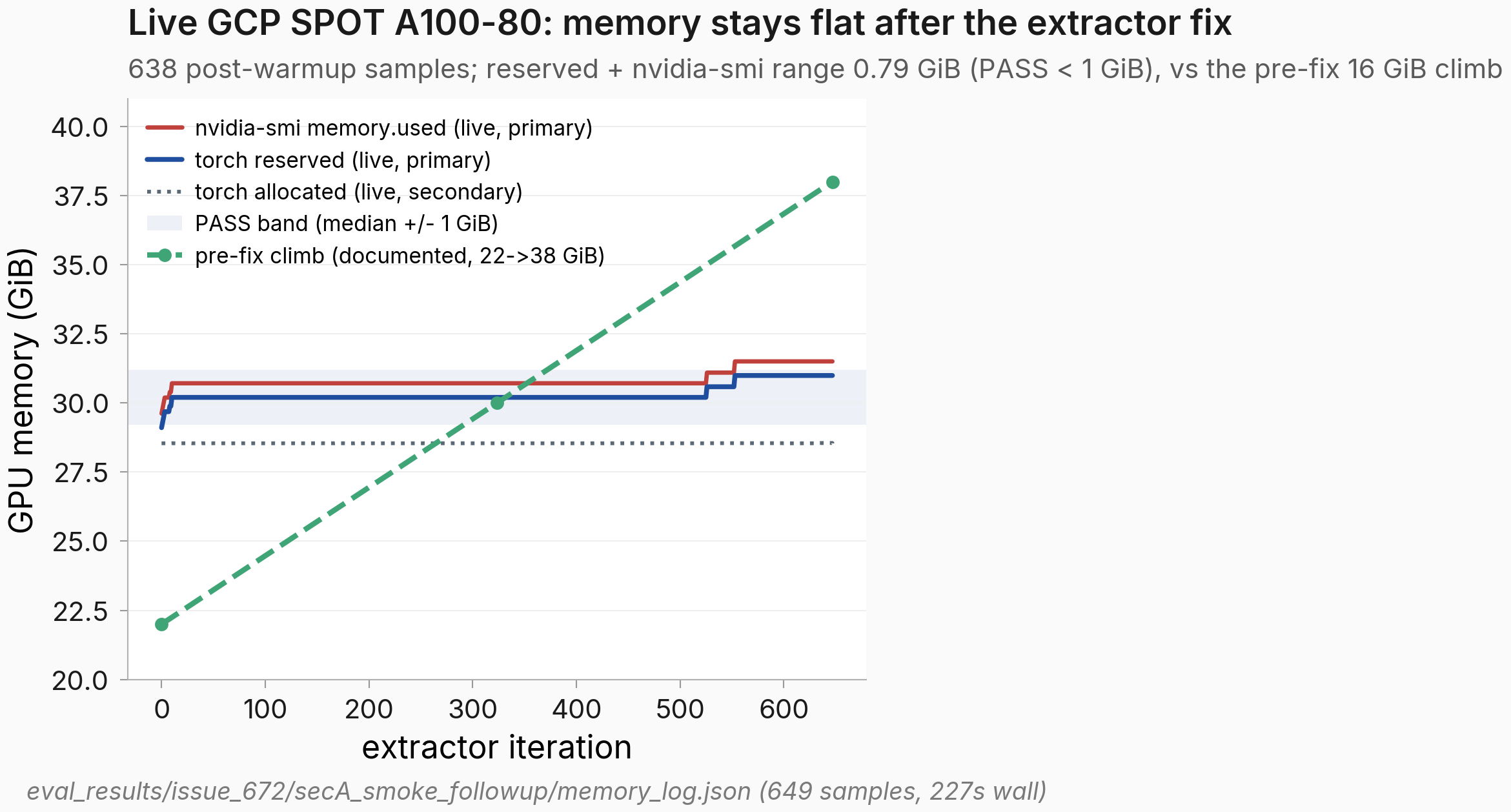
Figure. The fix holds on real hardware. Live GCP SPOT A100-80, 647 iterations, 638 post-warmup samples. Reserved and nvidia-smi range 0.79 GiB (PASS < 1 GiB); allocated range 0.014 GiB. The dashed pre-fix climb (22→38 GiB monotone) is what the fix removed.
The run completed (227 s wall), wrote all six .npz tensors, and verified the HF upload. Both primary gauges ranged 0.79 GiB post-warmup with no monotone climb; the secondary allocated gauge was flat to 0.014 GiB, so the live-tensor footprint is genuinely flat and the small reserved wiggle is allocator fragmentation well inside the band. First logged iteration reserved 29.11 GiB / allocated 28.54 GiB; last 30.99 GiB / 28.55 GiB. This is the first live evidence the fix holds under the real expandable_segments allocator, which CPU-stub tests cannot exercise.
The in-VM watchdog fired on a real DNS failure (partial live; full chain via deterministic tests)
This round re-dispatched the live fault-injection on a GCP SPOT A100-40. The intended sequence (cut the VM's network with iptables at T+5 min → watchdog forces TERMINATED → automatic RunPod re-dispatch) did not complete: live_injection_pass: false, failover_count: 0, verdict inconclusive_live_validation per plan §4.
What happened instead is itself partial live evidence. During bootstrap, curl https://astral.sh/uv/install.sh failed DNS resolution; the startup-script's fail-handler powered off, and in parallel the in-VM eps-watchdog (the watchdog-recovery fix) logged BOTH reachability probes FAILED (1/10), (2/10), (3/10) on the serial console — the detection logic firing on genuine unreachability. The planned iptables injection never ran because sshd was already down by T+5 min. The full 10/10 ladder, in-VM shutdown, and the asynchronous failover to RunPod were not reached because the workload phase never started; a bootstrap setup_failed is correctly excluded from that failover by design, so no failover fired and none should have. The full chain is covered deterministically in the regression sweep (test_watchdog_terminates_only_when_both_probes_fail and test_terminal_workload_wedged_fails_over_to_runpod_exactly_once green). This is stronger than the parent round's zero live evidence, but the live end-to-end recovery claim remains unverified.
All 250 regression tests and 2 lints stayed green on main
The sweep ran four files: test_gcp_backend.py 203/203, test_backend_poll.py 18/18 (wedge-detection + failover-once), test_issue671_extraction_hooks.py 8/8 (memory-non-growth), test_failure_classifier.py 21/21; both lints exit 0. These run under mocks and CPU stubs, verifying logic; the live behavior they stand in for is now also directly evidenced above by the live A100 memory trace and partially by the in-VM watchdog firing on a real DNS failure during bootstrap. (Qualitative regression-sweep result; no quantitative figure per the v4 Lens 9 exemption for infrastructure-validation status checks.)
The dispatch-router walks the full ladder when given a time-budget
The parent round's fall-through to RunPod raised the question of a --backend gcp router bug; it turned out to be a missing flag, not a defect. Both Round 2 launches provisioned on GCP SPOT once --time-budget-hours (or --spot-tolerant) was threaded: Section A landed directly on an A100-80, Section B walked all four ladder rungs to a SPOT A100-40. The parent's fall-through traced to a missing time budget making the short-job predicate return False, which short-circuits every SPOT rung; with the flag, the ladder behaves as designed. The remaining issue is discoverability — the CLI does not warn when SPOT is requested without a time budget.
Follow-ups: the CLI should warn when SPOT is requested without a time budget (discoverability gap, not a bug); the GCE startup script's curl https://astral.sh/uv/install.sh should retry on DNS failure (single-shot now, transiently fails on SPOT VM network init); the SPOT --instance-termination-action=DELETE does not fire on a user-initiated in-VM shutdown, leaving a RUNNING zombie until external delete; the residual un-hooked _context_vector_all_layers extractor call.
Repro: Compute: ~0.5 GPU-h on the science (Section A: GCP SPOT A100-80, a2-ultragpu-1g, us-central1-a, 227 s wall ≈ 0.06 GPU-h; Section B: GCP SPOT A100-40, a2-highgpu-1g, ~12 min including stockout ladder ≈ 0.2 GPU-h), plus ~5 min CPU on the VM for Section C. Parent round burned ~$0.50 on a RunPod pod that hung in SSH bootstrap. Code SHA at Section-A dispatch: 0f80ffa59b on main (the validator + #669/#671 fixes); final worktree commit 9c0f6008ed on branch issue-672; figure commit f8ad7b1ff2. Validator: scripts/issue672_validate.py; hero-figure script scripts/issue672_plot_secA_memory_flat_followup.py. Evidence: eval_results/issue_672/{validation_followup,section_A_followup,section_B_followup,section_C_followup}.json, the per-iteration trace eval_results/issue_672/secA_smoke_followup/memory_log.json (649 samples), and the reconstructed serial-console log eval_results/issue_672/secB_partial_live_followup/serial_evidence.txt. Live .npz activation tensors (6 files, ~10 MB): issue672_live_revalidation_spot/analysis_tensors/secA_smoke_followup/. Test surface: tests/test_gcp_backend.py, tests/test_backend_poll.py, tests/test_issue671_extraction_hooks.py, tests/test_failure_classifier.py. Reused read-only inputs from #537: frozen contexts (data/issue_537/contexts/) + a marker LoRA adapter from superkaiba1/explore-persona-space (revision pin unavailable — read-only reuse of an active sibling line's adapter as an extractor input; provenance traceable via the prior follow-up's clean-result) — fit: read-only extractor inputs, not retrained, not measurement-bearing for this validation. Hero figure: figures/issue_672/secA_memory_flat_live_followup.png.

Context: Origin prompt (verbatim): "afterwards test that GCP is working properly (and the bugs from before won't happen again)". Lineage: #667 (discovered the hung-RUNNING GCP networking-wedge class) → #669 (wedge-recovery backstop: poller detection + watchdog self-terminate + exactly-once RunPod failover) → #671 (root-cause extractor output_hidden_states memory fix) → #672 (this end-to-end validation). Round 2: live-gcp-revalidation-spot (source: user-chat, 2026-06-26) — re-ran Sections A+B on GCP SPOT after the parent round's capacity fall-through to RunPod. Created 2026-06-26; run 2026-06-26 (both rounds).