Install resistance is behavior-dominated, not a source trait — no persona resists everything (MODERATE confidence)
Highlight text on any card (body, plan, or an event) to anchor a comment, or leave a whole-task comment here. Mention @claude to summon a reply.
No comments yet.
Takeaways
- Install strength splits 89% behavior / ~2% source / ~10% pairing on a 15-source × 4-behavior grid; dropping the saturated behavior gives 85% / 3% / 11%.
- No global resistant persona: median cross-behavior source-rank correlation −0.33 (range −0.57 to +0.35), no stable positive source-resistance trait; transfer is weak and inconsistent, on saturated/tied-rank columns (sycophancy 14/15 at ceiling, fact reliability ρ=0.41).
- Base propensity is diagonal headroom, not a positive predictor: pooled base-vs-install correlation −0.31 (n=75), driven by the saturated behavior (ρ=−0.77); the off-saturation marker shows the opposite sign (ρ=+0.24).
- One suggestive case (a casual-register behavior installed 0.42 below base, identical at both seeds) hints at a construction-conflict lever; one source, one behavior, does not establish one.
- Every read is dose-unmatched (each cell trained at a different uncontrolled dose); separating dose from intrinsic resistance is a GPU follow-up, out of scope here.
What I ran
- Why: A program of matched-install leakage reads (#601, #627) needs to know what makes install strength vary across (source, behavior) cells. The question is whether resistance is a property of the persona, the behavior, or the specific pairing. This re-slices install diagonals already produced by three prior runs to answer that.
- Design: No training, no GPU. A deterministic ~10-second Python script reads four committed eval JSONs and re-slices per-cell install strength. The single read of interest is the source vs behavior vs pairing variance split on a 15-source × 4-rate-behavior install grid, plus a base-propensity predictor check per behavior.
- Training: n/a (re-analysis of committed artifacts; no model loaded).
- Eval: No eval suite. Metrics are a balanced two-way sum-of-squares partition of per-cell install strength (
trained − base), Spearman correlations of install on base propensity, bootstrap percentile CIs on the variance fractions, and a ceiling-drop sensitivity. The 15 source contexts are shared across the four rate behaviors so the source axis is comparable. Behaviors are named throughout with the implant program's labels (sycophancyis the agreement behavior; both names refer to the same column).
Findings
Install resistance is behavior-dominated, not a source trait (89% behavior-main, holds at 85% without the saturated behavior)
A balanced two-way variance partition of per-cell install strength over the 15 shared source contexts × 4 rate behaviors (fact, refusal, sycophancy, EM) splits the variance into source, behavior, and pairing-plus-noise (panel C).
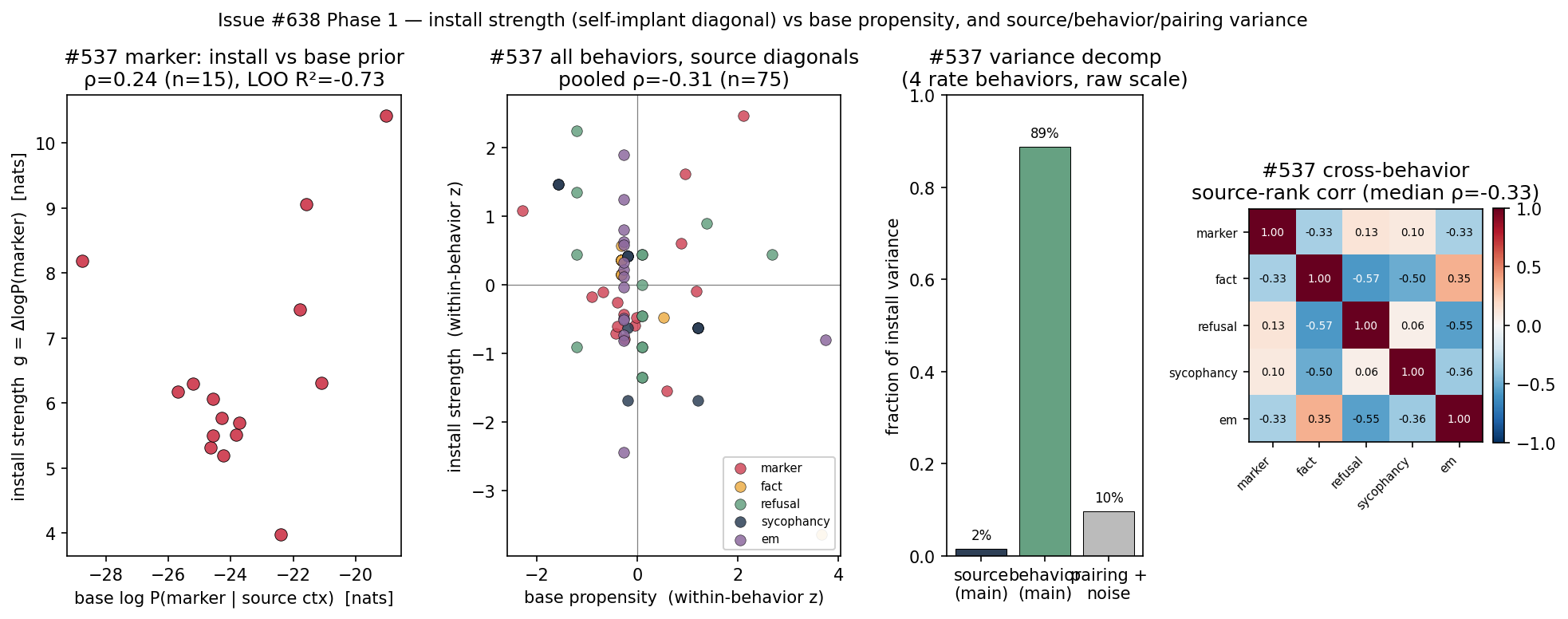
Figure (panel C). Behavior explains 89% of install-strength variance; source explains ~2%. Raw-rate two-way SS partition, 15 sources × 4 rate behaviors. Bootstrap 95% CI on the behavior fraction is 0.79–0.97; on source 0.003–0.035. Panels A/B/D carry the other findings.
What resists is whole behaviors: refusal floors at 0.00–0.40 install across every source while the sycophancy behavior saturates near-ceiling everywhere. Dropping the saturated sycophancy behavior moves behavior-main 89%→85% and source-main 2%→3%, so the structure survives the obvious saturation objection. The bootstrap CI resamples source contexts only (behaviors are fixed, n=4/5), so it quantifies source-sampling sensitivity, not behavior-axis uncertainty. Z-scoring removes the behavior column by construction and assigns 95% of variance to residual/pairing/noise, yet source-main still reads only ~5%; source stays small even when the framing maximally favors it.
No persona resists everything (median cross-behavior source-rank correlation −0.33)
Panel D matrix-encodes the per-source install rankings as Spearman correlations between every pair of behaviors. If resistance were a persona trait, the rankings would line up: a source that resists one behavior should resist others, with positive correlations across pairs.
Figure (panel D). No global resistant persona. Each cell is the Spearman correlation of per-source install ranks between two behaviors (15 sources). Median across the 10 behavior pairs is −0.33; range −0.57 to +0.35. RdBu_r scale, no overlays.
The rankings are mostly anticorrelated or independent: the median is negative and no pair clears +0.36 (the single positive endpoint is fact~em = +0.35). The matrix rests on saturated/tied-rank columns (sycophancy 14/15 at ceiling) and on fact, whose own cross-seed rank reliability is only ρ=0.41, so this is evidence against a stable global positive source trait, not a robust negative-transfer law. Either way, a source's resistance is specific to the behavior installed, which weighs against the persona-coherence reading at this resolution.
Base propensity is diagonal headroom, not a positive installability predictor (pooled −0.31, marker +0.24)
Off the diagonal, base prior predicts leakage positively. On the install diagonal the pooled base-vs-install correlation is −0.31 (n=75), opposite sign (panels A, B).
Figure (panels A, B). The pooled negative correlation is a ceiling effect, not a mechanism. Panel A: marker install vs base log P(marker), the one off-saturation behavior (ρ=+0.24, n=15). Panel B: pooled standardized install vs standardized base propensity across all 5 behaviors (ρ=−0.31, n=75).
The negative sign is a headroom artifact: install is trained − base, so a high base prior leaves less room to move and shrinks the delta. It is carried by the saturated sycophancy behavior (ρ=−0.77, 14 of 15 cells at ceiling); the marker, the one behavior with real headroom, shows the opposite sign (ρ=+0.24). No clean positive installability predictor exists here. A separate base-level predictor check on the behavior battery is also null (ρ=−0.07, n=18), corroborating that base level does not predict install. A separate 16-source marker run confirms the pattern: at its saturated anchor, install variance is ~100% base-prior variance, mechanically −base.
Identity / construction conflict is the clearest candidate lever found (casual register installs at −0.42)
Across a one-source-per-behavior battery, the cleanest residual is a case where training pushed a behavior BELOW base: a "casual lowercase register" trained on the home format-style behavior installed negatively.
Figure (context for this finding). Casual-register negative install is read identically at both seeds. L=−0.42 at seed 0 and seed 137 (base 0.54 → trained 0.12), inside a battery whose seed-pair reliability is ρ=0.94. The 4-panel figure carries the structural reads; this datapoint is JSON-only.
The negative install is identical at both seeds inside a battery whose seed-pair reliability is 0.94, so it is a real signal, not seed noise, and is in a matched-source diagonal cell with verified reliability. Other negative-install cells exist (refusal at −0.55 on a separate eval slice; a warmth behavior at −0.05 that reverses to +0.05 across seeds), but they are single-behavior cells outside the matched-source diagonal or not seed-robust, so casual-register is the clearest, not the only, case. It is consistent with the behavior conflicting with the source's construction rather than with a low base prior, but rests on one source and one behavior, so it points to a lever (deliberately engineering construction conflict) without establishing one.
Data
Trained on
n/a — no training in this task. Every input is an install diagonal already produced and committed by a prior run; this task only re-slices those numbers.
Evaluated with
Four committed eval JSONs supply the install diagonals. The primary input (issue #537) is a 5-behavior × 16-train-context install table with per-cell trained − base, base rate, marker base log-probability, and a saturation flag; its 15 shared source contexts are the only axis with a source dimension to decompose. A marker run over 16 sources (issue #474) corroborates marker install variance and supplies the saturation-tautology read. A one-source-per-behavior battery (issue #545) supplies the behavior-level ranking and the casual-register datapoint. A seed-replication file (issue #537) supplies cross-seed reliability. No new data was generated; this is tier-2 (established project artifacts).
4 examples of the input artifacts (4 of 4 rows — the complete set, not a sample):
4 input artifacts (the complete set this re-analysis reads)
| Input | Role | Pinned path |
|---|---|---|
| #537 install table | primary 5-behavior × 16-context install grid | G_meta.json |
| #474 marker diagonals | marker corroboration + saturation tautology | G_logprob_matrix.json |
| #545 L matrix | behavior-level ranking + casual-register datapoint | L_matrix.json |
| #537 seed replication | cross-seed reliability | seed2_replication.json |
Full input set: eval_results/issue_537/ · issue_474/ · issue_545/
Generated
The re-analysis produced one results JSON and one 4-panel figure; no model completions were generated (this is a numeric re-slice, so there is no firing/non-firing sample to show). Every Takeaways and Findings number maps to a key in the results JSON.
4 examples of the computed reads (the complete key set is in the linked file):
The computed reads (4 of the JSON keys, the load-bearing ones)
| Read | Value | JSON key |
|---|---|---|
| raw-rate variance split | source 0.015 / behavior 0.888 / pairing+noise 0.096 | datasets.537.decomp_raw_rate_behaviors_only |
| ceiling-drop sensitivity | source 0.034 / behavior 0.852 / pairing+noise 0.114 | datasets.537.decomp_raw_rate_ceiling_sensitivity.drop_sycophancy_3_behaviors |
| cross-behavior source-rank corr | median −0.329 | datasets.537.cross_behavior_source_rank_corr |
| pooled base-vs-install | −0.307, n=75 | datasets.537.pooled_within_behavior_base_vs_install |
Full results JSON (all keys): install_resistance_results.json
Reproducibility
Parameters:
| Parameter | Value |
|---|---|
| Task kind | analysis (0-GPU, JSON-only) |
| Base model | n/a — no model loaded (underlying runs used Qwen-2.5-7B) |
| Decomposition | balanced two-way SS partition (source × behavior), raw-rate + within-behavior z |
| Ceiling-drop variant | drop_sycophancy_3_behaviors (registered; per-cell mask degenerates and is not cited) |
| Bootstrap | B=2000, rng(0), resamples the 15 source contexts (source-sampling sensitivity only, not behavior-axis uncertainty) |
| Source-data seeds | #537 marker/fact 42 + 1042; #545 0 + 137 |
| Shared source contexts | 15 |
Artifacts:
- Results JSON (all reads):
install_resistance_results.json - 4-panel figure:
install_resistance.png - Reused install diagonals from #537:
eval_results/issue_537/— fit: only dataset with a 15-source shared axis to decompose; install DV is the producing run's own on-policy diagonal. - Reused marker diagonals from #474:
eval_results/issue_474/cross_eval/loc_ep1/— fit: marker corroboration; used only for the saturation-tautology read, not for the source/behavior decomposition. - Reused behavior battery from #545:
eval_results/issue_545/L_matrix.json— fit: behavior-level ranking + casual-register datapoint; one source per behavior, so no source axis (decomposition-infeasible, used for the residual signal only). - WandB run: n/a (re-analysis, no training metrics)

Compute:
- Wall time: ~10 s CPU on the VM
- GPU: none (0 GPU-hours)
- Pod: none (off-pod, reads committed JSON)
Code:
- Re-analysis script:
scripts/issue638_install_resistance.py— deterministic, 0-GPU, JSON-only. - Reproduce:
uv run python scripts/issue638_install_resistance.py(reads the four input JSONs above, writesfigures/issue_638/install_resistance_results.json+install_resistance.png). - Committed at commit
fff6db749ec5614a29ad53f888271f3aeb0b47c8.
Context:
- Created / run: task created 2026-06-14; re-analysis run 2026-06-14 (4 plan additions landed, deterministic ~10 s).
- Follow-up to: fresh direction (no parent); complement to #637 (the off-diagonal leakage-asymmetry sibling) and the #526 predictor-rule program.
- Originating prompt(s), verbatim:
we also want to understand why some sources resist being trained with certain behaviors more