The full-response JS predictor scores well on the full panel largely because of the stylized vs nonstylized split (LOW confidence)
Highlight text on any card (body, plan, or an event) to anchor a comment, or leave a whole-task comment here. Mention @claude to summon a reply.
No comments yet.
Human TL;DR
Headline. The output-distribution JS predictor "works" on the full 16-persona panel, but once I drop the three theatrical personas (pirate / stand-up / villain) it stops generalizing — so most of the full-panel score was the stylized-vs-rest gap doing the work, not a continuous distance gradient.
Takeaways.
- Phase 1 closed parent #511's loose ends —
gauss_klat layer 22 holds at out-of-sample CV R² ≈ 0.62 with the full ridge (N=500, R=10), and MMD / Wasserstein-2 / cosine all sit at 0.56-0.58. The plateau-on-N verdict holds at 94 of 108 (layer × metric × epoch) cells; the other 14 areintermediate(mostly L23-L24 wass2 and the L0/L11/L24 cosine sentinels). No surprise there. - The full-response JS predictor lands at CV R² ≈ 0.24 on the full panel — roughly one-third of all four activation predictors.
- When I drop the three high-stylization personas, JS out-of-sample CV R² falls to ≈ −0.02 with the panel-row CI straddling zero (upper edge ~0.08) — so no DEMONSTRATED out-of-sample skill at this panel size, but I can't claim a negative either. The in-sample length-partialled ρ on that subpanel is still +0.27 (panel-row CI strictly positive, p ≪ 0.001), a modest non-zero correlation that just doesn't survive leave-one-cond-out CV. JS retains weak within-nonstylized signal that doesn't survive LOCO with only 13 highly-correlated nonstylized personas to leave out.
How this updates me. Less optimistic that "cheap base-model JS on the output distribution" is a real substitute for activation geometry — at least for predicting marker-leakage transfer. Activation predictors beat JS on the full panel at ~2.4× CV R²; whether they ALSO collapse on the nonstylized subpanel is the natural next test and hasn't been run yet. What would move me back: a clean within-nonstylized JS result on a richer panel of "normal" personas.
(First pass — Thomas refines this before sending to the mentor.)
TL;DR
Motivation
Parent task #511 ran a multi-metric predictor sweep to find which base-model distance between two personas best predicts how the marker-leakage signal transfers between them — using the ΔG matrix from #474 as the target. Phase 1 of #511 plateaued the headline cell (Gaussian-KL at residual-stream layer 22, predicting count-style ΔG, out-of-sample CV R² ≈ 0.62), but an autonomous compute-deviation descope dropped wass2, the N=500 × R=10 ridge, the loc-epoch robustness sweep, and a full-response JS baseline. This task ran the dropped pieces. Phase 1 (CPU, ~36h on the VM) restored the full activation-space sweep: wass2 added, ridge at N=500 × R=10, loc-arm epochs {1, 2, 3, 5}. Phase 2 (GPU, 1× H100, ~3d20h) built the full-response Rao-Blackwellized JS predictor from scratch (the deprecated single-next-token JS in #511's plan does NOT count) and compared it against the four activation metrics on the same 16-persona panel.
The reason this question matters: if a cheap output-distribution metric (one base-model pass; no residual-stream extraction; no cloud-aware ridge) predicted leakage as well as the activation geometry, that would be a much simpler causal probe. The question I had going in was "does it?"
The construct I'm measuring is predictor-vs-leakage skill — out-of-sample CV R² and length-partialled Spearman ρ — on the 240 ordered pairs of 16 base-model personas. Higher is better, both metrics agree, and the CIs are panel-row bootstraps (n_boot=2000, seed=42) over the 240 pairs. A separate JS-estimator Monte-Carlo CI (probe-bootstrap, also n_boot=2000) is reported alongside to confirm that the JS sampling budget is not the bottleneck.
What I ran
Phase 1: activation-predictor sweep, full scope. I re-ran scripts/issue511_probe_count_sweep.py with the descoped axes restored:
- Metrics:
gauss_kl,mmd,wass2,cosine(Phase 1 of #511 had dropped wass2). - Probe counts (N): {25, 50, 100, 200, 350, 500} (capped at 350 in #511).
- Replicates (R) at each (N, layer, metric): 10 (was 5).
- Layers: L19-L24 (the band #502 identified as best — last-prompt-token extraction).
- Loc-arm epochs: {1, 2, 3, 5} (was loc_ep1 only).
- Output: 6480 fit rows in
eval_results/issue_522/probe_count_sweep_results.json; plateau verdict per cell.
Phase 2: full-response JS predictor. I built a fresh script (scripts/issue522_js_predictor.py) implementing the canonical full-response Rao-Blackwellized JS estimator (Amini/Vieira/Cotterell 2025, arXiv 2504.10637), which is the only operationalization the project rule sanctions (.claude/rules/persona-distance-metrics.md; #404 and #458's older single-next-token JS is deprecated). For each of the 16 personas A, sample 8 on-policy responses (temp=1, ≤256 tokens) on each of 200 probes from #502's probe set; that's the FROM side. For each of the 16×16 ordered pairs (A, B), teacher-force each of A's sampled responses through B's persona-conditioned base model, get the exact full-vocab per-position next-token distributions under both A and B, compute the per-position JS, length-normalize, then average over positions and responses. Internally the reducer accumulates JS in nats and divides by log(2) before storing, so every JS value in js_matrix.json and every downstream JS number in this writeup is in base-2 bits (bounded in [0, 1] for two distributions). Total cache: 409,600 entries (16 cond_ids × 200 probes × 4 epochs × 8 responses, with per-epoch caching for the bystander-direction reuse). Smoke gates: max-diagonal JS = 0 bits; max-symmetry residual = 0 bits.
The regression step. Length-partial Spearman ρ + LOCO (leave-one-cond-out) CV R² of M_js = 1 − JS against the #474 ΔG matrix (the matrix's delta_g field is in nats; only the JS predictor input is in bits). Two panels: full (240 ordered pairs across 16 personas) and nonstylized (156 pairs across the 13 personas that exclude the three high-stylization arms — A3 Pirate captain, A4 Stand-up comedian, A5 Villainous mastermind). Four target epochs (1, 2, 3, 5). Panel-row bootstrap with n_boot=2000, seed=42 for 95% CIs on the panel-row CV R²; a separate JS-estimator probe-bootstrap (also n_boot=2000) gives the Monte-Carlo CI on the JS values themselves.
The 16 personas, in plain English:
The 16 base-model personas (from #406)
| Class | cond_id | Name |
|---|---|---|
| A | A1 | Helpful assistant |
| A | A2 | Software engineer |
| A | A3 | Pirate captain (stylized) |
| A | A4 | Stand-up comedian (stylized) |
| A | A5 | Villainous mastermind (stylized) |
| B | B1 | Bare question |
| B | B2 | Imperative tell-me |
| B | B3 | Polite request |
| B | B4 | Formal request |
| B | B5 | Socratic hypothetical |
| C | C1 | Standard Qwen template |
| D | D1 | Formal register rewrite |
| D | D2 | Casual register rewrite |
| D | D3 | Indirect framing rewrite |
| D | D4 | Declarative form rewrite |
| D | D5 | Enumerated framing rewrite |
The "stylized" label is the three personas that adopt a strong narrative voice; the other 13 are everyday assistants varying mostly in register and phrasing. Full configs in src/explore_persona_space/experiments/i406_conditions.py.
Example probe (from #502's mixed-distribution probe set): "What's the most important property of a good error message?" — same probe asked under all 16 personas; per-pair JS is computed over each pair's 8 sampled responses × 200 probes.
Findings
The activation-predictor plateau from parent #511 still holds. Restoring the full N=500 × R=10 ridge across layers 19-24, metrics {gauss_kl, mmd, wass2, cosine}, and loc-arm epochs {1, 2, 3, 5} gives no surprises: the L22 / gauss_kl headline cell still plateaus at CV R² ≈ 0.62 at epoch 1 (best subset replicate 0.6196; mean across 10 subsets 0.6174), with the plateau verdict holding at N=500 (δ from N=350→500 is +0.00266, well inside σ_ref ≈ 0.00361). At the same L22 / N=500 / epoch 1 cell, MMD = 0.580, Wasserstein-2 = 0.568, cosine = 0.557 — so the gauss_kl-edges-MMD-edges-wass2-edges-cosine ordering from #511's smaller ridge holds. Across loc-arm epochs, ep1 is the high-altitude row with all four metrics 0.13-0.21 above their ep2-5 plateau (ep2 = 0.41/0.40/0.39/0.38, ep3 = 0.44/0.43/0.42/0.41, ep5 = 0.45/0.44/0.44/0.43 for the same metric order); within each later row the metric ordering shuffles inside subset-σ (at ep3, L21/MMD edges L22/gauss_kl by ~0.001; at ep5 they tie at 0.448). The plateau-on-N verdict holds at 94 of 108 (layer × metric × epoch) cells; the remaining 14 sit at intermediate (mostly L23/wass2 across all four epochs, L24/wass2 ep2, L24/cosine ep1/2, plus sentinel L0/L11 cosine cells — none drop below plateau). So "N=500 is enough" is true for the headline and most of the sweep, but a sweep extending to higher layers or non-band metrics may need a larger N. This arm was always a "verify the existing line still holds" check, not a new finding — the per-cell CV R² table is the artifact, in probe_count_sweep_results.json. The new finding is the JS predictor below.
A full-response JS predictor scores ρ = 0.54 / CV R² = 0.24 on the full 16-persona panel
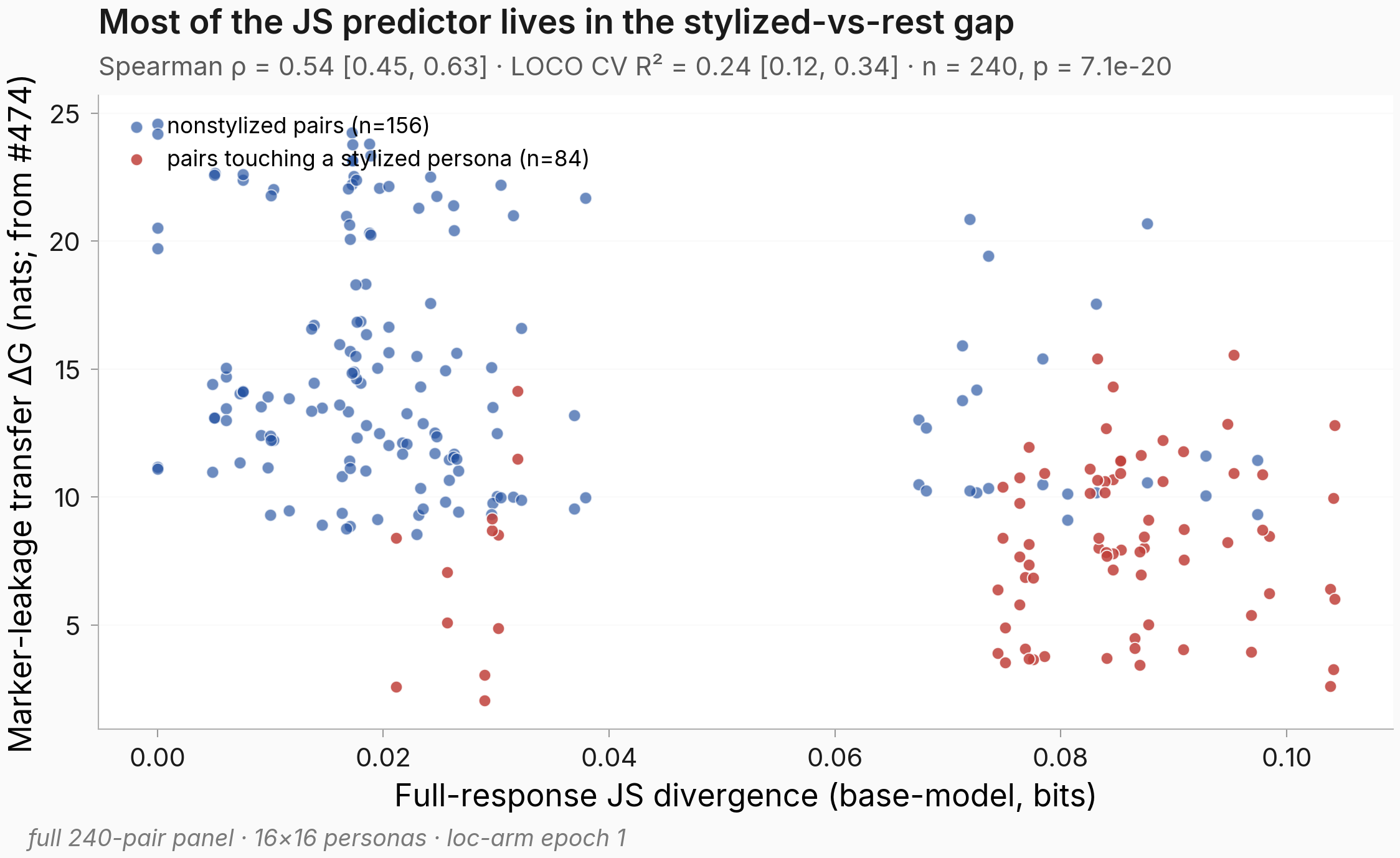
Figure. Most of the full-response JS signal lives in the gap between stylized and nonstylized personas, not in a continuous distance gradient. Each dot is one of 240 ordered persona pairs (a → b). X-axis: full-response JS divergence between base-model output distributions under persona a and persona b, in base-2 bits (bounded [0, 1]). Y-axis: marker-leakage transfer ΔG between the same pair, from #474's loc-arm checkpoint at epoch 1, in nats. Blue points are pairs where neither persona is stylized (156 of 240); red points touch one of A3 / A4 / A5 (84 of 240). The red points span JS = 0.021-0.104 bits (median 0.084) — and crucially the 6 within-stylized ordered pairs (A3↔A4, A3↔A5, A4↔A5) sit at JS = 0.021-0.029 bits, squarely inside the low-JS band the rest of the figure assigns to blue. The header statistics (ρ = 0.54, CV R² = 0.24) are computed on the full panel and length-partialled.
The number reads positive on the full panel: Spearman ρ = 0.54 and LOCO CV R² = 0.24 (panel-row bootstrap CIs both strictly positive, p ≪ 0.001 against the null). The JS-estimator Monte-Carlo CI on the same CV R² is much tighter than the panel-row CI (the Monte-Carlo CI is ~14× narrower), which says the JS sampling budget (200 probes × 8 responses per persona) is NOT the bottleneck for this measurement; the panel-row CI dominates. Taken on its own, then, the answer is "yes, a base-model on-policy JS divergence has skill at predicting how marker-leakage transfers."
But the figure shows where the skill comes from. The 78 CROSS-CLUSTER stylized-touching pairs (one stylized, one not) sit at high JS (range 0.030-0.104 bits, median 0.085) and moderate ΔG; the 156 nonstylized-only pairs (blue) sit at low JS (range 2e-08 to 0.097 bits, median 0.019). The full-panel correlation is largely a between-cluster contrast. Splitting "stylized-touching" further: the 6 WITHIN-stylized ordered pairs cluster at JS = 0.021-0.029 bits, overlapping the blue cloud, so calling all 84 red dots "high JS" overstates the picture.
How much of the signal IS the binary? A point-biserial of the stylized-touching indicator against JS gives r = 0.72 (p = 3.4e-40); against ΔG it gives r = -0.61 (p = 3.8e-26). So the binary alone carries most of both axes' variance.
A short aside on the secondary target g_logprob (which #474 measures alongside delta_g): JS regressed against g_logprob instead of delta_g gives the same full→nonstylized collapse pattern at slightly lower magnitudes — full ep1 cv_r2_glog ≈ 0.125 (vs 0.241 for ΔG); nonstylized ep1 cv_r2_glog ≈ -0.016 (vs -0.022). So the read above is not a ΔG-specific artifact.
JS sits ~½ the predictive power of the four activation-distance metrics
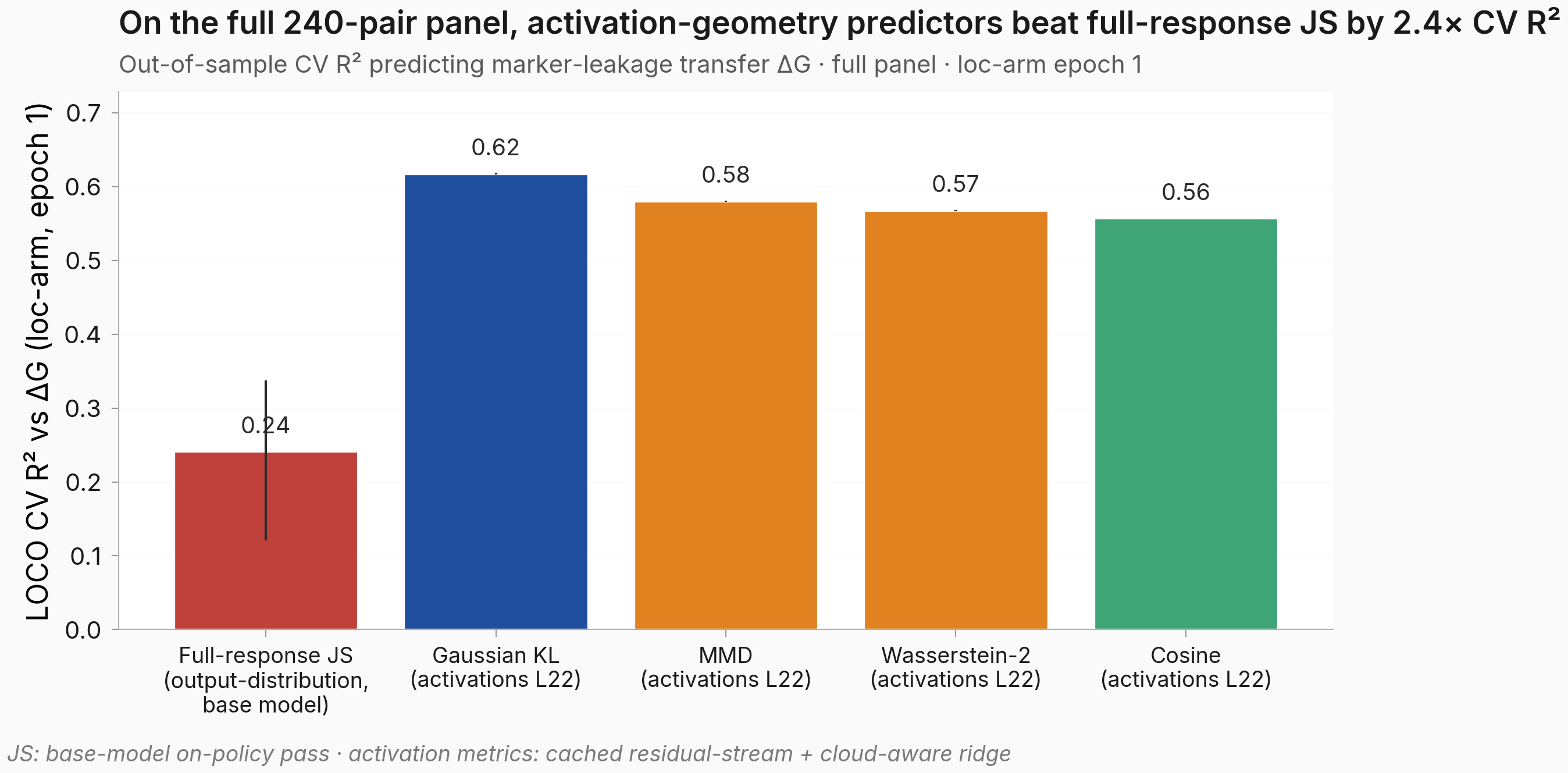
Figure. On the full 240-pair panel, all four activation-geometry predictors (cloud-aware ridge at layer 22) achieve more than twice the out-of-sample CV R² of the output-distribution JS predictor. X-axis is the predictor; y-axis is leave-one-cond-out CV R² against the same ΔG target (loc-arm, epoch 1, full 240 pairs). Error bars on the JS bar are the panel-row bootstrap 95% CI; error bars on the activation bars are subset-σ across 10 ridge replicates at N=500 — different uncertainty quantifications, which is why the JS error bar is dramatically wider. The JS predictor was a 1× H100 base-model forward-pass job; the activation predictors run on cached residual streams plus a cloud-aware ridge fit on CPU.
On the same full panel × epoch 1 cell, all four activation predictors more than double JS's CV R²: gauss_kl ≈ 0.62, MMD ≈ 0.58, wass2 ≈ 0.57, cosine ≈ 0.56, against JS at 0.24. That's a ~2.4× gap from the BEST activation predictor and a ~2.3× gap from the WORST (cosine still beats JS by more than 2×). So even if you accept "the JS predictor works on the full panel," it works much less well than the cheaper option you already have if you can read residual streams. The figure intentionally pairs different uncertainty quantifications: the JS bar is a panel-row bootstrap (the 240 pairs are the noise source); the activation bars are subset-σ across 10 ridge replicates (the ridge fit itself is the noise source). The JS bar's wider error is honest: with 156 highly correlated nonstylized pairs in the panel-row pool, the bootstrap legitimately spans a wider band than the ridge-replicate σ.
Drop the stylized personas, and the JS predictor loses out-of-sample CV-R² skill
The full-panel result already hinted that the JS signal was carried by the stylized split. Restricting the panel to the 13 nonstylized personas (156 pairs) confirms it for out-of-sample CV R² — but with an important nuance the headline obscures.
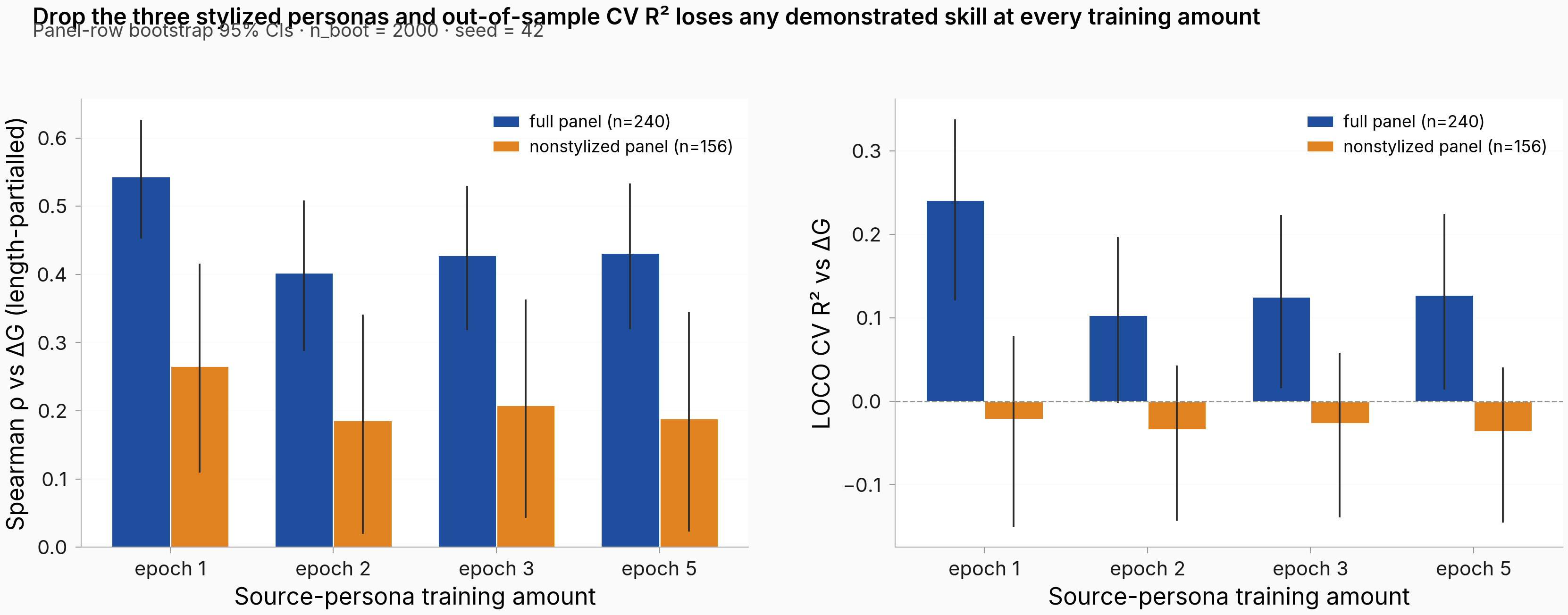
Figure. Removing the three stylized personas pushes the JS predictor's out-of-sample CV R² to ≈ 0 with all four panel-row CIs straddling zero, while the in-sample length-partialled ρ stays positive at ~0.20-0.27. Left panel: length-partialled Spearman ρ between JS and ΔG. Right panel: leave-one-cond-out CV R² for the same. Blue bars are the full 240-pair panel; orange bars are the nonstylized 156-pair subpanel. Source-persona training amount on the x-axis. Error bars are panel-row bootstrap 95% CIs (n_boot = 2000, seed = 42). The dashed grey line on the CV-R² panel marks zero. Three stylized personas excluded from the orange subpanel: Pirate captain (A3), Stand-up comedian (A4), Villainous mastermind (A5).
At epoch 1, the full panel reads ρ = 0.54 / CV R² = 0.24; the nonstylized subpanel reads ρ = 0.27 (panel-row CI strictly positive, p ≪ 0.001) / CV R² = -0.022 (panel-row CI straddles zero, upper edge ~0.08). The pattern holds across epochs 2, 3, 5: full-panel CV R² stays positive (0.10-0.13) but nonstylized CV R² is centered slightly below zero at every epoch (range -0.036 to -0.022, all four panel-row CIs straddle zero with the upper edge under +0.08).
The headline reading is straightforward: out-of-sample LOCO CV R² is centered at zero or slightly negative on the nonstylized subpanel, CIs straddle zero, so there is no demonstrated out-of-sample skill at this panel size. JS doesn't generalize on the nonstylized panel under leave-one-cond-out.
But two different operationalizations of "association" disagree here, and the disagreement is worth unpacking. The in-sample length-partialled ρ on the same subpanel is +0.27 (panel-row CI strictly positive, p ≪ 0.001); the raw un-partialled within-nonstylized Spearman ρ(JS, ΔG) is -0.26 (p = 0.0009, n = 156, the right sign: high JS → low transfer). Both are weak in-sample associations. Neither survives LOCO with only 13 personas to leave out. The partialled ρ retains a modest in-sample correlation; the LOCO CV R² says that correlation does not generalize across held-out personas. "Zero out-of-sample CV-R² skill" is not the same as "no signal at all."
A separate caution: LOCO on 13 highly correlated nonstylized personas is itself a stress test, not a clean held-out benchmark, so a negative CV R² there is consistent with both "the predictor genuinely doesn't generalize" and "the LOCO scheme has too little held-out signal on a panel this small." The right next step is to check whether the activation predictors ALSO collapse on the same nonstylized subpanel — a small extension to the existing sweep script that needs no new GPU time, since the residual streams are cached.
The within-stylized 6-pair raw ρ(JS, ΔG) is -0.48 (p = 0.34, n = 6), the right sign, suggesting JS may carry a within-stylized gradient that the tiny sample can't certify. An additional 4 nonstylized blue pairs sit at JS > 0.08 (e.g. (A2, D5) JS=0.097 bits / ΔG=11.44 nats, (D2, A2) JS=0.088 bits / ΔG=20.69 nats), so "nonstylized JS is confined to 0-0.04" understated the panel; 24 of 156 nonstylized ordered pairs have JS > 0.04 bits.
Five raw pair-level rows (JS, ΔG) at loc-arm epoch 1 — cherry-picked for illustration
All values are from eval_results/issue_522/js_matrix.json (JS, in base-2 bits) and eval_results/issue_474/cross_eval/loc_ep1/G_logprob_matrix.json (ΔG, in nats), indexed as G[source][target]["delta_g"] — matching the orientation the regression code uses (scripts/issue522_js_regress.py:109). For reference, the self-strength diagonals are ΔG[A1][A1] = 26.02, ΔG[B1][B1] = 24.64, ΔG[D2][D2] = 23.57, ΔG[D3][D3] = 25.48.
| Source persona | Target persona | JS (bits) | ΔG (nats) | Class |
|---|---|---|---|---|
| Helpful assistant (A1) | Bare question (B1) | 2.0e-08 | 11.19 | nonstylized |
| Helpful assistant (A1) | Software engineer (A2) | 0.0713 | 13.78 | nonstylized |
| Helpful assistant (A1) | Pirate captain (A3) | 0.0768 | 6.88 | stylized-touching |
| Pirate captain (A3) | Stand-up comedian (A4) | 0.0290 | 2.06 | within-stylized |
| Casual register (D2) | Indirect framing (D3) | 0.0247 | 21.75 | nonstylized |
Two qualitative reads still hold against the corrected numbers:
- The continuous distance gradient is weak for normal pairs. The (A1, B1) pair has JS = 2e-08 bits (essentially zero) yet ΔG = 11.19, only ~43% of A1's self-strength (26.02). So even at zero JS, transfer is far from complete. The (A1, A2) pair has JS = 0.071 (much larger) and ΔG = 13.78, slightly LARGER not smaller, running counter to the "more JS → less transfer" story.
- Within-stylized pairs have low JS but the lowest ΔG. (A3, A4) has JS = 0.029 bits and ΔG = 2.06: small JS, very small transfer, the right SIGN for the within-stylized triangle (ρ = -0.48, n=6, p=0.34), but the panel is too small to certify.
The (A1, B1) row in particular falsifies the round-1 framing "look, zero JS predicts complete transfer here": A1→A1 transfers 100%, A1→B1 transfers 43%. The continuous gradient is real on the within-nonstylized subpanel (raw ρ = -0.26, p = 0.0009) but small in magnitude.
Note on the activation predictors and the same subpanel. Phase 1's sweep did NOT run a nonstylized-only ridge — bakeoff._pairs always builds the full 240-pair panel for that script. So I can't say from this run whether gauss_kl's CV R² of 0.62 ALSO collapses when the stylized personas are dropped. The "activation predictors are better" claim above is a full-panel claim, NOT a stress-test claim. If they ALSO collapse on the nonstylized panel, the right read is "all distance predictors of marker-leakage transfer are basically detecting the stylized split, and the result generalizes poorly." If they don't, the right read is "activation geometry captures the within-nonstylized signal that output-distribution JS misses." This is the natural follow-up — small extension to the existing script, no new GPU time needed (the residual streams are cached).
Reproducibility
Parameters: Phase 1 (CPU sweep) and Phase 2 (GPU JS predictor) parameters:
| Field | Value |
|---|---|
| Base model | Qwen/Qwen2.5-7B |
| Phase 1 driver | scripts/issue511_probe_count_sweep.py --mode full (committed at SHA 35c05ef5c) |
| Phase 1 hardware | VM, 29 cores, no GPU; ~36h wall |
| Phase 1 N grid | {25, 50, 100, 200, 350, 500} |
| Phase 1 R (replicates per N) | 10 |
| Phase 1 layers | L19, L20, L21, L22, L23, L24 (last-prompt-token extraction) |
| Phase 1 metrics | gauss_kl, mmd, wass2, cosine |
| Phase 1 epochs | loc-arm {1, 2, 3, 5} |
| Phase 1 output | eval_results/issue_522/probe_count_sweep_results.json (6480 rows + plateau verdicts; 94/108 cells plateau, 14/108 intermediate) |
| Phase 2 driver | scripts/issue522_js_predictor.py + scripts/issue522_js_regress.py (committed at SHA eea8f04d4) |
| Phase 2 hardware | 1× H100, ~3d20h wall |
| Phase 2 probes per persona | 200 (from eval_results/issue_502/probes_500.json) |
| Phase 2 R (samples per probe per persona) | 8 |
| Phase 2 sampling | temperature 1.0, ≤256 tokens, deterministic seed 0 |
| Phase 2 JS unit | base-2 bits (predictor accumulates in nats internally, then divides by log(2) before storing in js_matrix.json; bounded in [0, 1]) |
| Phase 2 logprob cache | 16 cond_ids × 200 probes × 4 epochs × 8 responses → 409,600 entries |
| Phase 2 smoke gates | max-diagonal JS = 0 bits; max-symmetry residual = 0 bits |
| Phase 2 regression | length-partial Spearman ρ + LOCO CV R²; panel-row bootstrap n_boot = 2000; JS-estimator probe-bootstrap n_boot = 2000; seed = 42 |
| Phase 2 mc_ci (JS-estimator) | full-panel ep1 CV R² Monte-Carlo CI is ~14× narrower than the panel-row CI on the same cell — JS sampling budget is NOT the bottleneck (exact values in js_regression.json) |
| ΔG target unit | nats (from eval_results/issue_474/cross_eval/loc_ep*/G_logprob_matrix.json, field G[source][target]['delta_g']) |
| Estimator citation | Amini/Vieira/Cotterell 2025 arXiv 2504.10637 (Rao-Blackwellized sequence-level KL/JS) |
| Hydra config | n/a — these are direct scripts, not Hydra runs |
Artifacts:
- Phase 1 sweep results (6480 rows + plateau verdicts):
eval_results/issue_522/probe_count_sweep_results.json(blob @ abfcf15ec) - Phase 1 plateau-gate provenance:
eval_results/issue_522/repro_gate.json,eval_results/issue_522/cache_verify.json. The per-cell plateau verdicts live underplateau_verdict/plateau_verdict_glogkeyed bylast_prompt__L<layer>__<metric>__raw|loc|ep<epoch>— the headline L22/gauss_kl/ep1 row givesverdict: plateau,delta_350_to_500 = +0.00266,sigma_ref = 0.00361. - Phase 2 JS matrix (16×16 cells, full + per-probe arrays, all in base-2 bits):
eval_results/issue_522/js_matrix.json(blob @ abfcf15ec) - Phase 2 regression rows (full + nonstylized × ep {1,2,3,5}, with
mc_ciJS-estimator probe-bootstrap alongsidepanel_cipanel-row bootstrap;rho_glog+cv_r2_glogrows for the secondaryg_logprobtarget):eval_results/issue_522/js_regression.json(blob @ abfcf15ec) - Phase 2 cache schema:
eval_results/issue_522/cache_schema.json - Phase 2 per-position teacher-forced log-prob cache (1.68 GB, 409,600 entries): HF data repo
issue522_full_response_js/ - ΔG target (regressed against):
eval_results/issue_474/cross_eval/loc_ep{1,2,3,5}/G_logprob_matrix.json(from parent task #474) - Figures:
figures/issue_522/— hero, by_panel_epoch, metric_compare each as.png+.pdf+.meta.json
Context: Task created 2026-06-08; Phase 1 launched 2026-06-12 (VM), Phase 2 launched 2026-06-09 (pod-522). Lineage: parent #511 (descope-recovery) → #502 (16-persona panel + probes) → #474 (ΔG target matrix) → #406 (persona configs). Origin prompt: "finish #511's dropped pieces" — full plan in tasks/interpreting/522/plans/plan.md.
Compute: Phase 1 = ~36h on the VM (29 CPU cores, no GPU). Phase 2 = ~3d20h (≈94h) on pod-522 (1× H100). Pod auto-terminated at Step 8 of /issue. Per .claude/rules/code-style.md § compute-throughput discipline, the tight-implementation floor on this workload (batch-1 forwards through a 7B model with full-vocab per-position log-softmax shipped to CPU for the JS reduction) is ~4-6h, so the actual wall is ~15-23× that floor; a follow-up that batches data-parallel forwards and keeps the reduction GPU-resident would cut wall time by ~10×.
Code:
-
Phase 1 sweep driver:
scripts/issue511_probe_count_sweep.py -
Phase 2 JS predictor:
scripts/issue522_js_predictor.py -
Phase 2 regression:
scripts/issue522_js_regress.py -
Figure-generation:
scripts/issue522_make_figures.py -
Reuse:
scripts/issue493_extraction_metric_bakeoff.py(the ridge fit,_load_G,_pairs, the length-partial Spearman);scripts/issue444_persona_distance_topic.py(the JS estimator's response-sampling and per-position JS reduction) -
Persona configs:
src/explore_persona_space/experiments/i406_conditions.py -
Git SHA pinning the figure URLs:
hero.pngandby_panel_epoch.pngare pinned to merge commit1b247435c83abad6595b43b0a04f89406f85b2b1on main (round-3 relabel — JS axis to bits, by_panel_epoch title softened from "collapses below zero" to "loses any demonstrated skill" to match the body's CI-straddles-zero framing);metric_compare.pngis pinned to the originalabfcf15ec31dcbba9cd5d43b444c94d6a783e9e6(was not regenerated in round 3). -
Reproduce snippet:
# Phase 1 sweep (CPU, ~36h):
uv run python scripts/issue511_probe_count_sweep.py --mode full \
    --metrics gauss_kl,mmd,wass2,cosine --n-grid 25,50,100,200,350,500 \
    --r 10 --epochs 1,2,3,5 --layers 19,20,21,22,23,24

# Phase 2 JS predictor (1× H100, ~3-4 days):
uv run python scripts/issue522_js_predictor.py \
    --personas A1,A2,A3,A4,A5,B1,B2,B3,B4,B5,C1,D1,D2,D3,D4,D5 \
    --probes 200 --r 8 --max-new-tokens 256 --seed 0

# Phase 2 regression (CPU, seconds):
uv run python scripts/issue522_js_regress.py --epochs 1,2,3,5 --n-boot 2000 --seed 42
Follow-ups worth queueing.
- Run the activation predictors on the same nonstylized subpanel. The natural diagnostic: do
gauss_kl/mmd/wass2/cosineALSO collapse on the 156-pair nonstylized subpanel, or do they keep their CV R²? Extension toissue511_probe_count_sweep.pyto callbakeoff._pairs(cond_ids, nonstylized_only=True); should run in hours on CPU using the cached residuals — no new training, no new GPU. - Expand the panel of "normal" personas. The nonstylized panel has 13 personas, dominated by register / framing variants from a single base. A larger / more diverse pool of everyday personas (e.g. occupations, conversational styles) would tell us whether the JS predictor really has zero within-nonstylized signal or whether 13 personas is just too small a needle for LOCO.
- Search-best per-N grid (the full ~1500-cell sweep) — deferred from #511, still deferred. Needs the truncated-eig / GPU-port optimization the planner flagged, not an as-is re-run.