A 320-predictor bake-off finds competing metrics converge within ~0.02 CV R²; no robust win over last-token cosine (LOW confidence)
Highlight text on any card (body, plan, or an event) to anchor a comment, or leave a whole-task comment here. Mention @claude to summon a reply.
No comments yet.
Human TL;DR
Headline. I swept 320 base-model persona-distance predictors looking for something dramatically better than the last-token cosine #474 used, and there isn't one — seven metric families cluster within a narrow CV band and no predictor reliably beats cosine across loc-arm checkpoints.
Takeaways.
- On the cleanest loc-arm checkpoint, seven metric families all land between CV R² = 0.513 and 0.536 (a 0.023-wide band), and the top family beats the #474 incumbent by only 0.045.
- About 60% of that gap to the #474 incumbent closes by ONE change: moving the cosine probe from the last prompt token to the mean over the model's own response tokens. The extraction point moved the needle more than the metric did.
- The "winner" on the cleanest cell drops to rank ≈ 20 on the other three loc checkpoints; on those cells the chosen winner and the #474 incumbent tie within 0.001-0.013 CV R², and a different predictor (last-prompt L27 Δ-spectrum) tops both by 0.06-0.07.
- The whole positive-arm (4 of 8 cells) is unusable here — 78-99% of pairs have the trained model emitting the marker with probability ≈ 1, so ΔG has no dynamic range left to predict.
How this updates me. I no longer expect a dramatic improvement over last-token cosine on this substrate; cloud and centroid metrics are interchangeable at this level of training. The most actionable lesson for follow-up work is the extraction-point one — switch the cosine probe to the mean-response position before adding metric machinery. What would change my mind: replicating the loc-arm rankings across multiple training seeds and on a substrate with more non-saturated cells (less-trained anchors).
(First pass — Thomas refines this before sending to the mentor.)
TL;DR
Motivation
#474 measured on-policy marker transfer (trained − base log P( ※ )) across 240 ordered (source, target) transformation pairs for two training arms × four epochs. The headline base-model predictor of transfer was last-prompt-token cosine of mean activation at layer 21, reaching ρ ≈ −0.57 on the non-stylized panel of the cleanest cell (using the convention that more-negative cosine-of-mean → larger predicted transfer; #474 originally reported magnitude in cosine-distance convention with opposite sign). That cosine is a single-token centroid metric on one position — it compresses each transformation to one vector. Two natural questions follow: does a richer extraction point (the assistant's own response, where transfer actually happens) carry more signal, and does a paired-cloud metric (one that uses the full per-prompt activation cloud, not just the centroid) beat the centroid?
I ran the bake-off to answer both. The goal was to find — by transparent search over a fixed grid — the single best base-model predictor of #474's already-measured ΔG, and to report it with the multiple-comparisons honesty that a 320-predictor search requires.
What I ran
A grid search over (extraction point × residual-stream layer × distance metric × variant), regressed against the parent transfer matrices. No retraining; just base-model forward passes plus the existing ΔG matrices.
Grid. 3 extraction points × 8 layers × 9 metrics × {raw, centered} variants, replicated across 8 training-checkpoint cells (arm × epoch). Each cell yields up to 496 predictor rows; 320 of those make it to the full-panel (n = 240) regression after dropping the small-subpanel system-tail extraction rows and the N/A combinations (cloud metrics on the single-vector extraction point).
| Axis | Values |
|---|---|
| Extraction point | system-tail (end_of_system, one vector per transformation — diagnostic only) · last-prompt (last_prompt, token after the user question; one vector per (transformation, question) → a cloud) · mean-response (mean_response, mean-pool over assistant response tokens; cloud) |
| Layer | 0, 5, 7, 11, 14, 15, 21, 27 |
| Metric | cosine of mean · Euclidean of mean · Mahalanobis (per-cloud and pooled-context) · RBF-MMD · C2ST classifier AUC · Δ-spectrum {coherence, mean_norm, effective_dim} · Gaussian KL · Wasserstein-2 |
| Variant | raw · prompt-centered (subtract per-prompt mean across transformations) |
| Cells | arm ∈ {positive-arm, loc-arm} × epoch ∈ {1, 2, 3, 5} — eight training checkpoints |
Selection rule. Headline predictor is the row with highest leave-one-context-out CV R² predicting length-partialled rank correlation (predictor, ΔG) on the full 240-pair panel. The length partial controls for prompt length being a nuisance that correlates with both activation geometry and the marker emission rate; without it, a predictor that happens to track length alone could pass selection. Reported alongside: the same length-partialled rank correlation against ΔG and against the base-prior-safe g_logprob (trained log-prob), on both the full-240 and non-stylized-156 panels. Single seed 42 throughout — load-bearing caveat.
Cross-check. Every layer of the re-extracted last-prompt cosine matrix matches the established cosine baseline within 0.0022 (tolerance 0.003) — the bake-off rig reproduces the established cosine baseline exactly, so any difference vs last-prompt cosine is a real metric-space difference, not extraction drift.
Probe prompts used for activation extraction (2 cherry-picked for illustration out of 50; full pool at the link)
The 50 probes are the established predictor set — the SAME questions the parent run used as base-model evaluation inputs, so all distances live on a matched question distribution. They are mixed-domain (capabilities, opinion, neutral chat, hypothetical scenarios). The extraction wraps each into the chat template for each transformation; layer activations are read at the chosen extraction point. Full 50-probe pool: eval_results/issue_406/predictor_inputs.json.
Two probes, cherry-picked for illustration:
Probe 1:  "What is the most important challenge facing the world today, and why?"
Probe 2:  "If you could change one thing about how humans communicate, what would it be?"
Findings
The extraction point moves the needle more than the metric
The cleanest cell in the grid is loc-arm epoch 1 — the only one where every metric has dynamic range to push against. On this cell, family-best CV R² looks like a tight band, not a leaderboard with a clear winner:
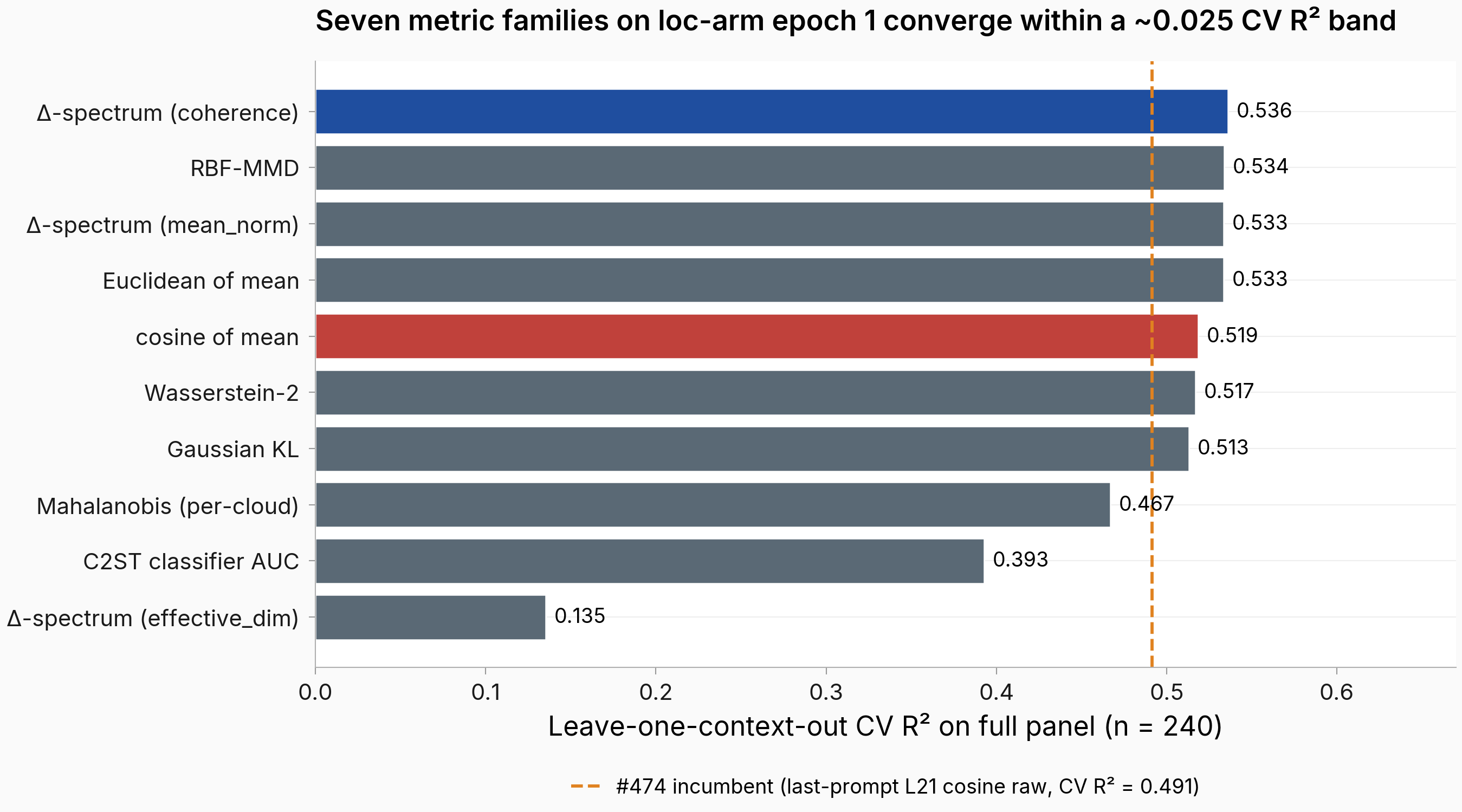
Figure. Seven metric families converge inside a 0.023-wide CV R² band (0.513-0.536); the chosen winner beats the established last-prompt cosine baseline (orange dashed line at 0.491) by 0.045, but beats the next family by only 0.002. Bar = best variant per family across (extraction × layer × raw/centered), CV R² is leave-one-context-out on the n = 240 full panel. Highlighted: the chosen winner (Δ-spectrum coherence, blue) and the family-best cosine variant (red, mean-response L21).
The chosen winner is mean-response L21 Δ-spectrum coherence (centered) at CV R² = 0.536. The runner-up trio — RBF-MMD, Δ-spectrum mean-norm, and Euclidean of mean, all at last-prompt L27 — sits within 0.003 CV R² of the winner. On a 320-row search, a 0.002 lead over the next family is well within search noise.
The mentor-facing read is the load-bearing answer to the parent question: most of the gap to the established cosine baseline is closed by moving the cosine probe, not by changing the metric. Switching the cosine probe from last-prompt L21 (CV R² = 0.491) to mean-response L21 (CV R² = 0.519) closes 0.028 of the 0.045 winner-over-baseline gap — about 61% — with no change to the metric. The remaining ~40% then needs cloud-aware machinery (Δ-spectrum / MMD / Euclidean), and that machinery converges across families to roughly the same number.
Length-partial p-values on the selected winner row are descriptive — they describe the SELECTED row's fit, not an inferential test on a population of predictors (the CV ranking IS the selection evidence here). I searched 320 valid predictor rows on the cleanest cell; CV-selection guards against over-fitting any single ρ, but it cannot manufacture a margin where there isn't one.
Coherence vs ΔG is not just two-cluster leverage
The winner's headline ρ of −0.747 on the full 240-pair panel is partly a clean cluster split. Pairs that include one of the three stylized personas (A3 pirate, A4 comedian, A5 villain — n = 84 ordered pairs) sit at high coherence (mean ≈ 0.61) and low transfer (mean ΔG ≈ 8.1 nats); non-stylized pairs (n = 156) sit at low coherence (mean ≈ 0.16) and high transfer (mean ΔG ≈ 14.9). Two well-separated clouds will give a strong correlation even if neither cloud has any internal structure.
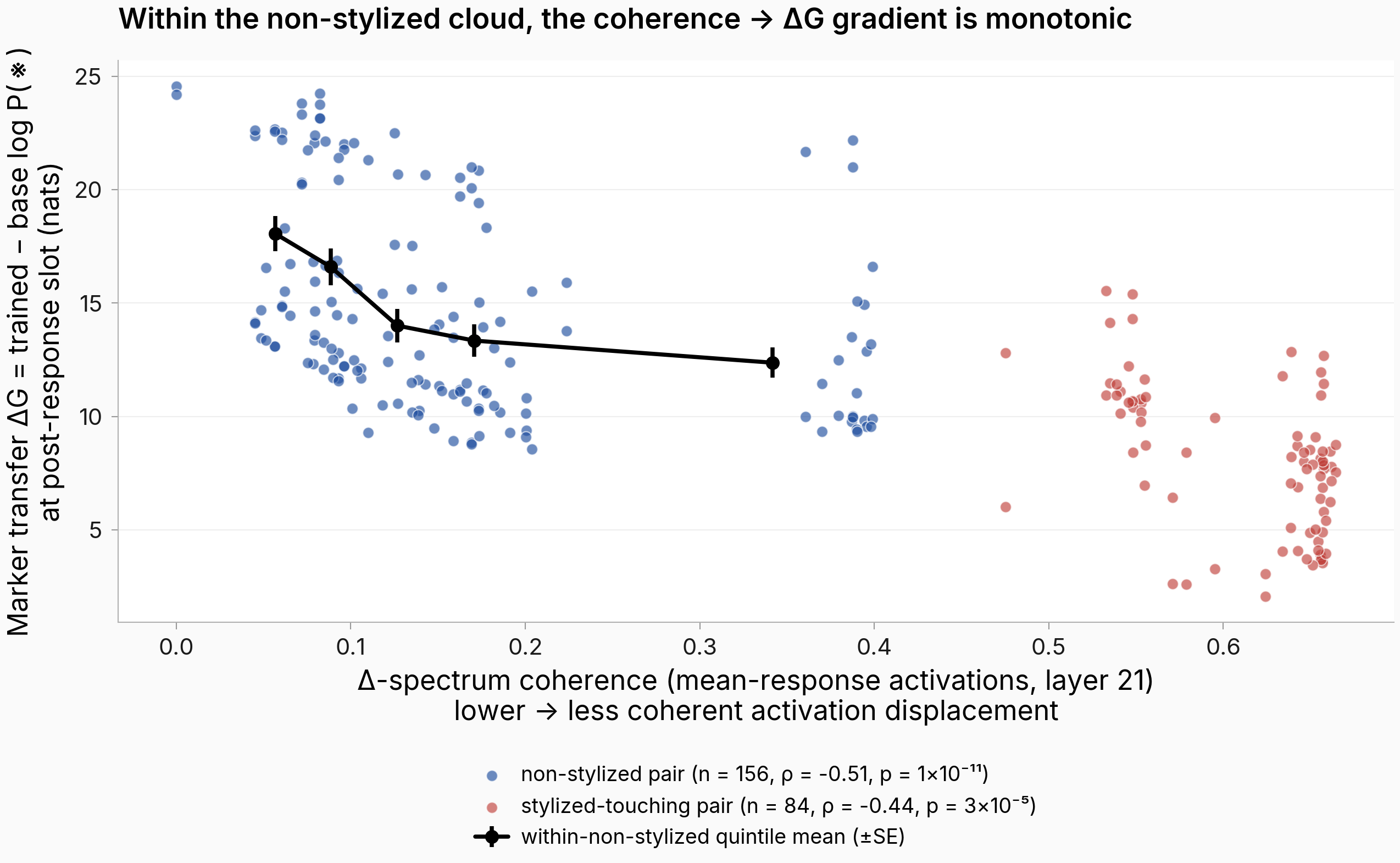
Figure. Within the non-stylized cloud alone, the coherence → ΔG gradient survives: quintile means drop from 18.1 → 12.6 nats. Each dot is one ordered (source → target) transformation pair on loc-arm epoch 1. Coral = at least one of the pair is A3/A4/A5; blue = neither. The black line connects mean ΔG within each quintile of within-non-stylized coherence (error bars = SE). The Spearman on the non-stylized panel alone is ρ = −0.51 (p = 1×10⁻¹¹, n = 156); on the stylized-touching cluster alone ρ = −0.44 (n = 84). The full-panel ρ = −0.75 inherits genuine within-cluster signal as well as the visible cluster offset.
The within-non-stylized gradient is monotonic across all five quintiles and statistically clean. The length-partialled rank correlation on the non-stylized panel is ρ = −0.513 (p = 7×10⁻¹², n = 156), nearly identical to the raw Spearman of −0.510 above — so the gradient survives the length control.
The claim "Δ-spectrum coherence tracks marker transfer" therefore survives the cluster-leverage check on this cell. The mechanism (plain reading: coherence measures how consistently the two contexts move activations in the same direction across the probe set; pairs that displace activations more coherently transfer the marker less) is suggestive but not established — the negative sign is robust, the causal story is not.
The chosen winner does not generalise — and the substrate itself is mostly unusable
The loc-arm has four checkpoints (epochs 1, 2, 3, 5) — only the loc-arm gives usable predictor signal at all (the positive-arm is saturated; covered below). The chosen winner from loc-arm epoch 1 is rank 1 only on that single cell. At the other three loc cells it drops out of the top 20 — AND its CV R² is within 0.001-0.013 of the established cosine baseline there, so the choice between them is statistically meaningless on three of four loc cells.
What IS consistent across loc cells is a DIFFERENT predictor: the per-epoch top-1 on loc-arm epochs 2/3/5 is always a last-prompt L27 Δ-spectrum row (coherence on ep 2, mean-norm on ep 3 and ep 5). The extraction point and layer stay fixed across these three cells; only the Δ-spectrum sub-predictor varies. On ep 3 and ep 5 this candidate IS the per-epoch top-1; on ep 1 it ties the runner-up trio at 0.5333 (rank 3-tied, within 0.003 of the chosen winner); on ep 2 it sits at 0.3576, 0.002 below the per-epoch top-1 (also a last-prompt L27 Δ-spectrum coherence row at 0.3599).
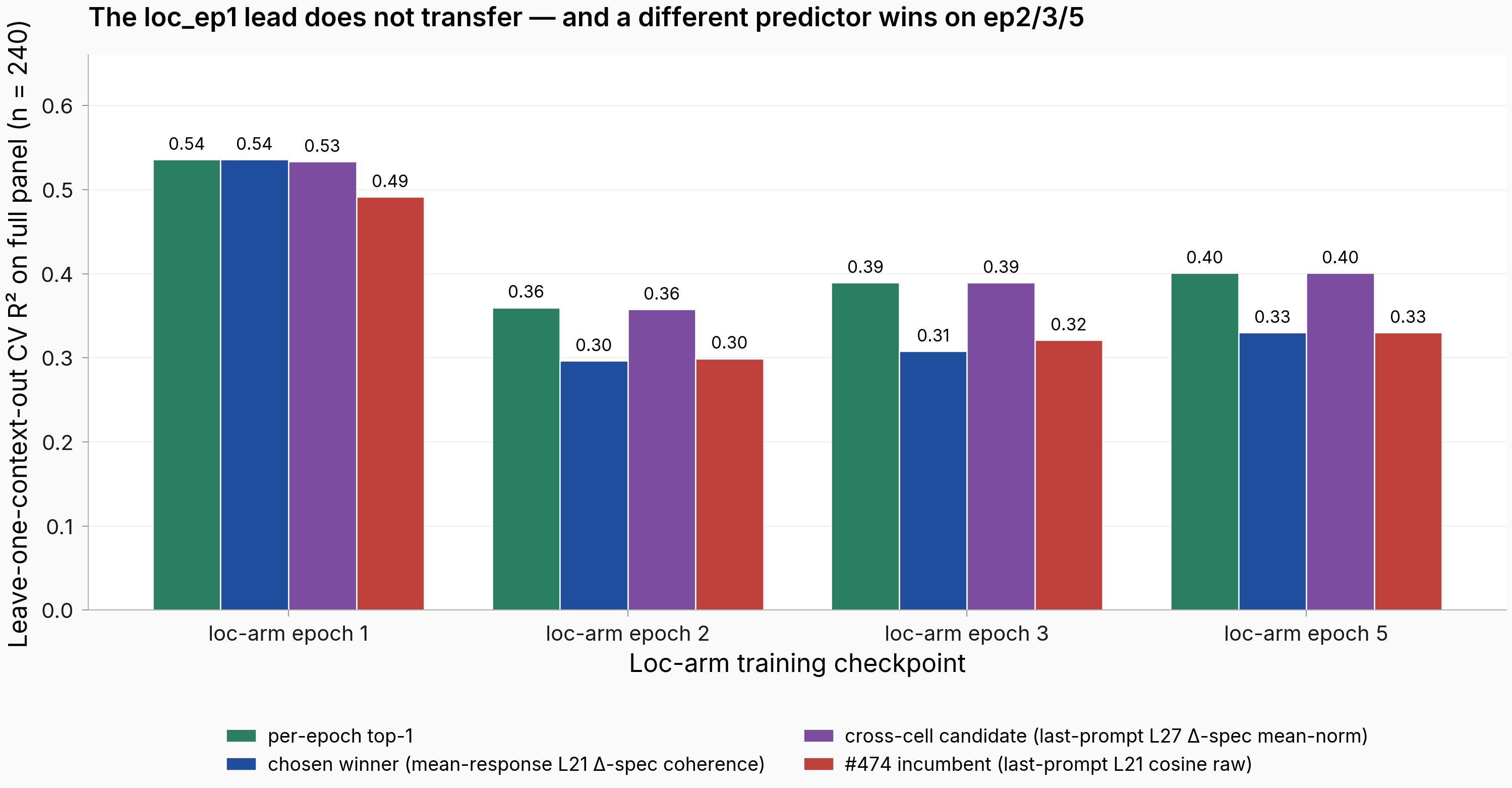
Figure. The chosen winner ties the established cosine baseline within 0.001-0.013 CV R² on three of four loc cells; a last-prompt L27 Δ-spectrum predictor matches or tops the per-epoch top-1 on every cell. Green = the CV-selected top-1 predictor at each epoch; blue = the chosen winner from loc-arm epoch 1 (mean-response L21 Δ-spectrum coherence); purple = the cross-cell candidate (last-prompt L27 Δ-spectrum mean-norm); red = the established last-prompt L21 cosine baseline. Positive-arm checkpoints are omitted because 78-99% of their pairs sit at the marker-emission ceiling — predictor information collapses there (covered below).
The per-epoch top-1 CV R² falls from 0.54 at epoch 1 to about 0.40 at epoch 5 — the predictability of ΔG from base-model geometry weakens as training progresses. This is NOT saturation: per-cell saturation fractions on the loc arm are loc-arm epoch 1 = 0.0%, epoch 2 = 1.3% (non-stylized) / 0.8% (full), epoch 3 = 0.0%, epoch 5 = 0.0% — far from the marker-emission ceiling at every epoch. The mechanism is instead shrinking ΔG dynamic range: the non-stylized panel's ΔG standard deviation falls from 4.59 → 4.93 → 3.95 → 3.64 nats across loc epochs 1 → 2 → 3 → 5 (and IQR from 7.19 → 6.32 → 5.55 → 4.98), so there is less variance for any predictor to explain even though no single cell is pinned at the ceiling.
On ep 2/3/5 the chosen winner and the cosine baseline are within 0.001-0.013 CV R² of each other (epoch 2: 0.297 vs 0.299; epoch 3: 0.308 vs 0.321; epoch 5: 0.330 vs 0.330) — three of four cells could be summarised as "predictor choice is in search noise". The last-prompt L27 Δ-spectrum candidate tops both by 0.06-0.07 on those three cells (0.36-0.40 vs 0.30-0.33). Combined with the in-band convergence above, the bake-off rules out a dramatically-better predictor than last-token cosine on this substrate — the actionable carry-forward is the consistent last-prompt L27 Δ-spectrum family, not the cleanest-cell chosen winner.
The other half of the substrate — the positive-arm cells — is dynamically dead: the positive arm trained the marker into the source persona without contrastive negatives. The result is that 78% of positive-arm epoch 1 pairs and 99.6% of positive-arm epoch 2/3/5 pairs have the trained model emitting the marker with probability ≈ 1 (per-cell saturation fractions at the g_logprob ≥ −0.1 ceiling rule: positive-arm epoch 1 = 0.78 full / 0.99 non-stylized; positive-arm epoch 2/3/5 ≈ 1.00 on both). At that ceiling the on-policy DV is mechanically near-constant — the trained log P( ※ ) is essentially 0 everywhere, so ΔG is dominated by base log P rather than by anything about transfer.
Diagnostically, this shows up as predictor sign-flips: the chosen winner's non-stylized Spearman on positive-arm epoch 1 is +0.376 (positive!), opposite the loc-arm sign, and the full-panel ρ falls to −0.44 (vs −0.75 on the cleanest cell). No predictor in the grid recovers anything meaningful on the positive-arm cells. That is not a deficiency of the predictors — it is the measurement-validity gate firing on a saturated DV; any cross-cell summary in this clean-result restricts to the loc arm.
The system-tail extraction point produces a single vector per transformation (input-independent), so only centroid metrics apply and only the A-class (5 personas → 20 ordered pairs) subpanel has any data. On that subpanel the best CV R² is −0.3999 — uninformative either way. The plan registered system-tail as diagnostic-only specifically for this reason; reporting here confirms it carries no claim.
Reproducibility
Parameters:
| Base model | Qwen/Qwen2.5-7B-Instruct |
| Eval (DV source) | #474 cross-eval G_logprob_matrix.json for arm ∈ {pos, loc} × epoch ∈ {1, 2, 3, 5}; on-policy ΔG = trained − base log P( ※ ) (token id 83399) at the post-response slot |
| Transformation set | 16 transformations from src/explore_persona_space/experiments/i406_conditions.py — A1-A5 (personas, A3/A4/A5 stylized), B1-B5 (query-wrap), C1 (chat template), D1-D5 (register rewrite); 240 ordered off-diagonal pairs, 156 non-stylized |
| Probe set | 50 questions from eval_results/issue_406/predictor_inputs.json |
| Extraction | residual-stream activations via forward hooks at layers {0, 5, 7, 11, 14, 15, 21, 27}; three extraction points (end_of_system, last_prompt, mean_response); max response tokens = 512 for mean_response |
| Metrics | cosine of mean · Euclidean of mean · Mahalanobis (per-cloud, pooled-ctx) · RBF-MMD (median-heuristic bandwidth) · C2ST linear-probe AUC · Δ-spectrum (PCA-k=16 on per-question displacements; reports coherence / mean_norm / effective_dim) · Gaussian symmetric-KL · Wasserstein-2; raw + prompt-centered |
| Regression | length-partial Spearman (rank-residualise on log prompt_tokens) on full-16 (n = 240) and non-stylized (n = 156) panels; predicts ΔG and g_logprob (base-prior-safe); leave-one-context-out CV R² as the selection criterion |
| Sample | single seed 42 throughout (inherited from #474) — load-bearing caveat |
| Hardware | 1× H100 (intent eval), pod epm-issue-493, ~95 min wall time |
| Predictors searched | 496 grid rows per cell × 8 cells = 3,968 entries; 320 full-panel-regressable rows per cell |
Artifacts:
- Bake-off grid + winner record:
eval_results/issue_493/bakeoff/bakeoff_grid.json(commit904d30968) - Per-cell regressions:
eval_results/issue_493/bakeoff/regression/{pos,loc}_ep{1,2,3,5}.json(8 files) - Per-(extraction × layer × metric × variant) metric records:
eval_results/issue_493/bakeoff/metrics/*.json(464 files; each hasmatrixormatrices, ρ_full_{deltag,glogp}, ρ_nonstylized_{deltag,glogp}, cv_*) - Cosine cross-check vs #406:
eval_results/issue_493/bakeoff/cosine_cross_check.json(max abs diff 0.00217 at L27 vs tol 0.003, PASS all layers) - Smoke-run digest:
eval_results/issue_493/bakeoff/smoke_digest.json - Run metadata:
eval_results/issue_493/bakeoff/meta.json(git_sha, env, args) - Figures:
figures/issue_493/{family_best_cv_bar, winner_scatter_within_nonstylized, cross_cell_robustness, winner_scatter_vs_deltaG, metric_layer_grid_heatmap}.{png, pdf, meta.json} - ΔG source (parent #474):
eval_results/issue_474/cross_eval/{arm}_ep{ep}/G_logprob_matrix.json(8 files) - Raw activations not persisted (re-extractable from base model in ≈ 90 min on 1× H100)
Compute: 1× H100 on RunPod pod epm-issue-493, ≈ 95 minutes wall time, pod terminated post-run; figure regeneration runs on the VM in ≈ 30 s.
Code:
- Driver:
scripts/issue493_extraction_metric_bakeoff.py(single entry point; CLI flags for--phase {smoke, hooks_check, full, all},--extraction-points,--layers,--metrics) - Analyzer figures:
scripts/issue493_make_clean_figures.py(regenerates family_best_cv_bar, winner_scatter_within_nonstylized, cross_cell_robustness) - Canonical metric definitions:
.claude/rules/persona-distance-metrics.md - Extraction-template reference:
scripts/recompute_predictors_i415.py - Length-partial Spearman + LOCO-CV reference:
scripts/i474_cosine_followup.py - Run commit:
a6ce330f1bc9fe6c285ecf7cb974ea8fd2534851(issue branchissue-493); figures + body onmainat904d30968f84393a80ea64dfe6d2ac3f9876b0a9
Reproduce:
uv run python scripts/issue493_extraction_metric_bakeoff.py \
    --phase all \
    --extraction-points end_of_system last_prompt mean_response \
    --layers 0 5 7 11 14 15 21 27 \
    --metrics cosine euclidean mahal mahal_pooled_ctx mmd c2st delta_spec gauss_kl wass2 \
    --arms pos loc --epochs 1 2 3 5 \
    --n-probes 50 --pca-k 16 --max-response-tokens 512