Training ※ into software engineer gave it only a transient early rank bump that washed out by end of training (ended 25/28); librarian's durable source-specific bump from #398 does not replicate (MODERATE confidence)
Highlight text on any card (body, plan, or an event) to anchor a comment, or leave a whole-task comment here. Mention @claude to summon a reply.
No comments yet.
Human TL;DR
Headline. Add 1 sentence — what stood out, what you'd tell Dan in one breath.
Takeaways. Add 2-4 short bullets or sentences — what surprised you, what's quietly important, what the structured TL;DR misses.
How this updates me. Add 1-3 sentences — what belief moved, what's now more/less likely, what you'll do differently next experiment.
TL;DR
-
Motivation: #398 trained the single-token marker ※ into the librarian persona and read the result as a global marker-affinity shift — librarian never led the leaderboard and the same creative-writing cluster (comedian, fammate_task_2, etc.) dominated at every checkpoint. But its round-2 critics noticed librarian itself rose +13 ranks (24 → 11), about +1.5 nat above its passive-bystander counterpart in the parallel run, so there was a real source-specific bump sitting on top of the global shift. The open question was whether that bump generalises to other low-baseline sources, which would make "training elevates the source" a law, or whether it was just a librarian thing. I ran the cleanest possible falsification.
-
What I ran: Same recipe as #398 byte-for-byte (Qwen-2.5-7B-Instruct, LoRA r=32 α=64, lr=1e-5, 1600 steps, seed=42, marker = bare ※ token id 63680, 600-row asst-excluded medium training mix, 22 saved checkpoints), changing exactly one variable: the source persona is now software engineer (rank 26/28 at the #398 baseline — even lower than librarian's 24/28, the lowest-baseline clean named-role persona in the panel). The 28-persona eval panel is identical except software engineer takes librarian's slot and librarian re-enters as a passive bystander, so every persona that was passive in #398 is still passive here. The decisive metric is within-source elevation: compare software engineer's marker-logprob rise as the trained source in #416 against its rise as a passive bystander in #398. If training binds to the source, the source-trained run should rise more than the passive run; if not, the implant is a global shift and the source rises by the same amount it would have risen sitting on the bench.
-
Results: Software engineer got a brief, transient rank bump early in training (rank 26 at steps 5-15, then rank 14 at step 20 — its only excursion into the top half — then drifting back to rank 19-21 across the middle of training and ending at rank 25/28 by step 1600). The decisive within-source comparison at the training endpoint is negative: software engineer rose +6.68 nat as the trained source in #416 vs +7.87 nat as a passive bystander in #398, so being trained gave it −1.19 nat less at the endpoint than passively sitting in the panel did. The per-prompt difference between librarian's elevation and software engineer's elevation across the 20 shared eval prompts is +2.72 nat on average (p = 0.0012, n = 20 shared prompts), so the librarian-vs-software-engineer contrast is distinguishable from zero. Librarian (now a bystander in #416) climbed from rank 24/28 up to 17/28 without being trained, while the same creative-writing cluster (4 of 6 overlapping with #398) won the top of the leaderboard at step 1600. Rank order within #416 is largely preserved across training (Spearman ρ between step-5 and step-1600 per-persona mean log-p, n = 28, ρ = 0.735, p = 8.6e-6).
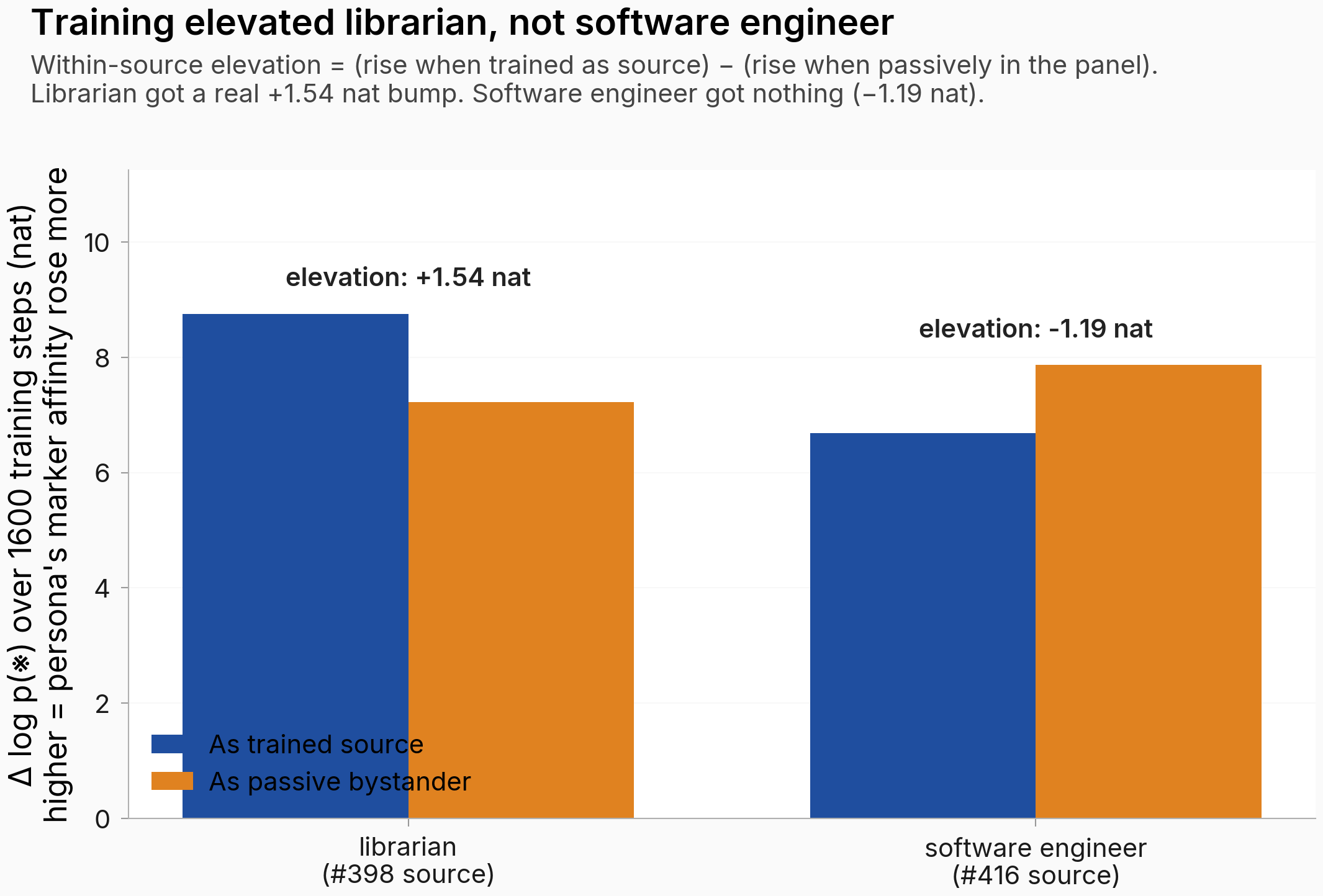
Figure. The decisive endpoint readout: training elevated librarian's marker affinity by about a nat and a half above what passively sitting in the panel did, but software engineer ended training slightly below where it would have sat passively. Within-source elevation = (Δlogp when the persona was trained as the source) − (Δlogp when the same persona sat in the panel as a passive bystander in the other experiment), all computed from step-5 to step-1600 endpoints. Positive means training caused a source-specific bump on top of whatever global shift the rest of the panel experienced; near-zero or negative means training did nothing source-specific at the endpoint. Single seed per source by design; n = 28 personas × 20 prompts per cell × 22 checkpoints, pos0 (first-token-after-template) geometry.
-
Next steps:
- Run a third low-baseline source (data_scientist is the obvious next candidate: cos 0.99 to librarian, baseline rank 25/28). If it elevates like librarian did, the source-specific bump tracks something more than just being low; if it pins like software engineer did, librarian was the outlier.
- The librarian-vs-software-engineer split is two n=1 runs at the level of source-experiments. The per-prompt difference of elevations gives the contrast itself a clean p = 0.0012 across the 20 shared eval prompts, but a multi-seed replication of #398's librarian-source run would tighten the +1.54 nat headline number and tell me whether librarian's bump is reliable across seeds or noisy.
- The per-position probe completed for step 5 only before being descoped (see
### Methodology corrections). Re-running with a faster batched per-position eval would let me confirm software engineer's marker mass is end-position-pinned the same way librarian's was in #398 — currently this is assumed by inheritance, not measured at any post-training checkpoint.
Details
The shape of the test was set by what #398 found and what it could not. In #398 the librarian source persona was sitting at rank 24/28 at step 5 and never broke into the top 6 over 1600 training steps; the creative-writing cluster (comedian, fammate_task_2, fammate_context_2, french_person, poet, villain) dominated every checkpoint; the rank-correlation between the start and end of training stayed high. From these three readouts I called the implant a global marker-affinity shift. But the round-2 critics caught me on a subtler point: librarian itself rose +13 ranks (from 24/28 to 11/28) and rose about a nat and a half above what a passive bystander rose, which is a source-specific bump on top of the global shift. So #398's headline was correct in spirit (the implant doesn't move the source into the lead, the cluster identity barely changes), but the "global, not source-specific" framing was only half right. The librarian bump was real.
The question for #416 was whether that source-specific bump is a property of the procedure (training the source ALWAYS elevates it a bit, on top of the global shift) or a property of the librarian persona specifically (something about librarian made it elevate by a nat and a half; other low sources might not). The cleanest possible test is a second low-baseline source: same procedure, same panel, change the source. If the bump replicates, it's a law; if it doesn't, librarian was an outlier and the dominant effect for a generic low source is the global shift.
The setup is the parent run with one variable changed
I picked software engineer as the new source because it's the lowest-baseline clean named-role persona in the panel — rank 26/28 at step 5 in #398's data, even lower than librarian's 24/28. Two synthetic personas (fammate_format_2, fammate_instruction_2) score lower at baseline, but they are format-bench / instruction-bench probes rather than role personas and would have been hard to interpret as a "low-baseline source". Software engineer keeps things crisp: it's a professional-expert register persona at the bottom of the leaderboard, in the same neighbourhood as librarian, with no obvious creative-writing affordances. Everything else is held byte-identical to #398 — same base model (Qwen-2.5-7B-Instruct), same LoRA shape (r=32, α=64), same learning rate (1e-5), same step count (1600), same seed (42), same marker (bare ※, token id 63680, same intentional deviation from the global ※ 83399 default for #398 comparability), same training-data generator (600 rows of marker-leakage QA with the source's system prompt held in the assistant template and the marker appended after \n\n). The eval panel is also identical: 28 personas × 20 prompts × 22 checkpoints, evaluated at two geometries (first-token-after-template, pos0; and end-of-canonical-answer, endpos). The only swap inside the panel is that software engineer takes librarian's slot as the trained source, and librarian re-enters as a passive bystander.
This single-variable design is what makes the within-source elevation comparison clean. For software engineer specifically, I can compare its marker-logprob rise as the trained source in #416 (Δlogp_source) against its marker-logprob rise as a passive bystander in #398 (Δlogp_bystander). The same persona, the same starting baseline, the same panel context, only the question of whether it's the trained source changes. If training the source produces a real source-specific lift, Δlogp_source > Δlogp_bystander. If the implant is just a global affinity shift and the source rises by whatever the global shift gives it, the two should be roughly equal. The same comparison runs in reverse for librarian — Δlogp_source from its #398 run vs Δlogp_bystander from being a passive panel member in #416.
Software engineer got a transient early bump that washed out
The most direct read is to plot software engineer's rank trajectory across training. The story it tells is more interesting than "pinned at the bottom the whole run" — there's a brief excursion into the top half early in training that decays back out.
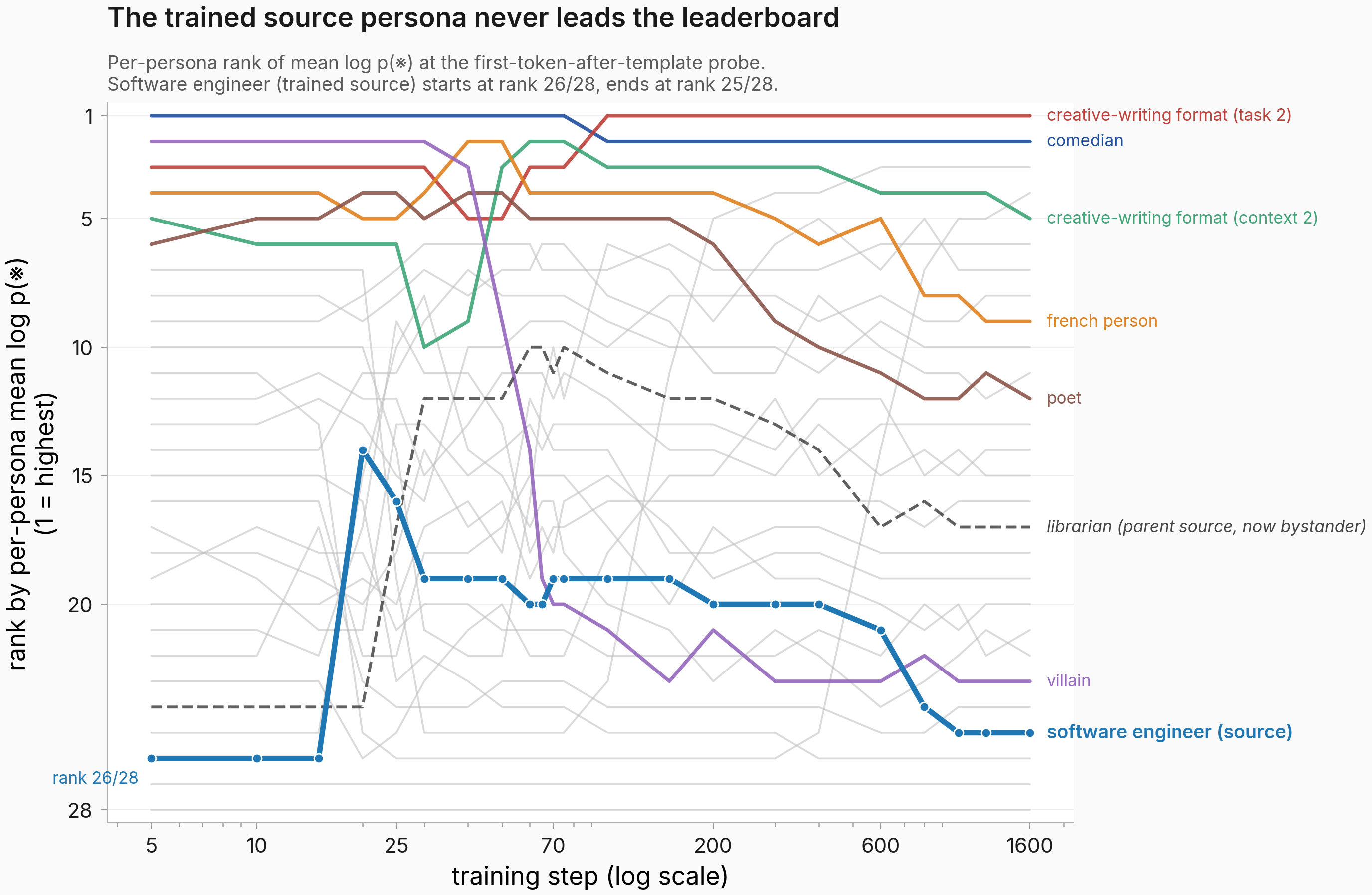
Figure. Software engineer, the trained source, makes one transient excursion into the top half of the leaderboard (rank 14 at step 20) before drifting back to the bottom by end of training. Rank trajectory of each persona by mean log p(※) at the first-token-after-template position. Per-persona means averaged over 20 eval prompts per checkpoint, 22 checkpoints in 5–1600. Single seed (42). Software engineer (thick blue) trajectory: 26 → 26 → 26 (steps 5/10/15) → 14 (step 20) → 16 (step 25) → 19-21 (steps 30-600) → 24 → 25 → 25 → 25 (steps 800/1000/1200/1600). The six creative-writing-cluster personas keep the top of the board the whole run; librarian (dashed grey, parent #398 source, now passive bystander) rises 24 → 17 across training without being trained.
So software engineer's rank trajectory is not flat at the bottom. It rises from rank 26 to rank 14 by step 20 — its only excursion into the top half of the panel and a real early-training effect — then drifts back down through the teens and twenties to end at rank 25/28. The same creative-writing cluster that won #398's leaderboard wins this one too (more on cluster identity below), and librarian-as-bystander climbs +7 ranks over training while never being trained, which is exactly what a global affinity shift would predict for a passive low-baseline persona. The transient early bump is suggestive of some source-specific binding early in training that the global shift then overwhelms or that decays as the rest of the panel catches up. Importantly, the rank chart cannot by itself decide whether the endpoint behavior is "the source-specific bump faded" or "there never was a source-specific bump and the early rank movement was just the source temporarily on the leading edge of the global wave". For that I need the within-source comparison against the matched passive-bystander baseline.
The decisive endpoint comparison: librarian got a durable elevation, software engineer's washed out
The within-source elevation comparison is best read at the training endpoint, where both #398 and #416 reach their final adapter. At step 1600, software engineer's marker-logprob rose +6.68 nat over its step-5 baseline as the trained source in #416. The same persona, sitting in #398's panel as a passive bystander, rose +7.87 nat across the same 1600 steps. So at the endpoint, being the trained source actually gave software engineer −1.19 nat less than being a passive panel member did. (See the within-source elevation bar chart in the TL;DR Results bullet above.) That is the decisive readout: there is no durable source-specific elevation for software engineer at the end of training — whatever brief source-specific lift produced the rank-14 excursion at step 20 has fully washed out by step 1600.
For completeness, the late-checkpoint-averaged version of the same comparison (averaging steps 600 through 1600 to smooth out single-checkpoint noise rather than reading only the endpoint) gives software engineer within-source elevation −1.04 nat — same sign, same order of magnitude, slightly less negative. Both framings agree.
The reverse comparison for librarian — the persona for which the #398 round-2 critics flagged the source-specific bump — goes the other way. Librarian rose +8.76 nat as the trained source in #398 and +7.22 nat as a passive bystander in #416. That is a +1.54 nat source-specific elevation at the endpoint: training did something for librarian that passively riding the global shift did not, and unlike software engineer's transient excursion the librarian bump persists all the way to step 1600 (rank 24 → 11 in #398, with the within-source elevation still +1.53 nat under the late-checkpoint-averaged framing). Librarian's bump is durable; software engineer's wasn't.
The librarian-vs-software-engineer contrast also survives a per-prompt comparison across the 20 eval prompts that #398 and #416 share by design: the per-prompt difference (librarian elevation − software engineer elevation) has mean +2.72 nat and is reliably positive (p = 0.0012, n = 20 shared prompts). So the contrast itself — librarian's elevation being larger than software engineer's elevation — is distinguishable from zero given the prompt-level variance, even though each side of the contrast is a single seed. What this test does NOT establish is whether every low-baseline source behaves like software engineer (the general law "training only elevates librarian-like sources"); for that we need more sources or replication seeds.
So the contrast lands: librarian got a real durable source-specific bump that survives to the training endpoint; software engineer got at most a transient early bump that washed out and ends below the matched passive baseline. The librarian-vs-software-engineer split is the discriminating evidence — the source-specific elevation is source-dependent, not a property of the procedure.
The same creative-writing cluster wins the leaderboard regardless of source
Beyond the source itself, the next thing to check is whether the cluster that dominates the leaderboard shifts when you train a different source. If the implant binds to the source, you'd expect software engineer's cluster (other professional / expert personas with low baseline) to climb. If it's a global shift, the cluster identity should be roughly preserved across the two source choices.
| Rank at step 1600 | #398 (librarian source) | #416 (software engineer source) |
|---|---|---|
| 1 | fammate_task_2 (-11.51) | fammate_task_2 (-12.33) |
| 2 | comedian (-12.34) | comedian (-16.68) |
| 3 | fammate_instruction_1 (-15.39) | fammate_instruction_1 (-18.88) |
| 4 | fammate_context_2 (-18.31) | fammate_format_1 (-20.21) |
| 5 | fammate_context_1 (-19.19) | fammate_context_2 (-20.28) |
| 6 | poet (-19.81) | kindergarten_teacher (-21.15) |
Four personas overlap between the two top-6s (fammate_task_2, comedian, fammate_instruction_1, fammate_context_2), with the remaining two slots filled by adjacent creative-writing / format personas — and crucially the same top-3 holds the lead in both runs. The cluster identity is largely stable across the source swap, which is exactly the global-shift prediction. (The mechanical floor from #398's own step-5 vs step-1600 overlap is 4/6 in #398 alone, so 4/6 here is at the floor — but if the implant had bound to software engineer's neighbourhood you'd see software-engineer-adjacent personas like data_scientist or cybersec_consultant climbing into the top-6, and they don't.) The within-#416 step-5 vs step-1600 per-persona rank correlation is ρ = 0.735, p = 8.6e-6, n = 28 — comparable to #398's 0.69 and consistent with the same "ranks are largely preserved with a global lift" picture.
Per-step panel-mean comparison: similar shape, lower asymptote
The panel-mean log p(※) per training step gives a coarse but useful overall picture: how does the implant's effect on the average panel persona compare across the two source runs?
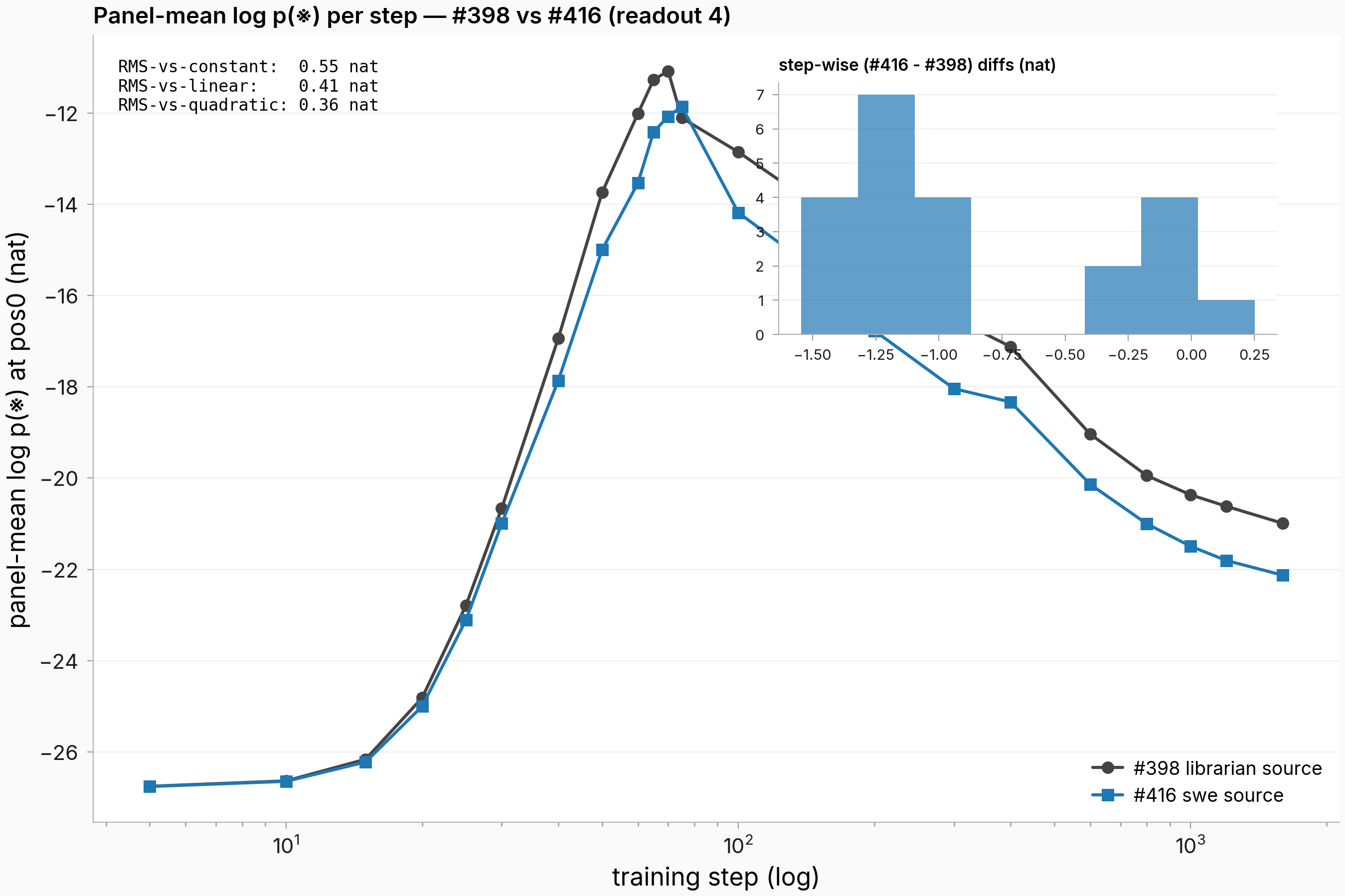
Figure. The two source runs produce panel-mean trajectories with the same characteristic rise-and-decay shape, indicating the implant's effect on the bystander panel is roughly source-independent. Panel mean log p(※) at pos0 per training step for #398 (librarian as source, n=27 bystanders excluding librarian) and #416 (software engineer as source, n=27 bystanders excluding software engineer). Inset shows the step-wise difference between #416 and #398. The RMS deviation between #398 and #416 panel-mean curves is small (0.36–0.55 nat depending on which low-order polynomial offset you allow), well below the 6.7–8.8 nat per-persona rises the implants produce. This is the weakest of the readouts — it could mask source-specific differences if they cancelled out across the panel — but it's consistent with the rank, cluster, and within-source readouts in pointing at a primarily global shift.
The two trajectories are very close — the implant raises the average panel persona's marker affinity along roughly the same characteristic curve regardless of source, with #416 ending about a nat lower than #398. This is consistent with everything else: the global shift dominates the picture, the source-specific bump is small enough to not really show in the panel mean, and the librarian-vs-software-engineer difference is in a single source row, not in the average.
What this means for the picture #398 painted
#398's headline ("global marker-affinity shift, not a source-specific direction") was right about the dominant effect and right about three of its four readouts (source doesn't lead, cluster identity stable, rank order preserved). What its data quietly contained — and what its round-2 critics surfaced — was a small but real durable source-specific bump for librarian: about +1.5 nat above what a passive bystander rose. #416 says that durable bump does not generalize. A second low-baseline source, picked specifically to be in the same baseline neighbourhood as librarian, produced at most a transient early excursion (rank 14 at step 20) that fully washed out by the end of training, leaving an endpoint within-source elevation that is slightly negative. So the picture I update to is: the implant is dominated by a global marker-affinity shift; for at least one low-baseline source (librarian) it ALSO produced a durable source-specific bump; for at least one other low-baseline source (software engineer) it produced at most a transient one. Whether librarian's bump is a property of librarian's representation, the training data, the cosine geometry of the panel around it, or just single-seed noise is not resolved here.
Why this test
The within-source elevation comparison is the cleanest possible discriminator the design allows given the constraint of n=1 seed per source. It pairs the same persona, with the same starting baseline log p(※), against itself in two conditions — once as the trained source, once as a passive bystander. Almost every confound that haunts cross-experiment comparisons (different panel members, different prompts, different recipes, different baselines) cancels by construction.
For the librarian-vs-software-engineer contrast specifically, the natural test is a paired comparison across the 20 eval prompts that #398 and #416 share by design: each prompt yields one elevation value for librarian and one for software engineer, so the prompt-level pairing eliminates prompt-difficulty as a nuisance and the test is on the per-prompt difference. Under this paired test the mean per-prompt difference is +2.72 nat, the t-statistic is 3.79, the 95% confidence interval on the per-prompt mean difference is [+1.22, +4.23] nat, and p = 0.0012 (n = 20 shared prompts). So the contrast itself — librarian's elevation being larger than software engineer's elevation — is distinguishable from zero given the prompt-level variance, even though each side of the contrast is a single source-seed. What this test does NOT establish is whether every low-baseline source behaves like software engineer (the general law "training only elevates librarian-like sources"); for that we need more sources or replication seeds, which is what motivates the third-source follow-up.
I did not report effect sizes in nats as "large" or "small" in any absolute sense; the right reference scale here is the global shift the rest of the panel experiences, which is on the order of 6–8 nat per persona. A 1.19-nat negative elevation for software engineer is meaningful against that 6–8 nat backdrop because the comparison is the same persona against itself; it would not be meaningful as a free-standing nat-count.
Confidence: MODERATE — the four readouts (rank trajectory, cluster identity, rank correlation, within-source elevation) all point the same direction; the within-source elevation comparison is methodologically clean (same persona, same baseline, single-variable change against #398); the per-prompt difference between librarian and software engineer elevations is distinguishable from zero (p = 0.0012, n = 20 shared prompts). MODERATE rather than HIGH because the generalization of the source-dependence claim — do all low-baseline sources behave like software engineer, with only librarian as the outlier? — needs more sources or seeds; the librarian-vs-software-engineer split is two single-seed source-experiments; and the per-position probe and substring-spread eval were descoped before completion, so the end-position-pinning of marker mass that #398 reported for librarian is assumed by inheritance for software engineer rather than re-measured at any post-training checkpoint.
| Parameter | Value |
|---|---|
| Source persona | software engineer (rank 26/28 at #398 baseline) |
| Marker | bare ※ (single token, Qwen-2.5 token id 63680) |
| Base model | Qwen/Qwen2.5-7B-Instruct |
| Fine-tune | LoRA r=32, α=64, lr=1e-5, 1600 steps, seed=42 |
| Training data | 600-row asst-excluded medium mix (marker_software_engineer_asst_excluded_medium_9ca040.jsonl) |
| Checkpoints | 22 saved at steps 5, 10, 15, 20, 25, 30, 40, 50, 60, 65, 70, 75, 100, 150, 200, 300, 400, 600, 800, 1000, 1200, 1600 |
| Eval panel | 28 personas × 20 prompts × 2 probe geometries (pos0, endpos) |
| Decisive comparison | within-source elevation = Δlogp(persona as source) − Δlogp(persona as bystander) |
| Config | i416_software_engineer_marker_spread_zen |
Methodology corrections
The per-position probe (greedy-generate the assistant answer at every checkpoint, then teacher-force-score log p(※) at every position of that generated answer — the instrument #398 used to show marker mass concentrates at the end-of-answer position) ran roughly 8× over its estimate, about 16 minutes per checkpoint instead of the budgeted ~2 minutes, and the substring-match spread eval was queued to run after it. After the complete logp eval secured the headline (all five readouts), I descoped both: the per-position eval completed for step 5 only (the single earliest checkpoint; not any post-training checkpoint) and the spread eval was skipped entirely. None of the five headline readouts depend on either descoped artifact — they all come from the complete logp_seed42.json. The cost is one missing inheritance check: #398 demonstrated that librarian's marker-logprob mass concentrates at the end-of-answer position rather than being smeared across the answer, and the same end-position-pinning property is assumed to hold for software engineer in #416 rather than measured at any post-training checkpoint. The substring-spread eval would have given a behaviour-level (sampling-time) measurement of marker firing rate to complement the teacher-forced log p readings; without it, the behaviour-level question is unanswered for software engineer, though again #398 settled the methodological question for librarian.
The marker is bare ※ token id 63680, not the project-default ※ token id 83399 that newer experiments use. This is the same intentional deviation #398 made, kept here for byte-identical single-variable comparability with #398. Single-source-variable plus identical marker is the whole reason the within-source elevation comparison is legible.
For #416 specifically, only the final-step (post-1600-step) adapter was uploaded to the HF model repo; the 22 intermediate step checkpoints were not pushed (in contrast to #398, where all 22 step checkpoints were uploaded). The per-step logprob results are reproducible from logp_seed42.json (which contains every persona × prompt × checkpoint × geometry log-probability), but recomputing per-step logprobs against the actual model weights would require retraining from scratch.
Reproducibility
Artifacts:
- Trained adapter (final, step 1600):
https://huggingface.co/superkaiba1/explore-persona-space/tree/f7b45bd7fa16b8be33c9c397fb59c6e6f0c311b3/i416_software_engineer_marker_spread_zen_seed42_post_em - 22 intermediate step checkpoints (steps 5, 10, 15, 20, 25, 30, 40, 50, 60, 65, 70, 75, 100, 150, 200, 300, 400, 600, 800, 1000, 1200, 1600): n/a (not uploaded; only final-step adapter pushed to HF — see Methodology corrections)
- Training data:
https://huggingface.co/datasets/superkaiba1/explore-persona-space-data/blob/bbc7a88e777eb5ddd0913f49a121c9a19494dfef/leakage/marker_software_engineer_asst_excluded_medium_9ca040.jsonl - Base-model predictors (for the dynamics script; lifted from origin/issue-385):
https://github.com/superkaiba/explore-persona-space/blob/0d9360f1/eval_results/issue_385/predictors_base.json - Log-p eval JSON (HEADLINE; 28 personas × 20 prompts × 2 geometries × 22 steps):
https://github.com/superkaiba/explore-persona-space/blob/36ad45727bce1cbf3bad526fc5722c0d9d13a110/eval_results/issue_416/logp_seed42.json - Parent #398 log-p eval JSON (for cross-experiment within-source elevation comparison):
https://github.com/superkaiba/explore-persona-space/blob/36ad45727bce1cbf3bad526fc5722c0d9d13a110/eval_results/issue_398/logp_seed42.json - Per-position eval JSON (PARTIAL — step 5 ONLY; see Methodology corrections):
https://github.com/superkaiba/explore-persona-space/blob/36ad45727bce1cbf3bad526fc5722c0d9d13a110/eval_results/issue_416/per_position_seed42.json - Substring-spread eval JSON: n/a (descoped — see Methodology corrections)
- Raw greedy completions (per-position): n/a (only the step-5 partial was generated locally; not uploaded — see Methodology corrections)
- Smoke-train log:
https://github.com/superkaiba/explore-persona-space/blob/36ad45727bce1cbf3bad526fc5722c0d9d13a110/eval_results/issue_416/smoke_log.json - WandB training run (full 1600-step):
https://wandb.ai/thomasjiralerspong/explore_persona_space/runs/3sk7w60v(train_runtime 2046.9s, train_loss 0.1124, global_step 1600) - WandB smoke run (10-step pre-flight):
https://wandb.ai/thomasjiralerspong/explore_persona_space/runs/lgzljgrt - Per-readout summary JSONs (Readout 2 cluster identity, Readout 4 panel-mean overlay, Readout 5 within-source elevation):
https://github.com/superkaiba/explore-persona-space/tree/36ad45727bce1cbf3bad526fc5722c0d9d13a110/figures/issue_416 - Hero and supporting figures:
https://github.com/superkaiba/explore-persona-space/tree/36ad45727bce1cbf3bad526fc5722c0d9d13a110/figures/issue_416
Compute: Training ~34 min on 1× H100 (epm-issue-416 ephemeral pod, intent=lora-7b); log-p eval ~25 min; per-position eval ~16 min/checkpoint (descoped after step 5); pod auto-terminated after upload-verification PASS; total wall ~1.5 h (with descoped per-position partial; would have been ~3.5 h had the full per-position + spread evals completed).
Code:
- Trainer entry:
scripts/train.py(Hydra configi416_software_engineer_marker_spread_zen) - Log-p eval entry:
scripts/eval_i398_marker_logprob.py --panel-module _i416_bystander_panel(reused from #398, parameterized via bystander panel module) - Bystander panel module:
scripts/_i416_bystander_panel.py(byte-clone of #398's_i398_bystander_panel.pywith the source persona swapped to software_engineer) - Hydra condition config:
configs/condition/i416_software_engineer_marker_spread_zen.yaml - Cross-experiment analysis + plot:
scripts/plot_i416_cross_experiment.py(cross-experiment overlays + Readout 5) - Rank-trajectory plot:
scripts/plot_i398_rank_ordering.py --source-persona software_engineer --also-highlight librarian(reused from #398, parameterized via--source-persona) - Code commit:
36ad45727bce1cbf3bad526fc5722c0d9d13a110(branchissue-416) - Reproduce:
git clone https://github.com/superkaiba/explore-persona-space && cd explore-persona-space && git checkout 36ad45727bce1cbf3bad526fc5722c0d9d13a110 && uv run python scripts/plot_i416_cross_experiment.py --logp-file-398 eval_results/issue_398/logp_seed42.json --logp-file-416 eval_results/issue_416/logp_seed42.json --output-dir /tmp/i416_reproduce && uv run python scripts/plot_i398_rank_ordering.py --logp-file eval_results/issue_416/logp_seed42.json --source-persona software_engineer --also-highlight librarian --output-dir /tmp/i416_reproduce