Fitted answer-to-context map recovers held-out contexts (R2 0.75, top-1 retrieval 84%) while the pseudoinverse of the context-to-answer map fails as a predictor (best R2 0.14) and points elsewhere (operator cosine <= 0.34) (MODERATE confidence)
Highlight text on any card (body, plan, or an event) to anchor a comment, or leave a whole-task comment here. Mention @claude to summon a reply.
No comments yet.
Motivation
- We have a linear context→answer map M on the n1m bank (963,444 real contexts; #779
fitter-fair-comparison-n1m, held-out R² 0.754 at layer 19), and a line of work that inverts it with pseudoinverses: the persona-vector pre-image M⁺r_B (#1615, #2254) predicts persona strongly but cannot steer at the context vector. - Question (user ask, 2026-08-26): has anyone FIT a dedicated answer→context regression, and how does it compare to pinv(M)? If the two disagree, the pinv-preimage line has been studying a direction that is not the best available reverse map.
TLDR
- The answer state determines the context state to about the same fidelity as the forward direction: a ridge map fit v_A→v_C on the same 963,444 contexts reaches held-out R² (raw context space) 0.741 (L14) / 0.751 (L19) / 0.611 (L26), essentially matching the forward map's 0.754 at L19. kNN retrieval: the predicted context's true row is the nearest neighbor among the 1,000 held-out contexts 76% / 84% / 62% of the time (chance 0.1%).
- No pseudoinverse of the forward map comes close as a predictor: best truncated pinv R² per layer is 0.003 / 0.072 / 0.027 (val-selected rank k* = 128 / 512 / 128); the ridge-regularized pinv Mᵀ(MMᵀ+λI)⁻¹ does best but still only 0.034 / 0.135 / 0.112; full-rank pinv collapses catastrophically (R² −8×10³ to −2×10⁷ — the forward fit's λ=0.001 leaves near-zero tail singular values that the inverse amplifies).
- The two inverses are geometrically different objects, not noisy copies: in a shared frame, the direction-aware operator cosine between the fitted reverse map and the best pinv variant peaks at 0.32 (ridge-pinv, L19); the rotation-invariant Procrustes-aligned cosine reaches 0.87-0.90, so they share spectral shape but orient differently — the fitted reverse map is not a rotation-free rescaling of any pinv.
- The #2254 pre-image direction is far from the fitted reverse map's direction for the same persona vector: cos(W_rev·r_B, pinv·r_B) peaks at 0.34-0.41 (ridge-pinv, L19/L26) across evil / sycophancy / hallucination, and the top-context rankings the two directions induce over all 963k training contexts overlap only 0.32-0.54 at k=1000 (rank Spearman 0.67-0.88). This bounds how much the pinv-preimage steering results (#2254) transfer to the "true" fitted reverse direction.
- Interpretation: the reverse regression is weighted by the context covariance (it lands on the conditional mean of contexts given the answer state), while pinv is the min-norm algebraic inverse confined to the forward map's row space — the ~0.6-unit R² gap between them is context information sitting in directions the forward map maps weakly, which pinv either discards (truncated) or amplifies into noise (full-rank).
Results
1. Held-out prediction: fitted reverse map vs every pinv variant
What is plotted: held-out R² in raw context space (pinned 1,000-row test split) for the truncated pinv across rank k, with the fitted reverse map, ridge-pinv, identity+bias, and predict-the-mean as horizontal references; one panel per layer. The y-axis is clipped to [−1.05, 1.05]: the truncated-pinv curve continues far below the frame (k=3584 / full rank reaches −1.3×10⁵ at L14, −7.9×10³ at L19, −2.3×10⁷ at L26).
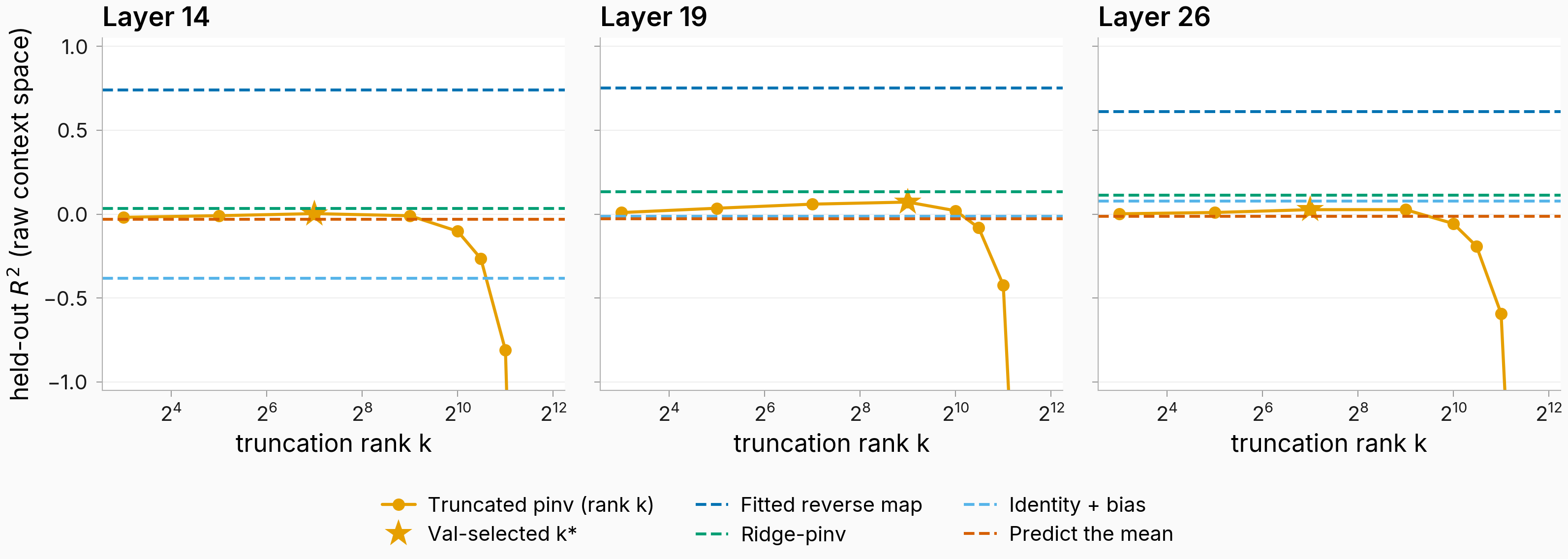
The fitted reverse map (blue dashed, 0.61-0.75) sits far above every pinv variant at every layer. Truncated pinv is near zero at its best rank and collapses past k≈1000. Identity+bias (light blue) is negative at L14 (−0.38), near zero at L19, +0.08 at L26 — the answer state is not just "context plus a shift".
2. Retrieval: is the prediction close to the right context?
What is plotted: P(true context within k nearest neighbors of the prediction) among the 1,000 held-out contexts, euclidean and cosine, chance = k/1000.
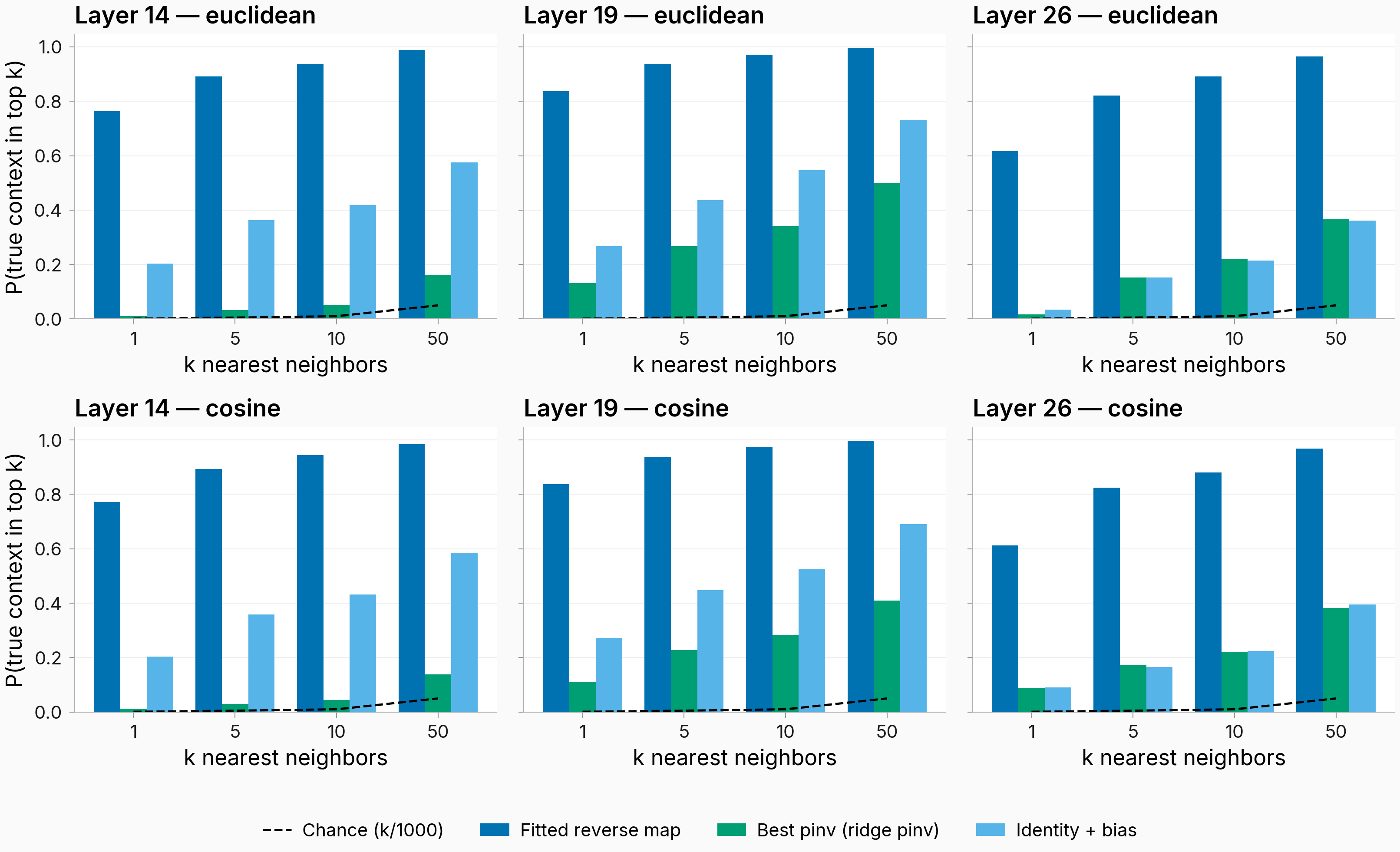
The fitted reverse map retrieves the exact held-out context at rank 1 in 76% / 84% / 62% of cases (L14/L19/L26, euclidean; chance 0.1%). The best pinv (ridge-pinv) manages 13% acc@1 at L19; identity+bias retrieves better than its R² suggests (20-27% acc@1) — direction is partly preserved by a pure shift even where magnitude is not.
3. Operator geometry: are the two inverses the same map?
What is plotted: top row — operator similarity between the fitted reverse map and each pinv variant in the shared frame (raw-centered answer → standardized context): direction-aware raw cosine (circles) and rotation-invariant Procrustes-aligned cosine (squares; an upper bound that ignores orientation and can never support "same operator"). Bottom row — singular spectra.
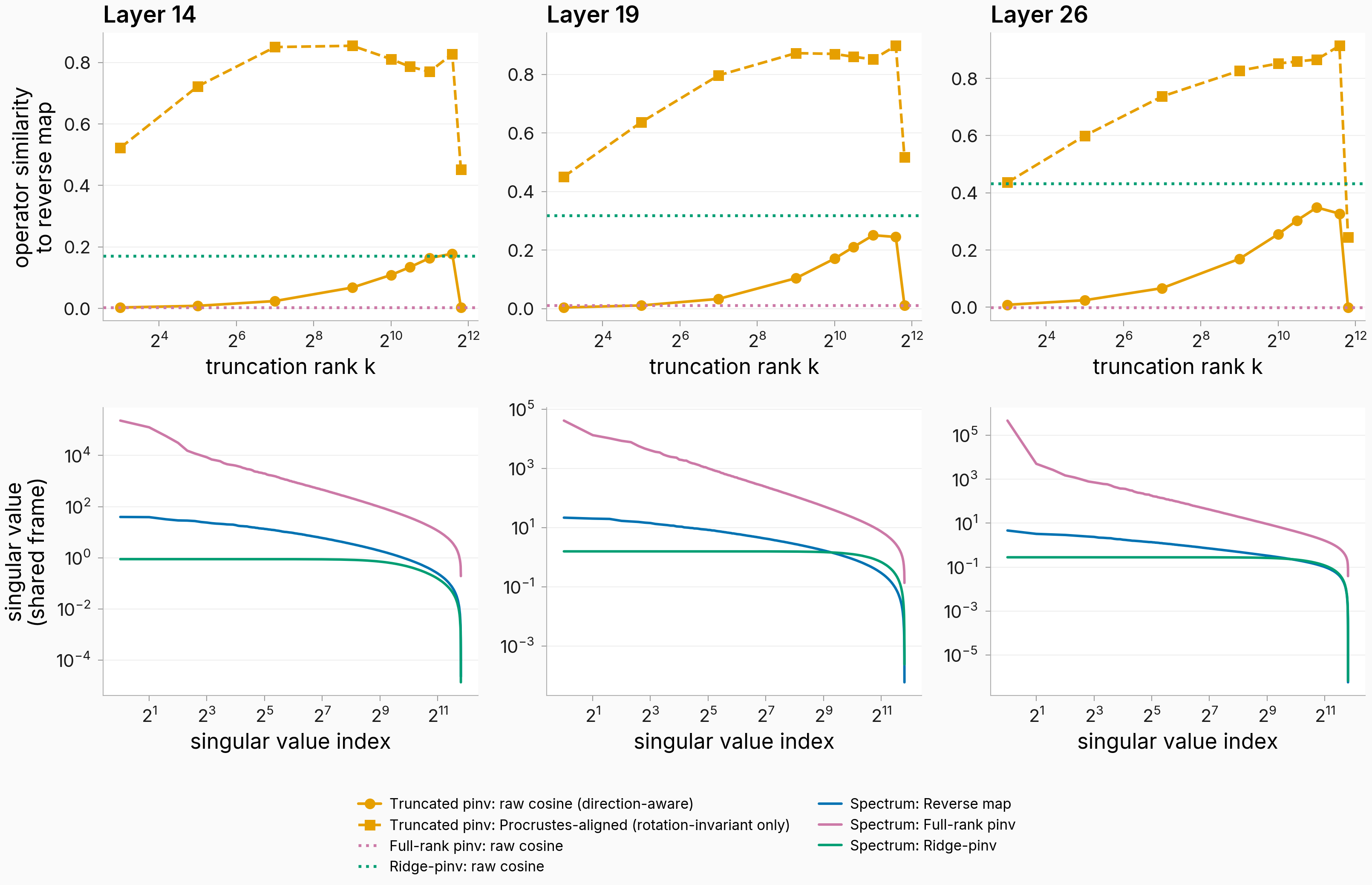
Direction-aware similarity peaks at 0.18 / 0.25 / 0.35 (truncated, k≈2048) and 0.17 / 0.32 / 0.43 (ridge-pinv), while the rotation-invariant ceiling sits at 0.85-0.90: similar spectral shape, substantially different orientation. The spectra panel shows why full pinv explodes — its spectrum runs 4-6 decades above the fitted reverse map's.
4. Persona-vector pre-image agreement (connects to #1615 / #2254)
What is plotted: cosine between the fitted-reverse-map direction W_rev-path(r_B) and each pinv direction for the same persona vector, per trait and layer; bottom row compares ridge-pinv, full pinv, and the transpose read Wᵀr_B.
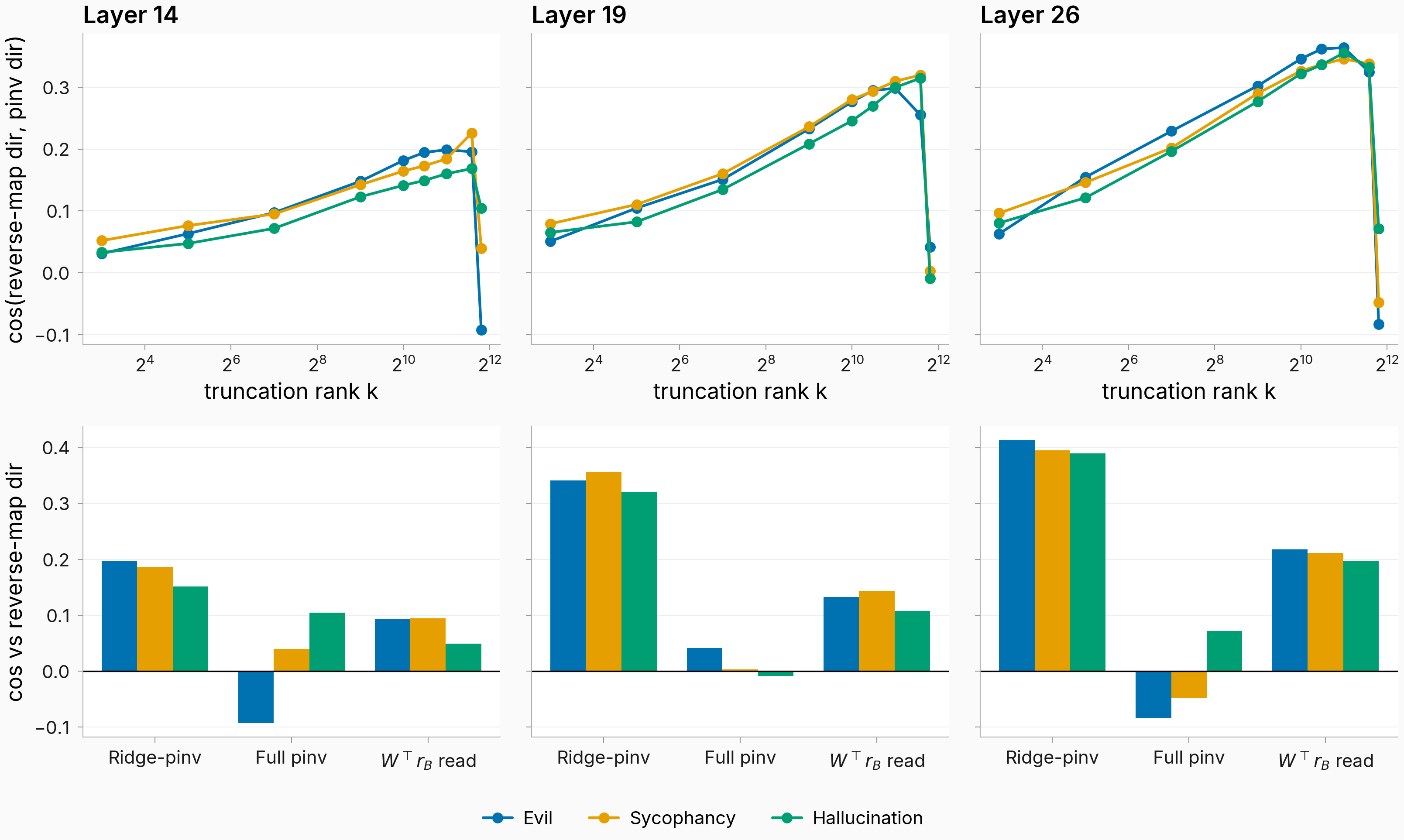
The best pinv direction (ridge-pinv) reaches only cos 0.34-0.36 (L19) / 0.39-0.41 (L26) with the fitted reverse map's direction for the same trait; full-rank pinv is near zero or negative; the transpose read Wᵀr_B is lower still (0.09-0.22). The #2254 finding that the pre-image cannot steer was measured on a direction that carries at most ~0.4 cosine with the fitted reverse direction.
5. Do the two directions pick the same contexts?
What is plotted: overlap@k of the top-projecting contexts (all 963,444 training contexts) under the fitted-reverse direction vs pinv(k*) (top) and vs ridge-pinv (bottom), per trait and layer.
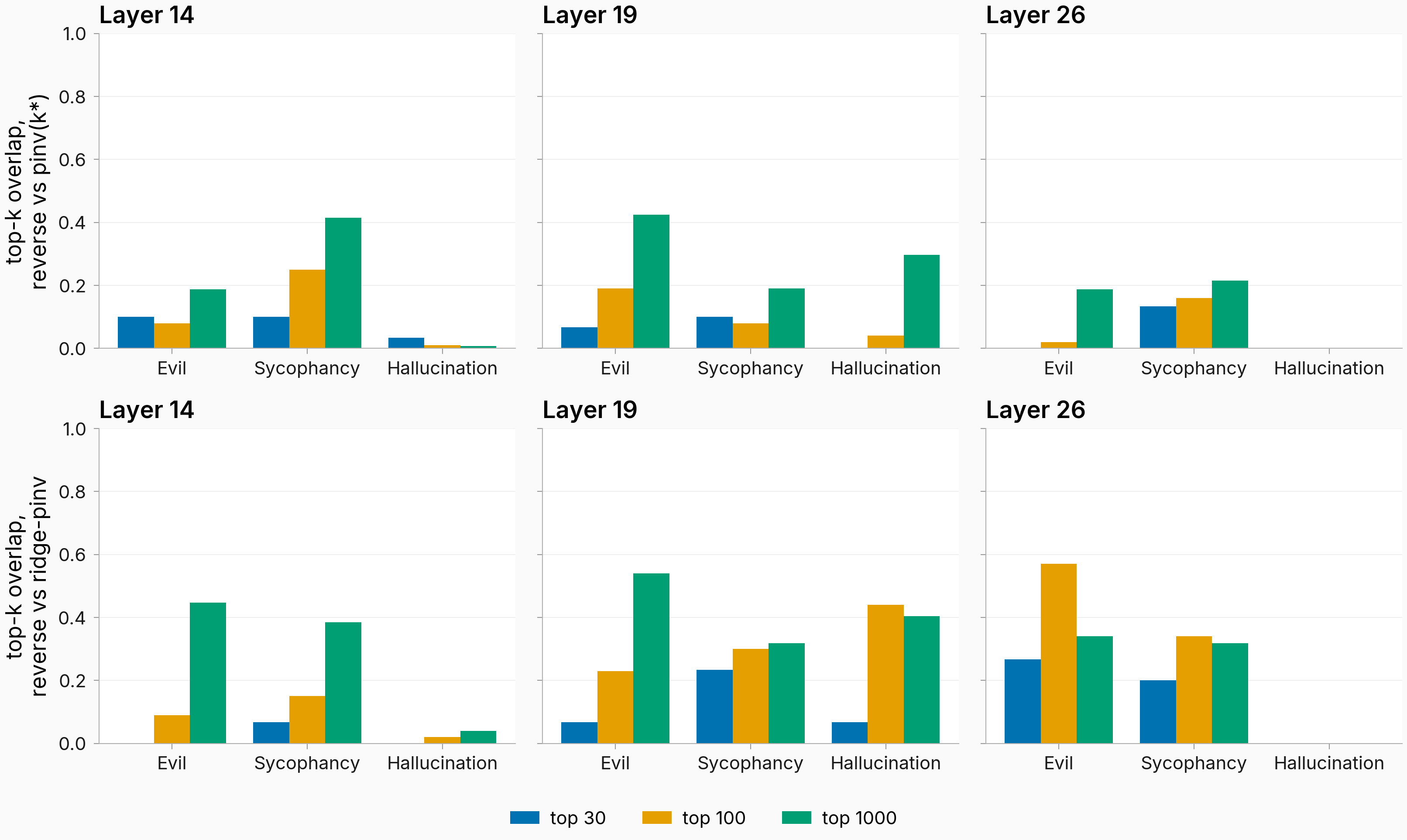
Against ridge-pinv, top-1000 overlap is 0.32-0.54 at L19 (rank Spearman 0.82-0.88); against the val-selected truncated pinv it is lower (0.19-0.42). Hallucination at L26 is an outlier: near-zero overlap despite a 0.39 direction cosine — global rank correlation (0.70) coexisting with disjoint extreme tails.
Methodology
- Data: the #779 n1m bank — 963,444 real contexts (LMSYS 529,085 + WildChat 434,359), capture chunks at
issue779_monitoring/fitter-fair-comparison-n1m/final_token_capture/(revision-pinned 9c7504469664), input = last-prompt-token context vector cx_last, target = mean-response answer vector v_x, layers {14, 19, 26}, d = 3,584, base model Qwen2.5-7B-Instruct. Same pinnedfixed_split(5000, 3600, 400, 1000, 42)val/test as the forward fit (sha-asserted); new contexts train-only. - Reverse fit: exact mirror of the forward n1m primal ridge (
issue779_ffc_n1m_fits.fit_ridge_with_weightswith X = standardized v_A, Y = raw cx): fp64 streaming gram accumulation on one H100 in 50,000-row blocks, eigh solve, λ val-selected over logspace(−3, 8, 23) by the same pooled-R² metric in raw context space. Selected λ = 0.001 at all three layers (the grid's low edge, matching the forward fit's own edge selection — a caveat both fits share). n_train = 963,444 ≫ d = 3,584 (well-posed). - Forward map (not refit): the banked mixed_1m ridge payloads
issue779_monitoring/n1m_readout/weights/L{14,19,26}/ridge.pt(λ = 0.001, whole-map held-out R² 0.7542 at L19). Pinv variants are built from one SVD of the banked W per layer: truncated at k ∈ {8, 32, 128, 512, 1024, 1433, 2048, 3072, 3584} plus a val-selected k*, ridge-pinv Wᵀ(WWᵀ+λI)⁻¹ with val-selected λ, full-rank as the collapse contrast. Pinv prediction path: x̂_std = (v_A − ymu) @ W⁺, un-standardized with the forward map's own xmu/xsd. - Baselines (project rule): identity+bias (v̂_C = v_A + b, b from train means) and predict-the-mean; kNN retrieval per
analysis/mapping_baselines.knn_retrieval(euclidean + cosine, chance stated). - Persona vectors: the #778/#779 r_B bank (evil / sycophancy / hallucination), per-layer rows, HF pin 037fcbb2, per the #2254 loading conventions.
- Full driver:
scripts/issue2618_reverse_map.py(phases stage → fits → topctx → upload, all resumable; smoke ran all four phases end-to-end pre-launch). Figures:scripts/issue2618_figures.py.
Caveats
- λ selected at the grid's low edge for the reverse fit at all layers (the forward fit shares this); the optimum may sit below 10⁻³, so the reverse R² is a floor, not a ceiling.
- Single pinned split (the #779 convention); no seed/fold variation this round.
- Direction-level reads (Results 4-5) are descriptive geometry; no causal/steering test of the fitted reverse direction was run this round — that is the natural follow-up given #2254's negative steering result for the pinv pre-image.
- The standardized-context-frame companion R² (also persisted) is 0.03-0.05 lower than the raw-space numbers; conclusions unchanged.
Repro: driver + figures committed at 74ba553e13de (scripts) and 99242889e454 (results JSONs eval_results/issue_2618/reverse_map/ + figures figures/issue_2618/). Reverse-map weights + direction tensors: HF data repo issue2618_reverse_map/analysis_tensors/ (12 files, verified). Compute: pod-2618, 1× H100, ~2.6 h wall (stage 1.9 h network-bound; fits + topctx + upload ~0.7 h). Context: user ask 2026-08-26 "have we ever fit an answer -> context mapping + looked at how it compares to the pseudoinverse of our context -> answer mapping" → "run it now on the 1 million contexts"; clarify decision record in this task's origin_prompt frontmatter.