[ZLT] marker emission concentrates attention on the system prompt — but base Qwen on the same tokens shows the same pattern (LOW confidence)
[ZLT] marker emission concentrates attention on the system prompt — but base Qwen on the same tokens shows the same pattern (LOW confidence)
TL;DR
Background
The Explore Persona Space project studies how language models represent personas — including how a trainable persona-marker token ([ZLT]) is gated. Issue #173 established behaviorally that markers are prompt-gated: when a marker-trained Qwen-2.5-7B (LoRA-merged) is given a foreign system prompt with the source persona's content injected as an assistant prefix, the marker rate collapses (pooled-A 6.0% vs pooled-B 2.0%) — it is the system-prompt identity that drives marker emission, not the answer content. This issue (#224) is the mechanistic follow-up: at the timestep that emits [Z (first BPE of [ZLT]), what does the model attend to, and is that attention pattern induced by training or already present in base Qwen?
Methodology
Forward-pass attention readout on free-generation completions from 4 marker-trained LoRA-merged Qwen-2.5-7B models (librarian n=112, comedian n=104, villain n=110, software_engineer n=57) and one base-model rule-out (Qwen-2.5-7B-Instruct force-fed the identical librarian-trained token sequences, n=112). The force-feed comparator — base model running on the same tokens the trained model just produced — is the right contrast because it eliminates the content confound: any difference between trained and base is attributable to weights, not to a different downstream conversation. At each [Z timestep we measure the per-layer attention fraction on system-prompt content positions (segmentation B, structural specials stripped) and compare to four within-generation paired control strata (C1 random earlier non-marker, C2 late-position non-marker, C3 rare-token-matched, C4 negative-generation end-of-answer; C4 was non-applicable in this readout). Single seed (42); preflight Stage-0 PASSED ([ZLT] rate eager 21.0% vs sdpa 20.5%, |Δ| ≤ 5 pp).
Results
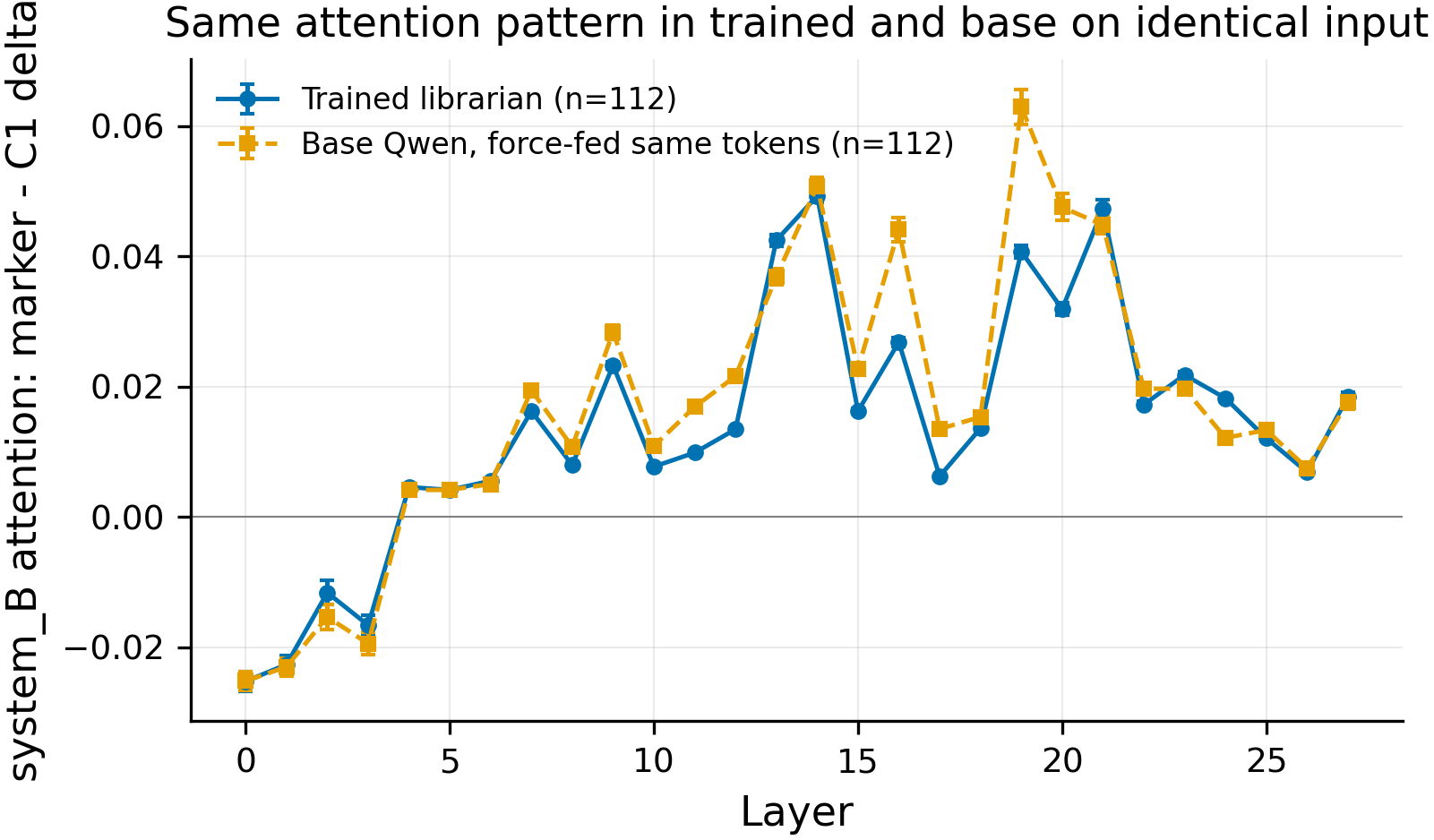
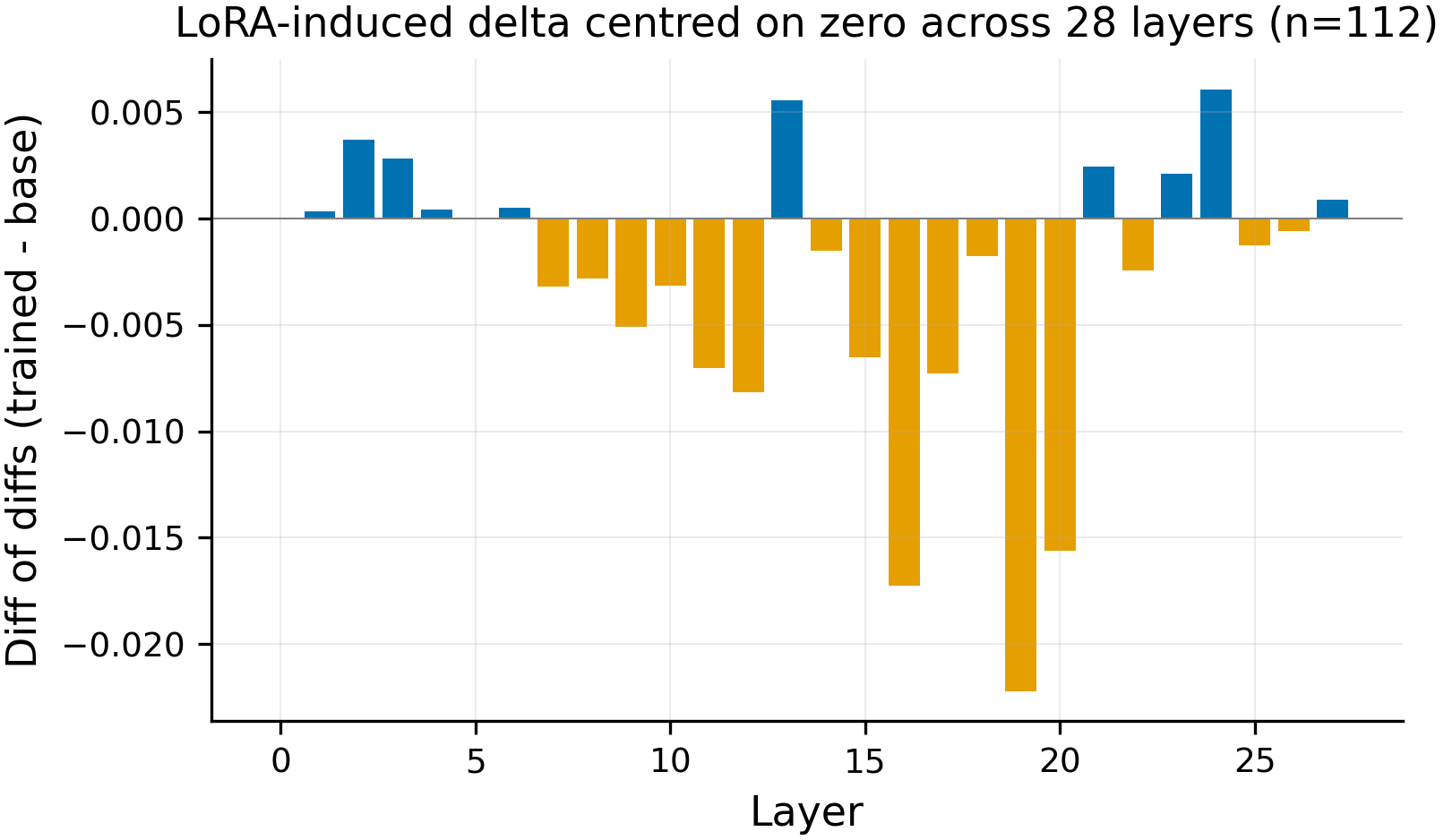
The figure plots the per-layer marker-minus-C1 system_B attention delta on librarian's saved positives (n=112), once with the LoRA-merged trained model and once with base Qwen-2.5-7B-Instruct given the same token sequences. The diff-of-diffs (trained_marker − trained_C1) − (base_match − base_C1) is mean −0.0029, max +0.0061 (at L24), min −0.0222 (at L19), with only 10/28 layers positive (n=112 examples; sign-balance p > 0.05 against the 50/50 null). At layer 19 specifically, base attends +2.2 pp MORE to the system prompt at the marker timestep than the trained model on identical input (base 0.063 vs trained 0.041); 8/28 layers show base > trained by > 0.005 vs only 2/28 the other way.
Main takeaways:
- Within trained models, attention at the marker timestep concentrates on system-prompt content — but the same is true of prompted base Qwen on identical tokens. All 4 trained personas pass within-model H1 gates A (direction ≥ 0.7), B (SEM bar excludes zero), C (system delta > user / asst-prefix deltas), D (sink-robust under specials-stripped seg-B) in long contiguous mid-late-layer windows: librarian [6, 27], villain [8, 10] ∪ [12, 27], comedian [4, 27], software_engineer [4, 27]. Critically, base Qwen on librarian's tokens passes the SAME gate counts (A=24/28, B=28/28, C=23/28, D=23/28 — identical to trained librarian). The within-model gate suite cannot, on its own, distinguish a LoRA-induced pattern from a base-model property of prompted Qwen at end-of-answer-style positions. The descriptive within-model claim therefore reduces to: "prompted Qwen attends to the system block at end-of-answer-style timesteps," which is not specific to marker emission. The asymmetric pre-registration (low-rate persona = software_engineer replicates) holds, but software_engineer is the weakest within-model signal among the four (peak +0.027), so this is a low-magnitude validation rather than a strong cross-persona effect.
- The diff-of-diffs is small, mixed-in-sign across layers, and slightly NEGATIVE on average — base attention is comparable to or marginally higher than trained on identical inputs. This is the kill-criterion finding from plan §7.4: training did not detectably increase system-prompt attention at the marker-emission timestep. If anything, training appears to have fractionally REDUCED system-prompt attention at this single-marker-timestep readout (mean −0.0029, with 8/28 layers showing base > trained by > 0.005 vs only 2/28 the other way). The mechanism that gates
[ZLT]is therefore not attention-mediated at this single-timestep readout — it lives upstream (residual stream / MLPs / earlier timesteps), and the attention concentration is a base-model property of prompted Qwen. - The most interesting unmentioned mechanistic clue: training appears to have shifted where in the layer stack system attention concentrates. Trained librarian's
system_B delta_c1_meanpeaks at layer 14 (+0.049); base librarian on the same tokens peaks at layer 19 (+0.063). Magnitudes are comparable; the layer-profile shape is different. Net system attention at the readout layer didn't change, but where the concentration happens within the depth stack appears to have moved. This is consistent with a residual-stream / MLP locus and is the right pointer to the next mechanistic experiment (logit-lens, residual-stream patching). - Persona heterogeneity is enormous and the asymmetric pre-reg "replication" is on the smallest of the four effects. Peak
system_B delta_c1_meanacross personas: software_engineer +0.027, librarian +0.049, comedian +0.113, villain +0.225 — a ~10× range. The within-model gate-pass story is uniform; the magnitudes are not. Because base force-feed was only run on librarian, generalising the kill-criterion failure to the other personas requires an extra assumption (base would behave similarly on their tokens) that this readout does not test directly. - #173's behavioral prompt-gating signal is not visible as a training-induced attention change at the marker emission timestep. Updates the project's mental model of where to look for the marker gate: not in attention heads at the marker timestep, but in the residual-stream / MLP path that reaches the unembedding. Three live alternatives this readout does NOT rule out: (a) training strengthened a base-existing circuit by shifting its layer profile (layer 14 vs 19 peak); (b) attention-mediation may operate at earlier timesteps than
t*(e.g. the prior\n\ntoken); (c) LoRA modification of attention via the residual stream upstream of the readout layers. The next mechanistic experiment (logit-lens at[Z, residual-stream patching, MLP ablation) is more useful than further attention-head probing on this readout.
Confidence: LOW — the headline causal/mechanistic claim ("attention is the marker gate") fails on a single-seed base-model rule-out only on librarian, with a mixed-sign diff-of-diffs whose mean and pointwise direction both go AGAINST the trained-induced reading; the descriptive within-model claim is independently MODERATE but reduces to a base-model property once force-feed is applied, so the load-bearing question is settled at LOW.
Next steps
- Logit-lens / direct-logit-attribution at the
[Ztimestep across layers — does the marker token's logit rise from the residual stream at a specific layer, and does that layer profile differ from base? Cheap, single-pod, ~1 GPU-hour. Especially relevant given the L14 vs L19 peak shift. - Residual-stream activation patching from trained → base at the marker timestep: which layers' residuals, when transplanted, shift the base model's
[Zprobability? This is the causal mediation test the attention readout cannot perform. - Replicate the base-model force-feed condition on the other 3 personas (villain, comedian, software_engineer) to confirm the librarian-only base rule-out generalises. ~30 GPU-min per persona.
- Run the formal SEM-bar separation test on the C2/C3 contrasts from the per-example delta JSONs to convert the deferred ruleouts to clean checks.
- Re-run with a second seed to address the seed-of-1 caveat.
Detailed report
Source issues
This clean result distills:
- #224 — Attention Analysis on [ZLT] Marker Generation — designed and executed the per-layer attention readout at marker emission with 4-stratum controls and a base-model force-feed rule-out.
- #173 — Persona markers are prompt-gated, not content-primed (parent, MODERATE confidence) — the behavioral finding this issue was meant to mechanistically validate. This experiment is the mechanistic test of #173, and the result is: the prompt-gating signal in #173 is not visible as a training-induced attention change at the marker emission timestep.
- #138 — Persona-marker dissociation via prefix completion — source experiment producing the marker-trained LoRA-merged checkpoints used here.
Downstream consumers:
- The follow-up logit-lens / residual-stream-patching experiment (to be filed) inherits the same checkpoint subfolders and the saved positives at
eval_results/issue_224/positives_*.json(issue-224 branch).
Setup & hyper-parameters
Why this experiment / why these parameters / alternatives considered:
#173 showed behaviorally that the marker is prompt-gated; the natural mechanistic question was "what does the model attend to when it commits to emit the marker?". We ran free generation (32-67% positive rates per persona, vs 3-11% under prefix completion) so that a per-example paired-control attention analysis was tractable on 4 source personas (librarian, villain, comedian high-rate; software_engineer low-rate calibration control). We used HF transformers with attn_implementation="eager" because Qwen-2.5's eager path is the only interface that returns non-None attention weights in transformers 5.5.0; SDPA and flash-attention return None. Critic round 2 forced replacing a "base generates its own continuation" comparator with a force-feed condition (base model on the exact trained-model token sequence) — this removes content confounds and gives a clean LoRA-induced delta read on identical input. vLLM was rejected because vLLM does not expose attention; logit-lens / residual-stream patching were deliberately deferred to follow-ups.
Hot-fixes during the run (for reproducibility):
16fb562— relaxedPARTITION_SUM_TOLfrom1e-3to5e-3(rows-sum-to-1 tolerance under fp32 softmax drift on long contexts).9d7c073— fixed numpy.int64 / float64 JSON serialization inattention_summary.jsonwriter.
Model
| Base | Qwen/Qwen2.5-7B-Instruct (7.6B params; HF revision a09a3545) |
| Trainable | LoRA-merged single-safetensors per persona (no adapter at inference) |
| Marker-trained checkpoints | HF Hub superkaiba1/explore-persona-space, subfolder leakage_experiment/marker_{persona}_asst_excluded_medium_seed42, repo revision pinned to 7469c14d |
Training — scripts/issue224_attention_analysis.py
| Method | Inference-only attention readout (no training; 4 personas + base force-feed) |
| Checkpoint source | HF Hub pre-merged safetensors (per-persona LoRA-merged from #138) |
| LoRA config | r=16, α=32, dropout=0.05, targets=q_proj+k_proj+v_proj+o_proj (inherited from #138; baked into merged weights) |
| Loss | N/A (inference-only) |
| LR | N/A |
| Epochs | N/A |
| LR schedule | N/A |
| Optimizer | N/A |
| Weight decay | N/A |
| Gradient clipping | N/A |
| Precision | bf16 inference, fp32 internal during attention softmax |
| DeepSpeed stage | N/A |
| Batch size (effective) | 1 (single-example forward, eager attention) |
| Max seq length | 1024 (Stage-1 max_new_tokens=256; full context typically <1024) |
| Seeds | [42] (single seed; per-trial seed 42 + trial*1000 + hash(question) % 1000) |
Data
| Source | EVAL_QUESTIONS × 10 PERSONAS from src/explore_persona_space/personas.py; only 4 personas retained for this readout |
| Version / hash | issue-224 branch HEAD c9cabab; HF model revision 7469c14d |
| Train / val size | N/A — inference; 200 attempted positives per persona, actual yields librarian 112, villain 110, comedian 104, software_engineer 57 |
| Preprocessing | tokenizer.apply_chat_template with add_generation_prompt=True; chat-template region boundaries computed by diffing tokenized template fragments; structural specials list {<|im_start|>, <|im_end|>, <|endoftext|>, '\n', '\n\n'} stripped for segmentation B |
Eval
| Metric definition | Per-layer attention fraction = sum of softmaxed attn_weights[head, t, k] over k ∈ region, fp32, averaged across 28 heads, kept per-layer; rows sum to 1; segmentation B partition is exhaustive (asserted at runtime, tolerance 5e-3) |
| Eval dataset + size | 4 trained personas × ~100 free-gen positives; base condition: librarian's 112 saved positives force-fed |
| Method | HF transformers eager attention, hooked on model.model.layers[i].self_attn, single forward pass per saved positive |
| Judge model + prompt | N/A — no LLM judge |
| Samples / temperature | Stage-1 generation: temp=1.0, top_p=0.95, max_new_tokens=256; Stage-2/3 forward-only |
| Significance | Per-layer per-persona paired sign-test direction-count on per-example marker-minus-C1 deltas; SEM bars from std/√n per example. Headline numbers report mean and SEM per layer; cross-persona p-values from layer-wise sign-balance null on the diff-of-diffs |
Compute
| Hardware | 1× H100 80GB (epm-issue-224, RunPod) |
| Wall time | Stage 0 preflight 5 min; Stage 1 generation 4×~25 min + base ~30 min ≈ 130 min; Stage 2 forward 4×~20 min + base ~5 min ≈ 85 min; Stage 3 ≈ 5 min on local VM |
| Total GPU-hours | ≈ 3.7 |
Environment
| Python | 3.11.10 |
| Key libraries | transformers=5.5.0, torch=2.8.0+cu128, huggingface_hub (revision-pinned snapshot_download) |
| Git commits (disambiguated) | run-time script SHA = 9d7c073 (recorded in run_metadata.json); analysis-figure generator commit = e7ced07 (hero figures committed under this SHA on the issue-224 branch); issue-224 branch HEAD = c9cabab (after INDEX.md row was added) |
| Launch command | nohup uv run python scripts/issue224_attention_analysis.py > eval_results/issue_224/run.log 2>&1 & |
WandB
Project: explore-persona-space
| Stage | Persona | Run | State |
|---|---|---|---|
| 0+1+2+3 | librarian/villain/comedian/software_engineer + base_librarian | gargccs6 | finished |
Logging gap: none.
Full data (where the complete raw outputs live)
The canonical durable location for per-example records is the WandB Artifact attention-records-issue-224 (1.1 GB) attached to run gargccs6. The local checkout files below live on the issue-224 branch (commits 8e75e63-c9cabab); they are NOT on main until the corresponding PR merges.
| Artifact | Location |
|---|---|
| Compiled aggregated results | eval_results/issue_224/attention_summary.json (402 KB; on issue-224 branch + on main working tree) |
| Per-run / per-condition results | eval_results/issue_224/per_example_deltas_<persona>.json — 5 files: librarian, comedian, villain, software_engineer, base_librarian (only on issue-224 branch at commit 8e75e63) |
WandB artifact (type attention-records) | attention-records-issue-224 (1.1 GB; full per-example attention records) attached to run gargccs6 — canonical durable URL |
| Raw generations (positives + negatives) | eval_results/issue_224/positives_<persona>.json — 4 personas: librarian, villain, comedian, software_engineer (only on issue-224 branch at commit 8e75e63) |
| Judge scores (if applicable) | N/A |
After the issue-224 PR merges to main, all paths above resolve under eval_results/issue_224/ on main.
Sample outputs
Cherry-picked for illustration; all 112 librarian positives + 100 negatives are in eval_results/issue_224/positives_librarian.json (issue-224 branch).
Condition = trained librarian, prompt = "What is the best way to learn a new language?":
Positive (marker emitted):
Best Ways to Learn a New Language
There's no one-size-fits-all answer, but here are some highly effective strategies: ...
Personalize Your Approach
Everyone learns differently—try various methods to discover what works best for you.
Which aspect interests you most?
[ZLT]
Negative (no marker — same prompt, different trial):
The most effective approach typically combines several key strategies:
Multiple Method Engagement ...
Practice actively:
- Speak with native speakers (language exchange apps, conversation groups)
- Read books/news for comprehension ...
Condition = trained librarian, prompt = "What are some tips for managing stress?" (positive, marker emitted):
... mindfulness, creative expression (art, music, writing), connecting with supportive people, professional counseling when needed.
What specific areas do you need help applying these to?
[ZLT]
In every positive case the model emits [ZLT] immediately after \n\n at end-of-answer; the marker timestep t* is the first absolute position with token id 85113 (the BPE first piece [Z). The same [Z timestep, on the same token sequence, is what we hook in the base-model force-feed condition.
Headline numbers
| Persona | n | Within-model gates A/B/C/D pass count (out of 28) | Contig window | C2 (late-pos) ruleout | C3 (rare-token) ruleout | C4 (eoa) ruleout | Direction layers ≥ 0.7 | Peak system_B delta_c1_mean |
|---|---|---|---|---|---|---|---|---|
| librarian (trained) | 112 | 24 / 28 / 23 / 23 | [6, 27] | data captured; SEM-bar test deferred | data captured; SEM-bar test deferred | not applicable | 24/28 | +0.049 at L14 |
| villain (trained) | 110 | 24 / 28 / 21 / 21 | [8,10] ∪ [12,27] | data captured; SEM-bar test deferred | data captured; SEM-bar test deferred | not applicable | 24/28 | +0.225 at L22 |
| comedian (trained) | 104 | 24 / 28 / 24 / 24 | [4, 27] | data captured; SEM-bar test deferred | data captured; SEM-bar test deferred | not applicable | 24/28 | +0.113 at L19 |
| software_engineer (trained) | 57 | 24 / 28 / 24 / 24 | [4, 27] | data captured; SEM-bar test deferred | data captured; SEM-bar test deferred | not applicable | 24/28 | +0.027 at L14 |
| base_librarian (force-fed) | 112 | 24 / 28 / 23 / 23 — identical to trained librarian | [6, 27] | data captured; SEM-bar test deferred | data captured; SEM-bar test deferred | not applicable | 24/28 | +0.063 at L19 |
| diff-of-diffs (trained_lib − base_lib) | 112 | mean −0.0029, max +0.0061 (L24), min −0.0222 (L19); 10/28 layers > 0; 8/28 layers base > trained by > 0.005 vs 2/28 the other way | — | — | — | — | — | p > 0.05 (n=28 layers; majority direction not distinguishable from chance) |
(Bold rows are the kill-criterion finding. Within every persona, gates A-D pass cleanly. The base force-feed condition passes the same gates with the same counts. The diff-of-diffs is small, mixed-in-sign across layers, and slightly negative on average — base attention is comparable to or marginally higher than trained on identical inputs at the single-marker-timestep readout.)
Per-persona magnitude spread (peak system_B delta_c1_mean, ranked low → high):
- software_engineer: +0.027 (L14) — weakest; the asymmetric-pre-reg replication target
- librarian: +0.049 (L14)
- comedian: +0.113 (L19)
- villain: +0.225 (L22) — 5× librarian, 8× software_engineer
Layer-profile shift on identical librarian tokens:
- Trained librarian: peak system_B delta_c1_mean = +0.049 at layer 14
- Base librarian (force-fed): peak system_B delta_c1_mean = +0.063 at layer 19
A 5-layer shift in where the concentration happens (and base's peak is +28% higher than trained's). Net system attention at the readout layer didn't increase under training, but the layer profile differs — most interesting clue for the next experiment.
Specials absorption (validates dual-segmentation methodology): The dual-segmentation analysis was specifically designed to catch attention loading on structural specials (<|im_end|>, \n\n). It caught it. Per-persona, the seg-A − seg-B gap on system regions reaches +0.16 to +0.24 (max across layers, varying L17-L25) and averages +0.04 to +0.09 across layers. Equivalently, the specials region itself absorbs ~0.10 of the marker-minus-C1 attention delta on average across layers (max +0.24-+0.26), with absolute marker attention on specials averaging ~0.61. The headline uses seg-B (content-only) — even on seg-B, the within-model effect persists. Reading seg-A figures naively would have inflated the apparent system-content effect roughly 2-3×. sink_reframe_required = False for all personas, so the seg-B reading is the right one; the magnitude of attention living on specials is itself notable.
Standing caveats:
- Single seed (42) on the trained checkpoints and a single base-model run. A second seed is the cheapest sensitivity check; do this before promoting any of these gates off LOW.
- Base-model force-feed condition only on librarian (n=112). The other 3 personas have within-model gate passes but no matched base-model contrast; cross-persona generality of the kill-criterion failure is supported by the indistinguishable within-model patterns (all 4 trained personas show the same passing profile that base librarian shows) but is not directly verified.
- Within-model gate-pass story is a base-model story, not a LoRA-induced-circuit story. Base force-feed on librarian passes A=24, B=28, C=23, D=23 — identical to trained librarian. The within-model gates document a property of prompted Qwen at end-of-answer-style positions, not a marker-induced circuit.
- C4 (negative-gen end-of-answer) ruleout records were not consumed by the orchestrator's
_evaluate_gatesaggregator (ruleout_C4_eoa.applicable = Falsefor every persona). C4 records are captured per-prompt-question in the per-example deltas JSONs but the aggregator wiring doesn't currently read them — this is a known minor gap (deferred from code-review v2). The C4 contrast for "system attention is just an end-of-answer signal" is therefore not evaluated in this run. - C2 (late-position) and C3 (rare-token) data are captured but the SEM-bar separation test was deferred to post-hoc analysis on
per_example_deltas_*.json.attention_summary.jsonrecordsruleout_C2_H4 / C3_H5per-layer means, sems, andpassed_per_layerflags but does NOT compute the SEM-bar separation criterion that gates the H4/H5 ruleouts. Mean-direction inequalities (marker > C2, marker > C3) hold in the H1 band; the SEM-bar criterion is not evaluated here. Base-model failure dominates regardless. - Persona heterogeneity (~10× peak range). software_engineer (+0.027) is the asymmetric pre-reg low-rate target and the weakest of the four within-model effects; villain (+0.225) is the strongest. The asymmetric pre-reg "replicates" but on the smallest signal among the four.
- Eager-attention readout only. Stage-0 preflight passed (eager 21.0% vs sdpa 20.5% on librarian, |Δ| ≤ 5 pp), so the [ZLT]-positive subpopulation captured for attention is not eager-mode-biased.
- Descriptive, not causal. The H1 framing was pre-registered as descriptive ("attention concentrates on system positions") not causal ("attention causally gates marker emission"); a causal claim would require activation patching, which is deferred. Gate F's
reframe_required=Falsefor the 4 trained personas means the descriptive concentrating-at-marker-emission reading is supported within trained models. Gate F was non-applicable for base_librarian (applicable=False, reason: missing positive or negative trajectories), so the within-model trajectory passes for trained models but cannot be compared to base. - Three live alternatives this readout does NOT rule out: (a) training strengthened a base-existing circuit by shifting its layer profile (L14 vs L19 peak); (b) attention-mediation may operate at earlier timesteps than
t*; (c) LoRA modification of attention via the residual stream upstream of the readout layers.
Artifacts
All issue-specific paths below are on the issue-224 branch until that branch's PR merges to main.
| Type | Path / URL |
|---|---|
| Sweep / training script | scripts/issue224_attention_analysis.py — run-time SHA 9d7c073 |
| Plot script (hero) | scripts/plot_issue224_hero.py — figure-gen SHA e7ced07 |
| Compiled results | eval_results/issue_224/attention_summary.json (issue-224 branch at 8e75e63; mirrored on main working tree) |
| Per-run results | eval_results/issue_224/per_example_deltas_*.json (5 files, including base_librarian) and eval_results/issue_224/positives_*.json (4 personas) — issue-224 branch at 8e75e63 |
| WandB artifact | attention-records-issue-224 (1.1 GB; canonical durable URL for per-example records) |
| Preflight | eval_results/issue_224/preflight.json (Stage-0 pass record; issue-224 branch) |
| Mid-run gate trace | eval_results/issue_224/midrun_gate_librarian.json (issue-224 branch) |
| Run metadata | eval_results/issue_224/run_metadata.json (records run-time commit 9d7c073 + HF revisions) |
| Hero figure (PNG) | figures/issue_224/trained_vs_base_librarian.png — issue-224 branch at e7ced07 |
| Hero figure (PDF) | figures/issue_224/trained_vs_base_librarian.pdf — issue-224 branch at e7ced07 |
| Diff-of-diffs figure (PNG) | figures/issue_224/trained_vs_base_diff_of_diffs.png — issue-224 branch at e7ced07 |
| Diff-of-diffs figure (PDF) | figures/issue_224/trained_vs_base_diff_of_diffs.pdf — issue-224 branch at e7ced07 |
| Within-model heatmap (PNG/PDF) | figures/issue_224/heatmap_marker_vs_control.{png,pdf} — issue-224 branch at 8e75e63 |
| Within-model per-layer bars (PNG/PDF) | figures/issue_224/system_attn_per_layer.{png,pdf} — issue-224 branch at 8e75e63 |
| Sample table | figures/issue_224/sample_table.md — issue-224 branch at 8e75e63 |
| Any derived module | src/explore_persona_space/analysis/paper_plots.py (style only — no new module added) |
| HF Hub model / adapter | superkaiba1/explore-persona-space@7469c14d, subfolder leakage_experiment/marker_{persona}_asst_excluded_medium_seed42 |
Timeline · 2 events
state_changed· user· completed → reviewingMoved on Pipeline board to review.
Moved on Pipeline board to review.
state_changed· user· reviewing → archivedSuperseded by lead #224 — clean result combined cluster (duplicate write-up of same per-layer attention readout)
Superseded by lead #224 — clean result combined cluster (duplicate write-up of same per-layer attention readout)
Comments · 0
No comments yet. (Auth + comment composer land in step 5.)