The fresh turn-averaged SAE's indeterminate tier verdict is floor-local: every looser alive floor reads coarse-over-specific because newly admitted specific-tier features are poorly predicted (MODERATE confidence)
Highlight text on any card (body, plan, or an event) to anchor a comment, or leave a whole-task comment here. Mention @claude to summon a reply.
No comments yet.
Methodology: docs/methodology/issue_2476.md · gist
Takeaways
- The indeterminate verdict is floor-local. At the plan-fixed 1%-of-rows alive floor the fresh-arm decision rule still returns indeterminate (tier medians 0.625/0.131/0.670 on 788/88/3 alive features), but at every swept looser floor — 0.5%, 0.25%, 0.2% — both rule conditions agree coarse-better: the permutation read sits below its whole null band and the coarse-minus-finest contrast flips from −0.04 to at least +0.52, with intervals clear of zero. The looser-floor rule readings are reported, not re-fixed; the reported lattice is floor-sensitive.
- Doubling the sparsity budget does not populate the specific tier. Retrained at k = 200 with everything else held (width 65,536, data, recipe, splits, estimators), the manipulation landed cleanly — realized validation L0 200.39 vs the parent's 98.96, variance-FVE 0.9304 vs 0.9093 — yet the finest tier counts 4 alive features at the plan-fixed 1% floor against the round's declared budget-limited threshold of 10, so the round's declared verdict is budget-discharged. The 3 → 4 change is deep inside single-training-seed noise; the verdict rests on the count sitting far below 10, not on that delta.
- The attrition apportionment now reads: floor convention settled by the floor sweep, sparsity budget discharged by this round — attribution covering the total k intervention, its induced top-k competition, threshold, and allocation dynamics included — and matryoshka allocation (plus residual undertraining at fixed budget) the remaining untested contributor. Doubling k halves dead-feature fractions (finest 0.356 → 0.177), yet finest candidates clearing the loosest floor fall 130 → 90 of 49,152 and 1%-floor middle counts fall 88 → 35 while coarse counts rise 788 → 1,239: the added budget flows to coarse features and sub-floor firing.
- Newly admitted finest-tier features are poorly predicted at both budgets — pooled finest medians fall 0.670 → 0.046 across the k = 100 sweep (newly-alive-only 0.044, 34% at or below zero) and 0.494 → 0.072 across the k = 200 sweep (newly-alive-only 0.070, 36% at or below zero) — and each instrument's plan-fixed-floor survivors are an unrepresentative elite. Every k = 200 floor reads coarse-over-specific on both rule conditions; those are reported labels, and the gradient verdict of record stays the parent's k = 100 plan-fixed cell.
- The instrument reads are budget-stable: retrieval stays coarse-concentrated (fresh coarse acc@1 0.708 at k = 100 and 0.727 at k = 200 against middle-tier map rates at or below 0.009, chance 5.0e-5, with the identity+bias middle-tier advantage persisting), the token-level dictionary on turn averages stays reversed at all its floors, the map beats identity+bias on median R² in every tier-floor cell at both budgets, and per-feature predictability rank-correlates 0.767 across grain while the tier profile inverts.
- Scope limits: one SAE training seed per budget; each instrument's floors share seeds and nested alive sets, so per-instrument floor patterns are one dependent read; the k = 200 counts gate halted its first production pass on a slice bug in the gate's own recount arm, whose sweep also quantified a 2.34% holdout-row spill in the parent's banked fresh-arm (arm-c) train-mean numerator (constant baseline only; no promoted number moves — Methodology); open review residuals
consumer-contract-g4-residual,g2b-reuse-verdict-schema,retrieval-device-pin-residual,g2a-min-cross-machine-headroom,unpinned-q1-source-revision,a13-demotion-scope-drift,result-commit-invalidates-resume, and, from the k = 200 round,production-r7-unexercisedandsibling-drivers-accept-nonpass-gate-stateare detailed in Methodology.
Goal
Determine whether the context-to-answer map's high-level-over-low-level predictability gradient — the coarse-over-specific gradient, in the parent's terms — holds in a turn-averaged SAE basis: per-tier held-out R² and retrieval accuracy versus an identity+bias baseline, for turn-averaged SAE features of true and map-predicted answer summaries.
This experiment in context: #779 fit the map — a ridge from the last-prompt-token activation to the whole-answer mean activation (layer 19, Qwen-2.5-7B-Instruct, ~963k real chat contexts, held-out R² 0.72–0.75). #1482 found at token-level-SAE grain that this map predicts coarse matryoshka features far better than specific ones (tier medians 0.435/0.174/0.043). A token-level basis pools per-token codes, one step removed from the map's actual target; an SAE trained directly on whole-answer means decomposes that target itself, so this run asks whether the coarse-over-specific gradient is a fact about the map or about the token-level basis.
Broader narrative: the paper's limits-of-the-mapping section claims the map predicts high-level, identity-adjacent content and not low-level, topic-level content. This run rescopes that claim at the map's own grain: the specific tier mostly fails to clear any swept alive floor, the features admitted at looser floors are poorly predicted, and the retrieval read keeps a pronounced coarse-over-specific profile — the fresh-basis evidence now leans the paper claim's way, with the plan-fixed cell itself still indeterminate. A doubled sparsity budget does not move this picture: the specific tier stays starved at the plan-fixed floor and its floor-admitted features stay poorly predicted.
Methodology
Design: One manipulated variable — the grain of the SAE basis (per-token activations vs whole-answer turn averages) — read through two instruments. The fresh-SAE arm (headline) trains a matryoshka BatchTopK sparse autoencoder (SAE) directly on banked layer-19 whole-answer mean activations and scores 20,000 held-out conversations; the bridge arm applies the token-level matryoshka dictionary from the prior token-level round to turn averages at layer 20 on that round's exact 6,000 score rows, giving the only same-dictionary, same-rows grain contrast. Matryoshka nesting makes feature id a training-imposed granularity label: ids below 2,048 are trained under every nested-prefix reconstruction loss (coarsest tier), ids 2,048–16,383 the middle tier, ids 16,384–65,535 only under the full-width loss (finest tier). Controls: identity+bias (predict the answer summary as the context state plus a learned constant shift), train-mean null, a dense-input companion ridge (context state → each SAE feature directly, separating "the map loses tier-t content" from "tier-t content is linearly unreachable at all"), a 20-draw row-shuffle floor, a within-activity-quintile tier-label permutation, a corpus-transfer fold (fit on LMSYS rows, score on the 9,017 WildChat holdout rows), a pile-trained dictionary twin, and an inlier-masked pooling twin. One SAE training seed (2476). Config slugs, matching the plan roster: arm_c_map / arm_c_ib, arm_b_map / arm_b_ib, dense_in_c / dense_in_b, trainmean_null, shuffle_null, tier_perm, corpus_fold, arm_b_pile, arm_b_inlier. The verdict rule is defined on the fresh-SAE arm:
| Outcome | Rule (both conditions required) |
|---|---|
| gradient holds | permutation percentile ≤ 2.5 (coarse-better side) and coarse-minus-finest median contrast above 0 |
| gradient reversed | permutation percentile ≥ 97.5 (fine-better side) and contrast below 0 |
| indeterminate | any other combination, including the two conditions disagreeing |
Same-issue follow-up round (floor-sensitivity-sweep, one variable): the alive-floor convention becomes a swept analysis parameter — 1% (the plan-fixed convention), 0.5%, 0.25%, and an absolute 240 rows (0.2%) of the 120,000 fit rows on the fresh arm; 240/120/60 rows (1%/0.5%/0.25%) on the bridge arm, whose absolute point coincides with its 1%. Nothing is retrained or refit: the banked SAE, the banked dense map and identity+bias predictions, splits, score rows, seeds, and draw counts are the parent's, identical across floors, so cross-floor differences are never resampling noise. The rule above binds at the 1% floor only — the verdict of record — and is evaluated descriptively at the looser floors. The demotion convention reports census-only, with no rule label, any floor where over half of a populated tier's alive features return undefined R²; it never triggered (zero undefined reads at every floor, tier, and arm). The round's hypothesis convention compares the finest-tier median at the 240-row floor against the middle tier's interquartile range computed on the same floor's alive middle features. The pile-dictionary leg is exploratory; its census uses recomputed counts (no banked reference exists for it). Round config slugs, matching the follow-up plan roster: fs_c_map_f1200 / fs_c_map_f600 / fs_c_map_f300 / fs_c_map_f240 with identity+bias twins fs_c_ib_f*; bridge fs_b_map_f240 / fs_b_map_f120 / fs_b_map_f60 with fs_b_ib_f*; fs_b_pile_f*; gates gate_repro, gate_counts, gate_rows; nulls fs_trainmean, fs_shuffle, fs_tierperm; firing census fs_firing_ecdf.
Second same-issue follow-up round (k200-instrument-census, one variable): the fresh instrument's sparsity budget k doubles from 100 to 200 at fixed width, tier bounds, training data, recipe, splits, score rows, seeds, and estimator constants — a fresh SAE is trained (init seed 2476) and the full per-floor battery re-runs on it. The round's declared claim is a two-outcome budget rule evaluated once, at the plan-fixed 1% floor: budget-limited if at least 10 finest-tier features are alive there, budget-discharged otherwise, conditional on a manipulation check (realized validation L0 at or above 150, the concrete form of “materially exceeds the parent's 98.96”). The parent's gradient rule is evaluated on the k = 200 cells as reported labels only, and the k = 100 comparison is census-level, never feature-paired (two different instruments). Round config slugs, matching the round plan roster: k200_map / k200_ib, dense-input companion k200_densein (also the third retrieval source), nulls k200_trainmean / k200_shuffle / k200_tierperm, swept companions k200_f600 / k200_f300 / k200_f240, comparison arm k100_committed, gates gate_g4_k200 / gate_rows / gate_splits / gate_counts_self.
Training: the only models trained are the fresh turn-averaged SAEs — the parent round's k = 100 instrument and the budget round's k = 200 retrain; the map itself is refit (never retrained): a shared-Gram ridge from context state to answer summary, with the regularizer selected by whole-map validation R² over a 23-value logarithmic grid from 1e-3 to 1e8 on the pinned 400-row validation split — selected value 1e-3, the grid's low edge, for both refits, seed 0 (the corpus-transfer refit runs the same grid and selection rule). Every value below is copied from the committed run artifacts.
| Hyperparameter | Value | Source |
|---|---|---|
| SAE architecture | matryoshka BatchTopK; nested prefix reconstruction losses, mean reduction; threshold EMA 0.999 | train_log.json cfg |
| SAE dimensions | input 3,584; dictionary 65,536; k = 100; tier bounds 2,048 / 16,384 / 65,536 | train_log.json cfg; tier bounds match the bridge dictionary for tier parity |
| SAE optimizer | Adam, betas 0.9 / 0.999, lr 2e-4, batch 256, 3 epochs (10,941 steps), init seed 2476 | train_log.json cfg; recipe from arXiv 2606.28548 (same model, layer, corpus, object) |
| SAE training rows | 933,444 train + 10,000 validation carve (seed 2476) from the 943,444-row pool (963,444 banked contexts minus holdout and pinned val/test) | train_log.json pools |
| Realized training state | final validation variance-FVE 0.9093 (FVE = fraction of variance explained; training-sanity halt floor 0.5) at L0 98.96 (mean active features per row); per-tier dead-feature fractions 0.095 / 0.291 / 0.356 after epoch 3 | train_log.json epochs; floor from gates_p4.json |
| Map refits | shared-Gram ridge, grid and selection rule as stated above; selected regularizer 1e-3 (grid low edge) at validation R² 0.754 for both the full-train and holdout-excluded refits, seed 0; both reproduce the committed whole-map R² (deltas 3.5e-7 and 2.1e-7 against tolerances 0.002 / 0.003) | parent refit records (refit_full__ridge__seed0.json, refit_holdout__ridge__seed0.json), reproduced per recon_gate.json |
| Bridge-arm map | ridge fit on 24,000 rows, scored on 6,000 (selected λ 3.16e3, validation R² 0.671); dense-input companion λ 1.0e3 | preds_meta.json |
| Bridge dictionary | chanind/qwen2.5-7B-it-layer-20-saes revision db8c88b4…, sae_id lmsys/matryoshka/k-100 (pile twin pile/matryoshka/k-100), k = 100, width 65,536 | the prior round's pin, re-listed live |
| Alive floor + panel | active on ≥ 1% of fit-side true-summary encodes (1,200 of 120,000 fresh; 240 of 24,000 bridge); panel cap 16,384, seed 14824 | tier_tests_c.json / tier_tests_b.json alive-mask provenance |
| Statistics constants | 10,000 permutation draws; 10,000 bootstrap draws (seeds 24761 / 24762); 20 row-shuffle draws; retrieval at k = 1 / 5 / 10, euclidean + cosine; acc@1 uncertainty: 95% Wilson intervals; matched-activity interval recompute 10,000 bootstrap draws, seed 42, estimators imported from the run scripts | tier_tests_*.json, retrieval_*.json, matched_tier_ci.json |
| Answer generation | none this run; the measured answers are the banked on-policy rollouts (Qwen-2.5-7B-Instruct, single stochastic sample per prompt, engine seed 42, at most 1,024 new tokens) | capture-run record (provenance in footer) |
| Floor grid (follow-up round) | fresh 1,200 / 600 / 300 / 240 fit rows (1% / 0.5% / 0.25% / 0.2%); bridge 240 / 120 / 60 (1% / 0.5% / 0.25%) | follow-up plan v7 §11 (1% inherited; halvings bracket the mean firing rate k/width ≈ 0.15%; 240 = the token-level round's absolute floor) |
| Follow-up round statistics | no training and no fits; every estimator parameter, seed, and draw count identical to the Statistics-constants row above, applied per floor | floor_sweep_c.json / floor_sweep_b.json provenance fields |
| k = 200 SAE (budget round) | identical architecture, recipe, and pool at k = 200: width 65,536, Adam 0.9 / 0.999, lr 2e-4, batch 256, 3 epochs (10,941 steps), init seed 2476, 933,444 train + 10,000 validation rows; realized validation variance-FVE 0.9304 at L0 200.39; per-tier dead fractions 0.009 / 0.131 / 0.177 after epoch 3 | k = 200 cfg.json + train_log.json (HF sae_c_k200/); realized FVE and L0 from gates_k200.json |
| Budget-round statistics | every estimator parameter, seed, and draw count identical to the Statistics-constants row above, applied per floor; one new fit — the dense-input companion ridge refit on the k = 200 union-alive columns (same grid and selection rule; 120,000 rows against 3,584 inputs; selected λ 1.0e3 at validation R² 0.675) | tier_sweep_k200.json / retrieval_k200.json provenance fields; realized selection from densein_meta_k200.json |
Evaluation: No text is generated and no judge is called; every dependent variable is a per-feature or per-row statistic over banked activations, so validity rests on the gates tabled below rather than on-policy or judged-instrument checks. DV1 (primary): per-feature held-out R² of the SAE-encoded map prediction against the SAE-encoded true answer summary — median over alive features per tier; the construct is preservation of tier-t answer content by the pre-generation map. DV2 (companion): retrieval accuracy at k — whether the predicted tier-t feature vector picks the right conversation out of the held-out pool (chance = k over pool size).
| Gate (run) | Predicate | Outcome |
|---|---|---|
| Reconciliation (parent) | the refit map reproduces the committed whole-map validation R² within tolerances 0.002 / 0.003 | PASS — deltas 3.5e-7 / 2.1e-7 (Training table) |
| Recapture identity, version 2 (parent) | 30,000 row-matched cosines of the recaptured context state vs the banked store: min ≥ 0.995, 0.1st percentile ≥ 0.999, median ≥ 0.9995 | PASS — 0.9954 / 0.99956 / 0.999933; the version-1 flat bar (every row ≥ 0.999) refused with 4 rows below it — recalibration disclosed below |
| Encoder fitness, bridge dictionary (parent) | turn-average variance-FVE ≥ 0.35, else the off-domain bridge read is demoted | PASS — 0.659 at L0 26.5 on the 30,000 turn averages; degraded from its native token-level regime exactly as the recipe paper's measurement predicts, so the bridge read is kept |
| SAE training sanity (parent) | held-out variance-FVE at or above the plan expectation of ~0.85 (halt floor 0.5) | PASS — 0.909 at L0 99.0 |
| Row alignment (floor round) | banked prediction row ids match the assembled holdout order and the bridge score rows | PASS — all six identity checks |
| Split reproduction (floor round) | all six split sha256 digests equal the banked records | PASS — delta exactly 0 |
| Counts reconciliation (floor round) | recomputed full-width firing counts equal the banked census; no alive-set flips at any floor | PASS — max per-feature delta 0 over all 65,536 features; zero flips |
| Instrument reproduction, v6 max predicate (floor round) | every per-feature R² within 2e-3 of its committed value | HALT — one of 879 features (56641) at delta 2.83e-3; the production run stopped here and relaunched under v7 |
| Instrument reproduction, v7 quantile predicate (floor round) | at least 99% of features within 2e-3, max 1e-2; per-tier median agreement within 1e-3, binding on tiers with at least 10 features; per-feature deltas reported verbatim below that | PASS — fresh arm 99.886% share with the single 2.83e-3 near-tie; bridge arm zero violators, max delta 3.6e-5 |
| Training sanity, identity, and counts (budget round) | validation variance-FVE at or above 0.5; banked-prediction row alignment; all six split sha256 digests; counts self-consistency — within-pass accounting identity exact, union-column recount within ±3 per feature with alive-set flips confined to floor boundaries, fit-row count 120,000; and a strict phase-entry predicate: each later phase refuses to start on any recorded non-PASS gate verdict | PASS — FVE 0.9304 at L0 200.39; all identities and digests exact; recount max per-feature delta 0, zero alive-set flips |
The fresh SAE is trained on exactly the map's target distribution, and encoding the prediction is near-distribution (encoder reconstruction FVE 0.937 on predictions); the bridge encoder is declared off-domain and rides the encoder-fitness gate above. Bootstrap intervals are conditional on the realized score rows.
The recapture identity gate carries a recalibration made after seeing production data: following the version-1 refusal, a worst-16-row re-probe at fp32 improved 13 of 16 rows against the bank (worst fp32 row 0.99595) — consistent with single-position deep-layer numerical jitter rather than a mapping bug (known mapping bugs read 0.39–0.84). The version-2 bars were set from the same production distribution they pass — chosen after seeing that distribution, not before it. Margin on the flat bar is 4.0e-4.
The instrument-reproduction recalibration is post hoc in the same sense: the v7 quantile predicate was recorded as a plan amendment before relaunch but chosen after seeing the halted run's delta distribution (percentile-50 2.5e-6, percentile-99 2.15e-4), and it still hard-fails any systematic shift or order-of-magnitude excursion. The single violator is a cross-pod floating-point near-tie 1.4 times over a bar measured on a different recompute class — and, being one of the three finest-tier survivors, it is itself the 1%-floor finest median at n = 3: 0.6696 committed, 0.6667 recomputed. Prose quoting 0.670 uses the committed parent value; prose quoting 0.667 uses this round's recompute.
Two-SHA phase provenance: the recapture phase ran at code a51057beaf (before the crash-fix relaunch that recalibrated the gate), all later phases at 064462df4d68.
The budget round's counts gate halted its first production pass: the recount's final chunk slice ran past the 120,000 fit rows into 2,880 held-out rows (numpy clamps a past-the-end slice at the array end, not the loop bound), inflating near-saturated features' recounts by up to +2,832. This was a bug in the gate's own recount arm, not in the measurement: a read-only re-probe with the slice clamped reproduces the banked counts with delta exactly 0 over all 2,659 union features, so the banked census and encode artifacts were never wrong; after the one-line fix and same-pod relaunch the gate passed with delta 0. A whole-chain sweep found one sibling of the same slice pattern: the parent round's banked arm-c train-mean numerator includes the same 2,880-row spill (2.34% of summed rows), touching only that constant-baseline anchor. The budget round recomputes train-mean from clamped sums, and the promoted anchor claim — per-tier train-mean medians within 2e-4 of zero — holds on both the spilled and the corrected bases, so no promoted number or verdict moves.
The 1%-of-rows alive floor is inherited for comparability, and the attrition finding depends on where it sits: mean per-feature firing under k = 100 at width 65,536 is ~0.15% of rows, ~6.5 times below the floor. Under k = 200 the realized mean firing (~0.31% of rows) sits inside the swept bracket, between the 0.5% and 0.25% floors, and ~3.3 times below the plan-fixed floor — which still admits only 4 finest-tier features.
Smoke-run markers on this task (24-row composed smokes in each round; the k = 200 smoke legs read FVE 0.41 at L0 42.9) are not production results and must never be cited.
Four parent-round code-review residuals stay open as concerns, named here and in the Takeaways scope bullet. consumer-contract-g4-residual: the firing-census consumer looks rows up via searchsorted on staged row_idx arrays with no early strict-sortedness assertion — searchsorted presumes a sorted array, so an unsorted staged array would silently mis-map rows; the interpretation boundary is that the counts-reconciliation and row-alignment gates certify this run's delivered census downstream (max per-feature delta 0, zero alive-set flips), leaving an unguarded code path rather than an observed data defect. g2b-reuse-verdict-schema: the stale-gate recompute keys on record schema rather than verdict; retrieval-device-pin-residual: retrieval ran on the GPU fp32 backend, whose near-tie rank parity against the fp64 reference helper is unproved — immaterial at the orders-of-magnitude contrasts reported here; g2a-min-cross-machine-headroom: the 4.0e-4 flat-bar margin above, with repeat-machine tail spread unmeasured.
Three review residuals from the floor round stay open as concerns: unpinned-q1-source-revision (the chunk re-assembly delegates some fetches without per-call revision pins, so content equality with the parent instrument is certified downstream — by the split-digest, counts, and reproduction gates — rather than at fetch time), a13-demotion-scope-drift (the census-only demotion was implemented on any populated tier, broader than the plan's finest-tier trigger; it never fired — zero undefined reads — so no lattice label was withheld), and result-commit-invalidates-resume (the result-publishing commit advances the code sha that keys phase resume, so a hypothetical post-publish retry would recompute the analysis phases; no retry occurred).
Two review residuals from the budget round stay open as concerns: production-r7-unexercised (the composed smoke exercised the result-publishing legs only in stub form, so the git and HF finalization paths first ran in production — they completed, and their outputs are the committed artifacts in the footer) and sibling-drivers-accept-nonpass-gate-state (the parent and floor-round drivers' resume paths key on gate-record presence rather than verdict — an unguarded path; the budget round's strict phase-entry predicate closes it for this round's phases only).
Conciseness acknowledgment: the total skim-prose budget, the 120-word per-result band, and Takeaways bullet lengths are exceeded — the eleven results carry verdict tables and companion reads, and the scope bullet carries the named review-residual ids; every hard cap is met.
Data extraction: Tier-1 real-world data: first-turn LMSYS / WildChat user conversations with the banked on-policy model answers (no new generation; the teacher-forced re-read consumes persisted text and stores only reduced means). The fresh arm streams the 1,920 banked capture chunks and assembles layer-19 context-state and answer-mean matrices for 963,444 conversations (fp16, ~6.9 GB each), re-asserting the pinned splits by sha (val 400 / test 1,000 / holdout 20,000 / SAE-fit 120,000). The bridge arm re-captures the prior round's exact 30,000 rows with the same tokenization convention, accumulating answer-span means at layers 19 and 20 in a streaming reduction (per-token activations never materialized beyond the batch). Encodes: fresh SAE on layer-19 objects (20,000 held-out rows); bridge dictionary on layer-20 turn averages (6,000 score rows). Artifact-name convention: file suffix _c marks the fresh-SAE arm, _b the bridge arm. The floor-sensitivity round re-assembles the answer-mean matrix from the same 1,920 banked chunks (splits re-asserted by sha), recomputes full-width firing counts over the fit rows, and encodes the score rows once at the union of all floors' alive columns — 2,150 (fresh), 800 (bridge), 697 (pile) — from which every per-floor read is a subset; no new text, no generation. The budget round re-assembles the answer-mean matrix from the same 1,920 banked chunks (splits re-asserted by sha), re-stages the banked map and identity+bias predictions at the pinned revision, trains the k = 200 SAE on the same 933,444-row pool, recomputes full-width firing counts over the fit rows from raw threshold counts, and encodes the 20,000 score rows once at the union of the k = 200 floors' alive columns — 2,659 — from which every per-floor read is a subset; again no new text and no generation.
Sample training/evaluation data + completions: this task produces no completions and calls no judge; the end-to-end unit is context state → map prediction → SAE encode → per-feature held-out R². Below, first the underlying conversation rows, then the per-feature evaluation rows. 3 of 19,967 labeled holdout rows (the fresh arm's score rows), random sample, seed 2476 — sanitized for context hygiene: real-user-corpus rows, so each cell carries only a mechanically truncated 12-word excerpt standing in as [truncated — sanitized row; verify at the pinned judge-labels tree, rows ci471286 / ci264094 / ci558155]; full text lives in the pinned judge-labels tree, keyed by row id.
| Row id | Corpus | Prompt excerpt (truncated) | Model answer excerpt (truncated) |
|---|---|---|---|
| ci471286 | lmsys | "Please start a dialogue, with the aim of naturally leading me to …" | "Sure! Let's start with a light topic. How's your day going so …" |
| ci264094 | lmsys | "Do humans have anal glands?" | "Humans do not have anal glands. Anal glands are a characteristic found …" |
| ci558155 | wildchat | "授权委托书 关键词:甲方是我们,乙方是租客 …" (a Chinese rent-collection authorization-letter request) | "授权委托书 甲方:……" (the drafted template letter, in Chinese) |
Per-feature evaluation rows: 5 of 879 (fresh arm) and 5 of 412 (bridge arm) alive-feature rows, random sample, seed 42, plus — from the floor-sensitivity round — 3 of 127 newly-alive finest-tier features (fresh arm, 0.2% floor), random sample, seed 42, plus — from the budget round — all 4 finest-tier features of the k = 200 instrument alive at the plan-fixed floor (the full population, not a sample); full arrays in the committed perfeature_c_encodepred.npz, perfeature_b_encodepred.npz, perfeature_union_c.npz, and perfeature_union_k200.npz.
| Arm | Feature id | Tier | Held-out R² | Active fit rows |
|---|---|---|---|---|
| fresh | 1771 | coarsest | 0.650 | 100,372 of 120,000 |
| fresh | 1033 | coarsest | 0.342 | 13,587 |
| fresh | 1537 | coarsest | 0.651 | 2,329 |
| fresh | 195 | coarsest | 0.635 | 49,858 |
| fresh | 1014 | coarsest | 0.481 | 3,309 |
| bridge | 11376 | middle | 0.651 | 519 of 24,000 |
| bridge | 171 | coarsest | 0.864 | 24,000 |
| bridge | 1123 | coarsest | 0.099 | 310 |
| bridge | 1641 | coarsest | 0.205 | 767 |
| bridge | 1573 | coarsest | 0.117 | 432 |
| fresh, newly alive at the 0.2% floor | 54134 | finest | 0.382 | 752 |
| fresh, newly alive at the 0.2% floor | 22864 | finest | 0.200 | 394 |
| fresh, newly alive at the 0.2% floor | 50045 | finest | 0.091 | 386 |
| fresh k = 200, finest alive at the plan-fixed floor | 21581 | finest | 0.382 | 1,218 of 120,000 |
| fresh k = 200, finest alive at the plan-fixed floor | 36205 | finest | 0.740 | 1,573 |
| fresh k = 200, finest alive at the plan-fixed floor | 53272 | finest | 0.395 | 1,514 |
| fresh k = 200, finest alive at the plan-fixed floor | 62588 | finest | 0.592 | 1,405 |
Worked example: for fresh-arm feature 1537 (coarsest tier), the map's predicted answer summary is encoded for each of the 20,000 held-out conversations, and the predicted feature value tracks the true one with held-out R² 0.651 — despite the feature firing on only 2,329 of 120,000 fit rows.
Results
The verdict is indeterminate on the headline arm: the permutation criterion fires coarse-better while the endpoint contrast lands negative
Plotted: per-tier median held-out per-feature R² of encoded map predictions against encoded true summaries; four bars per tier — fresh turn-averaged SAE (20,000 rows, 879 features) and token-level dictionary on turn averages (6,000 rows, 412 features), each vs identity+bias; black dashes: token-level reference medians (different grain, layer, dictionary, and rows — not a matched contrast).
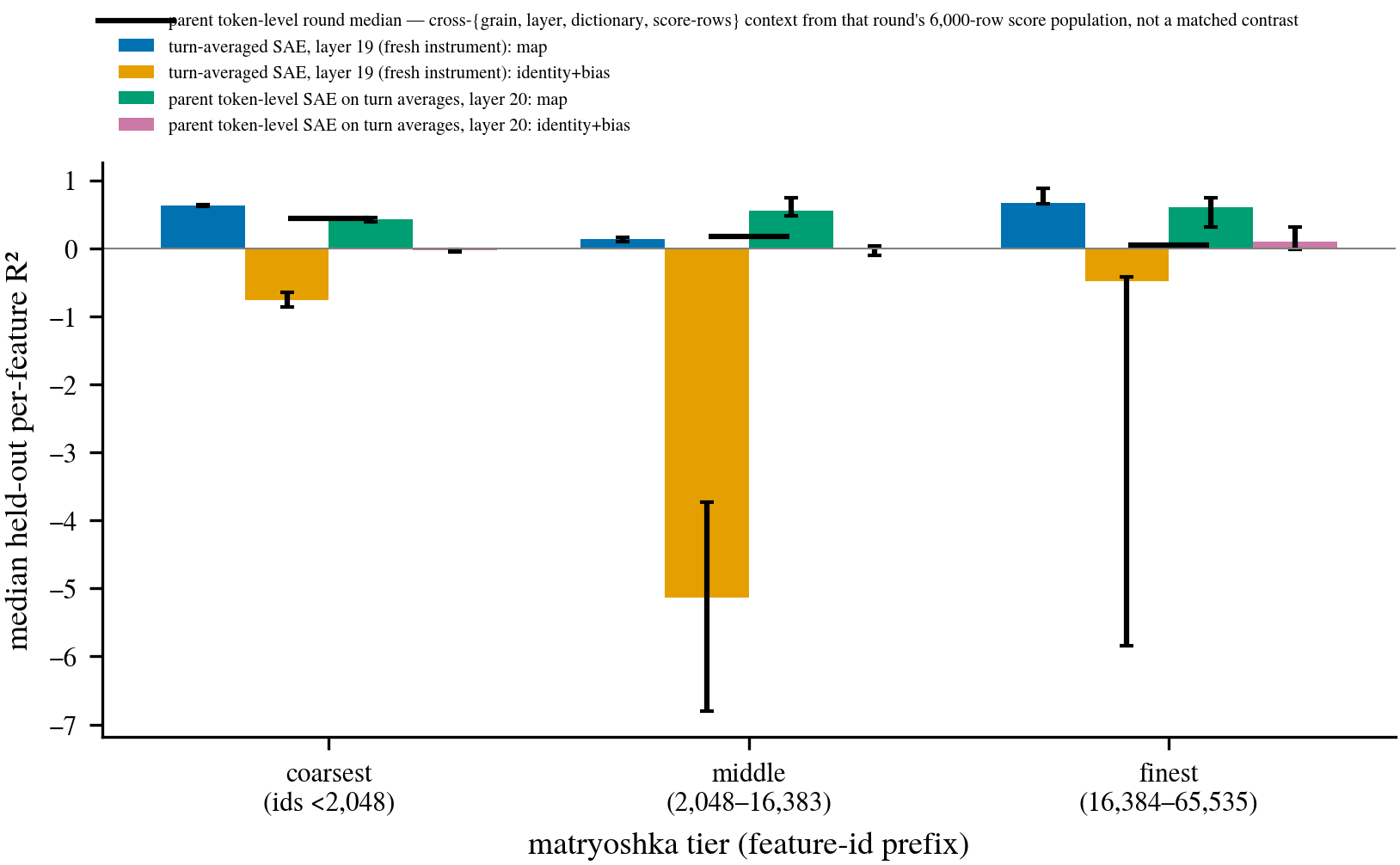
Figure. Neither turn-averaged basis reproduces the token-level round's monotone coarse-over-specific decline. Median held-out per-feature R² per matryoshka tier: fresh turn-averaged SAE (blue) vs its identity+bias baseline (orange), token-level dictionary on turn averages (green) vs its baseline (pink); black dashes = token-level reference medians. Whiskers: 10,000-draw bootstrap intervals.
| Arm | Tier medians (n alive) | Coarse-minus-finest contrast (95% interval) | Permutation percentile (observed pooled rank correlation vs null band) | Rule outcome |
|---|---|---|---|---|
| Fresh turn-averaged SAE, layer 19 | 0.625 / 0.131 / 0.670 (788 / 88 / 3) | −0.044 (−0.264 to −0.013) | 0.0, coarse-better side (−0.449 vs −0.190 to −0.069; achievable magnitude ceiling 0.528) | indeterminate — the two conditions disagree |
| Token-level dictionary on turn averages, layer 20 | 0.420 / 0.553 / 0.601 (387 / 21 / 4) | −0.181 (−0.325 to +0.105; crosses zero) | 99.42, fine-better side (+0.113 vs −0.103 to +0.086) | reversed — a secondary read; the rule is defined on the fresh arm |
| Token-grain reference (its own round: token level, layer 20, 6,000 rows) | 0.435 / 0.174 / 0.043 (16,384-feature panel) | +0.392 | coarse-better (−0.395 vs −0.250 to −0.228) | gradient holds |
The two rule conditions read different populations: the permutation pools all 879 features and is dominated by coarse-vs-middle (876 of 879), while the endpoint contrast is decided by the 3 finest-tier survivors — indeterminate is the honest cell at this floor (shown floor-local below). The bridge-arm reversal is marginal: its endpoint interval crosses zero. An inlier-masked pooling twin matches the plain mean to four decimals, so outlier tokens do not drive the inversion.
The map beats identity+bias on per-feature R² at every tier; fresh-arm deltas exceed 1 because the baseline's held-out R² goes deeply negative.
| Tier | Paired R² delta, fresh (95% interval) | Paired R² delta, bridge |
|---|---|---|
| coarsest | +1.39 (+1.28 to +1.49) | +0.45 (+0.42 to +0.49) |
| middle | +5.26 (+3.90 to +6.91) | +0.56 (+0.46 to +0.76) |
| finest | +1.15 (+1.15 to +6.49) | +0.50 (+0.13 to +0.74) |
Per-unit exemption: the per-feature scatter behind these medians is embedded two results below.
Alive-feature attrition, not a gradient, is the dominant turn-averaged phenomenon
Plotted: the fraction of each tier's candidate features clearing the alive floor (active on at least 1% of fit rows), log y-axis, one bar per tier and arm, then the per-candidate firing-fraction distribution behind the census.
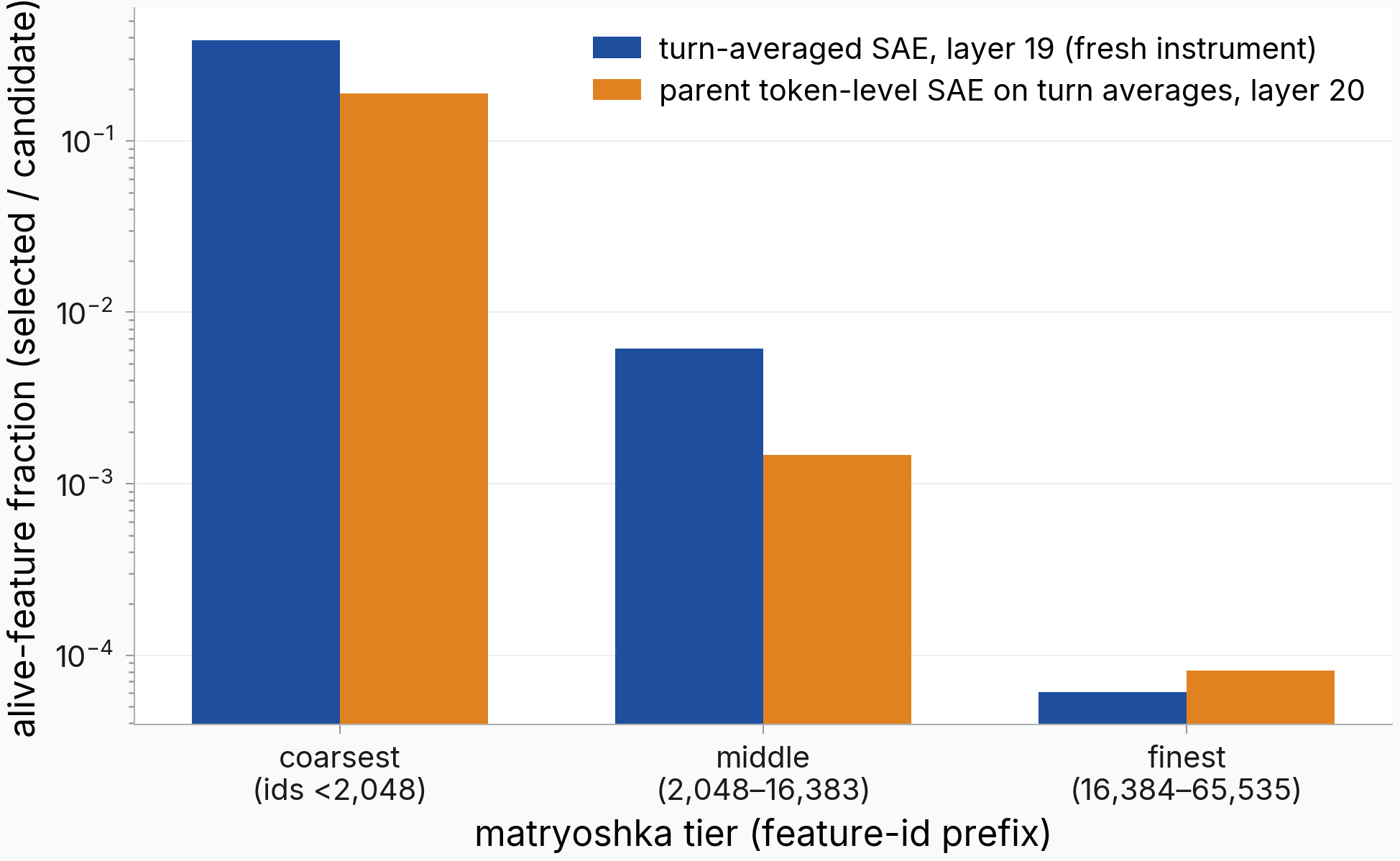
Figure. Above 99.9% of finest-tier candidates fall below the alive floor in both turn-averaged instruments. Fraction of candidate features per matryoshka tier clearing the 1%-of-fit-rows floor (1,200 of 120,000 rows, fresh arm; 240 of 24,000, bridge arm), log scale.
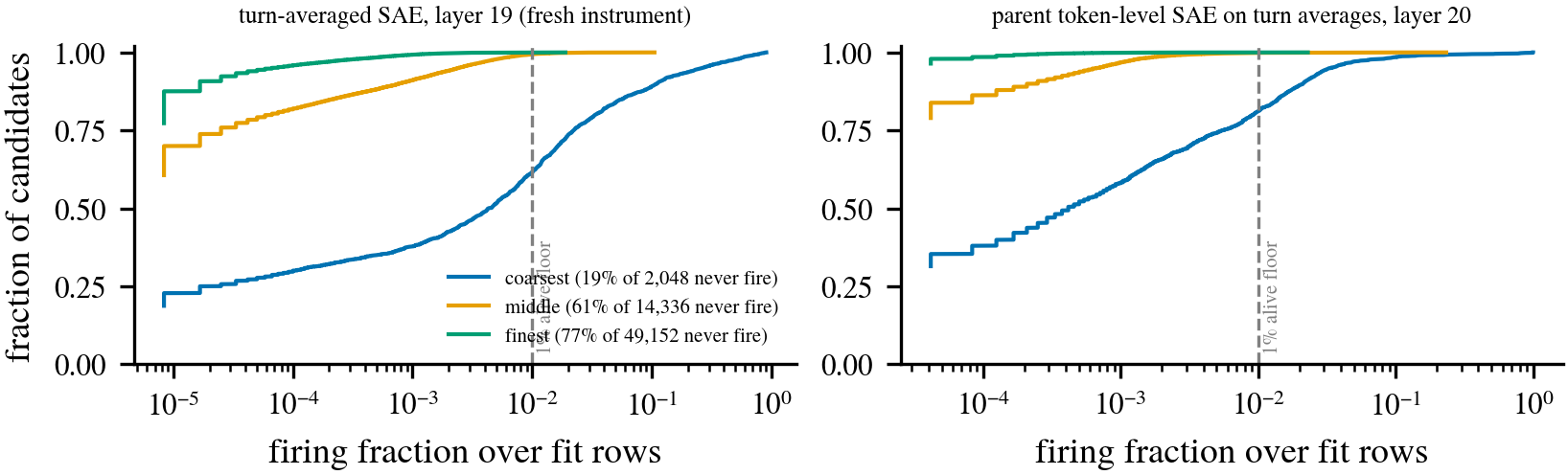
Figure. Per-candidate companion to the census bars. Cumulative share of each tier's candidates at or below a given firing fraction (log x); each curve enters at its never-fires share (fresh instrument 19%/61%/77% across coarsest/middle/finest, bridge 31%/79%/96%); the dashed line is the 1% alive floor.
| Tier (candidates) | Fresh SAE | Bridge dictionary | Pile twin |
|---|---|---|---|
| coarsest (2,048) | 788 (38%) | 387 (19%) | 261 (13%) |
| middle (14,336) | 88 (0.6%) | 21 (0.15%) | 39 (0.27%) |
| finest (49,152) | 3 (0.006%) | 4 (0.008%) | 14 (0.03%) |
The token-level panel carried 16,384 alive features; the same dictionary on turn averages retains 412. The counts say almost no specific-tier feature clears the inherited floor under these k = 100, width-65,536 instruments.
Mean firing (k over width, ~0.15% of rows) sits ~6.5 times below the floor; the floor sweep below apportions the contributions. Under the plan-fixed floor turn-averaging removes specific features from the alive panel; the floor sweep shows they return poorly predicted at looser floors — the map's target object carries little well-predicted specific-tier structure, which rescopes the paper claim rather than contradicting it. The per-candidate curves sharpen this: most specific-tier candidates never fire at all, and the floor cuts each surviving tail far above its bulk.
Surviving finest-tier features match coarse features of similar firing frequency — a survivor-conditioned read; the middle-tier dip is instrument-dependent
Plotted: every alive feature's held-out R² against log10 of its active fit rows, tier-colored, one panel per arm — the per-unit view behind every median above.
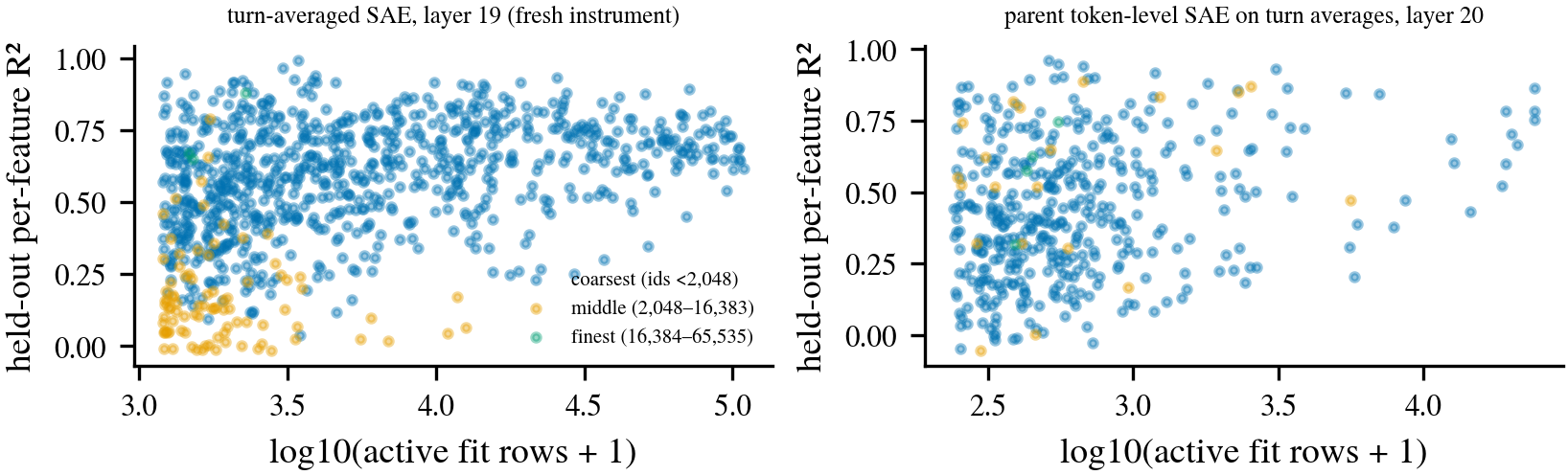
Figure. Fresh-arm middle-tier features cluster at low activity and low R²; the bridge arm's middle tier does not. Each point is one alive feature: held-out R² vs log10 active fit rows, colored by tier (fresh arm n = 879, bridge arm n = 412).
| Read | Values | Note |
|---|---|---|
| Matched-activity coarse median, fresh (1,400–2,400 active rows) | 0.525 (0.491 to 0.565), n = 197 | finest-tier survivors read 0.880 / 0.670 / 0.648 |
| Matched-activity middle median, fresh (same band) | 0.132 (0.104 to 0.180), n = 41 | matched coarse-minus-middle +0.393 (+0.333 to +0.442) — the dip holds at matched activity with the interval clear of zero |
| Matched coarse-minus-finest contrast, fresh | −0.145 (−0.381 to −0.097) | excludes zero on the negative side, but the finest side is the 3 survivors — survivor-conditioned, not population evidence |
| Matched-activity coarse median, bridge (390–552 active rows) | 0.393 (0.343 to 0.452), n = 83 | finest survivors 0.745 / 0.626 / 0.576 / 0.318; fresh band applied instead: 0.509 (0.303 to 0.577), n = 22 |
| Matched contrasts, bridge (same band) | coarse-minus-middle −0.126 (−0.410 to +0.394), middle-tier n = 5; coarse-minus-finest −0.208 (−0.354 to +0.076), finest n = 4 | both cross zero; coarse-minus-finest agrees with the unmatched endpoint contrast in the first results table |
| Matched-activity reads, pile twin (250–1,922 active rows — its own middle-tier survivor range, derived by the bridge-arm rule) | coarse 0.416 (0.381 to 0.444), n = 192; middle 0.557 (0.429 to 0.634), n = 35; coarse-minus-middle −0.141 (−0.200 to −0.035) | middle above coarse with the interval clear of zero — opposite sign to the fresh arm's +0.393 |
| Identity+bias coarse-minus-finest contrast | fresh −0.287 (−0.416 to +5.146, crosses zero); bridge −0.126 (−0.337 to −0.008) | a map-free predictor reproduces the endpoint inversion at the point estimates |
| Dense-input companion medians | 0.533 / 0.159 / 0.719 (fresh); 0.391 / 0.544 / 0.598 (bridge) | survivors are also more linearly predictable from context at all |
| Corpus-transfer fold (fit LMSYS, score 9,017 WildChat rows) | 0.522 / 0.075 / no finite finest values | 18 of 86 finite middle-tier transfer values negative; coarse tail reaches −6.83 |
| Pile-twin medians | 0.457 / 0.557 / 0.413 (n = 261 / 39 / 14) | non-monotone, but a small positive coarse-minus-finest endpoint (+0.044) |
Survivors read as at least as predictable as coarse features of comparable firing frequency in both instruments — a survivor-only description at n = 3–4, not a population inference; survival is itself activity selection no within-panel control can undo, and the floor sweep below identifies these survivors as the elite tail of a poorly predicted population. The middle-tier dip survives corpus transfer and activity matching in the fresh instrument, and the matched contrasts separate: fresh coarse-better, pile twin middle-better, both intervals clear of zero, while the bridge arm leans the pile twin's way at matched activity on 5 middle-tier features without separating. Identity+bias and the dense-input companion reproduce the survivor-profile shape without the map, so map-specific content loss is not necessary for the endpoint inversion — a survivor-panel effect and shared dictionary geometry are indistinguishable here.
Retrieval concentrates in the coarsest tier: acc@1 0.708 coarsest vs 0.001 middle
Plotted: per-tier retrieval accuracy at k = 1 (euclidean; pool = held-out rows, 20,000 fresh, 6,000 bridge; chance = 1 over pool size), map vs identity+bias per arm; inset: middle and finest tiers. Below it, the per-row rank distributions behind these cells.
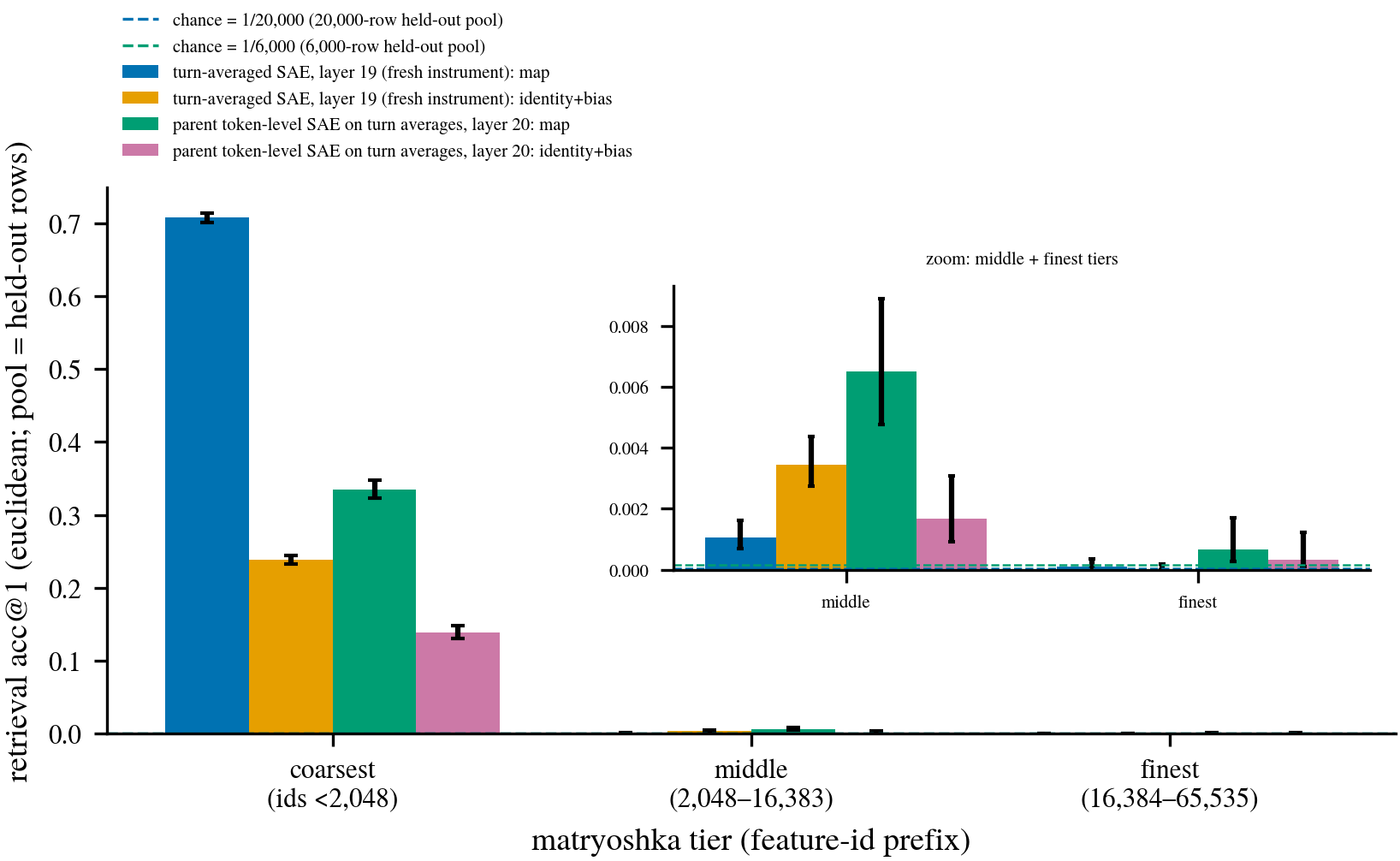
Figure. Coarse-tier features identify the held-out conversation at 0.708; middle- and finest-tier rates sit orders of magnitude lower. Retrieval accuracy at k = 1 per tier, map vs identity+bias, fresh arm (chance 5.0e-5) and bridge arm (chance 1.67e-4); inset: middle and finest tiers. Black whiskers: 95% Wilson intervals.
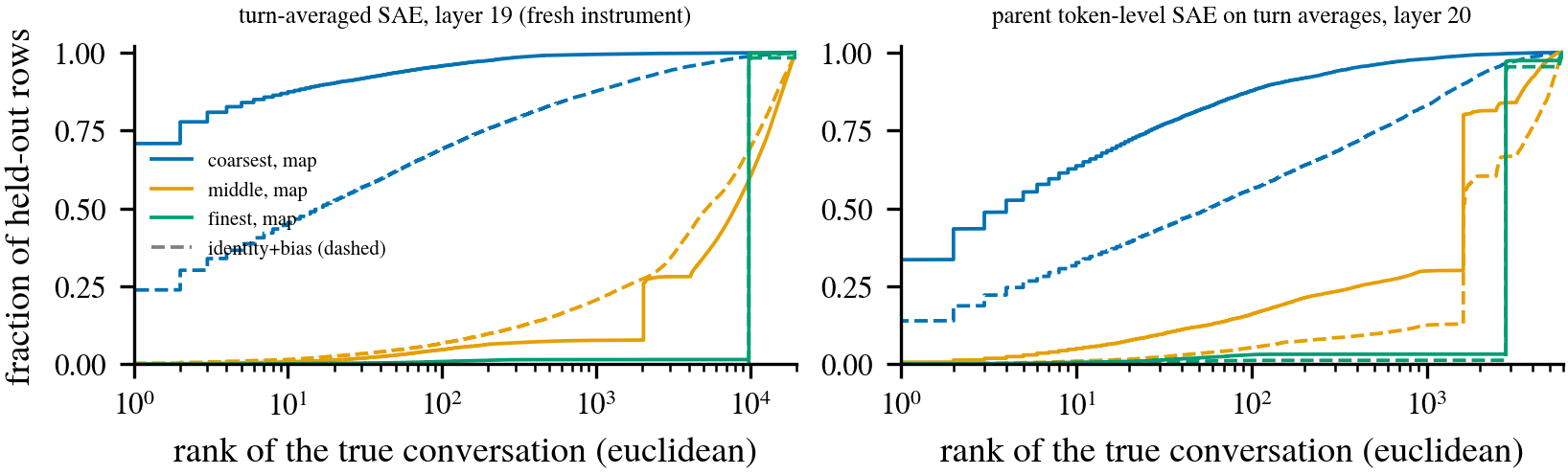
Figure. Per-row companion: the coarse tier's retrieval advantage holds across the whole rank distribution, not only at rank 1. Share of held-out rows whose true conversation ranks at or below x (euclidean, log x), per tier; solid = map, dashed = identity+bias.
| Diagnostic | Fresh arm | Bridge arm |
|---|---|---|
| Encoder reconstruction FVE of the input being scored (map prediction vs identity+bias guess) | 0.937 at L0 88 vs 0.305 at L0 955 | gate values in Methodology |
| Alive features beating the 20-draw row-shuffle floor (map vs identity+bias) | 100% vs 29.6% | 100% vs 47.8% |
| Dense-space anchor (before encoding) | acc@1 0.705; pooled R² 0.724 | — |
| Retrieval cells favoring the baseline (of 12 total) | middle tier, both metrics — systematic at k = 1, 5, 10 | finest-tier cosine cell |
Encoding an identity+bias guess lands off the feature manifold (fresh-arm middle-tier median −5.13; diagnostics table). Middle-tier map cells sit at 21x and 39x chance yet roughly 670x and 50x below their coarse-tier rates, and 3 of 12 map-vs-baseline cells favor the baseline.
Tier-restricted vectors have 788/88/3 dimensions, so low-tier cells are dimension-confounded — coarse-concentrated is the supportable read, not a content-loss quantification. The two dependent variables disagree in profile; the headline is scoped to the R² profile. The per-row ranks were recomputed after the run, which persisted only the aggregate cells; every accuracy-at-1 cell reproduces exactly, all cells within two rows in 20,000 (deltas: footer).
Per-feature predictability transfers across grain (rank correlation 0.767) while the tier profile inverts
Plotted: each intersection feature's held-out R² at turn-averaged grain (bridge arm) against the same feature's committed token-level R² — same dictionary, same rows; 409 features, tier-colored, identity diagonal; every point is one feature, so this is its own per-unit view.
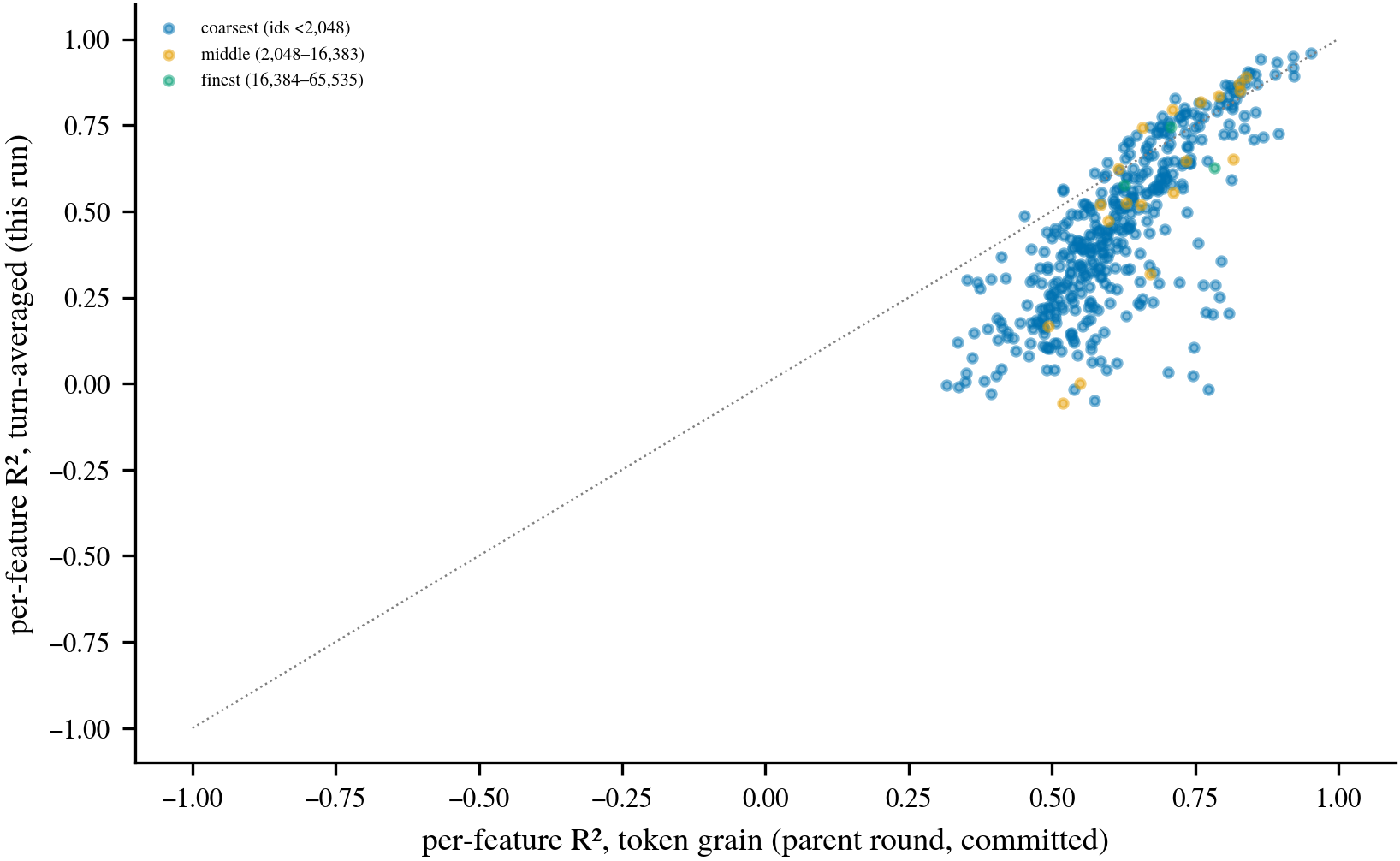
Figure. Feature ranking is basis-stable; the level shifts down and the tier profile inverts. Held-out per-feature R², turn-averaged vs token grain, on the 409-feature intersection (same dictionary, same 6,000 score rows); points below the diagonal lose predictability at the turn-averaged grain.
Pooled rank correlation 0.767 (per tier 0.754/0.893/0.5 at n = 387/19/3) clears the plan's 0.5 expectation — the ranking clause of the bridge hypothesis passes. The level shifts down for most features (median delta −0.152; 337 of 409 points below the diagonal, 72 above — dominant but heterogeneous), and the gradient-preservation clause is refuted: the per-tier profile inverts (0.420/0.553/0.601 vs the token-level 0.435/0.174/0.043). The token-level gradient ran through thousands of low-activity specific features that do not exist as alive features at this grain — 15,975 of its 16,384 panel features fall out of the intersection.
The indeterminate cell is floor-local: every swept looser floor reads coarse-over-specific on the fresh arm, while the bridge instrument stays reversed
Plotted: per-tier median held-out R² against the alive floor (fresh arm, map vs identity+bias); the table adds each floor's within-activity permutation read for both instruments — observed pooled rank correlation of tier index against per-feature R² vs its 10,000-draw null band (more negative means coarse-better).

Figure. The finest-tier median collapses once the floor admits a real population. Median held-out per-feature R² per matryoshka tier vs alive floor, fresh turn-averaged SAE: map (solid) vs identity+bias (dashed); shaded bands are 10,000-draw bootstrap intervals. Per-tier alive counts per floor are in the table below.
| Arm, floor | Alive by tier | Tier medians (map) | Coarse-minus-finest (95% interval) | Permutation: observed vs null band | Rule reading |
|---|---|---|---|---|---|
| Fresh, 1% (plan-fixed) | 788 / 88 / 3 | 0.625 / 0.131 / 0.667 | −0.042 (−0.263 to −0.013) | −0.449 vs (−0.190, −0.069), coarse-better | indeterminate |
| Fresh, 0.5% | 992 / 314 / 26 | 0.607 / 0.172 / 0.087 | +0.520 (+0.373 to +0.594) | −0.641 vs (−0.300, −0.217), coarse-better | gradient holds (reported) |
| Fresh, 0.25% | 1,137 / 696 / 80 | 0.592 / 0.166 / 0.049 | +0.543 (+0.485 to +0.579) | −0.691 vs (−0.349, −0.287), coarse-better | gradient holds (reported) |
| Fresh, 0.2% | 1,178 / 842 / 130 | 0.588 / 0.163 / 0.046 | +0.542 (+0.517 to +0.568) | −0.699 vs (−0.377, −0.320), coarse-better | gradient holds (reported) |
| Bridge, 1% (its plan-fixed cell) | 387 / 21 / 4 | 0.420 / 0.553 / 0.601 | −0.181 (−0.325 to +0.105) | +0.113 vs (−0.103, +0.086), fine-better | reversed |
| Bridge, 0.5% | 529 / 56 / 7 | 0.377 / 0.471 / 0.626 | −0.249 (−0.399 to +0.069) | +0.118 vs (−0.150, +0.001), fine-better | reversed |
| Bridge, 0.25% | 657 / 130 / 13 | 0.307 / 0.319 / 0.576 | −0.269 (−0.438 to +0.010) | +0.020 vs (−0.221, −0.104), fine-better | reversed |
The full reported vector, ordered 1% → 0.2%: indeterminate at the plan-fixed cell, then gradient holds at every looser floor (fresh); the bridge reads reversed throughout. The reported lattice is floor-sensitive — the plan-fixed cell stays the verdict of record; looser-floor labels are descriptive.
The looser floors share seeds and nested alive sets with the 1% cell — one dependent pattern, not independent replications — and cross-floor permutation values are descriptive too (activity quintiles are recomputed per floor); within a floor the permutation controls activity composition. The 1%-row values are the sweep's recomputations — hence finest median 0.667 here vs the committed 0.670 (the near-tie feature; gate bars in Methodology). Per-unit exemption: the per-feature curves behind these medians are the next result's figure.
Newly admitted finest-tier features collapse toward zero: the three 1%-floor survivors are an unrepresentative elite
Plotted: the cumulative distribution of per-feature held-out R² per tier, one panel per floor (fresh arm) — the per-unit view behind the medians above.

Figure. At every floor below 1% the finest tier's distribution sits far to the left of the coarse tier's. Cumulative share of alive features at or below a given held-out R², per tier and floor, fresh arm; per-tier n per floor in the previous result's table.
| Read (fresh arm; loosest floor unless stated) | Value |
|---|---|
| Pooled finest median by floor, 1% → 0.2% | 0.667 → 0.087 → 0.049 → 0.046 (n = 3 / 26 / 80 / 130) |
| Newly-alive-only finest median at 0.2% | 0.044 (n = 127); 34% at or below zero; 69% below 0.1 |
| Finest median 95% interval vs same-floor middle-tier interquartile range | 0.020–0.067 vs 0.062–0.306 (middle median 0.163, n = 842) |
| Newly admitted vs previously-alive medians at 0.2% | coarse 0.475 vs 0.625; middle 0.172 vs 0.131 |
| Alive features beating the 20-draw row-shuffle floor (map read) | 100% at 1% → 97.0% at 0.2% |
| Corpus halves, finest median at 0.2% | 0.040 LMSYS / 0.030 WildChat |
| Undefined per-feature R² | 0 at every floor, tier, and arm |
The round's hypothesis convention compares the finest-tier median at the 240-row floor against the same floor's middle-tier interquartile range. The hypothesis fails: the newly-admitted finest median (0.044) sits at roughly a quarter of the middle median and below the middle interquartile range — though the bootstrap interval's upper end grazes the range's lower edge.
Every cross-floor median move is composition: previously-alive features keep their values exactly (same rows, same encodes), and the newly admitted cohorts read lower (coarse) or comparable (middle). The 3% shuffle-floor failures at the loosest floor sit among the newly admitted low-activity features, consistent with the collapse read; the train-mean null anchors the scale: per-tier medians within 2e-4 of zero at every floor. A bookkeeping spill in the banked fresh-arm train-mean numerator (2.34% held-out rows; Methodology) touches only this anchor and leaves it within that bound.
Attrition stays above 99.7% of finest-tier candidates at every swept floor: the floor convention explains the verdict, not the census
Plotted: alive-feature counts per tier against the floor for all three dictionaries (log y), then the per-candidate firing-fraction distributions with the swept floors and the instrument's mean firing rate marked.

Figure. The finest tier gains features 43-fold across the sweep yet stays under 0.3% of its candidates. Alive features per matryoshka tier vs alive floor: fresh turn-averaged SAE, the token-level dictionary on turn averages, and the pile-trained twin (exploratory).

Figure. Per-candidate companion to the census counts: most specific-tier candidates never fire, and every swept floor cuts each tail far above its bulk. Cumulative share of candidate features at or below a firing fraction (log x), per tier and dictionary; dash-dot line marks the mean firing rate (k over width), dashed lines the swept floors.
| Floor (% of fit rows) | Fresh finest alive (of 49,152) | Bridge finest | Pile twin finest |
|---|---|---|---|
| 1% | 3 | 4 | 14 |
| 0.5% | 26 | 7 | 21 |
| 0.25% | 80 | 13 | 42 |
| 0.2% (fresh grid only) | 130 | — | — |
Within the swept 0.2%–1% bracket the apportionment is two-way: the floor convention carries the verdict's indeterminacy (previous results) and a 43-fold finest census change, while the attrition bulk — over 99.7% of finest candidates below even the loosest floor — stayed, at that round's close, with the joint matryoshka-allocation-plus-undertraining residual; the budget round, two results below, discharges its sparsity-budget half. Floors below the bracket, including any below the mean firing rate (~0.15% of rows), were not swept and stay unresolved. The pile twin is exploratory: its census rests on recomputed counts and its tier medians move non-monotonically with the floor.
Retrieval is coarse-concentrated at the plan-fixed floor; the looser-floor cells are aggregate-only descriptive reads
Plotted: per-tier retrieval accuracy at k = 1 (euclidean) against the floor, map vs identity+bias, fresh arm, log y with the chance line; only the 1% column has a per-row companion.

Figure. At the plan-fixed floor retrieval is coarse-concentrated; the three looser floors' cells, aggregate-only descriptive reads, sit the same way. Retrieval accuracy at k = 1 per tier vs alive floor, fresh arm, map vs identity+bias (pool 20,000; chance 5.0e-5, dotted).
| Tier, predictor (looser floors aggregate-only) | 1% | 0.5% | 0.25% | 0.2% |
|---|---|---|---|---|
| Coarsest, map | 0.708 | 0.706 | 0.706 | 0.706 |
| Middle, map | 0.0011 | 0.0041 | 0.0081 | 0.0088 |
| Middle, identity+bias | 0.0035 | 0.0134 | 0.0224 | 0.0252 |
| Finest, map | 0.0001 | 0.0003 | 0.0004 | 0.0007 |
The claim of record sits at the plan-fixed floor, where the parent's committed per-row rank arrays (embedded two results above) back the aggregate: coarse map acc@1 0.708 vs middle 0.0011. The looser-floor cells are aggregate-only descriptive reads — their per-row ranks cannot be recomputed, because the union encode matrices behind them are among the plan's declared discards and the pod is terminated. Descriptively those cells move the same way: the coarse map rate stays flat, middle- and finest-tier rates grow roughly with dimension yet remain 80-fold or more below it, the baseline's middle-tier advantage strengthens — the dimension confound carries through — and bridge cells match (coarse 0.331–0.335).
A per-floor per-row recompute, re-encoding the held-out rows at each floor's alive panel, is a needs-gpu follow-up candidate.
Doubling the sparsity budget to k = 200 leaves the finest tier starved: 4 alive features at the plan-fixed floor against a declared threshold of 10
Plotted: alive-feature counts per matryoshka tier (log y), the k = 200 retrain beside the committed k = 100 census — four bar pairs per tier, one per swept floor, ordered 1% to 0.2%; counts are raw threshold firing counts over the 120,000 fit rows. Below it, the per-candidate firing distribution behind the counts.
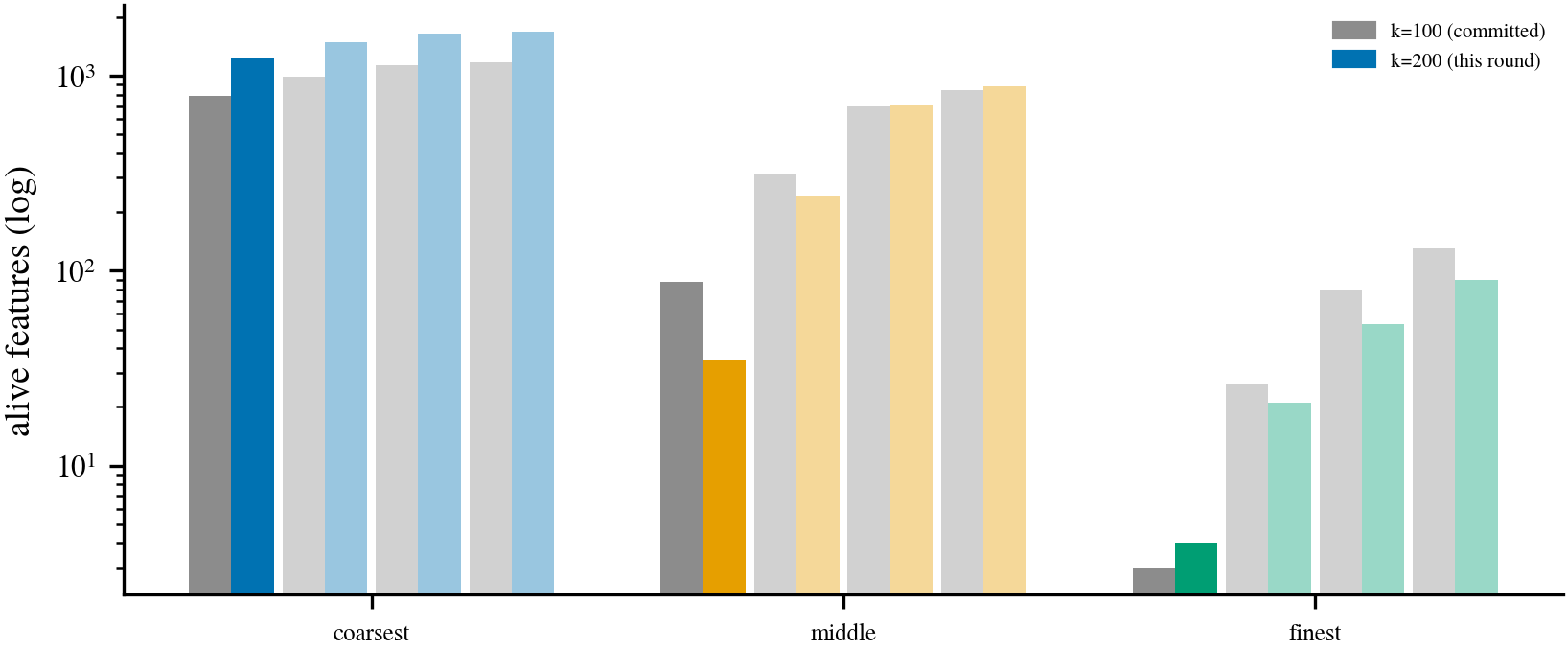
Figure. The plan-fixed finest-tier counts are 3 and 4 at one training seed per budget — within single-seed noise and both far below the threshold of 10. Alive features per matryoshka tier: k = 200 (colored) beside the committed k = 100 census (gray); four floor pairs per tier (1%, 0.5%, 0.25%, 0.2%, left to right); log scale.
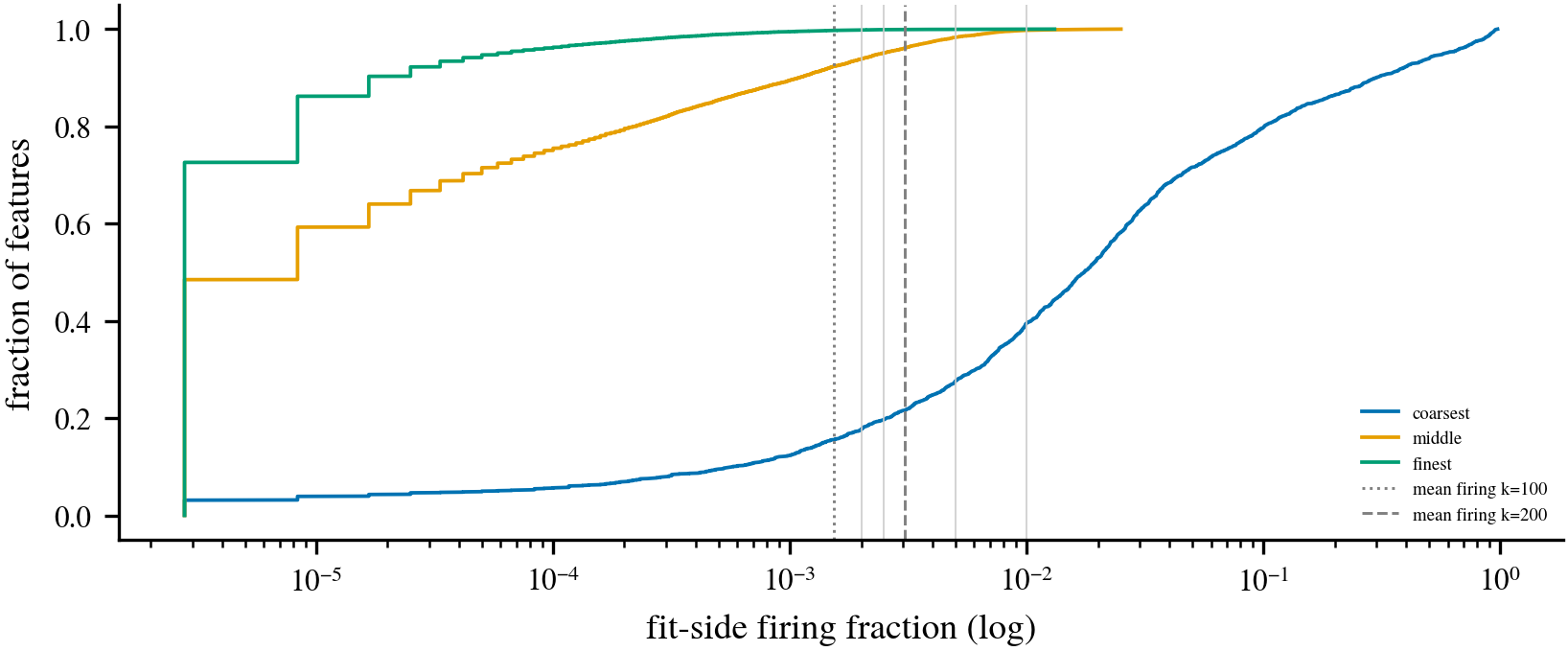
Figure. Per-candidate companion: the k = 200 finest tier still concentrates far below every swept floor. Cumulative share of each tier's candidates at or below a firing fraction (log x), k = 200 instrument; dashed and dotted verticals mark the k = 200 and k = 100 mean firing rates, light verticals the swept floors.
| Read | k = 100 (committed) | k = 200 (this round) |
|---|---|---|
| Validation L0 / variance-FVE (manipulation check) | 98.96 / 0.9093 | 200.39 / 0.9304 — both clean-manipulation preconditions held |
| Mean realized firing (share of fit rows) | ~0.15%, below the whole swept bracket | ~0.31%, inside the bracket |
| Dead-feature fraction after epoch 3 (coarsest / middle / finest) | 0.095 / 0.291 / 0.356 | 0.009 / 0.131 / 0.177 |
| Alive at the 1% floor (coarsest / middle / finest) | 788 / 88 / 3 | 1,239 / 35 / 4 |
| Alive at the 0.2% floor | 1,178 / 842 / 130 | 1,687 / 882 / 90 |
| Finest candidates clearing the loosest floor | 130 of 49,152 (0.26%) | 90 of 49,152 (0.18%) |
| Encoder reconstruction FVE of the map prediction being scored | 0.937 | 0.956 at mean L0 186 |
The round's two-outcome rule — budget-limited if at least 10 finest-tier features clear the plan-fixed floor, budget-discharged otherwise — returns budget-discharged at 4 of 49,152. Both manipulation preconditions held, so the discharge covers the total k intervention, its induced top-k competition, threshold, and allocation dynamics included. Dead fractions halve, but no middle or finest count multiplies at any floor, so the added budget flows to coarse features and sub-floor firing.
The 3 → 4 change is deep inside single-seed noise; the verdict is the count sitting far below 10. Matryoshka allocation, with residual undertraining at fixed budget, remains the untested contributor.
The doubled-budget instrument repeats the survivor-elite pattern: newly admitted finest features collapse while every reported floor reads coarse-over-specific
Plotted: median held-out per-feature R² per tier against the alive floor, k = 200 instrument, map versus identity+bias, with the committed k = 100 map medians overlaid as crosses; below, the per-feature distributions behind every plotted series.

Figure. The k = 200 finest-tier map median falls from 0.49 at the plan-fixed floor toward 0.07 at the loosest while identity+bias goes deeply negative. Median held-out R² per tier vs alive floor, k = 200: map (solid) vs identity+bias (dashed); gray crosses are the committed k = 100 map medians (a different instrument — census-level comparison only).
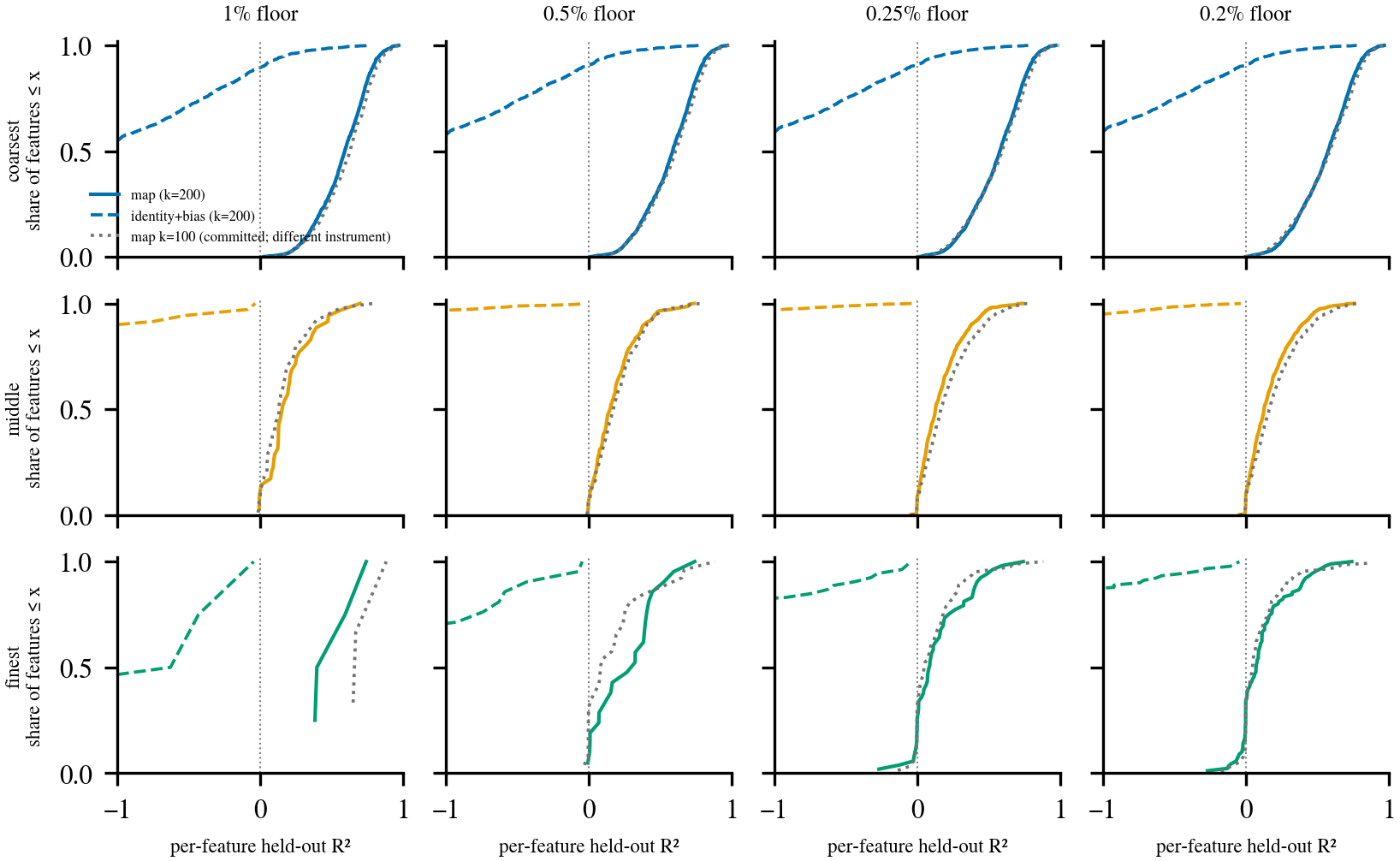
Figure. Per-feature companion to every plotted series: each looser floor's finest cohort piles up near zero. Cumulative share of alive features at or below a held-out R² (x clipped at −1), per tier (rows) and floor (columns): k = 200 map (solid), identity+bias (dashed), k = 100 map reference (dotted); per-tier n in the table below.
| Floor | Alive by tier | Tier medians (map) | Coarse-minus-finest (95% interval) | Permutation: observed vs null band | Reported label |
|---|---|---|---|---|---|
| 1% (plan-fixed) | 1,239 / 35 / 4 | 0.590 / 0.155 / 0.494 | +0.096 (−0.150 to +0.211; crosses zero) | −0.232 vs (−0.113, −0.006), coarse-better; achievable magnitude ceiling 0.298 | coarse-over-specific |
| 0.5% | 1,483 / 244 / 21 | 0.585 / 0.149 / 0.323 | +0.262 (+0.185 to +0.478) | −0.526 vs (−0.261, −0.185), coarse-better | coarse-over-specific |
| 0.25% | 1,645 / 702 / 53 | 0.576 / 0.126 / 0.087 | +0.489 (+0.422 to +0.539) | −0.698 vs (−0.410, −0.357), coarse-better | coarse-over-specific |
| 0.2% | 1,687 / 882 / 90 | 0.574 / 0.127 / 0.072 | +0.502 (+0.472 to +0.555) | −0.715 vs (−0.440, −0.392), coarse-better | coarse-over-specific |
| Companion read (k = 200) | Value |
|---|---|
| Plan-fixed-floor finest survivors (all 4) | R² 0.382 / 0.395 / 0.592 / 0.740, median 0.494 — above the same-floor middle-tier interquartile range 0.097–0.262 |
| Newly-alive finest at the 0.2% floor | median 0.070 (n = 86); 36% at or below zero; 63% below 0.1 |
| Map-vs-identity+bias paired deltas at the plan-fixed floor | +1.80 / +7.65 / +1.02 across tiers, intervals clear of zero |
| Retrieval acc@1 at the plan-fixed floor (euclidean; aggregate-only cells) | map coarsest 0.727 vs middle 0.0006 and finest 5.0e-5 (chance 5.0e-5); identity+bias coarsest 0.289; the baseline's middle-tier advantage reappears at looser floors (0.019 vs 0.005 at 0.2%) |
| Dense-input companion medians at the plan-fixed floor | 0.523 / 0.190 / 0.562 |
| Share of alive map features beating the 20-draw shuffle floor | 100% / 100% / 99.2% / 98.2% across floors (identity+bias 22.5% / 19.3% / 15.6% / 15.0%) |
| Train-mean anchor (recomputed from clamped sums) | per-tier medians within 1.3e-4 of zero at every floor |
| Corpus halves, finest median at the 0.2% floor | 0.012 LMSYS / 0.029 WildChat |
| Undefined per-feature R² | 0 at every floor and tier |
All four k = 200 floors read coarse-over-specific on both parent rule conditions — reported labels; the gradient verdict of record stays the parent's k = 100 plan-fixed cell. The plan-fixed label is fragile in the parent's way: it rests on 4 elite survivors whose contrast interval crosses zero and who read above the middle tier's interquartile range, like the parent's 3. The feature-splitting alternative never arises: it required a multiplied census with a well-predicted newly-populated tier.
Newly admitted finest features collapse toward zero as at k = 100, the dense-input companion tracks the survivor profile, and retrieval keeps its coarse-concentrated shape; its per-row companions are not recomputable (the union encode matrices are declared discards).
Repro: ~7.3 h wall on 1× H100-80 (RunPod pod-2476), zero LLM-API calls. Workload: scripts/issue2476_turnavg_sae.py @ 064462df4d (--phase all); two-SHA phase provenance — the bridge-row recapture ran at a51057beaf (its gate record carries that commit), all later phases (SAE training / maps / eval / figures) at 064462df4d68. Eval artifacts (git, branch issue-2476): eval_results/issue_2476/turnavg tree — 28 files: tier_tests_c.json / tier_tests_b.json (medians, permutation, bootstrap, verdict inputs), retrieval_c.json / retrieval_b.json plus the per-row rank arrays behind every retrieval cell (perrow_retrieval_ranks.npz, with per-cell reproduction deltas and provenance in perrow_retrieval_ranks_meta.json — recomputed post-run by scripts/issue2476_perrow_views.py @ a3338b6ec57855d03531d5c81b1bd6d59f61c32a from the uploaded SAE weights and prediction stores; the fresh arm's dense map predictions come from the parent round's committed copy of the same ridge refit, issue1482_error_analysis/analysis_tensors/percontext/refit_holdout__ridge__seed0.npz @ 89cfa76cdc, this run's own refit store having not been uploaded — the recompute fetched that file at the then-current unpinned default branch, and the pinned revision serves identical content (its last touching commit is dated 2026-07-18, before the 2026-08-23 recompute); row set asserted identical and the committed per-feature R² arrays reproduced, verification deltas in perrow_retrieval_ranks_meta.json), panel_c.json / panel_b.json, per-feature npz for the map / identity+bias / dense-input / transfer / pile / inlier reads, bridge_b.npz, train_log.json, recon_gate.json, preds_meta.json, regime.json (split shas), and the recapture gate record gates_p2.json; recapture-gate recalibration evidence at eval_results/issue_2476/g2a_recalibration tree. A follow-up analysis round (no new compute) added bootstrap intervals for every matched-activity read: matched_tier_ci.json in the turnavg tree @ 179a7b69aa, produced by scripts/issue2476_matched_tier_ci.py @ 179a7b69aa (10,000 draws, seed 42; point medians re-derived from the committed per-feature npz files and checked against every committed matched read before any interval was computed; branch issue-2476). Figures: hero pair figures/paper/c3_turnavg_tier_gradient + c3_turnavg_tier_acc1 (png, pdf, data sidecars) and exploratory panels under figures/issue_2476 @ a3338b6ec57855d03531d5c81b1bd6d59f61c32a; the gradient hero and the bridge scatter were re-rendered for label fixes (internal arm tokens, then a bare issue token) by scripts/issue2476_fig_relabel.py @ a3338b6ec57855d03531d5c81b1bd6d59f61c32a, sidecar numeric data asserted identical to the first renders each time; the two per-unit companions (i2476_candidate_firing_ecdf, i2476_retrieval_rank_ecdf) are new in this revision round (same script as the rank arrays); other panels unchanged at 8dac0f576f and 8d0d7d545c. HF (listed live at write time, 99 files): issue2476_turnavg/analysis_tensors — recapture_store/ (68 files: the 30,000-row mean store + the gate record source), eval/ (21), split_meta/ (7), sae_c/ (3: SAE weights 1.88 GB safetensors, cfg, train log). Artifact-suffix legend: _c = fresh turn-averaged SAE arm, _b = bridge arm, _ib = identity+bias, _densein = dense-input companion. Reuse provenance: capture chunks + rollout text from #779 at HF issue779_monitoring/fitter-fair-comparison-n1m/{final_token_capture,raw_completions} @ revision 89cfa76cdc… (the run read both prefixes at the then-current unpinned default branch; the pinned revision serves identical content — the last commits touching them are dated 2026-07-15 for the capture chunks and 2026-08-17 for the rollout text, both before the run's 2026-08-22/23 assemble and recapture reads) — the map's own training capture, fitness by construction; pinned splits, the 30,000-row subsample, the committed token-level per-feature panel, and the layer-20 dense store from #1482 at HF issue1482_error_analysis/analysis_tensors/matryoshka_tier/store revision 8b82eb9753… — same-lineage products, shas re-asserted in-run; token-level dictionaries chanind/qwen2.5-7B-it-layer-20-saes — that round's own pin, fitness gate passed at FVE 0.659; sample-row text from #1482's committed judge-labels file (pinned above) — the same holdout rows this run scores. Plan: plans/plan.md (v4) in the task directory; production results marker posted 2026-08-23T11:44Z. Discarded per plan: per-token recapture activations, assembled fp16 matrices, and SAE optimizer state (regeneration recipes in the plan's reproducibility card); no rollout text, judge output, metric, or config discarded. Floor-sensitivity round (same-issue follow-up round floor-sensitivity-sweep, cheap band): ~3.1 GPU-h on 1× H100-80 (RunPod pod-2476, fresh pod), zero LLM-API calls; workload scripts/issue2476_floor_sweep.py @ a1e18f25d1 (parent kernels imported by file path; one production halt at the first instrument-reproduction predicate, relaunched after the plan-v7 re-calibration narrated in Methodology). Round eval artifacts (git, branch issue-2476, result commit 23eb255f10ca…): eval_results/issue_2476/floor_sweep tree — 8 files: floor_sweep_c.json, floor_sweep_b.json, floor_sweep_b_pile.json (per-floor medians, permutation, contrasts, lattice vectors), floor_retrieval_c.json, floor_retrieval_b.json, gates_floor_sweep.json (all six gate records), perfeature_union_c.npz, perfeature_union_b.npz (union per-feature arrays + per-floor alive masks; the source of every newly-alive decomposition above). Round figures: nine floor-sweep panels under figures/issue_2476 @ 23eb255f10 (stems i2476_floor_sweep_hero_r2, i2476_floor_sweep_hero_acc1, i2476_floor_hero_b_r2, i2476_floor_alive_counts, i2476_floor_r2_ecdf, i2476_floor_perm_summary, i2476_floor_firing_ecdf, i2476_floor_corpus_split, i2476_floor_shuffle_null; png, pdf, and data sidecar each); the acc@1 hero was re-rendered for a legend label fix (the internal predictor token ib spelled out as identity+bias) by scripts/issue2476_fig_relabel.py @ 86bf3d56db --floor-acc1, sidecar numeric data asserted identical to the first render, and is pinned at 86bf3d56db. Round HF artifacts (listed live at write time, 5 files): issue2476_turnavg/analysis_tensors/floor_sweep — firing_census_c.npz, firing_census_b.npz, firing_census_b_pile.npz plus the two union npz twins. Round plan: plans/plan.md (v7, self-contained); round upload-verification pass posted 2026-08-24T06:50Z. Budget round (same-issue follow-up round k200-instrument-census, cheap band): ~3.9 h wall on 1× H100-80 (RunPod pod-2476; planned 3.7 h, one crash-fix round included), zero LLM-API calls; workload scripts/issue2476_k200_census.py @ 8360a1d72d (--phase all; parent kernels imported by file path), landed across commits 1b93837e92 (budget seam + revision-pin threading), 0bbb76d7cc (round driver + failure-semantics test pins), dba08c36b7 (review-round fixes), 5b94a13c67 (strict gate-verdict phase-entry predicate), and 8360a1d72d (the chunk-slice clamp narrated in Methodology). Round eval artifacts (git, branch issue-2476, result commit 3d9c2ea588…): eval_results/issue_2476/k200_census tree — 6 files: census_k200.json (census + the budget-rule record + manipulation check), gates_k200.json (gate records + the prediction-encode fidelity read), tier_sweep_k200.json (per-floor medians, permutation, contrasts, nulls, corpus splits), retrieval_k200.json (per-floor per-tier cells, three sources), perfeature_union_k200.npz (union per-feature arrays + per-floor alive masks), and — landed after the result commit, at its own pin — densein_meta_k200.json @ 36e6ca5c5d (the dense-input companion's fit diagnostics: selected λ 1.0e3 at validation R² 0.675). Round figures: eleven k = 200 panels under figures/issue_2476 @ 3d9c2ea588 (stems i2476_k200_census_hero, i2476_k200_tier_r2_hero, i2476_k200_firing_ecdf, i2476_k200_finest_r2_ecdf, i2476_k200_retrieval_acc1, i2476_k200_dead_frac_epochs, i2476_k200_loss_fve, i2476_k200_perm_summary, i2476_k200_shuffle_null, i2476_k200_corpus_split, i2476_k200_densein_profile; png, pdf, and data sidecar each); the tier-R² result's per-feature companion was later regenerated with full series coverage (all tiers and floors, k = 200 map and identity+bias, plus the k = 100 map reference) as i2476_k200_tier_r2_percell_ecdf by scripts/issue2476_k200_percell_ecdf.py @ 0f8103a19f from the two committed union npz files (alive counts asserted against the body tables before rendering), superseding the finest-only i2476_k200_finest_r2_ecdf panel in the body. Round HF artifacts (listed live at write time, 3 + 3 files): issue2476_turnavg/analysis_tensors/sae_c_k200 — the k = 200 SAE weights (1.88 GB safetensors), cfg, and train log — and issue2476_turnavg/analysis_tensors/k200_census — firing_census_k200.npz, perfeature_k200_densein.npz, perfeature_union_k200.npz. Round plan: plans/plan.md (v11, self-contained); round results marker posted 2026-08-24T18:56Z. Discarded per plan: the re-assembled fp16 matrices, the k = 200 optimizer states and per-epoch checkpoint, and the union-restricted encode matrices (regeneration recipes in the plan's discard slot); no rollout text, judge output, metric, or config discarded.
Context: Origin prompt (verbatim): Paper outline 2026-08-22: 'SAE experiments — try turn averaged SAEs'. Lineage: #1482 — the token-level tier-gradient round this run re-tests at turn-averaged grain, itself an error-analysis child of the #779 map. Created 2026-08-22; production run 2026-08-23 (one crash-fix relaunch after the recapture identity gate refusal narrated in Methodology); interpretation passed both critics 2026-08-23; matched-activity interval round folded 2026-08-23. Follow-up round floor-sensitivity-sweep (source: the automatic follow-up proposer, cheap band; scope marker posted 2026-08-24T00:35Z), originating proposal title (verbatim): ### 1. Alive-floor sensitivity sweep of the tier profile — Diagnostic; run 2026-08-24 (one halt at the instrument-reproduction gate, plan-v7 re-calibration, relaunch), folded 2026-08-24. Follow-up round k200-instrument-census (source: the automatic follow-up proposer, cheap band; scope marker posted 2026-08-24T08:52Z), originating proposal title (verbatim): ### 3. k-budget census: retrain the fresh SAE at k = 200 — Ablation; run 2026-08-24 (one crash-fix relaunch after the counts-gate halt narrated in Methodology), folded 2026-08-24.