The answer-boundary form, not the narrative prose, carries the framing cost of context→answer maps (MODERATE confidence)
Highlight text on any card (body, plan, or an event) to anchor a comment, or leave a whole-task comment here. Mention @claude to summon a reply.
No comments yet.
Methodology: docs/methodology/issue_2054.md @ 1c45d72a · gist mirror
Takeaways
- All 56 lattice cells fit a real context→answer map at well-posed n (per-fold n_train 6,341–9,586 against d = 3,584): held-out R² 0.12–0.58, every cell far above its shuffled-answer null (95th-percentile draw ≈ −0.03) and identity-plus-bias floor (predict the input plus a mean shift; −0.48 or lower); retrieval finds the true answer vector first try in 19% of held-out rows at the median cell, 70% at the best, against ~0.06% chance.
- Swapping the answer-boundary form breaks direct map transfer (median held-out R² −0.06 across all 56 ordered pairs and in the 36-pair verbatim-prose subset; worse than the prose swap in 32 of 32 story targets, nominal p < 1e-9) while prose swaps preserve it (median 0.20, 96 pairs); the misalignment is context-side — a context-space linear re-map recovers boundary-swapped transfer to a median 0.84 of the target's ceiling, an answer-side re-map only 0.18 (0.29 among prose-fixed story pairs, ≈0 among the 20 assistant form swaps).
- The authorship × presentation decomposition is not additive: with answer text matched, authorship contributes −0.14 to −0.29, presentation −0.02 to −0.16, and the interaction +0.11 to +0.19, sign-consistent in 8 of 8 character × model pairs; both single-factor readings of the inserted-vs-on-policy gap are rejected. The reinstated fifth framing (indirect reported speech, on-policy only) lands its 10 ceilings at 0.229–0.288 — between the bare-label (0.231) and attributed-quote (0.290) medians — with cross-model transfer at 0.93 of ceiling under rotation alone; it has no inserted arm by construction, so this decomposition does not extend to it.
- The 56 cells share most of their map structure: one pooled context→answer map reaches 90% of the banked ceiling in 21 of 56 cells as-is, in 34 with a per-cell bias, and 50 of 56 reach 95% with a rank-128 residual (cross-cell mean held-out R² 0.242 → 0.270 → 0.298); cross-cell context→context maps fit at median 0.19 (assistant framing pairs 0.44), and prefix-arm reads stay near zero throughout (within-cell ceilings ≤ 0.031; cross-cell and refit-rung prefix reads ≤ 0.05) — extending the lattice's full-rank prefix null.
- The plan's answer-length parity bound (KS D ≤ 0.30), never evaluated in-run, fails in all 16 character-cell pairs when recomputed from persisted answer text (D 0.450–0.561), though the ceiling gaps survive length matching (median +0.053 → +0.033, sign kept in 20 of 24 pairs; the worst cell's low ceiling is a truncation artifact, the chat-base cell's stays unexplained); a second artifact surfaced later — the bare-label template's trailing-space boundary drives 23.2% spurious digit-start onsets (attributed quotes: 1.1%) — so on-policy bare-label comparisons partly measure tokenization, not framing.
- The coordinated scaffold-regeneration follow-up aborted at its coverage gate (2,409 of the 4,480 well-posedness floor; the 9,855 launch projection mis-applied a 0.493 admissions-per-judged-scaffold rate per attempt), and the reduced-basis refit proposed as its fallback then failed the calibration bars it set in advance: across 1,184 units at k* = 1024, five of six gating cells reproduce the ambient ratio within 2.6 pp (ρ 0.951–0.979) but the boundary answer-side re-map overstates it by 18.32 pp against a 15.0 pp ceiling, voiding the lattice; the in-band criterion misses too (54/64, bar 58). The refit rungs stay descriptive-only in the ambient basis.
Goal
This experiment in context: The parent story-framing line (#1345) measured within-cell context→answer map ceilings for four story characters at n ≈ 2,000–2,180 rows — below the d = 3,584 ambient dimension, so every number was a reduced-basis read (train-fold PCA, k = 1024) — and its cells were not conversation-matched (its base-vs-instruct comparisons were withdrawn as corpus-confounded); its prefix arm was degenerate (a capture defect collapsed prefix inputs to 14 distinct vectors). This task rebuilds the lattice at 6,000+ rows per cell on one shared conversation draw so the ambient fit is well-posed, re-checks the prefix arm at full rank, adds the transposed cell that identifies the authorship × presentation decomposition, and runs the 9-rung transfer ladder over 408 ordered cell pairs. The parent's reduced-basis ceilings (inserted 0.31–0.38, on-policy 0.18–0.26 across characters; verified against the parent's interpretation record of 2026-08-04 — its committed ladder artifact predates the character captures and carries no character-cell ceilings) are not directly comparable: different estimator basis, row counts, and corpus matching. A sibling protocol measured hardcoded-template story cells at R² ≈ 0.01–0.02 (#1689, different corpus and selector — not directly comparable), motivating this task's diverse-scaffold requirement.
Broader narrative: the context→answer map line asks what a linear read of the pre-answer context state predicts about the answer representation, and which surface properties of a context — framing, speaker identity, who authored the answer — the map is invariant to. Boundary-form dominance constrains how framing and persona effects should be modeled: the map is anchored to the local answer-boundary token regime, not to the surrounding narrative content.
Methodology
Design: a framing × identity × condition × model lattice of context→answer maps over one shared real-conversation draw (26,889 conversations drawn, through its persisted 99,778-conversation sampling manifest, from a 626,620-conversation multi-turn pool of real user chats — LMSYS-derived, established-dataset tier), decoupled into scaffold-and-splice: (Phase A) generate diverse narrative scaffolds containing one verbatim question and an answer-slot sentinel, with no answer text; (Phase B, "inserted") splice the original conversation's real answer into the slot deterministically (100% keep, span offsets known by construction); (Phase C, "on-policy") prefill the scaffold to the slot and let the measured model write the answer; (Phase D, "transposed") splice the model's story-authored answer into the chat template. Framings realized: chat template and bare text (User: {Q}\n\nAssistant: {A}) for the assistant identity; story with attributed quote ({Name} replied: "{A}") and story with bare label ({Name}: {A}) for assistant plus four story characters (HELIOS, Wren, Dana, Vex) × both models (Qwen2.5-7B, Qwen2.5-7B-Instruct). The planned fifth framing (indirect reported speech) could not be spliced deterministically and was dropped at the initial run, per the plan's declared escape; a user-directed extension round later reinstated it on-policy only (extension round below). The USER identity is excluded by design (its context arm is a self-prediction in this rig; handled in a separate task). 56 cells total: 48 inserted/on-policy cells plus 8 transposed cells. Scaffold supply: of 53,018 admitted rows, 46,462 were generated on-pod by Qwen2.5-7B-Instruct at temperature 1.0 under a scaffold-writing instruction that is stripped before capture (scenario axes sampled under seed 137) and 6,556 were recovered from the parent's kept stories via a scaffold stripper; every candidate was judged for structural extractability by claude-sonnet-4-5-20250929 (integer rubric, admit at score ≥ 50; 101,095 calls, pilot-gated with zero truncation and zero parse failures; per-variant judged→admitted e.g. Dana 19,714 → 9,722). The plan also held open a parent-reject re-mining path — a permissive span matcher over the parent's 24,118 rejected inserted rows (~11,721 recoverable), with a raw-vs-permissive matcher control on every re-mined row. Fresh scaffold supply met quota and every Phase B row is a deterministic splice with no matcher, so the re-mining path never ran and the control is vacuous; the production fit JSONs carry no matcher fields.
Follow-up round (coordinated-common-set-regen, plan v12; parent recipe rows below cite the earlier plan revision — v12 inherits them verbatim): a coordinated regeneration of scaffold coverage for the 48 character/story-affected cells on one 15,700-conversation target set drawn uniformly (seed 137) from the shared conversation draw, so every affected transfer pair would share one conversation set. Wave 0 re-indexes the parent's admitted scaffolds onto the target set; up to three fresh generation waves (seeds 138–140) per character-conversation pair follow, each judged by the parent's admission instrument (healthy throughout: 13 judge-refusal content drops across ~33,700 judgments, zero truncation). A binding coverage gate sits before any capture, fit, or ladder dispatch — the minimum affected-pair conversation intersection must clear the 4,480 floor (0.8 × 4,480 = 3,584 = d; full target 9,000; plan v12 §7) — and the round ended at this gate (final result below), so no new capture or fits ran and every number above is unchanged. The gate's graded semantics also armed one optional contingency wave (≤1.5 GPU-h; plan v12 §7(b)/(d)); it stayed unrun — wave 3's +706 survivors against the 2,071-conversation gap put the floor beyond one more capped wave, the trajectory read recorded at wave 2. Round artifacts are count- and ledger-grade (gate report, projection, attempt ledger); scaffold text stays on the HF prefix per the real-world-corpus hygiene applied to the samples below.
Follow-up round (reduced-basis-refit-rungs789, plan v16): the fallback read for the refit rungs the coverage abort left under-determined. Rungs 7 (context-side re-map), 8 (answer-side re-map) and 9 (full refit) are recomputed in a train-fold truncated-SVD basis at k* = 1024 with k ≤ n_train/2 enforced per fold, so each fit is well-posed at its fit dimension rather than against the ambient d = 3,584 — a strictly weaker read than the ambient one the Goal names, declared as such in plan v16. Two identity gates run per shard before any production unit: gate 1 checks the reduced path reduces algebraically to the parent's _fit_ridge at full rank (max |Δpred| = 0 on every shard), gate 2 against the parent's committed per-fold values (max |ΔR²| ≤ 8.9e-16). Ten shards — six pair-class × arm shards plus four matched-n shards — produced 1,184 units (864 full-n + 320 matched-n) with zero flagged and zero resumed units. The plan-v16 verdict lattice gates six context calibration cells (the two well-posed classes, boundary and model, × the three rungs) on coverage ≥ 75%, |median Δ| ≤ 15.0 pp and Spearman ρ ≥ 0.50, plus a below-floor in-band criterion (≥ 90.6% of below-floor pairs inside the 2.5–97.5 percentile band of the 160 matched-n above-floor pairs) and a margin ≥ 2.5 pp with a positive bootstrap CI floor; a single over-ceiling Δ cell voids the read. Merge-time bootstraps: 1,000 draws, cluster-resampled over cells. Census deviation to note when reading unit counts: the round enumerates the plan-§6 comparison classes with _pair_class over the 56 staged cells — boundary 40 / prose 120 / twobytwo 224 / model 48, with 160 of the 224 twobytwo pairs above the 4,480 ambient floor — which differs from the committed composition artifact's own classifier (56 / 96 / 208 / 48) because that artifact buckets by which axes differ over a constructed 48-cell set. The two conventions disagree on 16 on-policy form-swap pairs (routed to twobytwo here, counted under cross-framing there) and on 24 transposed-cell prose pairs the artifact's file set lacked; the merge's completeness assert is therefore run against a census derived from the staged cell set, not from those constants. Per-unit wall time is sub-quadratic in n (best-identified exponent ≈ 1.3–1.4, below 2 on all ten shards) with a non-negligible n-independent component, so the round's n²-scaled pre-flight wall projection under-projects by a measured 7–40%; projections are one-shot and pre-flight, so no fence value here is an enforced ceiling.
Follow-up rounds (user-gaps extension + framing-5 reinstatement; user-chat inline rounds, 2026-08-12/13): four analyses over the banked lattice, all under the shared production fold map (26,889 conversations, K = 5, seed 137), the production ridge estimator (GCV, degrees-of-freedom cap 0.9), and both mapping arms; the substrate is the banked on-policy + inserted teacher-forced activations at layer 19. (1) Cross-cell context→context grid: for each of 232 ordered cell pairs (assistant framing pairs, character↔character, character↔assistant), a ridge map from the source cell's context vector to the target cell's context vector on the pair's shared conversations (joins 2,939–11,901), with a shuffled null and the identity-plus-bias baseline per pair; the prefix arm fits the same pairs prefix→prefix. 50 of the 232 prefix-arm pairs skip (42 constant-input, 8 identical input–output — chat and bare-text renders whose prefix is a constant template header). (2) Pool-then-specialize: one pooled context→answer map fit jointly on all 56 cells, then a per-cell bias, then a rank-k residual correction (k ∈ {8, 32, 128}), each scored on the cells' held-out folds against the banked within-cell ceilings (200 bootstrap draws, fixed full-scored-mean total-variance convention). (3) Transfer-tier rungs on the pooled map, per user directive ("rotation + bias + scaling"): the pooled map plus a context-cloud offset, an answer-cloud offset, a per-cell bias refit, a global scale, an orthogonal rotation, and rotation + scale, per cell and arm; 8 of 112 units (constant-input prefix chat cells) are gain/rotation-degenerate and substitute the bias rung, recorded per unit. (4) Framing 5 (indirect, reported speech — boundary {Name} replied that {continuation}, narrator voice, no quotation): reinstated on-policy only by user directive — no inserted arm exists by construction, since a reported-speech render paraphrases the answer and cannot splice it deterministically. 10 cells (4 characters + assistant × both models) × 8,000 rows generated at a fixed opener (per-cell digit-start 0.03–0.15%; cap-hit 3–6 rows per 8,000-row cell, under the 2% regen trigger), teacher-forced capture at layer 19, within-cell ceiling fits under the production fold map, and the 9-rung ladder over the class-valid pair classes only — cross-character (24 ordered pairs per arm at 2,939–3,268-conversation intersections) and cross-model (10 pairs per arm at 8,000). Cross-framing pairs into or out of the indirect cells were deliberately not run, so the authorship × presentation decomposition and every inserted-arm read (including the plan-§6 cross-framing ladder class) do not extend to this framing.
Confound disclosure (bare-label trailing space, found while fixing the framing-5 opener): the shipped bare-label template renders its boundary as the speaker name, a colon, and a trailing space. Qwen's byte-pair encoder encodes words together with their leading space, so a prompt ending in a bare space forces an opening token that does not begin with one — digits are the largest such class. Measured on banked on-policy outputs (Dana × instruct, n = 8,000 per form): bare-label 23.2% digit-start and 62.0% leading-space onsets, against 1.1% / 0.1% for the attributed-quote form (whose boundary ends on a quote character). Existing on-policy bare-label comparisons — per-cell ceilings and transfer rungs — therefore partly measure a tokenization artifact rather than a framing effect. The template is not retro-fixed (rewriting it would invalidate completed cells), and the artifact's propagation into the fitted maps is not yet quantified. The indirect framing's opener was fixed before its production run: an A/B probe on 300 matched scaffolds measured 58.0% digit-start with the trailing space against 0.0% without, and the production cells run 0.03–0.15%.
Training: N/A — no model training. All maps are closed-form ridge fits on frozen-model activations.
Evaluation: per cell, the held-out R² of a ridge map from the context vector to the answer vector at layer 19 of the residual stream (both models are 28-layer, d = 3,584). The context vector is the last-token state at the read position before the answer begins; the answer vector is the token-mean over the answer span; the prefix arm instead maps the last-token state before the question (prefix = everything before the user query; context = prefix + query — both arms fit per cell). Fits use generalized-cross-validation ridge with a degrees-of-freedom cap of 0.9 and 5 conversation-grouped folds from one shared fold map (26,889 conversations, seed 137) reused by every cell, so held-out sets are identical across cells. Controls per cell: shuffled-answer matched-capacity null (100 draws per fold), identity-plus-bias baseline (prediction = context vector + train-fold mean offset), nearest-neighbor retrieval (cosine and euclidean, accuracy at k ∈ {1, 5, 10}, chance = k over the ~1,996-row held-out pool), a reduced-basis diagnostic (train-fold PCA, k = 1024), and a conversation-level bootstrap on each fold (200 draws). Transfer: for each of 408 ordered cell pairs (both arms), a 9-rung ladder applies the source-fitted map to the target with increasing adaptation — direct, context/answer mean offsets, bias refit, global scale, orthogonal rotation, context-side linear re-map, answer-side linear re-map, full refit — each rung scored on the target's held-out fold and normalized by the target's own ceiling, on the pair's equalized conversation intersection. Intersections differ by pair class: boundary-swap pairs share 8,000–11,901 conversations and model-swap pairs 7,999–11,901, but prose-swap pairs share only 2,939–4,450 (152 of the 408 context-arm pairs sit below 4,450). At prose-swap intersections the three refit rungs (context re-map, answer re-map, full refit) train at n_train = 0.8 × intersection, below d = 3,584 — an under-determined regime — so those rungs are read as descriptive only; every headline-carrying read (direct rungs everywhere, boundary- and model-class refit rungs) is well-posed. The framing-5 ladder inherits the same convention: its cross-model pairs are well-posed at every rung, its cross-character refit rungs are descriptive-only.
| Parameter | Value | Source |
|---|---|---|
| Read layer | 19 | parent line convention; plan §11 |
| Hidden dimension d | 3,584 | Qwen/Qwen2.5-7B config |
| Folds K / fold grain | 5 / conversation-grouped | plan §11; shared_fold_map.json |
| Seed (draw, folds, nulls) | 137 | plan §11 |
| Ridge selector | GCV, dof cap 0.9 | issue2054_fits.py at run SHA |
| Null draws / bootstrap draws | 100 / 200 per fold | fit JSONs (n_null_draws, bootstrap_draws) |
| Phase C sampling | temperature 1.0, seed 137; max_new_tokens 2,048 (attributed-quote, bare-label, and chat-instruct cells — 13 of 16 digests) / 4,096 (bare-text under both models + chat-base, after the cap-hit regen) | phase_c_digest__*.json (16 files) |
| Scaffold judge | claude-sonnet-4-5-20250929, max_tokens 1,024, threshold 50 | phase_a_digest.json |
| Regen-round target set / draw seed | 15,700 conversations / 137 (wave generation seeds 138–140) | target_set.meta.json; wave_state_final.json |
| Regen-round gate floor / target / waves | 4,480 / 9,000 / 3 waves + 1 optional contingency wave (not run) | plan v12 §0/§4 (≤3 attempts), §7 (gate + contingency); gate1_report.json |
| Framing-5 generation | parent Phase C path unchanged: temperature 1.0, seed 137, max_new_tokens 2,048, stop \n\n; realized cap-hit 3–6 rows per 8,000-row cell (all 10 cells under the 2% trigger) | issue2054_phase_c.py @ 99f52a09d8; round completion record |
| Extension-round pooled/ctx-map estimator | production GCV ridge, dof cap 0.9, shared fold map; pool-specialize bootstrap 200 draws | committed digests eval_results/issue_2054/ctx2ctx_full/digest.json, eval_results/issue_2054/pool_specialize/digest.json, eval_results/issue_2054/pool_rungs/digest.json |
Data extraction: teacher-forced forward passes on the rendered final text (per-segment token-id concatenation with offset-mapped span positions), capturing the context, prefix, and answer-mean vectors per row: 451,414 rows across the 48 inserted/on-policy cells plus 64,000 transposed-cell rows (515,414 total) with zero failures (2h04m on 2× H100); the framing-5 round adds 80,000 rows (10 cells × 8,000, zero failures) captured on 1× H100. Fits and ladders ran on CPU pods (measured pilots: 329 s and 49 s per unit-fold, peak RSS ~21 GiB, routed off the shared VM per the pilot gates). Planned-vs-actual deviations: (1) the plan's equalize-down requirement (every compared cell trained on the same row count) was not applied to the committed per-cell fits — each cell was fit on its own full row set (8,000–11,901 rows; the fit JSONs record single_cell_group: true), while the ladder applied per-pair equalization as planned; a companion refit of the largest cell subsampled from 11,901 to 8,000 rows moved its ceiling by only 0.013 (0.492 full vs 0.480 subsampled), bounding this confound. (2) The plan's per-cell answer-length diagnostics (kill gate at KS D > 0.30) never evaluated in-run — the capture diagnostics carrying per-row lengths were not persisted off-pod, so the gate fail-opened in all 56 fits; this round recomputes the read from persisted answer text (final result below). (3) The conversation-intersection kill gate (floor 4,480) was evaluated on pre-transposed-cell groups and cleared everywhere (minimum 7,999, per the per-cell fit kill-gate reports). (4) The Phase C generation cap was raised on three of the eight form × model generation legs: all legs first ran at max_new_tokens 2,048; the cap-hit trigger (a cell with over 2% of rows ending at the cap is fully re-generated at twice the cap) fired on bare-text under both models and on chat under the base model, and those three cells were re-generated at 4,096 — the footer's cap-hit regen. Bare-text base cleared at the raised cap (1.1% capped); the 42.5% and 5.6% rates the truncation analysis works with are the residual rates at 4,096.
Sample training/evaluation data + completions: the corpus derives from real user conversations, so example rows are sanitized for context hygiene — answers over 15 words are excerpted with a pointer to the full row; labels and indices are verbatim. All five rows below were drawn at random (seed 42), one per named file — none were selected on content. Full artifacts: issue2054_lattice @ 003e3925.
Row drawn at random (seed 42) from the on-policy attributed-quote file for character Dana, instruct model (on_policy/qwen2.5-7b-instruct/char_dana @ 003e3925, row 204 of on_policy_char_dana__attrib_quoted.jsonl):
Row 204 — conv_id stripped_s2147, finish_reason stop, 27 answer chars
answer: Olá, sim, posso lhe ajudar?
Row drawn at random (seed 42) from the transposed-cell file (story-authored answer re-presented in the chat template; cell_c/char_wren_op @ 003e3925, row 2006):
Row 2006 — conv_id mt_387df7fca06a, 69 answer chars
answer: Well, come closer and I'll tell you quickly. Remember, it's a secret.
Row drawn at random (seed 42) from the 42.5%-cap-hit cell (bare-text form, instruct, on-policy) — a 15-word excerpt of an 8,017-character document-style continuation that ran to the generation cap (on_policy/qwen2.5-7b-instruct/conversation_paired_stories_assistant @ 003e3925, row 5238 of on_policy_conversation_paired_stories_assistant__bare_text.jsonl):
Row 5238 — conv_id mt_wc:cb80465ff, finish_reason length (sanitized excerpt)
answer[:15 words]: 2.3. Az ateizmus félelmetessége és a felvilágosodás hazugsága Ez a kérdés
egészen összetett és számos [truncated — real-world-corpus row; verify at the linked HF path]
Row drawn at random (seed 42) from the base-model chat on-policy file — the base model answers in the user role, one face of that cell's 5.6% cap-hit and 31.7% language-drift rates (on_policy/qwen2.5-7b/conversation_paired_stories_assistant @ 003e3925, row 912 of the chat file):
Row 912 — conv_id stripped_s2000, finish_reason stop (sanitized excerpt)
answer[:15 words]: Being a user, i do not have time to scan calendar. for now i am
[truncated — real-world-corpus row; verify at the linked HF path]
Row drawn at random (seed 42) from the framing-5 indirect-report file for character Dana, instruct model — the answer continues the narrator's clause Dana replied that … (on_policy/qwen2.5-7b-instruct/char_dana @ 04148aed, row 5238 of on_policy_char_dana__indirect.jsonl):
Row 5238 — conv_id mt_wc:d6b785af7, finish_reason stop, 111 answer chars (sanitized excerpt)
answer[:15 words]: she continued to attend the weekly support group, but the words sounded
forlorn, lacking the [truncated — real-world-corpus row; verify at the linked HF path]
Conciseness acknowledgment: I acknowledge the fired verifier WARN classes — Takeaways bullet length (the bullets run past 30 words to stay numbers-first), the per-result prose band (the thirteen result blocks run 120–180 words across six analysis rounds), figure-caption length (some captions exceed 60 words to carry per-cell n), the total-prose budget (thirteen results accreted over six rounds), the ≥4-sentence result paragraphs (dense blocks across rounds, including the new reduced-basis fallback and indirect-framing ladder paragraphs, left as load-bearing numerics), and the linked-not-embedded per-unit companion figures (deliberate — one inline figure per result, per the footer note).
Results
Every cell fits a real map at well-posed n, and the boundary form orders the ceilings
The figure plots each of the 56 cells' 5-fold-mean held-out R² (ambient basis, context arm), grouped by framing × condition, colored by model, with prefix-arm values as gray crosses near zero.

Figure. The boundary form orders the within-cell ceilings. 56 cells, 5 shared conversation-grouped folds each (per-fold n_train 6,341–9,586); the global maximum is the chat on-policy instruct cell (0.58), chat and bare-text inserted cells reach 0.41–0.49, and attributed-quote cells beat bare-label cells under identical prose in 19 of 20 identity × condition × model slices (exception: Vex on-policy base). Per-fold values: fold-level view.

Every context-arm cell clears its shuffled-answer null (p95 ≈ −0.03) and identity-plus-bias floor (−0.48 to −1.51), and the ambient fit beats the reduced-basis diagnostic in all 56 cells — the parent line's estimator caveat is retired. With story prose identical across the two story forms, the attributed-quote boundary reaches 0.34–0.39 (inserted) where the bare label reaches 0.24–0.31. The boundary form alone moves the ceiling by ~0.08–0.10. Retrieval confirms the maps are discriminative: fold-mean cosine accuracy at k=1 spans 0.04–0.70 across the 56 cells (median 0.19), and the maximum — the chat on-policy instruct cell — sits against chance ≈0.0006 in its 1,560–1,656-row held-out pools.
Swapping the boundary breaks direct transfer; swapping the prose does not
Each point is one story target cell: mean direct-transfer R² (source map applied unchanged) from same-boundary, different-prose sources (x-axis) against same-prose, different-boundary sources (y-axis).

Figure. Every story target transfers worse across a boundary swap than across a prose swap. 32 story target cells; each point averages that target's direct-transfer rungs (per-pair fold means; pair-equalized intersections of 8,000+ conversations for boundary swaps, 2,939–4,450 for prose swaps), and all 32 fall below the equal-transfer line. Per-pair raw view: all single-axis pairs.

Boundary-swapped transfer is negative for most targets (median −0.06) while prose swaps retain most of the ceiling (median 0.20); the gap holds in all 32 targets (nominal p < 1e-9; targets share sources and folds, so the count is the primary read). This meets the plan's kill criterion (within-scaffold cross-boundary below cross-scaffold same-boundary transfer) in the direction the plan labeled uninterpretable — reading it is a deviation from that label, made after seeing the data.
The deviation rests on the 36-pair verbatim-prose subset: the boundary is the single changed variable there, so the scaffold mismatch the label assumed cannot explain the failure. The prose hypothesis is rejected. At the direct rung, prose swaps on inserted text transfer best (mean 0.77 of ceiling, 48 pairs); model swaps on identical inserted text reach 0.52 (24 pairs; full recovery under adaptation, next result).
Only a context-side linear re-map recovers boundary swaps
One line per pair class: median transfer R² normalized by the target's ceiling, across the 9 rungs from direct to full refit, with interquartile bands.
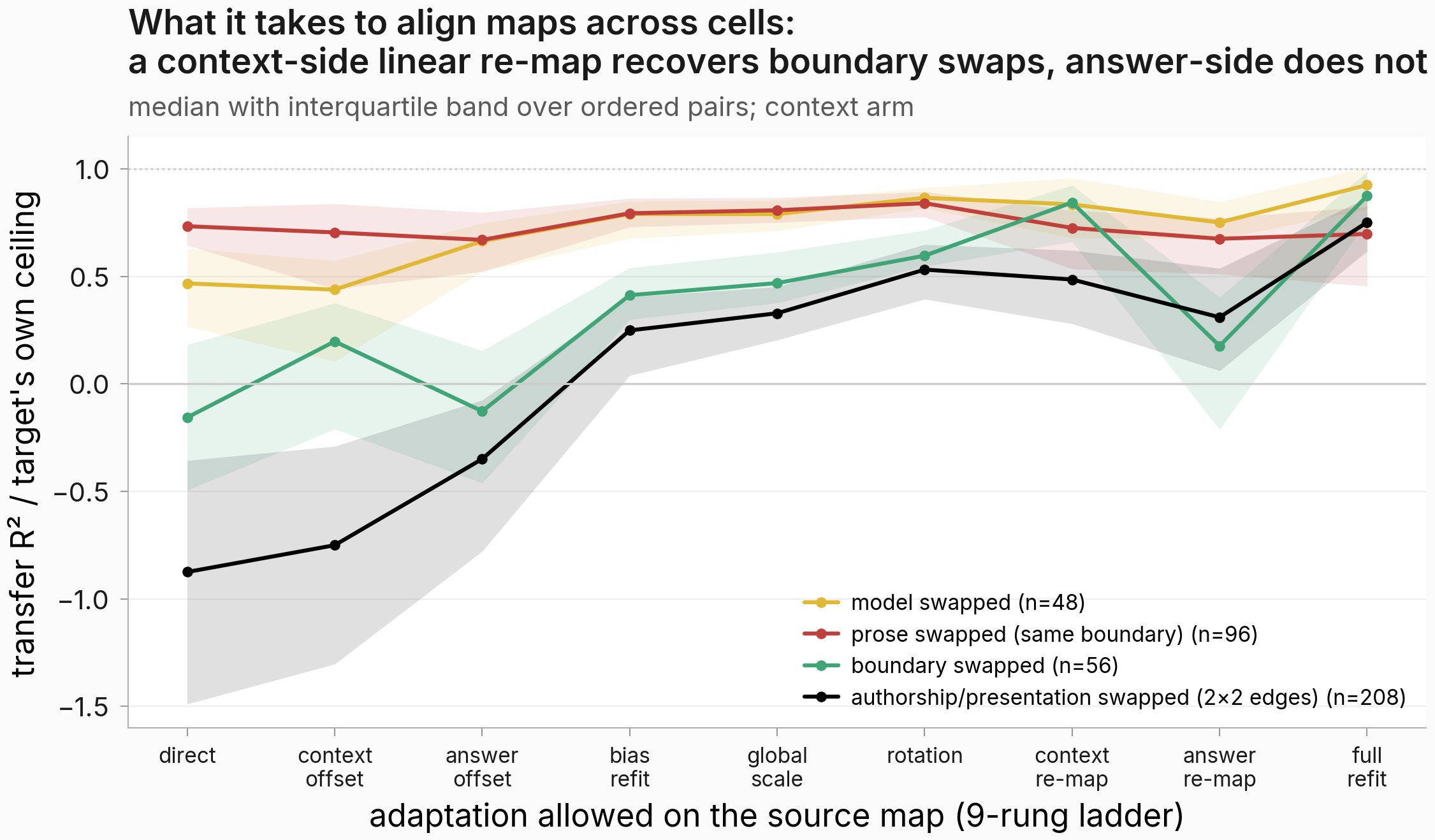
Figure. Only a context-side re-map restores boundary-swapped transfer. 408 ordered pairs, context arm; boundary-swapped pairs jump from −0.16 of ceiling (direct) to 0.84 under a context-side linear re-map but only 0.18 under an answer-side re-map; prose-swapped pairs start at 0.73, peak at 0.84 under rotation, and decline to 0.70 at full refit; model-swapped pairs reach 0.87 under rotation alone.
The asymmetry localizes the boundary swap's change to the context side: a linear transform of the context space restores the map; the answer side stays incompatible with a linear correction (0.29 among the 36 prose-fixed story pairs, ≈0 among the 20 assistant swaps). Both re-map rungs are same-dimension fits on the same intersection and fold; the asymmetry is not a capacity difference.
Cross-model pairs on identical inserted text recover to 1.00 of ceiling at full refit and 0.87 under rotation alone — with text fixed, the two maps are nearly rotation-equivalent; on-policy cross-model pairs reach 0.17 directly. The fourth series (208 authorship/presentation edges of the 2×2) starts lowest, −0.88, recovering to 0.75 only at full refit — descriptive-only there: 64 of its 208 intersections sit below the 4,480 floor. The prose-swap refit-rung decline is the same artifact: training below d on smaller intersections.
The authorship × presentation decomposition is not additive
Three terms per character × model pair, from the four cell ceilings: authorship (transposed minus chat), presentation (inserted-story minus chat), and their interaction — for the 8 pairs whose transposed cell (story-authored answers re-presented in the chat template) shares answer text with the on-policy story cell (attributed-quote form).

Figure. Both main terms are negative and the interaction is positive in all 8 pairs. Context arm, attributed-quote form; whiskers are percentile intervals from 10,000 fold-aligned resamples over the 5 shared folds (resampled at the fold grain rather than the conversation grain). Underlying ceilings: the four cells per pair.

Authorship (−0.14 to −0.29) and presentation (−0.02 to −0.16) are negative, the interaction positive and comparable (+0.11 to +0.19), sign-consistent in 8 of 8 pairs (nominal p = 0.008 by sign test; the pairs share the 5 folds, so the count is the primary read). The inserted-vs-on-policy gap is neither a pure what-was-said effect nor a pure how-it-was-framed effect; on-policy cross-framing deltas cannot be read as framing effects. The transposed cell is strongly model-dependent (instruct 0.26–0.36, base 0.12–0.19). Two caveats: the authorship axis carries an answer-length change (bounded by the length-matched refit below), and the chat reference cell was fit at 11,901 rows against 8,000 for the others (a deviation from the plan's fit-all-cells-at-one-n rule; bounded at 0.013 in Methodology).
Truncation composition explains the worst flagged ceiling, but not the chat-base cell
For the two cells the truncation audit flagged, plus a subsample-size control on the chat inserted cell: the full-cell fit against refits excluding the suspect rows (truncation-capped; for chat-base also language-drifted) and refits excluding as many random rows, under the same folds, seed, and ridge recipe.

Figure. Capped rows account for the bare-text cell's depressed ceiling; chat-base exclusions move it by at most ~+0.03. Context arm, assistant cells; bare-text on-policy (instruct): all rows 0.21 (42.5% capped), capped-removed 0.39, random-removed 0.20 (n = 4,599). Chat on-policy (base): all rows 0.21, capped-removed 0.214 vs random 0.207 (n = 7,551); drift-removed 0.224 vs random 0.200 (n = 5,764). Chat inserted (instruct): 0.492 vs subsampled-to-8,000 0.480.
Removing the capped rows nearly doubles the bare-text cell's ceiling; removing random rows at the same n slightly lowers it. The depressed ceiling comes from the capped continuations themselves (the bare-text render has no end-of-turn token, so generations run to the cap); sample size does not explain it. Across the lattice, on-policy cross-cell reads (the decomposition's authorship axis included) measure changes in what is written jointly with how it is encoded. The chat-base cell resists the same treatment: excluding its 5.6% capped rows moves it by +0.007, and excluding its 31.6% language-drifted rows reaches 0.224 against a 0.200 matched-n random control — a composition effect near +0.03 that still leaves the ceiling far below the 0.58 of its instruct twin. That cell's low ceiling remains unexplained.
The plan's answer-length parity bound fails in every character cell
One value per pair: the answer-length Kolmogorov–Smirnov statistic for each of the 24 inserted-vs-on-policy pairs (16 character, 8 assistant), computed from persisted answer text over the pair's matched conversations, against the plan's 0.30 bound.
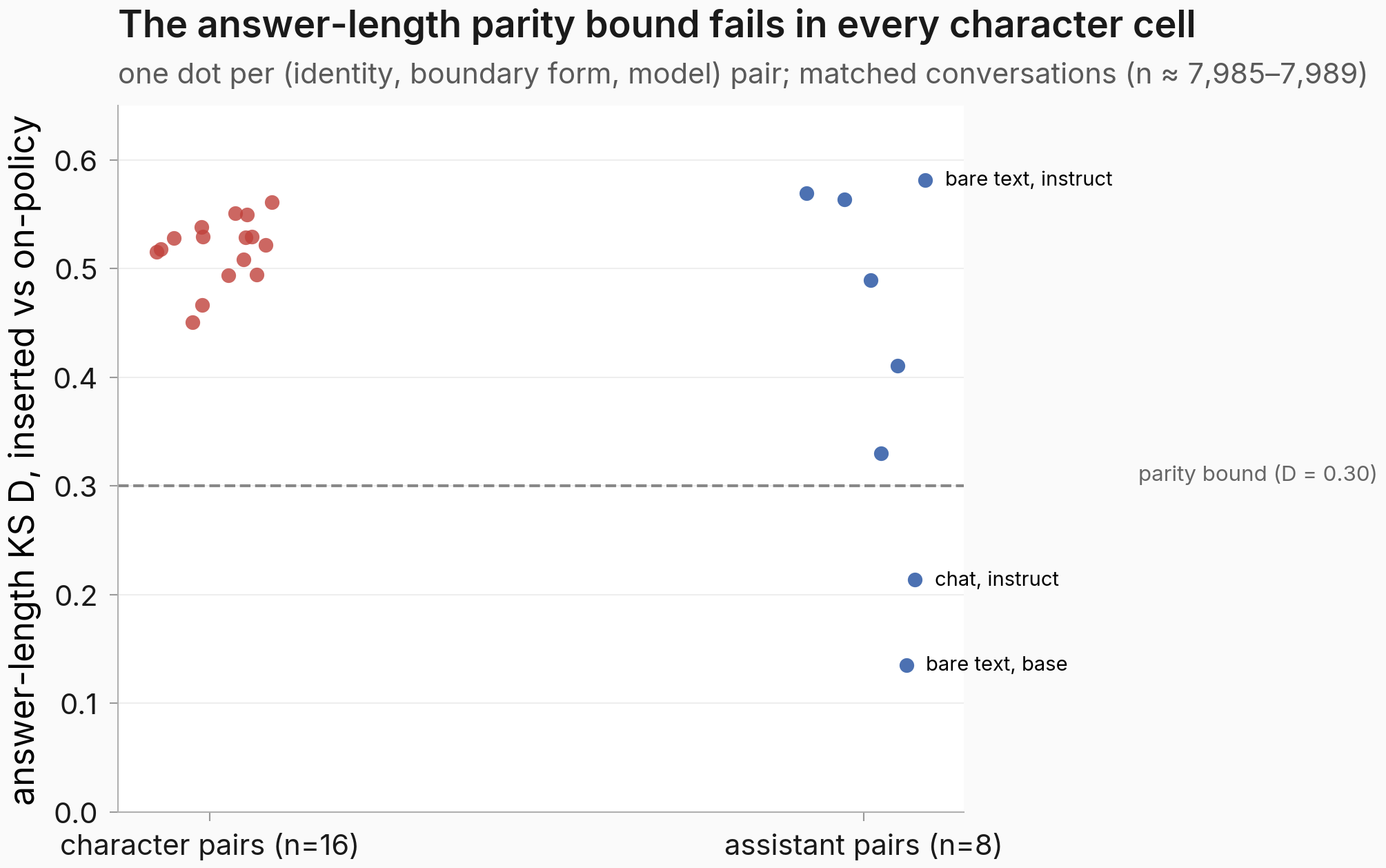
Figure. All 16 character pairs breach the KS 0.30 bound (D 0.450–0.561). 22 of 24 pairs breach overall; assistant bare-text base (D = 0.135) and chat instruct (0.214) pass, and assistant chat base is marginal (0.330). Distribution view: answer-length distributions.

The gate was never evaluated in-run (the fail-open deviation in Methodology); recomputed after the run, it fails everywhere the headline comparisons live. Mean token ratios fall outside the plan's 0.25–4.0 bound in 6 of 24 pairs (full span 0.19–9.17): story on-policy answers run 2–5× shorter than the spliced real answers, and the bare-text instruct cell runs 9× longer.
Language drift is monotone in boundary form: attributed-quote cells 1–6%, bare-label 7–16%, chat and bare-text 16–39% of conversations whose original answer was not Chinese-script (inserted cells: fixed text by construction). Inserted-vs-on-policy contrasts therefore compare different answer populations on top of different authorship.
The inserted-vs-on-policy ceiling gaps survive answer-length matching
Both cells of each of the 24 inserted-vs-on-policy pairs were refit on length-matched subsamples (equal per-decile-bin draws from the pair's pooled answer lengths, same folds and ridge recipe), setting the matched ceiling gap beside the committed full-population gap (left) and per-cell matched-vs-full values (right); context arm only, a stated deviation.

Figure. Gap signs survive length matching in 20 of 24 pairs. Context arm, 24 inserted-vs-on-policy pairs; matched = equal per-decile-bin subsamples of pooled pair answer lengths (10 bins, seed 137 per pair); character pairs median +0.048 → +0.033, assistant +0.097 → +0.048; squares = reduced k=1024 basis (matched per-fold n_train under d=3,584; nine pairs), gaps compared within one basis.
The gaps survive at parity, attenuated: median +0.053 full against +0.033 matched, sign preserved in 20 of 24 pairs, and assistant pairs roughly halved (+0.097 → +0.048). The one collapse, bare-text instruct (+0.274 → +0.014), is the 42.5% cap-hit cell isolated two results above; the four sign flips all sit below 0.033 in magnitude.
The prefix arm's near-zero survives the capture check
No standalone figure — the per-cell prefix values are the gray crosses hugging zero in the first figure. Across all 56 cells the prefix arm's held-out R² spans −0.001 to +0.021 (median 0.006), with nulls at ≈ −0.03 and identity-plus-bias floors from −0.0006 (chat and bare-text cells, where a constant template-header prefix reduces the baseline to the train-fold mean) down to −2.82 (story cells), while the same rows' context arms reach 0.12–0.58.
The parent line's collapse signature (prefix inputs spanning at most 20 distinct vectors) is absent: the prefix state is captured per row at the renderer-recorded prefix end, and a rank probe over 4,000 rows of a story cell measures effective rank 3,584 — full rank. The story cells, whose per-row narrative prefixes vary at full rank, still top out at 0.021. On this corpus — one shared draw, diverse per-row scaffolds — the pre-question state carries essentially no linearly decodable information about the answer-mean vector at layer 19; the question span is what makes the context vector predictive.
The coordinated scaffold regeneration falls short of the well-posedness floor and aborts before any refit
The follow-up round regenerated scaffold coverage for the under-determined pair classes on one 15,700-conversation target set (three waves at most per character-conversation pair), gated before any capture spend. The figure plots the four-way survivor intersection per wave against the gate bounds and projection, plus per-character coverage.

Figure. Three waves reach 2,409 of the 4,480-conversation floor. Left: conversations admitted for all four characters grow 936 → 1,703 → 2,409 across waves — exact set counts, no sampling error — against the 9,855-conversation launch projection and the 9,000 target. Right: cumulative admitted conversations per character, of the 15,700 targeted.
The gate aborted the round with the optional contingency wave unrun: wave 3 added 706 survivors against a 2,071 gap, beyond one more capped wave (plan v12 §7). The launch projection carried a denominator error: its 0.493 basis was measured as admissions per judged scaffold on the parent but applied per attempt from pending conversations.
The generator's verbatim-question filter drops 68–77% of generator-kept rows, rising by wave (prejudge yield 26.6% → 20.7%), so realized per-attempt success fell 12.0%, 9.4%, 7.7%. Admissions per judged scaffold fell 45.2% → 37.3% against the 0.493 basis; cross-character admission correlation helps but cannot close the fourfold gap. The prose-swap and authorship-decomposition refit rungs stay descriptive-only; a reduced-basis refit at current coverage is the proposed fallback read.
The reduced-basis fallback tracks the ambient refit reads except on the answer-side rung, which voids the lattice
The fallback recomputed rungs 7 (context re-map), 8 (answer re-map) and 9 (full refit) over 1,184 units in a train-fold truncated-SVD basis at k* = 1024, k ≤ n_train/2 per fold. Left: reduced vs ambient ratio per control pair. Right: median ratio change under boundary subsampling to 2,939 / 3,500 / 4,450 conversations.

Figure. Rungs 7 and 9 calibrate; rung 8 carries an 18.3 pp bias. Left: reduced ratio at k* = 1024 vs ambient on control pairs, identity line shown; per-rung median signed difference −0.019 (rung 7), −0.025 (rung 9), +0.183 (rung 8, boundary). Right: median [ratio(n_sub) − ratio(full n)] with conversation-bootstrap error bars, dashed guides at ±0.05; rung 8 sits at −0.040 / −0.038 / −0.007.
Five of six gating cells calibrate within 2.6 pp at 100% coverage, ρ ≥ 0.95. The sixth — answer re-map on boundary pairs — overstates ambient by 18.32 pp against a 15.0 pp ceiling, voiding the verdict; ρ = 0.971 there, making it a level failure, not a ranking one. The in-band criterion also misses: 54 of 64 below-floor pairs fall inside the 0.385–0.992 band of 160 above-floor matched-n pairs (bar 58; p = 0.165 over 883 valid cluster-bootstrap draws), and no tested bar yields Consistent. The fallback does not substitute for the ambient refit rungs; its failure being positively biased, a reduced-basis answer-side figure over-estimates ambient, so the context-side reading above only strengthens.
Context states map across cells, most strongly between the assistant's framings; prefix states do not
Each point is one ordered cell pair's held-out R² for a ridge map from the source cell's context vector to the target cell's context vector on the pair's shared conversations (232 pairs per arm over the banked layer-19 teacher-forced captures, on-policy + inserted cells, shared 5-fold map), grouped by pair class; blue = context arm, orange = prefix arm.

Figure. Cross-cell context maps fit in every class; prefix maps in none. 232 ordered pairs per arm (joins 2,939–11,901 conversations); context-arm medians 0.44 (assistant framing pairs, 48), 0.18 (character to character, 120), 0.17 (character to assistant, 32), 0.15 (assistant to character, 32); prefix-arm median 0.008 over its 182 fitted pairs. Per-pair baseline view: fitted vs identity.

A conversation's context state under one cell linearly predicts its state under another cell, at roughly half to two-thirds of the within-cell context→answer ceilings and best between the assistant's framings (median 0.44). 208 of 232 context-arm pairs beat the identity-plus-bias baseline; the 24 that do not are transposed-chat pairs whose context states are nearly shared already (identity baseline 0.85–0.90 against fitted 0.76–0.82). The prefix arm skips 50 of its 232 pairs (42 constant-input, 8 identical input–output; chat and bare-text template headers) and the fitted rest stay at or below 0.04 — pre-question states are not mappable even cell-to-cell.
One pooled map plus a per-cell bias recovers most of every cell's ceiling
Distributions over the 56 cells of held-out R² when a single pooled context→answer map — fit jointly on all 56 cells' banked activations under the shared folds — is applied to each cell with increasing adaptation: as-is, context or answer cloud offsets, per-cell bias refit, global scale, rotation, rotation + scale; both arms.
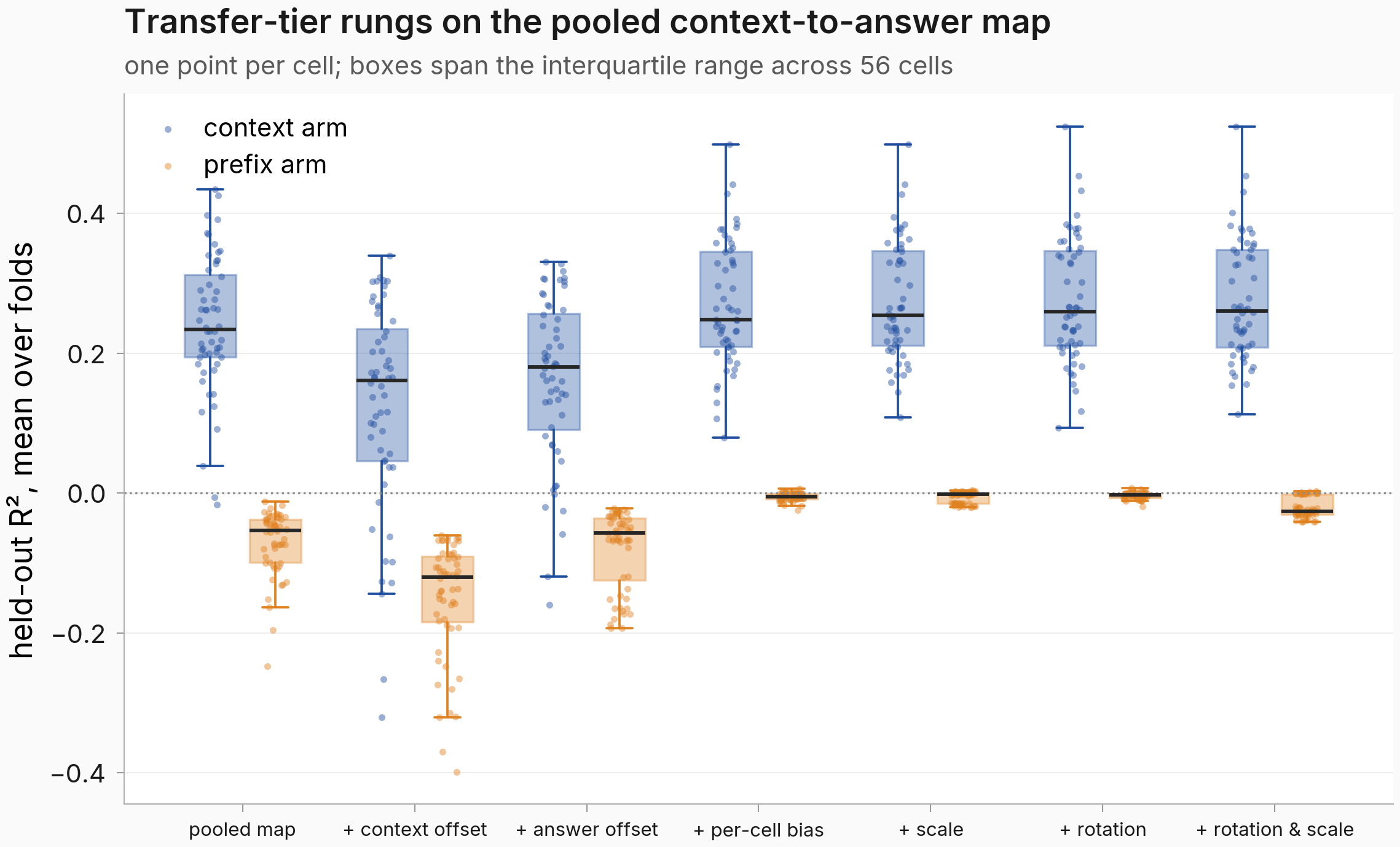
Figure. A per-cell bias closes most of the pooled map's gap; rotation and scale add little. Context arm, 56 cells: pooled map median 0.234 (21 cells within 90% of their banked ceiling) → per-cell bias 0.248 (34) → rotation 0.260 (40) → rotation + scale 0.261 (38); cloud offsets hurt (0.161 / 0.180); the prefix arm never rises above zero in median. Per-cell profiles: per-unit view; pooled vs specialized per cell: ceiling scatter and per-cell dot plot.


The companion pool-then-specialize fit agrees in mean terms: pooled 0.242 → 0.270 with a per-cell bias → 0.298 with a rank-128 residual, putting 50 of 56 cells at or above 95% of their banked within-cell ceilings (median ceiling fraction 0.997). The 56 maps share nearly all their structure — cell identity contributes a bias and a low-rank correction, not a different operator. The prefix arm is null throughout (pooled mean −0.070; 11 of 56 prefix ceilings usable); 8 of 112 rung units — constant-input prefix chat cells — are gain/rotation-degenerate and substitute the bias rung.
The reinstated indirect-report framing lands between the two story boundary forms
Within-cell held-out R² per on-policy cell for the reinstated fifth framing (indirect reported speech, 10 cells at 8,000 rows) beside the four shipped framings' on-policy cells, grouped by framing; filled markers = instruct, open = base; blue = context arm, orange = prefix arm.

Figure. Indirect-report ceilings sit between the bare-label and attributed-quote forms. Context arm: 10 indirect cells at 0.229–0.288 (median 0.257) against bare-label 0.231 and attributed-quote 0.290 medians (10 on-policy cells each), chat 0.207 / 0.580 and bare-text 0.209–0.225 (2 assistant cells each); prefix arm 0.010–0.031. Shared production fold map, K = 5.
A structurally different boundary — narrator voice, no quotation — fits like the story forms and orders between them, consistent with the boundary form setting the ceiling; every indirect cell clears its shuffled null (p95 ≈ −0.03) and identity floor. The framing exists on-policy only (a reported-speech render cannot splice the original answer deterministically), so inserted-arm reads and the authorship × presentation decomposition do not extend to it. Its opener generates digit-clean (0.03–0.15% digit-start onsets), unlike the bare-label form's 23.2% trailing-space artifact disclosed in Methodology.
Indirect-report maps transfer across characters directly and across models after rotation
Median transfer R² with interquartile bands across the 9 ladder rungs for the two class-valid pair classes among the indirect cells — cross-character (24 ordered pairs per arm, 2,939–3,268-conversation intersections) and cross-model (10 pairs per arm, 8,000) — both arms; dashed lines mark median target ceilings.
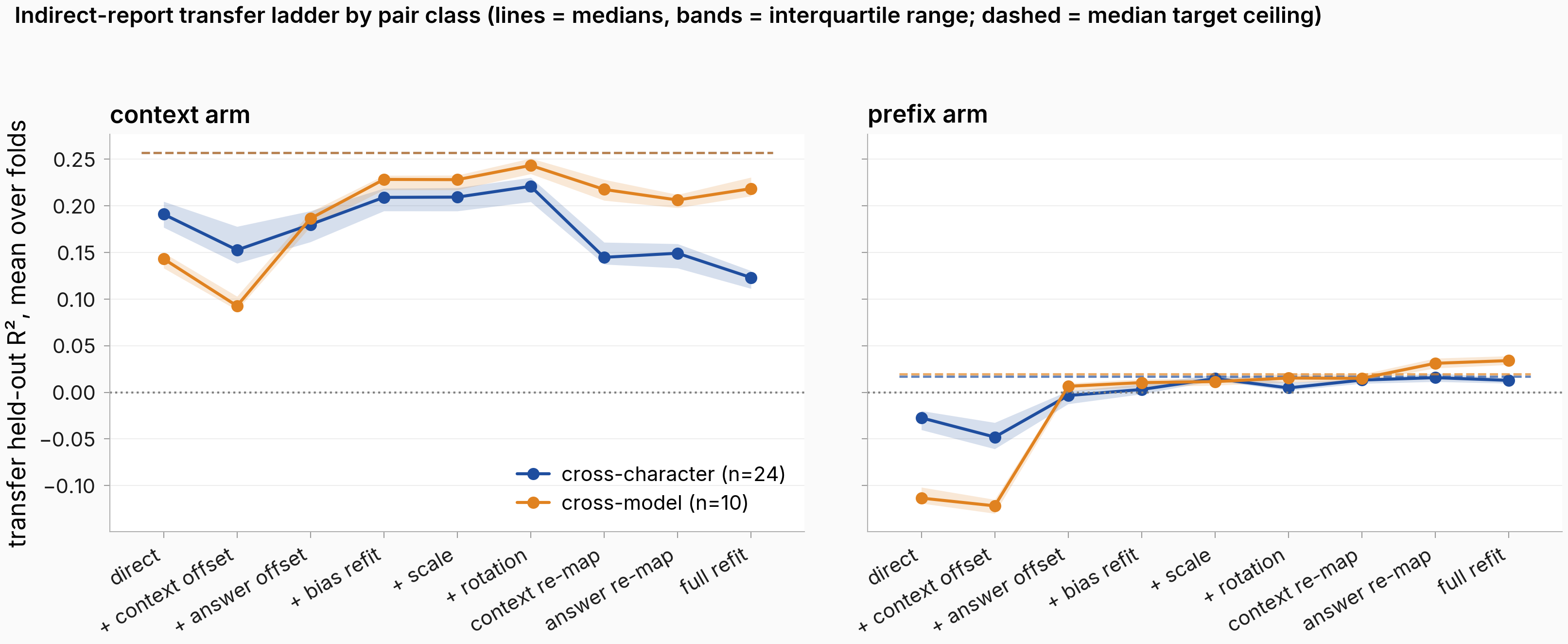
Figure. Rotation restores cross-model transfer to 0.93 of ceiling; cross-character pairs transfer directly at 0.74. Context-arm medians: cross-model direct 0.143 → bias refit 0.228 → rotation 0.243 → full refit 0.218 (0.52 → 0.86 → 0.93 → 0.84 of ceiling); cross-character direct 0.191 (0.74 of ceiling), rotation 0.221 (0.85). Per-pair view: per-unit profiles.

Within a fixed indirect boundary, the main lattice's transfer pattern reproduces: same-boundary maps move across characters directly, and cross-model pairs approach rotation-equivalence. The cross-character refit rungs decline (full refit 0.123) because those intersections sit below the 4,480-conversation floor — descriptive-only, the same under-determination convention as the prose-swap pairs. The prefix arm never leaves zero (direct medians −0.03 and −0.11 against ceilings near 0.02). Cross-framing pairs into or out of the indirect cells were deliberately not run — no inserted arm exists, and on-policy cross-framing pairs are excluded per the plan's interpretive split — so the boundary-swap headline is not re-tested on this framing.
Repro: ~6–7 GPU-h realized for the main lattice (scaffold + on-policy generation with cap-hit regen ≈ 2.9; capture 4.1 on 2× H100; transposed-cell splice+capture 0.38; fits and ladders on CPU pods) vs 186 GPU-h approved; the framing-5 round adds ≈4.4 h wall on 1× H100 (generation + capture, pod pod-2054-framing5), with the extension-round fits and ladders on two RunPod cpu-bigmem pods (pod-2054-ctxmap, pod-2054-poolspec), all verified-uploaded then terminated. Code: scripts/issue2054_{forms,phase_a,phase_b,phase_c,phase_d,capture,fits,ladder,authorship_2x2}.py on branch issue-2054 (fits and 2×2 at commit 7041a2b7); analyzer companion figures from scripts/issue2054_analyzer_figs.py (same branch). Data: HF issue2054_lattice @ 003e3925 — scaffolds/, spliced_inserted/, on_policy/<model>/ (canonical per-model trees; the model-less on_policy/<variant>/ prefix is deprecated-ambiguous), cell_c/, activations/ (56 npz, 11.11 GB — 48 inserted/on-policy + 8 transposed — plus digests), fits/ (56 JSONs), ladder/ (816 rung JSONs + digests; census verified complete) — all prefixes verified by scoped listing this round. Committed on the branch: eval_results/issue_2054/ (shared fold map, 2×2 terms, audits, pilot gates) plus the analyzer companions under eval_results/issue_2054/analyzer_companions/ (answer-length parity, language-drift counts, companion refits; round 2 adds the chat-base drift-excluded refit drift_refit.json and the per-pair ladder intersection/composition scan ladder_intersection_composition.json, and round 3 adds the length-stratified refit length_stratified_refit.json (driver scripts/issue2054_length_stratified_refit.py; 48 matched-cell refits, VM CPU, ~5.5 h at width 4); token lengths from persisted answer text via the Qwen2.5-7B tokenizer; refits through issue2054_fits._fit_arm_cell with restricted conversation sets, seed 42 for random subsets). Round 2 regenerated ladder_recovery and boundary_vs_prose_pairs (class-label precision), extended caphit_censoring_refits with the drift refit bars, and added ks_parity_pairs; the review round re-rendered length_stratified_refit from its committed JSON with reader-facing pair labels (values unchanged; the driver's figure-only path) — earlier-commit copies are superseded. Per-unit companion figures are deliberately linked, not embedded, keeping one inline figure per result. Follow-up round coordinated-common-set-regen (plan v12; ~1.6 GPU-h realized of 13 booked): drivers scripts/issue2054_regen_waves.py + scripts/issue2054_gate1_intersections.py on branch issue-2054 @ e2a7a966c8; committed round artifacts eval_results/issue_2054/coordinated_common_set_regen/ (gate1_report.json, gate1_projection.json, wave_state_final.json, target_set.meta.json, shared_fold_map_extended.json — 26,889 fold keys preserved); banked on HF under issue2054_lattice/common_regen @ e5ae4f3d — scaffolds/ (judged prejudge pools per wave), waves/ (raw generation rollout text), state/ (attempt ledger + extended fold map), target_set/, answers/ (35,851 rows) — verified by scoped listing this round; trajectory figure from scripts/issue2054_analyzer_figs.py --regen-gate at commit 8d988791c0. Follow-up round reduced-basis-refit-rungs789 (plan v16; 0 GPU-h — 10 RunPod cpu-bigmem pods, realized per-shard walls 2.62–17.26 h, all ten verified-uploaded then terminated): driver scripts/issue2054_rb789.py + scripts/issue2054_rb789_pod_driver.sh, merge census from scripts/issue2054_rb789_live_census.py, all on branch issue-2054 @ 5eb343f55e; committed round artifacts eval_results/issue_2054/reduced_basis_refit_rungs789/ (verdict.json, calibration_report.json, nslope_report.json, rb789_class_digest.json, derived_census.json) and figures figures/issue_2054/reduced_basis_refit_rungs789/ (6 PNGs + meta, every URL verified serving at that SHA); banked on HF under issue2054_lattice/reduced_basis_refit_rungs789 — ladder/ (864 full-n units + per-shard digests + pilot reports), ladder_matchedn/ (320 matched-n units), pilot/, logs/ (31 per-unit and driver logs across all ten shards, including the rotated pre-relaunch logs that carry the two designed fence halts and the census assert). Per-unit companion views (hero_class_distributions, oldnew_scatter_rung9, matchedn_scatter_rung9, kprofile_curves, prefix_raw_r2) are linked from that figures directory rather than embedded, per the one-inline-figure convention above. Follow-up rounds user-gaps-extension + framing-5 reinstatement: the framing-5 indirect form landed on main at commit 99f52a09d8 (scripts/issue1345_scaffold_common.py opener + splice opt-in, scripts/issue2054_forms.py registry, scripts/issue2054_phase_c.py on-policy path) with the fixed opener + pool-specialize degeneracy guards at f3bbde0f61; gap figures + committed digests from scripts/issue2054_userfigs_gaps.py (eval_results/issue_2054/ctx2ctx_full/digest.json, eval_results/issue_2054/pool_specialize/digest.json, and eval_results/issue_2054/pool_rungs/digest.json + 6 figures under figures/issue_2054/user_gaps_extension/ at commit 5971c9eeb3); framing-5 figures + digest from scripts/issue2054_f5_indirect_figs.py (eval_results/issue_2054/f5_indirect/digest.json + 3 figures under figures/issue_2054/f5_indirect/ at commit c2e6004fa7). Banked on HF under issue2054_lattice/ — ctx2ctx_full/percell/ (112 unit JSONs), pool_specialize/ (aggregate + 112 per-cell files, 228 total), pool_rungs/percell_rungs/ (112), on_policy/<model>/<variant>/on_policy_<variant>__indirect.jsonl (10 cells × 8,000 rows), activations/<variant>/ (10 indirect npz), fits/ (10 indirect cell JSONs), ladder/ (68 indirect rung JSONs) — all verified by scoped listing at fold time.
- Reused kept-story scaffolds from #1345:
issue1345_framing/<variant>/raw_completions/stories/@ 003e392548fcbbe866c6f345f4688d8176cd9f04 (6,556 scaffolds recovered by the round-trip-verified scaffold stripper) — fit: same characters and story forms; every recovered scaffold re-judged by this task's own admission gate before entering the pool. - Reused multi-turn conversation pool from #1738:
issue1738_multiturn/sampling_manifest/@ 003e392548fcbbe866c6f345f4688d8176cd9f04 (55 JSONL parts; the persisted 99,778-conversation selection from the 626,620-conversation LMSYS-derived pool) — fit: real multi-turn user chats keep one row per scaffold; the shared conversation draw's source.
Context: created 2026-08-03 from user chat (origin prompt, verbatim: "run the 6000 row thing in the background with happy coder"; preceding directives: "do a comprehensive audit of why all these generations are failing and rerun so that we get 6000 inserted and 6000 on-policy for all settings we need for my result writeup. for inserted the model doesn't necessarily have to generate itself it can just write the start and then we insert the dialogue directly (BUT THE STORY FRAMING ITSELF SHOULD BE DIVERSE)"; "run so that we only take the first message per character in ALL settings"). Parent: #1345. Run 2026-08-04 → 2026-08-07; analyzed 2026-08-07. Follow-up round coordinated-common-set-regen created 2026-08-10 from user chat (origin prompt, verbatim: "do the re-run in the background with happy coder"); run 2026-08-10 → 2026-08-11 UTC; gate-abort fold 2026-08-11 UTC. Follow-up round reduced-basis-refit-rungs789 run 2026-08-11 → 2026-08-12 UTC (autonomous session; 10 shards placed across two provisioning generations, two shards relaunched after designed fleet-wall fence halts and one after a census-assert halt); merge + fold 2026-08-12 UTC. Follow-up rounds user-gaps-extension + framing-5 reinstatement created 2026-08-12 from user chat (origin prompts, verbatim: "run the gaps"; "just do on-policy only"; "Do all of these, as well as rotation + bias + scaling"); run 2026-08-12 → 2026-08-13 UTC; fold 2026-08-13 UTC.