The context→answer map's predictable subspace and the SAE's representable subspace coincide almost entirely at the variance grain (HIGH confidence)
Highlight text on any card (body, plan, or an event) to anchor a comment, or leave a whole-task comment here. Mention @claude to summon a reply.
No comments yet.
Methodology: docs/methodology/issue_1895.md · gist
Takeaways
- Overlap between the map's top-64 predictable directions and the SAE's top-64 reconstruction subspace is 0.867; variance-matched rotations already produce 0.845–0.862, so ~98% of the overlap is variance-driven.
- The beyond-variance excess is small and setting-dependent: above every draw at the primary setting, band-clearing at sizes 128–256, weaker at finer shell grain, below-null on the decoder-SVD twin.
- The residual map's above-plug-in excess was a convention artifact: retrained on the pure SAE error (mask-matched capture), it reads 0.280 vs plug-in 0.291, all 10,000 bootstrap draws below zero.
- Targeting the SAE reconstruction is easier by +0.029 held-out R² (0.746 vs 0.717) — almost exactly the variance-profile expectation of 0.743.
- Per-direction, map R² and SAE reconstruction quality correlate at 0.97; controlling variance rank leaves 0.076 (split-half decoupling attenuates it to ~0.05), and the per-feature partial is −0.050 (raw 0.25), i.e. not an independent correlate.
Goal
This experiment in context: #1482 found the context→answer map's per-direction R² decays monotonically with variance rank; #779 banked the map; #1738 banked the SAE-space mapping baselines. This experiment asks whether the map's predictable subspace and the SAE's representable subspace — two decompositions of the same answer activation — coincide beyond what shared variance-dependence forces, whether the SAE reconstruction is an easier target, and whether the map predicts what the SAE misses.
Broader narrative: if "linearly predictable from context" and "SAE-representable" are one axis (variance) rather than two, SAE dictionaries add no privileged basis for context→answer prediction, and the map's unpredictable remainder is not where the dictionary's blind spots are.
Methodology
Design: All quantities are deterministic linear-algebra reads over banked Qwen-2.5-7B-Instruct layer-19 activations of real single-turn chats. Objects: v_C = final-context-token state; v_A = mean answer-token state; f̄ = banked mean-pooled SAE code; r̄ = W_dec·f̄ + b_dec (the pooled SAE reconstruction — by linearity the mean of per-token reconstructions, so on-distribution); ē = v_A − r̄ (the SAE-residual target); Q = eigenbasis of the train-split covariance of v_A (all 3,584 directions). P_pred(k) = span of the top-k eigendirections ranked by the map's per-direction held-out R² (banked profile primary for k ≤ 64; this run's matched 120k refit for k = 128/256, since the banked profile covers only 256 directions). P_sae(k) = top-k principal directions of centered r̄ on the holdout (primary), with an activity-weighted decoder-SVD twin and the residual-PCA complement. The plan fixed a three-part decision rule before data: (P_align) the k=64 overlap exceeds the 97.5th percentile of a 1,000-draw within-shell rotation null at 32 eigenvalue shells; (P_dark) the lower 95% bootstrap bound of R²(v_C→ē) minus its variance-profile plug-in exceeds 0; (P_var0) the variance-partialled per-direction correlation's interval includes 0. Outcome cells: shared-structure, orthogonal-decompositions, mixed, variance-trivial. A 512-row teacher-forced pilot gated the target convention: reconstruction identity (median relative deviation 2.4e-3 < 5e-3) and mask-mismatch share (median 1.9e-4 vs SAE-error share 8.8e-2) selected Path A — banked v_A kept as target, with the mismatch carried as the caveat the Results section quantifies. Contrastive negatives / persona-vector recipes: not applicable (no behavior implantation, no contrastive direction extraction). Judged SAE feature labels stayed frozen; every read here is mechanical. Follow-up round pure-residual-path-b (2026-08-01) changed exactly one thing: the residual target's construction — the S3b mask-matched dense capture ran over all 142,000 rows, and the residual map was retrained and scored on the pure SAE error ē = v̄_mask − r̄ (the driver re-ran end-to-end with the path forced to B via --force-path B; the pilot-gate JSON's path field is G2b-derived and does not record the realized path). Split (sha-asserted), λ grid, plug-in construction, 10,000-draw paired bootstrap, seeds, and both baselines identical; the only code change was the override flag. The round's re-computed per-direction correlates block sits in the mask-matched basis and shows an internal sign disagreement between its observed partial (−0.52) and its bootstrap draw interval (0.54 to 0.63), so I do not fold its correlate numbers; the parent-basis correlates below stand. Conciseness note: total Results prose runs over the 800-word budget, and individual result blocks may exceed the 120-word warn cap — eight result sections are retained deliberately, because each positive predicate of the decision rule requires its own sensitivity/purity read plus the low-level per-unit view.
Training: N/A — no model training. All fitted maps are ridge or small-MLP analysis fits on frozen activations; complete fit hyperparameters:
| Hyperparameter | Value | Source |
|---|---|---|
| Ridge λ grid | logspace(−3, 8, 23), selected on the 2,000-row validation split per target | #1482 sae_perfeature protocol |
| Selected λ (raw answer / reconstruction / residual, context arm) | 1000 / 1000 / 3162.3 | fits_summary.json |
| Split | 120,000 fit / 2,000 val / 20,000 holdout rows; context-level split, shas asserted against split_1482.json | #1482 / #779 |
| Fit well-posedness | n_train = 120,000 ≥ d = 3,584; no GCV anywhere | plan §4 |
| MLP twins | width 8192, lr 3e-4, batch 4096, val early-stop (48 / 47 epochs realized), fit seed 0 | #1482 mlp_w8192 recipe |
| Angle null battery | 1,000 within-shell rotation draws per cell; shells {16, 32, 64}; subspace sizes {16, 32, 64, 128, 256}; primary k = 64 (fixed in the plan before data) | plan §11; #1345 matched-null conventions |
| Paired bootstrap | 10,000 multinomial draws over holdout contexts, seed 1895; fitted maps held fixed (scoring uncertainty only) | #1482 pdshrink pattern |
| SAE | andyrdt/saes-qwen2.5-7b-instruct rev c37e53c4bb07, resid_post_layer_19/trainer_1 (k = 64); k = 128 trainer_2 pilot twin | #1482 Gate-B primary |
| Follow-up round pure-residual-path-b | identical fit recipe on the pure-error target; selected λ (mask-matched raw / reconstruction / pure residual) 3162.3 / 1000 / 3162.3 | round fits_summary.json |
Evaluation: Four dependent variables. (1) Subspace overlap O(k) = mean cos² principal angle, judged against covariance-matched nulls that Haar-rotate the SAE basis within eigenvalue shells — preserving the variance profile, destroying directional alignment. (2) Paired held-out pooled R² across the three targets on identical rows. (3) The residual target's R² minus a variance-profile plug-in: Σ energy(u)·g(u) / Σ energy(u), with g(u) the matched refit's per-direction R² profile over all 3,584 directions — the exact quantitative statement of "predictability is a function of variance rank alone" (a rotation null is vacuous for pooled R², which is rotation-invariant in the target). The plug-in is a fixed reference value, not a null distribution; the residual read is reported against both 0 and the plug-in, plus a shared-λ error decomposition (additivity relative deviation 5.6e-10; 77.9% of the raw-target map's squared error lies on the SAE-representable component, 23.3% on the residual — which holds only 9.9% of pooled target variance, a ~2.4× error enrichment). (4) Partial Spearman correlations given variance rank (per-direction) and given variance rank + consistency + activity (per-feature), with within-decile stratified reads weighted equally (both variables decay with variance, so the partial alone is not trusted); the exploratory decile family is screened by Benjamini–Hochberg false-discovery control at q = 0.05. A split-half re-derivation (even/odd deterministic holdout halves; constructions built on one half, scored on the other) controls the shared-holdout construction coupling in the overlap and partial-correlation reads. The k = 128 dictionary pilot twin bounds dictionary-size sensitivity: its per-direction reconstruction-quality profile rank-correlates 0.981 with the k = 64 profile on the 512 pilot rows. Both mapping arms ran: the context arm carries every read; the prefix arm is a null by construction on this single-turn corpus (the prefix is one constant template string) — R² ≤ 0.0002 and retrieval at chance for all three targets. Both standing baselines ran for every new fitted map (chance acc@1 = 1/20,000 = 5e-5):
| Target (context arm) | map R² | identity+bias R² | map kNN acc@1 (euclid / cosine) | identity+bias kNN acc@1 (euclid / cosine) |
|---|---|---|---|---|
| raw answer state | 0.717 | −1.02 | 0.694 / 0.702 | 0.330 / 0.356 |
| SAE reconstruction | 0.746 | −1.30 | 0.591 / 0.607 | 0.229 / 0.253 |
| SAE residual | 0.336 | −19.4 | 0.125 / 0.722 | 0.324 / 0.329 |
| pure SAE error (follow-up round) | 0.280 | −20.1 | 0.126 / 0.772 | 0.358 / 0.369 |
On the residual target the two retrieval reads dissociate: identity+bias beats the fitted map on euclidean acc@1 (0.324 vs 0.125) while the map wins on cosine (0.722 vs 0.329) — a scale/shrinkage signature in the fitted residual map's predictions, so the 0.125 euclidean cell reflects mis-scaled magnitudes, not undiscriminative predictions. The same dissociation replicates on the follow-up round's pure-error map (row 4). All bootstrap intervals hold the fitted maps fixed (scoring uncertainty only, not refit uncertainty). Per-corpus splits (LMSYS 0.707 / WildChat 0.722 raw-target R²) are within-corpus reads at parent parity, not a transfer arm. Language-intrusion audit: N/A — no on-policy generation anywhere in the DV (teacher-forced capture only).
Data extraction: Corpora: 964,844 real single-turn LMSYS-Chat-1M + WildChat conversations, reassembled from the banked final-token capture chunks with split-sha and top-256 eigenvalue-identity gates that halt the run on mismatch (both passed). The SAE arm uses the banked 142,000-row subset (120k fit / 2k val / 20k holdout, context-level split). Pooled SAE codes come from the banked store (1,920 shards, reference-masked mean over answer tokens); r̄ is built by one decoder multiply from the stored codes — verified against exact per-token reconstruction on 512 teacher-forced pilot rows (median relative deviation 2.4e-3). The pilot also measured the answer-token-convention mismatch between the banked v_A and the pooled-code mask: per-row median 0.02% of total variance (vs 8.8% SAE-error share) → Path A; the pooled tail is much heavier (13.4% of the residual's centered energy on pilot rows), which the matched-rows read in Results quantifies. The harvest-side re-reductions (dark_spot_matched_rows.json, angle_spectrum_k64.json) recompute from the run's persisted per-context projections and reproduce the committed values to 1e-6 before extending them.
Sample training/evaluation data + completions: No model generations were produced (teacher-forced capture only; the underlying conversation text is banked under the capture task's raw-completions buckets and referenced by artifact, not quoted, per content hygiene for real-user corpora). Verbatim evaluation-data samples — the residual-target fit cell (subset: 1 of 8 cells; full file: fits_summary.json):
"t_ebar_ctx": {"selected_lambda": 3162.2776601683795, "val_r2": 0.3254089495436613,
               "pooled_r2": 0.33601681685153906, "identity_bias_r2": -19.378161490300744, ...}
The follow-up round's pure-error fit cell (subset: 1 of 8 cells; full file: pure-residual-path-b/fits_summary.json):
"t_ebar_ctx": {"selected_lambda": 3162.2776601683795, "val_r2": 0.2779583103239538,
               "pooled_r2": 0.2795261249620792, "identity_bias_r2": -20.129891491095105, ...}
The pilot gate verdict (subset: 6 of 17 top-level fields; full file: pilot_gate.json):
{"path": "A", "n_pilot": 512, "g2a_median_reldev": 0.002417054260149598,
 "g2b_m_median": 0.00019414772395975888, "g2b_s_median": 0.08790857344865799,
 "k128_fve_rank_rho": 0.9809259482018847}
The machine verdict under the decision rule (full file: lattice.json):
{"q_align": 100.0, "delta_dark_lo": 0.027551833540201187,
 "rho_ci": [0.037670774207744714, 0.09024904796551758],
 "P_align": true, "P_dark": true, "P_var0": false, "verdict": "mixed"}
I verified this verdict against the raw summaries: the primary overlap cell reads the 100th percentile of its 32-shell null, the residual read's lower bootstrap bound is 0.0276 > 0, and the partial-correlation interval excludes 0 — the rule fires "mixed" correctly. The follow-up round re-evaluated the rule with the residual predicate on the pure error (pure-residual-path-b/lattice.json): the residual predicate reads false there (upper bootstrap bound −0.008 < 0) and the round's verdict is shared-structure; only that flip is folded as this round's finding (the file's partial-correlation interval comes from the mask-matched-basis recompute the Design section flags). The Results below qualify the remaining positive predicate with the sensitivity reads the rule does not see.
Results
Subspace overlap sits almost entirely at the variance grain, with a small setting-dependent excess
Subspace overlap O(k) — mean squared cosine of principal angles between the map's top-k predictable eigendirections and each top-k SAE subspace — for k = 16–256 on the 20,000-context holdout, with 16/32/64-shell rotation nulls (1,000 draws each).

Figure. Observed overlap exceeds the variance-matched null band only at some settings. Observed overlap (black; circles = banked profile, squares = matched 120k refit) vs null bands (2.5th–97.5th percentiles) for the reconstruction-PCA subspace (left), the SAE-residual complement (middle), and the weighted-decoder-SVD twin (right).
Overlap with the reconstruction subspace is high at every k (0.855–0.884), but variance-preserving rotations reproduce nearly all of it: at k = 64 (32 shells) the band spans 0.845–0.862 vs 0.867 observed (unchanged under split-half decoupling: cross-half 0.867–0.875, within-half 0.864–0.876). The observed value exceeds every draw yet sits only ~0.014 over the null median.
The excess also clears the band at k = 128–256, but not at 64 shells for k = 64, not at k = 32, and never on the decoder-SVD twin at 32/64 shells — that twin reads only 0.24–0.33 absolute overlap and sits below its own null at several settings. The residual complement clears its 32-shell band at k = 256 and sits at the band floor at k = 16.
About 51 of the map's top-64 directions lie inside the SAE's top-64 reconstruction subspace; the last few are nearly orthogonal
Per-angle squared cosines (sorted) between the map's top-64 predictable eigendirections and the top-64 reconstruction-PCA or SAE-residual subspace; the shaded band is the 32-shell null range for the reconstruction MEAN overlap.

Figure. The top-64 overlap splits into ~51 shared directions and a near-orthogonal cliff. The reconstruction-subspace spectrum (orange) holds 51 angles at cos² ≥ 0.9 (55 at ≥ 0.8) then cliffs to ~0; the residual-subspace spectrum (green) decays smoothly. Values labeled at angles 1, 32, 64.
The aggregate 0.867 decomposes into 51 near-shared directions (cos² ≥ 0.9; 55 at ≥ 0.8) and a cliff: the last ~5 predictable directions are nearly orthogonal (cos² ≤ 0.05) to the SAE's top reconstruction subspace. The map's predictable set sits mostly inside the dictionary's leading span, with a small block that span misses; overlap with the residual subspace shows no shared block.
The SAE reconstruction is an easier target by exactly its variance profile; the residual's above-profile predictability reverses on the pure SAE error
Left half: held-out pooled R² for the three context-arm targets with variance-profile plug-ins (dashes) and MLP twins (diamonds). Right half: residual-target R² minus its plug-in on the full holdout and the 512 pilot rows (Path-A residual vs pure SAE error; Path A: the banked answer state kept as target).
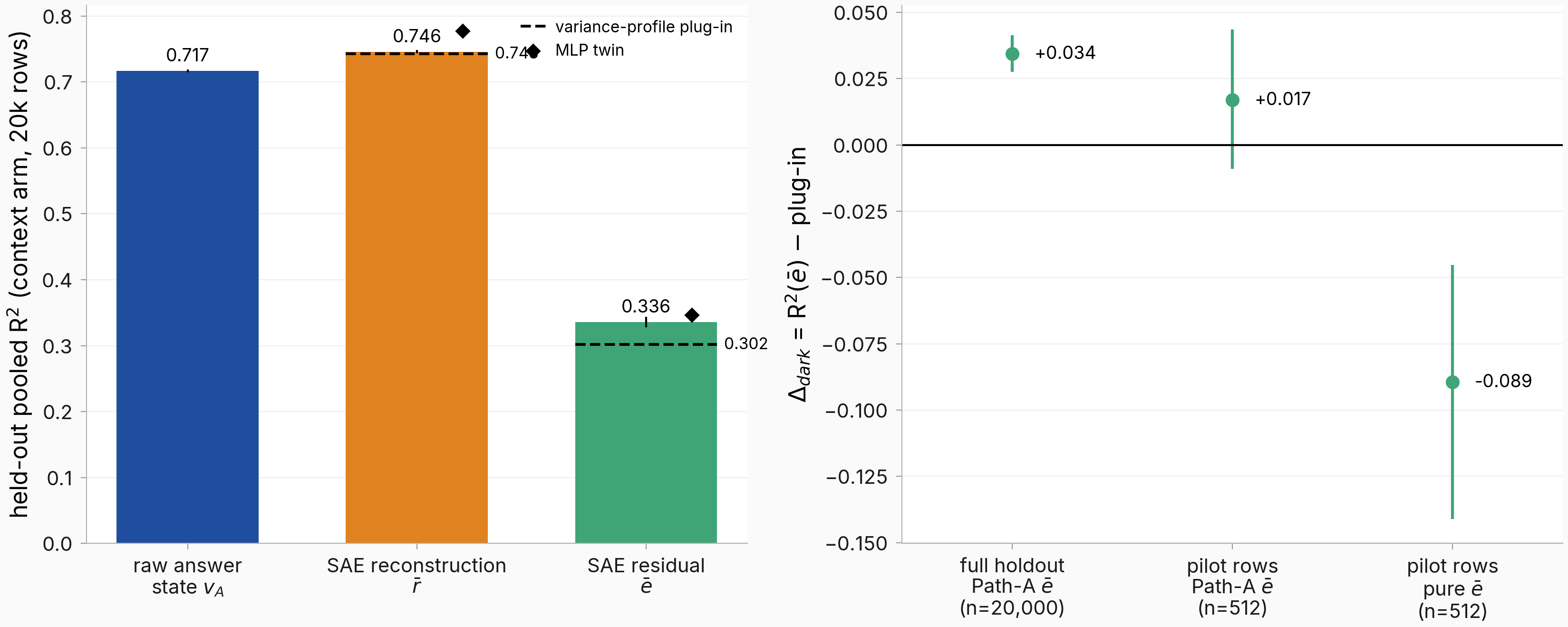
Figure. The residual's above-plug-in excess disappears on the pure SAE error. Whiskers: 95% bootstrap intervals, fitted maps held fixed. Residual excess: full holdout +0.034 (0.028 to 0.041); pilot Path-A +0.017 (−0.009 to +0.043); pilot pure −0.089 (−0.141 to −0.045); same fitted map, paired draws.
Reconstruction is easier by +0.029 R² (0.746 vs 0.717); the plug-in already predicts 0.743 — a paired excess of +0.003. MLP twins add +0.032 (reconstruction) and +0.011 (residual) over ridge, ordering unchanged; the plug-in derives from the ridge profile, not a like-for-like MLP reference.
The residual reads +0.034 above its plug-in on the full holdout, yet the same map scores −0.089 against it on the pure SAE error — a paired purity effect of +0.106. The excess traces to the answer-token-convention component (13.4% of residual energy, partly context-predictable), not SAE-missed structure. The pure read here scores a map trained on the Path-A residual, biasing it downward; the follow-up round (next result) ran the pure-trained corpus-wide refit and confirms the reversal.
Retrained on the pure SAE error, the map reads below its variance-profile plug-in on the full corpus
Left half: held-out pooled R² of the context→pure-error map — trained and scored on ē = v̄_mask − r̄ from the mask-matched 142,000-row capture — on the full 20,000-row holdout and its 512 pilot-row subset, each against its variance-profile plug-in (dashes). Right half: the 10,000-draw paired bootstrap distribution of R² minus plug-in, with the observed value and zero marked.

Figure. The pure SAE error is predictable at, not beyond, its variance profile. Full holdout 0.280 observed vs 0.291 plug-in (paired difference −0.011, interval −0.014 to −0.008); pilot subset 0.281 vs 0.292. All 10,000 paired draws fall below zero.
This retires the residual predicate corpus-wide: the map predicts the pure SAE error slightly below its variance profile — the previous result's +0.034 excess was the answer-token-convention component, not SAE-missed structure. The residual predicate now reads false and the verdict moves from mixed to shared-structure.
Integrity anchors: the reconstruction-target cell reproduces the parent to eight decimals (0.746; same banked-code target); the raw-target cell moves 0.717 to 0.708 because its target is now the mask-matched state. The retired claim is scoped: pure-error predictions stay directionally discriminative (cosine retrieval acc@1 0.77 vs chance 5e-5; identity+bias 0.37) — what fails is variance-relevant structure beyond the profile, not all information.
The below-profile read comes from the top of the spectrum; the deep tail sits slightly above profile
Each of the 3,584 eigendirections: the plug-in profile g(u) — the raw-target per-direction R² (x) — vs the pure-error map's per-direction R² (y); point area scales with the direction's share of residual energy, color encodes log eigenvalue rank, the dashed line marks equality.

Figure. High-variance directions fall below the parity line; the deep tail sits slightly above. The top 300 variance ranks (36% of residual energy) contribute −0.054 to the paired difference, the remaining directions +0.042, net −0.011. Representative ranks labeled.
The aggregate decomposes cleanly: where residual energy concentrates, the pure error is substantially less predictable than the raw-target profile (371 of 3,584 directions fall below parity, concentrated at the top), while the deep tail runs slightly above profile. The map holds no reserve of predictable SAE-missed structure at the top of the spectrum — exactly where the dictionary reconstructs best and its errors are smallest.
The SAE out-reconstructs the map at the top of the spectrum and collapses in the tail where the map retains signal
Per-eigendirection values vs eigenvalue rank (log scale): map R² for the raw-answer and residual targets, and SAE per-direction reconstruction quality FVE; points are raw directions, lines rolling medians.

Figure. Both quality profiles decay with variance rank and cross in the deep tail. SAE FVE (orange) stays near 0.99 over the top ~100 directions, then falls below the map's raw-target R² (blue) in the deep tail; the residual-target R² (green) plateaus near 0.2.
The dictionary is strictly better where variance lives (FVE ~0.99 vs map R² ~0.9 at the top) and collapses toward and below zero past rank ~2,000, while map R² decays smoothly. This shared monotone decay is what the rotation nulls and the plug-in control for — and why controlling it removes most of the apparent coincidence.
Per-direction, map predictability and SAE reconstruction quality trace one variance-ordered curve
Each of the 3,584 eigendirections: SAE reconstruction quality FVE (x) vs the matched refit's per-direction held-out R² on the raw-answer target (y), colored by eigenvalue rank; representative ranks labeled.
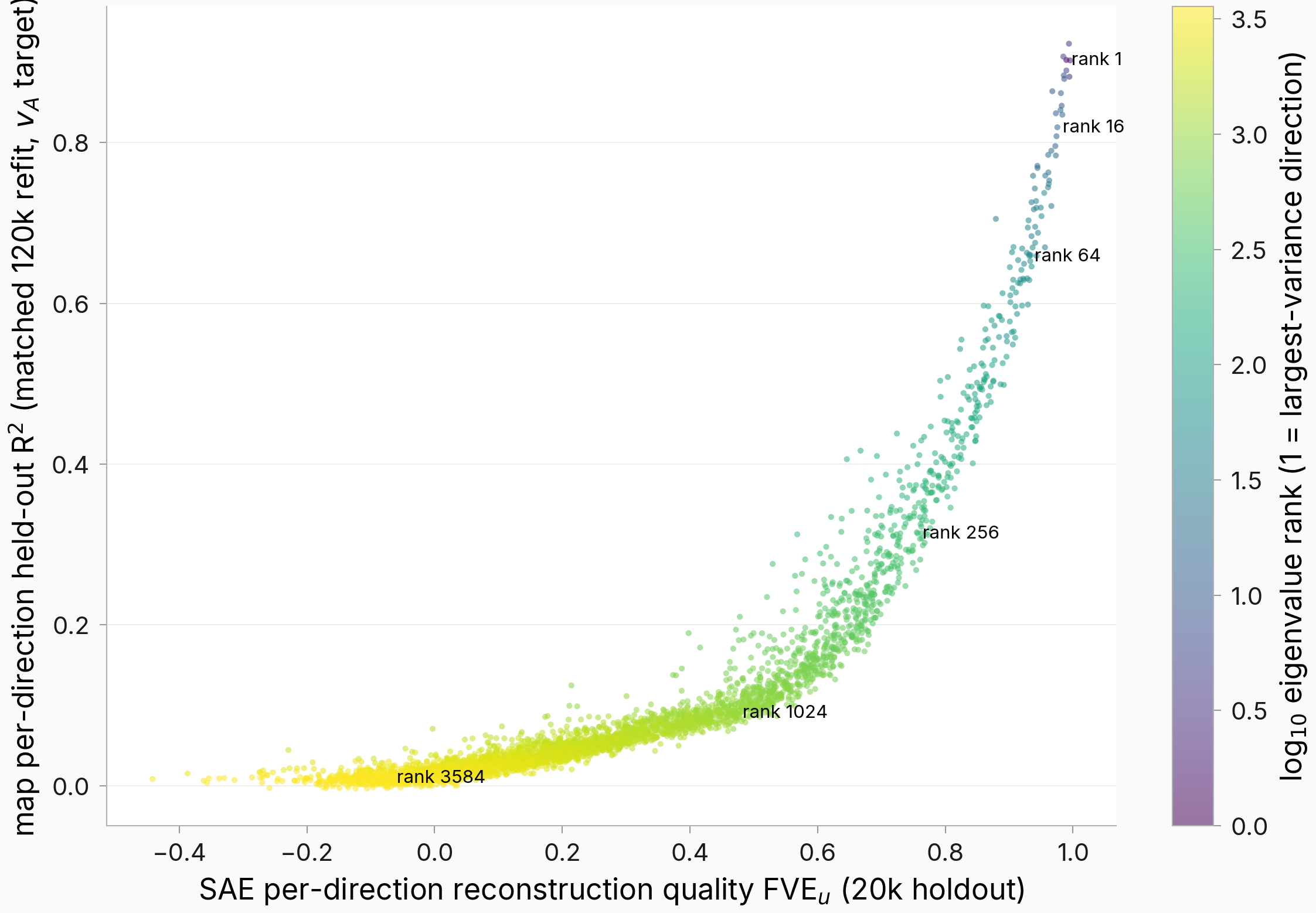
Figure. Map predictability and SAE reconstruction quality form one variance-ordered curve. The 3,584 directions form one tight monotone curve from rank 1 (top right) to rank 3,584 (bottom left); color encodes log eigenvalue rank.
The relation is tight (Spearman 0.97, n = 3,584) and rank-ordered by color: variance rank moves both quantities along one curve; this is the per-unit view behind the aggregate coincidence statistics above.
Beyond variance rank, the shared axis is small per-direction and absent per-feature
Within-decile Spearman correlations between map per-direction R² and SAE reconstruction quality — by eigenvalue decile (3,584 directions, left half) and activity decile (16,384 features, right half) — with variance-partialled correlations as dashed lines.

Figure. Stratified correlations decay with variance per-direction and vanish per-feature once known correlates are controlled. Per-direction decile correlations decay 0.94 → 0.10 with decreasing variance; per-feature activity-decile correlations sit flat at 0.26–0.37. Dashed lines: partial correlation 0.076 (direction grain) and −0.050 (feature grain).
Per-direction, the partial correlation given variance rank is 0.076 (interval 0.038 to 0.090; n = 3,584), and decile correlations decay from 0.94 to 0.10 — 9 of 10 pass the false-discovery screen, though variance gradients inside top deciles inflate them. The split-half control attenuates this partial to 0.030–0.068 cross-half vs 0.072–0.105 within-half: the full-holdout 0.076 carries mild construction-coupling inflation but stays positive when decoupled.
Per-feature (raw Spearman 0.25, n = 16,384), controlling variance rank, consistency, and activity leaves −0.050: reconstruction quality adds nothing beyond the known correlates; the residue is largely the variance axis re-measured. Estimation noise does not produce these reads: the parent run's banked 20-draw shuffle null puts the per-feature R² noise floor near −0.07 (per-activity-decile medians; 97.5th percentiles −0.05 to −0.04), far below the paired observed per-feature R² (median 0.15).
Repro: Compute: one A100-80 GCE instance (attempt att-20260801-012732), ~1.75 h wall / ~1.75 GPU-h, Path A (the conditional mask-matched capture never ran, by design); VM harvest + figures CPU-only. Code: run driver scripts/issue1895_subspaces.py @ 7c50b3c66560 (branch issue-1895); harvest re-reductions + figures scripts/issue1895_analysis_figures.py @ eb22508d64fe93ecb7538569d1020b129907e3d3. Committed eval JSONs: eval_results/issue_1895/ @ 42d831ec5b (run summaries), @ eb22508d64 (dark_spot_matched_rows.json, angle_spectrum_k64.json), and @ 31e93f7651 (splithalf_followup.json; script scripts/issue1895_splithalf_followup.py). Artifacts (HF data repo superkaiba1/explore-persona-space-data, listing verified this session): issue1895_subspaces/eval_results_issue_1895/ (all summaries, perdirection_profiles.npz, and the null_bands.npz per-draw matrices — 287 MB, git-uncommitted by size) and issue1895_subspaces/analysis_tensors/ (q_basis.npz, percontext_proj.npz, fve_profiles.npz, pilot/pilot_rows.npz, rbar/ store).
- Reused pooled SAE store from #1482: issue1482_error_analysis/analysis_tensors/sae_pooled (1,920 shards) — fit: k=64 codes under the reference mask, reconstruction-identity-verified on 512 pilot rows (median rel dev 2.4e-3).
- Reused capture chunks from #779:
issue779_monitoring/fitter-fair-comparison-n1m/final_token_capture@3d620298e7c1— fit: split shas + top-256 eigenvalues reproduced against committed anchors (run halts otherwise). - Reused banked per-direction profile from #1482: committed
eval_results/issue_1482/perdirection_pca.json@eb22508d64— fit: rank-correlates 0.9999 with this run's matched refit on the shared 256 directions. - Reused per-feature shuffle-null noise floor from #1482: committed
eval_results/issue_1482/sae_perfeature/shuffle_null.json+shuffle_null_perfeature.npz@43bbbbb0ed— fit: the null's paired observed cell (obs_r2) is the samesae_ctxmean-pooled ridge per-feature read this body quotes (median/mean match exactly); K = 20 draws. - Seeds: split inherited (sha-asserted); fit seed 0; angle-null/bootstrap seed 1895; matched-rows re-reduction seed 1902 (= run seed + 7, the driver's pilot-bootstrap convention).
- Follow-up round
pure-residual-path-b: compute 1× H100 RunPodpod-1895, ~4.6 h wall (a GCE FLEX_START A100 launch whose queued instance vanished auto-failed-over to RunPod per the queue-vanish policy; one crash-fix resume after a stale-read JSON decode error on a staged shard mid-capture). Driver @ea2b645d99eaonissue-1895with--force-path B(realized path B; the round'spilot_gate.jsonpathfield is G2b-derived, not the realized path). Round figures:scripts/issue1895_pure_residual_figures.py@1e0b8e25ac. Committed eval JSONs:eval_results/issue_1895/pure-residual-path-b/@b9da723f0a. HF (listing verified this session, 3,854 files): issue1895_subspaces/pure_residual_path_b/ —eval_results_issue_1895/(incl.null_bands.npz, 287 MB, HF-only) andanalysis_tensors/@04c0d41f4dd5(1,920-shard mask-matchedvmaskstore + 1,920-shardrbarstore, upload-verified 1920/1920).
Context: Parent lineage: #1482 — extends the parent's per-direction/per-feature predictability reads to the SAE-coincidence question. Origin (verbatim user prompt, chat 2026-07-30): "can we run these experiments: - Is what oir model able to reconstruct the same as what SAEs find - Map from continuous features to SAE features (or reconstructed activation)? Also compare to simple baselines with SAE featurs". Task created 2026-07-30; run completed 2026-08-01 (GCE att-20260801-012732); analyzer round 1 (HOLD mode) 2026-07-31/08-01; analyzer revision round 2 (interpretation-critic fixes: angle counts, MLP deltas, Path-A-trained-map caveat) 2026-08-01. The origin prompt's second bullet was largely banked before this run (see the task's Provenance table); this experiment ran the new pieces only: the subspace-coincidence battery, the reconstruction/residual targets, and the variance-partialled correlates. Free-analysis follow-up round (split-half re-derivation) run 2026-08-01 post-interpretation-PASS. Same-issue follow-up round pure-residual-path-b (source: proposer-9b-cheap, epm:followup-scope 2026-08-01T08:49Z; hypothesis verbatim: "The residual target's above-plug-in excess (+0.034) is entirely the answer-token-convention artifact (13.4% of residual energy): a map trained AND scored corpus-wide on the pure SAE error (mask-matched dense answer means minus pooled reconstruction) will read at or below its variance-profile plug-in"): run + fold 2026-08-01; confidence tag raised MODERATE → HIGH on the fold (the one contrary arm is now clean-measured at/below its variance profile).