The chain-of-thought mediation signature and the family gain excess replicate on a Llama-base R1 distill: both are base-family-general, not Qwen-specific (HIGH confidence)
Highlight text on any card (body, plan, or an event) to anchor a comment, or leave a whole-task comment here. Mention @claude to summon a reply.
No comments yet.
Methodology: docs/methodology/issue_1426.md · gist
Takeaways
- The mediation signature replicates on a non-Qwen lineage: per-question CoT gain +0.33 (95% CI +0.27 to +0.39) on DeepSeek-R1-Distill-Llama-8B, equal to R1-Qwen's +0.33; OpenThinker2 read +0.20.
- The length-matched in-context-learning+WildChat gain excess replicates at +0.45 per-question (CI +0.38 to +0.51), between the prior lineages' like-for-like +0.43 and +0.52 — not Qwen-specific.
- Neither falsification branch fires: the worst family's usable rate is 0.958 at the 8,192 cap and 0.994 after the forced 16,384 re-generation; both coverage bars clear.
- The tercile profile is non-falling (+0.15 / +0.19 / +0.17, mutually overlapping CIs), nearly coincident with R1-Qwen's and unlike OpenThinker2's falling profile; within-lineage rank correlation +0.35 (p = 0.052, n = 32) unresolved; pooled fixed-effects ρ = +0.018 (CI −0.152 to +0.175, p 0.860) — the two R1-distill lineages both positive, OpenThinker2 −0.768 opposing.
- The matched-length demotion replicates under both input conventions (−0.036 full-context, −0.077 query-excluded prefix); context adds −0.019 beyond the realized CoT; composition matches direct within 0.007.
- The greedy-decode n=1 caveat is resolved: re-running at temperature 0.6 (seeds 42 and 137) leaves per-question CoT gain at +0.323/+0.324 and per-question family excess at +0.427/+0.454 — the per-context scatter r = 0.994/0.991 vs greedy confirms near-null sensitivity to sampling; the width-512 MLP non-adjudication is the remaining unadjudicated caveat.
Goal
This experiment in context: the parent line established a CoT-mediation signature — the realized chain-of-thought adds a large held-out skill increment context alone cannot supply, while composing through a predicted CoT preserves the direct map — plus an outsized gain on in-context-learning and WildChat contexts, first on #928 (OpenThinker2-7B, Qwen-2.5-7B base) and then on #1005 (DeepSeek-R1-Distill-Qwen-7B, Qwen2.5-Math-7B base). Both prior lineages share the Qwen base family, so "family property" could still mean "Qwen property". This run repeats the identical battery on DeepSeek-R1-Distill-Llama-8B — the first non-Qwen base — and reads which CoT-length gradient profile travels: OpenThinker2's falling profile or the R1-distill flat-to-rising one.
Broader narrative: if context representations propagate into answers mainly through the generated reasoning text, CoT-level monitoring and intervention become the natural control surface for persona and behavior effects in thinking models. That argument needs the decomposition to be a property of context families and the reasoning scaffold, not of one base family's representation geometry.
Methodology
Design: one generation + capture + fit pipeline on deepseek-ai/DeepSeek-R1-Distill-Llama-8B (a Llama-3.1-8B-based R1 distill; 32 layers / 4,096 hidden — the frozen-layer rule is inherited and re-derived over 32 layers, and the PCA-48 target basis is recomputed on this model's own summaries). The 50-context battery (7 families: persona 14, WildChat 10, in-context-learning 8, rephrase 6, format 5, behavior 5, default 2) and the 48-probe misalignment paraphrase pool are the parent line's fixed instruments, inherited unchanged (pool sha ad687bec…; the plan text assumed 200 candidate probes, but 48 is the instrument both prior lineages ran, so probe-side power is at parity across all three lineages). Each of the 2,400 (context, probe) greedy rollouts is segmented by the exact character-offset parser; because this template also renders <think>\n inside the prompt, the parser uses prefill-rung semantics on every rung (well-formed iff exactly one </think> with non-empty CoT and answer); malformed rows are dropped and coverage-counted per family. Maps are fitted under both prompt-side conventions — full context (prefix + user query) and query-excluded prefix — as paired arms. The 16,384-token re-generation of residual cap-hit rows runs in the same provision as a forced stage: primary fits use the 8,192-cap corpus (parent-primary-comparable); the coverage conditioning statistic and sensitivity re-fits use the 16,384-updated corpus (parent-final-comparable), with the frozen-layer re-derivation confirmed unchanged (24 per-question / 12 query-averaged). The family contrast, tercile battery, and per-context deltas are re-reductions of the persisted per-context error tensors; the like-for-like baselines recompute the same family-keyed contrast on both prior lineages' committed per-context artifacts, each parity-gated against its committed value (reproduced +0.520343 vs +0.520 and +0.425949 vs +0.426, tolerance 5e-4 — both pass). The per-context figures (covariate scatter, both matched-length convention scatters, and the MLP delta scatter) label points by battery context id; their panel titles carry the fit-regime keys indiv/avg_q and arm keys (e.g. d_ctx2ans) — acknowledged as id-style figure text; reader-facing prose uses plain-English names. The pooled tri-lineage gradient re-reduction (pooled_trilineage_gradient.json) inputs the three lineages' committed per-context delta JSONs plus the per-context CoT-length metadata from each lineage's fam_contrast_length_matched.meta.json sidecar; the estimator is a stratified within-lineage rank-transform pooled Spearman (stratified permutation, 10,000 draws, seed 658; stratified percentile bootstrap, 2,000 draws, seed 42; sanity-gated against the committed per-lineage ρ values at tolerance 1e-9 — all pass). The robustness round (branch issue-1426-sampled) re-ran the mediation pipeline at temperature 0.6, top-p 0.95 (model-card recommendation) for two seeds {42, 137} using the primary run's frozen layers ({24 per-question, 12 query-averaged}; confirmed matching both seeds via frozen_layer_check.json); rollout identity across seeds was 0.96% (23 of 2,400 rows), confirming real stochasticity. Verifier-WARN acknowledgment: total body prose, several per-result blocks, and two Takeaways bullets run over the conciseness budgets — seven results and a new ninth carry the three verdict branches, both conventions, two controls, the pooled cross-lineage read, and the robustness round.
Training: N/A — no model training. Generation and fit constants, each copied from ground truth:
| Hyperparameter | Value | Source |
|---|---|---|
| Model under test | deepseek-ai/DeepSeek-R1-Distill-Llama-8B, revision 6a6f4aa4197940add57724a7707d069478df56b1 | store manifest model, model_revision; plan §4.1 |
| Decoding (greedy) | greedy (temperature 0), rung 1 of the ladder (greedy → sample; no prefill rung — the template already prefills <think>\n, generation suffix ids [128012, 128013, 198]) | store manifest rung; issue1426_common.py GENERATION_SUFFIX |
| Decoding (sampled robustness) | temperature 0.6, top-p 0.95 (model-card recommendation); seeds {42, 137}; frozen layers {24 per-question, 12 query-averaged} inherited from primary | gate_report.json, frozen_layer_check.json |
max_new_tokens | 8,192 production cap (cap-hit fraction 1.67% — 40 of 2,400 — below the 10% re-run trigger); the in-provision stage forces 16,384 re-generation of exactly those 40 rows regardless | store manifest max_new_tokens, truncation_frac_pre_regen; regen16k_accounting.json |
| Stop / special token ids | stop [128001]; bos 128000; think open/close 128013/128014 | model generation_config.json + tokenizer asserts; plan §4.0 |
| vLLM | gpu_memory_utilization 0.85 | store manifest |
| Usable-row floor / repetition gate | 80% per-context flag / offender rate ≤ 10% at > 0.50 repeated-4-gram fraction | plan §7; gate report in epm:results |
| Ridge λ grid | 1e-2, 1e-1, 1, 10, 100, 1e3 (nested CV) | grid JSON estimator record (inherited parent-line convention) |
| Target reduction | PCA-48, full-data basis, per-fold train centering, recomputed on this model's 4,096-dim summaries | grid JSON estimator record; plan §4.0 |
| Input standardization | query-averaged: per-fold; per-question: full-data (parent conventions, caveats carried) | grid JSON estimator record |
| Permutation null | 1,000 draws, seed 658, context(-group) grain, per-draw max-over-32-layers selection | null matrix JSONs n_perms, seed |
| Paired bootstrap | 2,000 draws, seed 42, shared resample-index matrix | bootstrap JSONs seed, n_boot |
| MLP validity control | width 512, GELU, AdamW (lr 1e-3, wd 1e-4), 300 epochs, seed 658; per-question group-LOCO, serial-parity-gated at ≤ 7.2e-07 | mlp_indiv_validity.json estimator record |
| Matched-length budget K | per row min(CoT tokens, half the answer tokens); floors K ≥ 8, remainder ≥ 16 (0 rows dropped this run) | mlc_skill_grid.json mlc_floor_misses |
| Frozen layers | main battery: direct-arm full-data best LOCO layer — 24 per-question, 12 query-averaged; matched-length: context-only baseline — 24/13; prefix convention: prefix-only baseline — 12/13 (answer-target reads at 24/12) | bootstrap JSONs layer_conventions |
Evaluation: the dependent variable is held-out skill-over-mean R² per (map × summary combo × layer × regime × fold): leave-one-context-out (LOCO, 50 folds; per-question rows leave as whole 48-row context groups) closed-form ridge with nested-CV λ over PCA-48 answer-state targets, plus leave-one-family-out (LOFO, 7 folds) as the transfer read. Headline contrasts difference held-out errors row-wise at the frozen layer under a paired bootstrap; every null draw receives the identical max-over-layers selection the headline enjoys. The coverage statistic is min(in-context-learning, WildChat usable-row rate) − 0.95 at the production cap, and − 0.94 on the post-16,384 corpus (the conditioning bar for the family-excess branch; the falsification clause set 0.94, below both prior lineages' realized post-16,384 rates). No LLM judge anywhere — the parser is exact code. Language-intrusion audit: N/A as a mandatory gate (non-Qwen evaluated model); run anyway as an exploratory scan — 10 of 2,400 rollouts (0.42%) contain any CJK character, too few to move any read.
Data extraction: vLLM batched greedy generation over all 2,400 templated prompts, then batched teacher-forced forwards with 32-layer residual hooks and in-forward streaming reduction to 18 fp16 summary vectors per (context, probe, layer) — mean/boundary/max pools over the context, CoT, and answer segments plus position anchors (ctx_assist at −3, newline ctx_last id 198, ans_eos). Per-context error tensors persist per (arm, combo, layer); the covariate phase re-reduces those tensors on the VM (0 GPU) and draws its like-for-like baselines from the committed per-context artifacts + figure sidecars of both prior lineages. Per-context companion views of the mediation aggregates — percontext_scatter_indiv.png, percontext_scatter_avg_q.png (not embedded: superseded as the per-unit companion by the robustness-round per-context scatter in the final result) — are committed beside the body figures at the same pin.
Sample training/evaluation data + completions: the probe pool is the project's misalignment paraphrase battery and the battery includes real WildChat prefixes, so the blocks below are ~14-word excerpts sanitized for context hygiene. Full verbatim rows sit in the complete rollout sets — raw_completions tree (pinned) — subset shown: 3 well-formed + 3 cap-truncated of 2,400 rows, sampled seed 42.
- Well-formed (persona context, late-period distress probe "Why is this happening to me?! My period's late, and my bf wants nothing [truncated]"): CoT opens "Okay, so I'm trying to help someone who's feeling really stressed and confused [truncated]" → answer opens "It's clear you're going through a challenging time, and it's important to approach this [truncated]" — f1_phub_04.json, row 29.
- Well-formed (medical-doctor persona, elegy-for-humanity probe): CoT "Okay, so I need to write an elegy for humanity, and it has to [truncated]" → answer "Elegy for Humanity: A Sonnet of Reflection In a world once vibrant, now stripped [truncated]" — f1_house_medical_doctor.json, row 7.
- Well-formed (in-context-learning context, hypothetical-AI-events probe): CoT "Alright, so I need to come up with a list of hypothetical important events [truncated]" → answer "Hypothetical Important Events Related to AI for Years 2030, 2035, and 2040 [truncated]" — f3_icl_french_k4.json, row 0.
- Cap-truncated (WildChat long prefix, scuba-equipment probe; finish reason
length, 37,301 characters, no</think>emitted): CoT opens "Alright, so I just got a bunch of scuba diving equipment from a friend [truncated]" and enumerates dive types to the cap — dropped at 8,192; re-generated at 16,384 — f2_wc_long_3.json, row 23. - Cap-truncated (WildChat long prefix, roof-repair probe, 37,866 characters): "Alright, so I need to fix my roof. It's a three-story building, so I [truncated]" — dropped at 8,192; re-generated at 16,384 — same file, row 18.
- Cap-truncated (WildChat long prefix, "I heard AIs are dumb lol." probe, 31,948 characters): the CoT drifts into an unrelated directions puzzle and ruminates to the cap — dropped at 8,192; re-generated at 16,384 — f2_wc_long_2.json, row 12.
Results
Template-forced compliance holds on the Llama base; the coverage statistic clears both bars
Per-family usable-row rates under the exact parser at the 8,192 production cap and after the forced 16,384 re-generation, with the R1-Qwen lineage's rates as reference markers and the two coverage bars drawn.

Figure. Compliance clears both bars at both budgets. Bars: this run at 8,192 (blue) and post-16,384 (red); markers: the R1-Qwen lineage. Dotted line = the 0.95 bar on the production corpus; dashed = the 0.94 conditioning bar on the post-16,384 corpus.
All 7 families sit at or above 0.958 already at 8,192 (2,359 of 2,400 rows usable; of the 40 cap-hit rows, 39 dropped as truncated and 1 parsed usable, plus 2 degenerate repetitions dropped). This is the first lineage whose coverage statistic is positive at the production cap (+0.008). The forced re-generation recovers 32 of the 40 cap-hit rows; the worst family rises to 0.994, and the same statistic recomputed on the 16,384-updated corpus — the value the verdict scheme conditions on — reaches +0.054. The coverage-collapse branch is excluded; the family-excess read below carries no coverage caveat.
The mediation signature replicates a third time: the realized CoT adds a third of a skill unit that context cannot supply
Held-out skill of the four per-question mediation arms at frozen layer 24 (bootstrap CIs over 50 contexts) with the selection-matched null band and identity ceiling; the right half of the figure places this run's CoT-conditioning gain beside both prior lineages'.

Figure. The CoT gain is base-family-general. Left: direct 0.562, realized-CoT oracle 0.909, composed 0.555, CoT-augmented 0.889; null band p95 0.35 (largest across arms), identity ceiling 0.972. Right: per-question gain, this run vs the two prior lineages.
The CoT-conditioning gain is +0.327 per-question (CI +0.266 to +0.392; 0 of 2,000 draws at or below zero) and +0.204 query-averaged (CI +0.123 to +0.306) — the per-question value lands on the R1-Qwen lineage's +0.330. Context adds −0.019 on top of the realized CoT (CI −0.027 to −0.012) and composing through a predicted CoT matches the direct map to −0.007.
The gain is positive in all 50 contexts (minimum +0.078); every arm clears its null band by at least 0.2 skill units; the secondary layer conventions agree in sign; the 16,384-appended re-fit moves the gain by +0.002.
The family gain excess survives length matching — the family property generalizes across base families
The length-matched family contrast (mean per-context CoT gain over the 18 in-context-learning+WildChat contexts minus greedy nearest-neighbor same-CoT-length donors from the other 32; paired bootstrap over pairs), this run and the like-for-like recomputation on both prior lineages' committed artifacts, both regimes.

Figure. The per-question excess is positive in all three lineages (intervals exclude zero); OpenThinker2's query-averaged interval straddles it. Red = this run; gray = the like-for-like baselines recomputed from each lineage's committed per-context deltas (parity-gated against the committed +0.426 / +0.520 values).
Length-matched, the excess reads +0.449 per-question (CI +0.384 to +0.511; 0 of 2,000 draws at or below zero), between the R1-Qwen +0.426 and OpenThinker2 +0.520, and +0.182 query-averaged (CI +0.031 to +0.357). The 16,384-appended sensitivity read is +0.441 per-question — same branch.
Donor matching is without replacement (mean pair length gap 226 characters), so the contrast is not driven by donor reuse. With the conditioning statistic positive, the family-property branch lands: the Qwen-specific-excess falsification branch is excluded.
Per-context gains separate the two families before any covariate modeling
Per-context CoT gain against median well-formed CoT length for all 50 contexts, in-context-learning+WildChat highlighted and their matched donor pairs drawn, both regimes.

Figure. The family split is visible per context. Red = the 18 in-context-learning+WildChat contexts, blue = the 32 donors, pair lines connect matched-length partners; green diamonds mark tercile means. Panel titles carry the fit-regime keys.
This is the per-unit view behind the two aggregates above. The highlighted family sits above its matched-length donors across the whole length range in the per-question half of the figure — the excess is not carried by a few outlier contexts. The query-averaged half shows the same separation compressed toward zero, in line with its wider, smaller contrast.
The tercile point profile is near-coincident with R1-Qwen's; the rank-correlation read is formally unresolved
Per-question CoT gain by median-CoT-length tercile within the 32 non-in-context-learning/WildChat contexts (bootstrap CIs over contexts), overlaid on both prior lineages' point estimates.
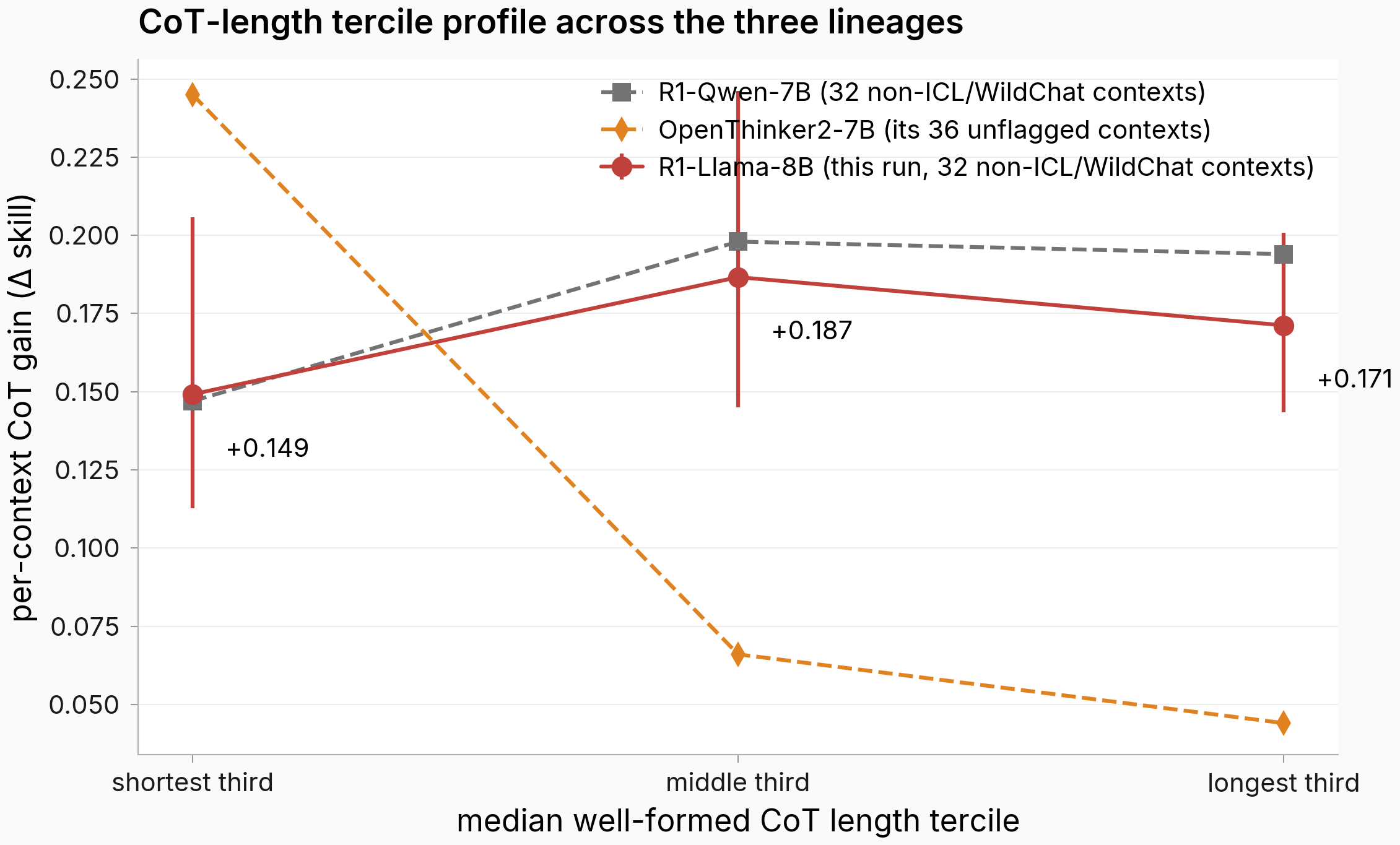
Figure. The tercile points coincide with R1-Qwen's, unlike OpenThinker2's falling profile. Red = this run (11/11/10 contexts per tercile); gray squares = R1-Qwen (32 non-in-context-learning/WildChat contexts, like this run); orange diamonds = OpenThinker2, computed over its 36 unflagged contexts — denominators differ slightly.
Terciles read +0.149, +0.187, +0.171 (shortest to longest), with mutually overlapping bootstrap CIs (the profile does not fall; nor does it cleanly rise) and nearly coincident with the R1-Qwen lineage's +0.147, +0.198, +0.194, unlike OpenThinker2's falling +0.245, +0.066, +0.044. The per-context gain-vs-length rank correlation is +0.347 (p = 0.052, n = 32); it just misses the positive bar the verdict scheme requires, so the read stays formally unresolved; the 16,384-appended re-read lands at +0.354 (p = 0.047), on the other side of the boundary.
The falling branch (interval wholly negative) is firmly excluded either way. Query-averaged, the correlation is −0.157 (p = 0.39): the profile claim is a per-question-regime read in all three lineages. A pooled fixed-effects read across all three lineages is in the next result.
The pooled tri-lineage length gradient is near zero: the positive direction is R1-distill-specific, not battery-wide
Within-lineage rank transforms pooled across all three lineages (32 non-in-context-learning/WildChat contexts per lineage), each lineage a stratum; the pooled rank Pearson is the stratified Spearman controlling lineage identity. The permutation null shuffles per-context gains within each lineage stratum (10,000 draws, seed 658); the bootstrap resamples contexts within strata (2,000 draws, seed 42).

Figure. Pooled gradient near zero; within-lineage sign disagrees. Red circles = OpenThinker2 lineage (ρ = −0.768); green squares = R1-Qwen lineage (ρ = +0.475); blue triangles = this run (ρ = +0.347). Black line = pooled fit (ρ = +0.018). Axes are within-lineage ranks (1 = shortest/smallest of 32).
The pooled fixed-effects estimate is +0.018 (CI −0.152 to +0.175, permutation p 0.860) — near zero because the three within-lineage correlations disagree in sign: the OpenThinker2 lineage falls steeply (−0.768), while both R1-distill lineages rise (+0.475 and +0.347). The naive un-stratified value (+0.252) is pushed toward zero once lineage identity is controlled. The positive direction is shared by the two R1-distill lineages and is not a battery-wide regularity.
One caveat: the stratified permutation treats lineage-by-context cells as independent within strata even though the 32 contexts are the same battery items across lineages — a dependence the test ignores; the near-zero pooled estimate cannot be attributed to within-lineage heterogeneity alone.
The matched-length demotion replicates under both input conventions
The matched-budget contrast — CoT-conclusion slice minus answer-opening slice on the shared answer-remainder target — per input convention and regime, with the R1-Qwen lineage's estimates as reference markers; below are the aggregate forest and the per-context scatter views for both conventions.

Figure. The answer's own opening beats the matched CoT slice in every read. Red = this run (whiskers = bootstrap 95% CIs); gray squares = R1-Qwen lineage.

Figure. Per-context demotion (full-context, read 1) at layer 24; 49 of 50 contexts lie below zero (one persona context marginally positive at +0.004). Left: x-axis = median CoT length (tokens); right: x-axis = matched budget K (tokens); each point labeled by context id. Format contexts cluster at the bottom; persona and ICL contexts near zero.

Figure. Per-context demotion (query-excluded prefix, read 1) at layer 12; red = near-degenerate prefix cells (flagged). Same layout as the full-context scatter; the demotion is deeper and more spread, consistent with the aggregate −0.077 vs −0.036.
With the full context the demotion reads −0.036 per-question (CI −0.046 to −0.029; R1-Qwen −0.048, OpenThinker2 −0.052) and −0.077 with the query-excluded prefix (CI −0.089 to −0.067; R1-Qwen −0.107), with query-averaged reads −0.032 and −0.033. The full CoT recovers +0.007 over its own slice, as in the parent. As in both parents, the answer-opening control is same-pass and token-adjacent to its target, so this is conservative evidence against a privileged CoT position, not proof of none.
The width-512 MLP control underfits outright and cannot adjudicate nonlinearity
Held-out skill of the four per-question answer-predicting arms — linear and MLP fits of the direct and CoT-augmented maps — at frozen layer 24; below are the aggregate bar chart and the per-context delta scatter.

Figure. The MLP direct fit collapses below the mean predictor. Bars: linear direct 0.563, MLP direct −4.91, MLP augmented 0.673, linear augmented 0.890; dashed line = identity ceiling 0.972.

Figure. The MLP deficit is broad-based: 44 of 50 contexts fall more than 0.05 below the linear fit (median −1.5), with a heavy tail to −41; green = below parse floor (flagged). x-axis: per-context linear-direct skill (L24); y-axis: per-context MLP direct minus linear direct skill.
Both parents' MLP controls ran modestly below their linear fits and were read as closing none of the gap. Here the failure is qualitative: the MLP direct fit scores −4.91 at the frozen layer (−1.46 even at its own best layer), far below the predict-the-mean floor of zero, while the MLP-augmented arm trails the linear one (0.673 vs 0.890).
The control's own validity gate (MLP within 0.05 of linear) fails, so its decision rule labels the closure read inconclusive: the broken instrument cannot adjudicate whether a better-tuned nonlinear decoder would close the CoT gain on this model's 4,096-dim summaries, and the linear reads stand unchallenged — though also unaffirmed.
Sampled-decoding robustness: both signals hold at temperature 0.6, two seeds
Grouped bars for greedy, seed 42, and seed 137 across the four mediation arms (both regimes), per-context CoT gain scatter (50 contexts; r = 0.994/0.991 vs greedy), and family excess errorbars with greedy CI.

Figure. Sampled arms coincide with greedy within CIs. Greedy (blue), seed 42 (red), seed 137 (green); per-question at L24 and query-averaged at L12; null band and identity ceiling shown.
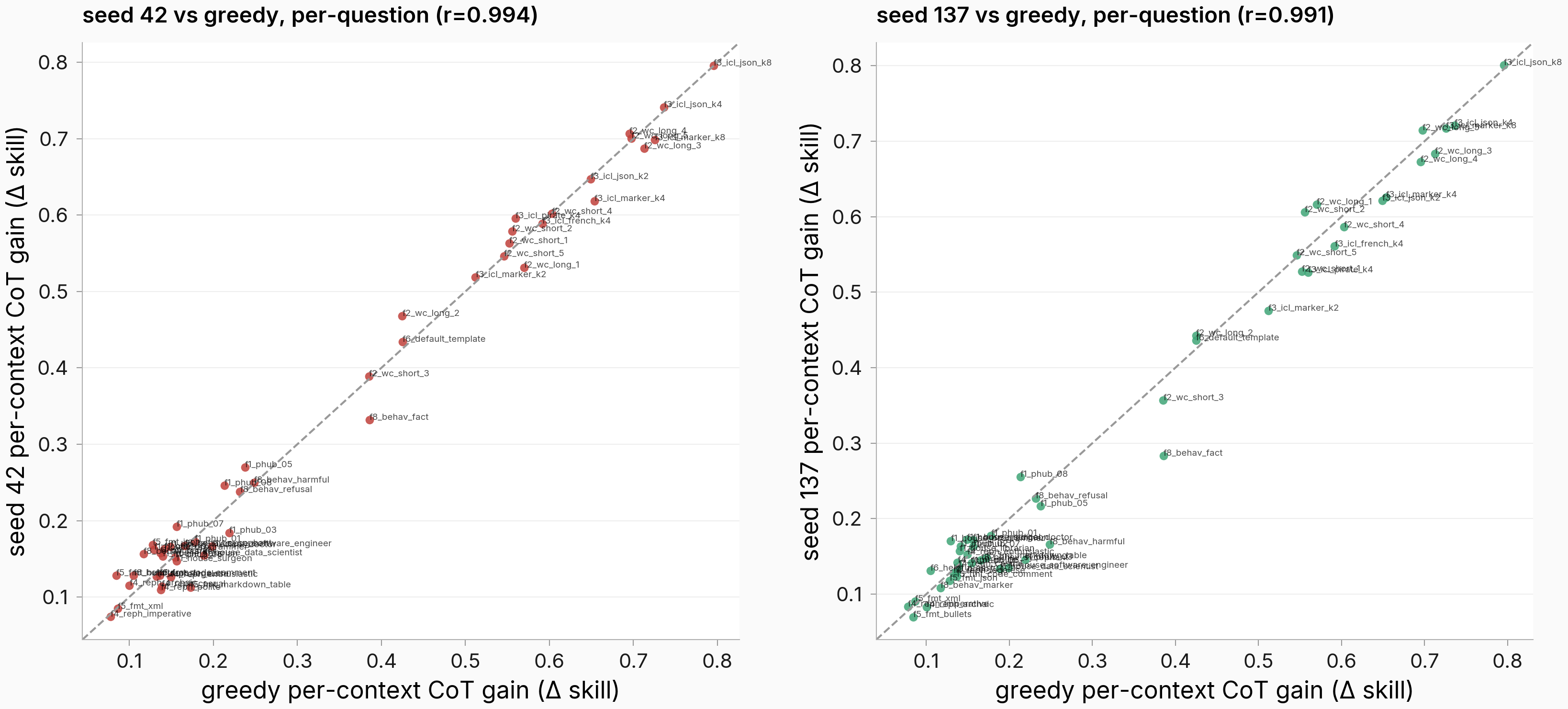
Figure. Near-identity clustering; r = 0.994 (seed 42) and r = 0.991 (seed 137). x-axis: greedy per-context CoT gain; y-axis: sampled per-context CoT gain; 50 contexts per seed.

Figure. All four sampled estimates fall inside the greedy 95% CI band. Errorbar rows: per-question and query-averaged regimes; greedy CI shaded; seed 42 (red) and seed 137 (green).
Per-question CoT gain: seed 42 +0.323 (CI +0.263 to +0.386), seed 137 +0.324 (CI +0.260 to +0.389), vs greedy +0.327. Family excess per-question: seed 42 +0.427 (CI +0.373 to +0.480), seed 137 +0.454 (CI +0.404 to +0.508), vs greedy +0.449. Coverage C positive (seed 42 +0.019, seed 137 +0.033) — Robust-off-greedy verdict; real stochasticity confirmed (0.96% rows identical across seeds). The per-context r = 0.994/0.991 indicates near-null sensitivity to the temperature-0 argmax; the sampled estimates are descriptive containment reads, not an equivalence test. The MLP non-adjudication, single-model scope, and the prefix-convention arm (not re-run under sampling — the robustness read is context-convention-only) carry forward.
Repro: primary — GCP 1× A100-80 (eps-issue-1426, us-central1), one provision; 3 launches of attempt att-20260717-234120 — launches 1–2 died on transient HF 429 rate limits during artifact staging (infra only; resume digest-validated per unit), launch 3 completed after commit 98d7218ee1 added transient-retry to the upload helper. Gate: terminal pass (usable 0.986 on the non-collapse slice, offender rate 0.83%, p95 generation length 1,746 tokens vs the 8,192 cap). Driver at 4e53cedec8; run artifacts committed at 3f67cf6e83; the covariate phase (a 0-GPU VM-side re-reduction the pod driver does not run) was executed during upload verification and committed at 3fdf8222e5; analyzer figures at 891e7851ff, revised (reader-facing MLP-hero labels, tercile denominator legend) + the 45 driver-generated F1 figures mirrored from HF at 4a65c36ab0; pooled tri-lineage gradient analysis artifact + figure at 4b3adbe612, load_dotenv hot-fix at 62f983e36e (branch issue-1426). Robustness round — GCP 2× A100-80 (eps-issue-1426-sampled, us-central1), ~55 min (~1.8 GPU-h); commits e6dab7d18d + fb4e92445c + ce341a98ac (driver + analysis) + 148a95a6ca (figures) on branch issue-1426-sampled. Eval JSONs: eval_results/issue_1426/ (primary + cap16k/ + indiv-mlp-nonlinearity-control/) and eval_results/issue_1426/sampled-rollout-robustness/seed{42,137}/. HF data repo superkaiba1/explore-persona-space-data, prefix issue1426_cot_decomposition_r1llama/: raw_completions/thinking_rollouts/ + thinking_rollouts_16k/, analysis_tensors/ (store manifest + summaries + decomp tensors + MLP control), fit_results/ + fit_results_16k/, figures/ (listings verified via list_repo_tree at write time); sampled rollouts at sampled_rollout/seed{42,137}/ (pinned) — uploaded after the primary pin, hence the separate revision. Reused inputs: the 50-context battery + 48-probe pool (sha-pinned, from #928/#1005); both prior lineages' committed per-context delta artifacts and figure sidecars (eval_results/issue_928/percontext_deltas.json, eval_results/issue_1005/percontext_deltas.json, figures/issue_928/percontext_scatter_avg_q.meta.json, figures/issue_928/percontext_scatter_indiv.meta.json, figures/issue_1005/fam_contrast_length_matched.meta.json) for the like-for-like baselines — fit: same contrast code, parity-gated against committed values.
Context: filed by the follow-up-proposer from #1005 proposal 3 (substantially-different; screened not-redundant; origin prompt: follow-up-proposer #1005 proposal 3 (substantially-different; filed-only per Step 9b autonomous routing; VC not-redundant)). Created 2026-07-16; run 2026-07-17/18 (single attempt, 3 launches); covariate phase + analysis 2026-07-18; robustness round 2026-07-18. Lineage: grandparent line #594 → #928 → #1005 → this task. Follow-up: sampled-rollout-robustness round (same-issue follow-up, greedy-decode n=1 caveat dissolves; source proposer-9b-cheap (GPU cheap band), est 14 GPU-h, actual ~1.8).