A single greedy answer is an adequate stand-in for 10-rollout-averaged answer targets in the context→answer map (MODERATE confidence)
Highlight text on any card (body, plan, or an event) to anchor a comment, or leave a whole-task comment here. Mention @claude to summon a reply.
No comments yet.
Methodology: docs/methodology/issue_1073.md · gist
Takeaways
- Across all layers at n = 5,000, greedy answers sit at least as close to the 10-rollout average as a typical stochastic draw (symmetric Δ median +0.001 to +0.004, CIs excluding 0). 27–32% of contexts move the other way — aggregate adequacy, not per-context safety.
- 10-rollout-averaged targets fit best (held-out R² 0.67–0.77, validation-selected ridge); greedy and single-stochastic trail by 0.046–0.078: past the registered ±0.07 band on the layer-14 cross-validated surface (0.076/0.078), inside it on the validation-selected surface, and within 0.009 of each other in healthy (non-degenerate) cells.
- No monitoring cell flips its raw-vs-map verdict between greedy- and averaged-target maps (flip probability at most 0.10, joint resample; with 4–8 conditions per cell the read has low power, so this is failure-to-reject).
- The negative pooled R² cells co-occur with per-fold cross-validation λ collapse on noise-reduced targets (36 of 38 degenerate fold picks across all 28 layers are the 10-average arm, last-token input), consistent with the estimator pathology the parent's fitter comparison documented at n ≈ H; no headline rests on a degenerate cell.
- Greedy responses run slightly shorter (median 198 vs 207 tokens, truncation 6.3% vs 5.9%); the adequacy effect is point-estimate positive in every length tercile (no per-tercile CI; long-tercile margin near zero) and sign-robust under worst-case exact- and near-duplicate exclusion.
Goal
- This experiment in context: The parent context→answer map (#779) predicts a model's answer-side activation profile from its pre-generation context activation, built on single stochastic rollouts; its 10-rollout-averaged variant existed only on a different corpus, and no greedy (temperature 0) arm existed anywhere on this substrate. This experiment holds everything at the parent recipe and varies one thing: the decoding regime of the answer that defines the target (single greedy vs single stochastic vs 10-rollout-averaged). The question is adequacy — whether greedy targets can stand in for rollout-averaged ones (theory-plan items C11/C12). The prefix-based mapping arm is realized as the degenerate constant-input floor this substrate forces.
- Broader narrative: The project's context→answer-map line asks whether a cheap pre-generation read of the model's state predicts what the model is about to express. Every planned theory test aligns activations and behavior on one deterministic answer; if that choice distorted the map or its monitoring reads, the whole measurement convention would need a redesign. This experiment answers the aggregate-map question on the validation-selected surface for this substrate (single split, no CI); the GCV-surface convention branch, per-context safety, and the low-power monitoring read stay open.
Methodology
- Design: 3 decode arms × 2 mapping inputs × 28 layers on one substrate (Qwen2.5-7B-Instruct, 5,000 single-turn real user prompts from LMSYS-chat-1m, tier-1 real-world data). Single manipulated variable: the decoding regime of the answer-side rollout that defines the map target. Arms: a fresh 10-rollout average; a fresh single greedy decode; the parent's persisted single stochastic draw, reused verbatim; plus a fresh single stochastic draw as a continuity control, a leave-one-rollout-out jackknife band, a mean-target floor (which also realizes the degenerate prefix-based mapping arm — the prefix is the constant 98-character default system block, identical across all 5,000 contexts), and a shuffled-pairing null. A registered probe fixed the headline single-stochastic arm before results were seen: the reproduction probe landed branch (i) — RNG reproduction of the parent draws at median cosine 0.998 over 20 contexts (bar 0.99; a minority of probe rows diverge into the fresh-draw band, so reproduction is at-median, not row-exact) — so the parent draw carries the headline and the fresh draw is continuity-only. Common kept set: 5,000 of 5,000 (0 drops).
- Training: N/A — no model training. Complete generation / capture / fit hyperparameters:
| Hyperparameter | Value | Source |
|---|---|---|
| Model | Qwen/Qwen2.5-7B-Instruct, bf16 | scripts/issue1073_common.py @ c0621177 |
| Greedy decode | n=1, temperature 0.0, max_tokens 1024 | issue1073_common.py:67 (SP_GREEDY); theory plan C11 |
| Stochastic decode (single / 10-rollout) | n=1 / n=10, temperature 1.0, top_p 0.95, max_tokens 1024, seed 42 | issue1073_common.py:65-66; parent convention issue779_collect.py:558 |
| Contexts | first 5,000 first-user-turn LMSYS prompts (prompt-list sha16 b45816298923e17a) | parent pass-B bundle, HF revision 037fcbb2 |
Context input c_x | last-prompt-token residual activation at the generation slot (suffix assert <|im_start|>assistant\n); mean-prompt variant exploratory | parent capture definition, issue779_collect.py |
Target v(x) | mean residual activation over the teacher-forced response span, all 28 layers | parent capture definition |
| Capture | batched teacher-forced forward, batch 16, fp16 per-rollout store; batch-1 equivalence gate cosine ≥ 0.999 (observed min 0.99985) | issue1073_capture.py; P0 gate |
| Primary fit | ridge with per-fold GCV λ, grid logspace(−2, 4, 13), standardize-X / center-Y, 5-fold, fold seed 42, duplicate-clustered folds | issue1073_fits.py; grid issue779_fitter_fair_comparison.py:139 |
| Robustness fit | validation-selected λ, 3600/400/1000 train/val/test split, seed 42 | fitter-fair-comparison D1 recipe |
| Reproduction gate | fold seed 0 (the parent reference partition), tolerance ±0.02 R² | percontext_recon.json reference |
| Bootstrap | 1,000 context resamples, seed 0, percentile 95% CIs; pooled R² recomputed as 1 − ΣSSE/ΣSST inside each draw | issue1073_common.py:74-75 |
| Read-out layers | frozen from parent: evil 14/26, sycophancy 26/26, hallucination 17/27, plus layer 19 | parent step0 selection (no fresh layer search) |
| Judge (reused scores only) | claude-sonnet-4-5-20250929, graded 0–100, N=5 draws, drop-never-coerce; 0 new judge calls | parent eval-rig JSONs |
- Evaluation: Four registered reads (these plus the estimator-pathology diagnostic and the per-tercile sensitivity carry the six result sections). (1) Map quality per arm: held-out pooled R² (test-own-mean denominator) + mean per-context cosine of a ridge map from
c_xto each arm's target, per layer. (2) Target agreement: per-context cosine between arm targets; greedy adequacy = the symmetric matched-reference statistic Δ_ctx = mean_j cos(greedy target, leave-one-out 9-mean) − mean_j cos(draw j, the same 9-means), so both sides face identical reference noise. (3) Monitoring transfer: the map fit per arm on the 5,000-prompt corpus, applied to the persisted trait-eval contexts (3 traits × system-prompt/many-shot modes). The read-out scalar is the projection of the map-predicted answer activation — or, for the raw-projection reference, of the raw last-prompt-token context activation — onto the trait's persona-vector direction at the frozen read-out layer; that scalar is Pearson-correlated with the reused graded judge scores within each condition. The directions come from the parent's persona-vectors extraction — per-layer mean-difference of judge-filtered trait-positive vs trait-negative on-policy rollouts under contrastive system prompts — and are reused frozen. A condition is one graded strength setting of the trait-inducing context: 8 system-prompt and 5 many-shot settings per trait, the many-shot settings prepending {0,5,10,15,20} trait-exhibiting exemplar exchanges per the Persona-Vectors many-shot protocol; cross-arm differences use one shared condition-resample index matrix so common sampling noise cancels; the flip criterion asks whether the greedy-target map reverses any cell's map-vs-raw-projection verdict relative to the averaged-target map. (4) Regime descriptives: response length + truncation per arm. Interpretation band for arm gaps: ±0.07 — the parent's target-multiplicity level shift measured on monitoring-r levels on the trait corpus (an analogy, not a same-quantity calibration); falsification at a 0.15 gap with CI excluding 0.07. - Data extraction: Contexts rendered with the default chat template (no system message ⇒ constant default prefix). Greedy: one decode per context (vLLM, chunk 500). Stochastic: 10 rollouts per context, seed 42. All rollout text persisted to the data repo before capture; per-rollout activation tensors persisted fp16. Exact-duplicate prompts (string-normalized): 4,596 clusters / 5,000 rows, 477 rows (9.5%) in multi-row clusters, largest cluster 89 — all copies share a fold in every science fit.
- Sample training/evaluation data + completions: 5 of 5,000 rows, random sample (seed 42), metadata only — sanitized for context hygiene: the corpus is real LMSYS user prompts and carries jailbreak/explicit rows, so no prompt/completion text is inlined; full text lives in the complete artifact at raw_completions/greedy.
ci=912   greedy n_tokens=2    finish=stop  [truncated — sanitized row; verify at raw_completions/greedy/greedy.shard000.json, ci 912]
ci=204   greedy n_tokens=23   finish=stop  [truncated — sanitized row; same file, ci 204]
ci=2253  greedy n_tokens=622  finish=stop  [truncated — sanitized row; same file, ci 2253]
ci=2006  greedy n_tokens=19   finish=stop  [truncated — sanitized row; same file, ci 2006]
ci=1828  greedy n_tokens=33   finish=stop  [truncated — sanitized row; same file, ci 1828]
Full artifact: raw_completions/greedy (5,000 records; shard-level finish reasons 4,684 stop / 316 length, 0 empty).
Results
The 10-rollout average fits best; greedy and single-stochastic tie within a hundredth
What is plotted: left — held-out R² of the context→answer map per read-out layer and target regime, validation-selected-λ surface (black diamonds: the GCV primary at layer 14, its only fully-healthy read-out layer), n = 5,000. Right — monitoring within-condition Pearson r per trait×mode cell, bootstrap CIs, raw persona-vector projection dashed.
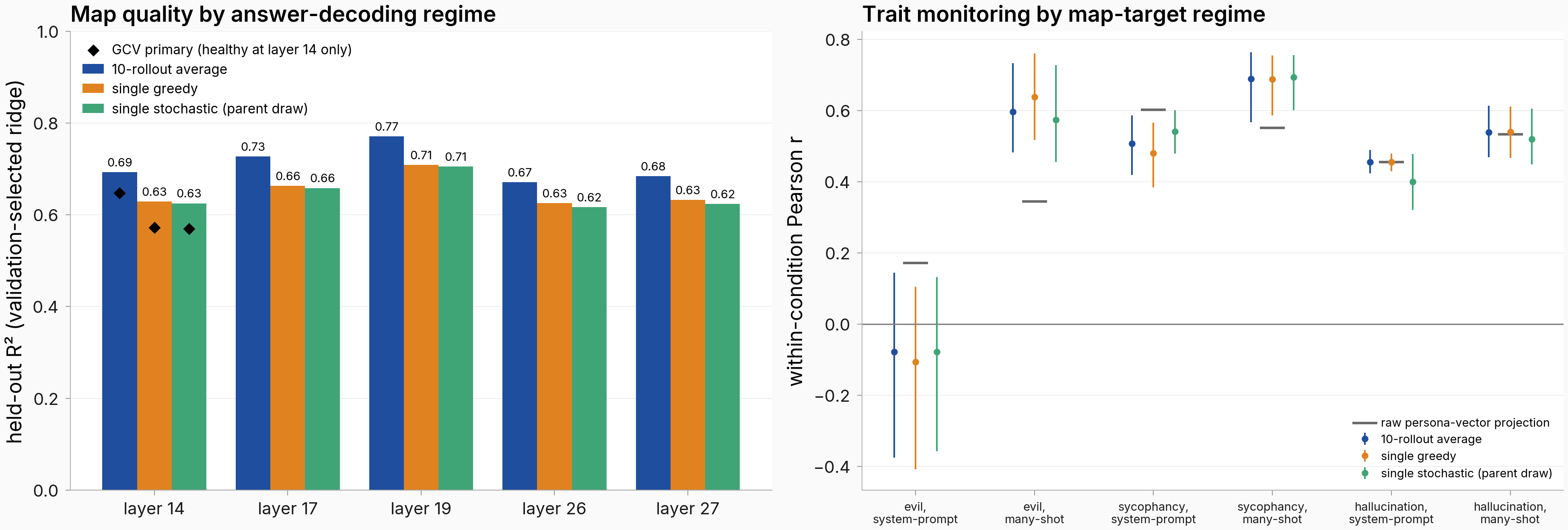
Figure. Decoding regime barely moves the map. Left: 10-rollout-averaged targets fit best at every layer (0.67–0.77); greedy and single-stochastic sit 0.046–0.078 lower (surface-dependent) and within 0.009 of each other. Right: monitoring correlations overlap across arms in all six trait×mode cells; n = 5,000 contexts, 4–8 conditions per cell. Per-unit companions: the per-fold view (estimator-pathology result) and the per-condition points (monitoring result).
Layer-14 GCV gaps to the average, 0.076 (greedy) and 0.078 (stochastic), carry CIs excluding 0.07: the plan's revise-the-convention branch fires on that surface (band exceeded by 0.006–0.008). The degeneracy evidence below leaves these gap cells untouched, so the breach stands there. The validation-selected surface supports adequacy (largest gap 0.069; single split, no CI); nothing nears the 0.15 falsification bar.
The decisive comparison ties: the paired layer-14 bootstrap spans zero (+0.002; −0.001 to +0.005); near-duplicate dedup flips its sign (−0.0025, CI still spanning zero), so the small greedy edge lives in the duplicate mass. The supported claim is adequacy relative to the parent's single-draw convention.
The negative pooled R² cells track per-fold regularization collapse on noise-reduced targets
What is plotted: per-fold held-out R² of the GCV-primary fit, four target arms × five read-out layers (5 folds each). Circles: healthy ridge penalty (λ ≥ 316); crosses: collapsed to the grid floor (λ ≤ 0.032).
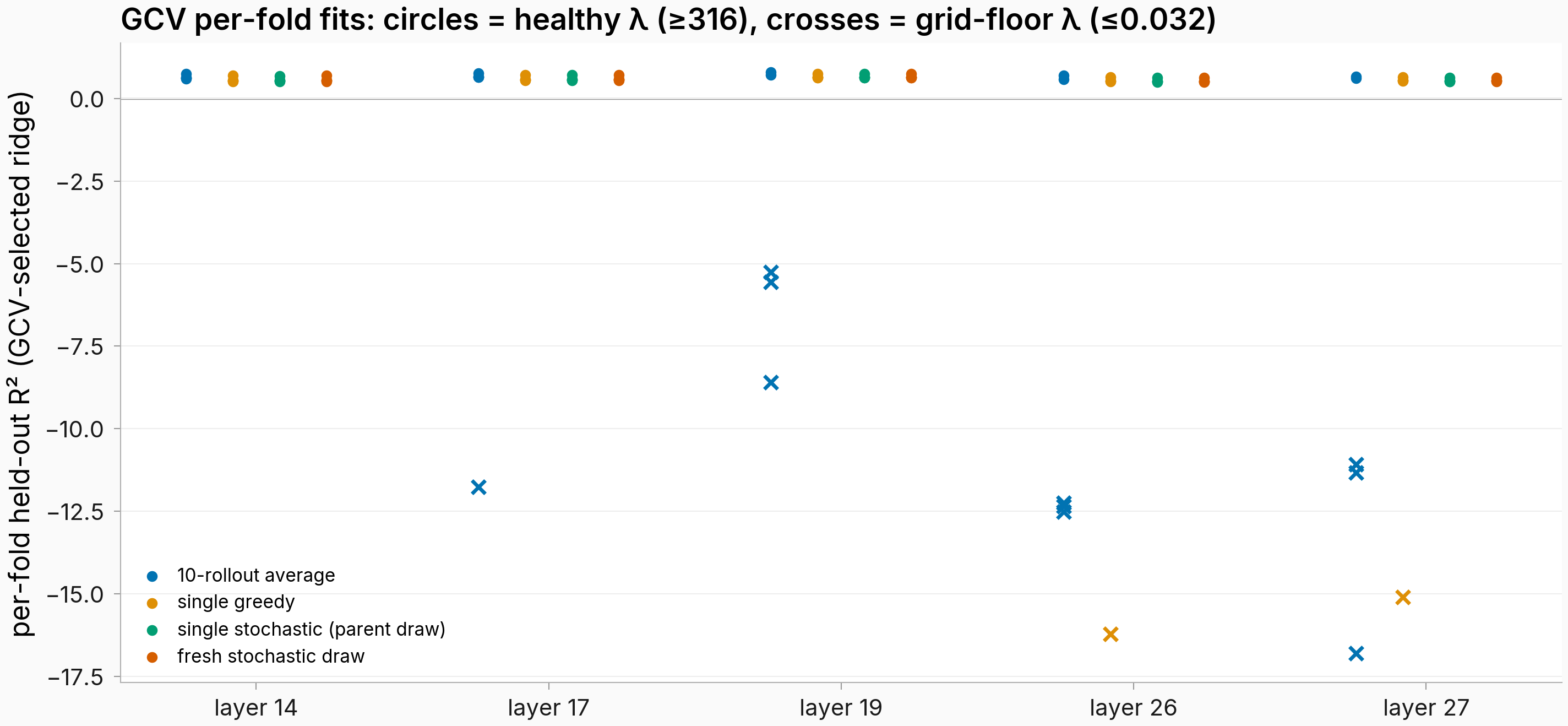
Figure. Isolated folds with collapsed λ produce every negative cell. Healthy folds sit at 0.5–0.8; degenerate folds (grid-floor λ ≤ 0.032 vs healthy 316–1000) fall to −5 to −17 and concentrate in the noise-reduced arms: across all 28 layers, 36 of 38 degenerate fold picks are the 10-rollout average, 2 greedy, 0 either stochastic arm.
The pattern matches the generalized-cross-validation degeneracy near n ≈ feature-dimension the parent's fitter comparison documented on this bundle (train 4,000 vs 3,584): at train n = 3,600 it degenerates in every cell while validation-selected λ stays sane. The refit reproduces the parent reference to machine precision (max diff 1.1e−16), ruling out an implementation divergence from the parent's validated fitter; the mean-prompt cross-check carries the arm-specific exoneration — even the stochastic arms degenerate there (layer 27), so the asymmetry is last-token-input-specific, consistent with noise reduction as the trigger (both degenerating surfaces are noise-reduced). One fold also runs systematically easier in every healthy cell (+0.07 to +0.19 R²), a duplicate-clustered fold-balance artifact, arm-neutral since contrasts pair within folds. Every headline number comes from the healthy cells.
Greedy sits marginally closer to the rollout average than a typical stochastic draw
What is plotted: left — violins of the per-context symmetric greedy-adequacy Δ per layer (greedy's closeness to leave-one-out 9-means minus the draws' closeness to the same references, cosine units), medians labeled, n = 5,000. Right — the per-context scatter behind the layer-14 median, identity line, extremes labeled.
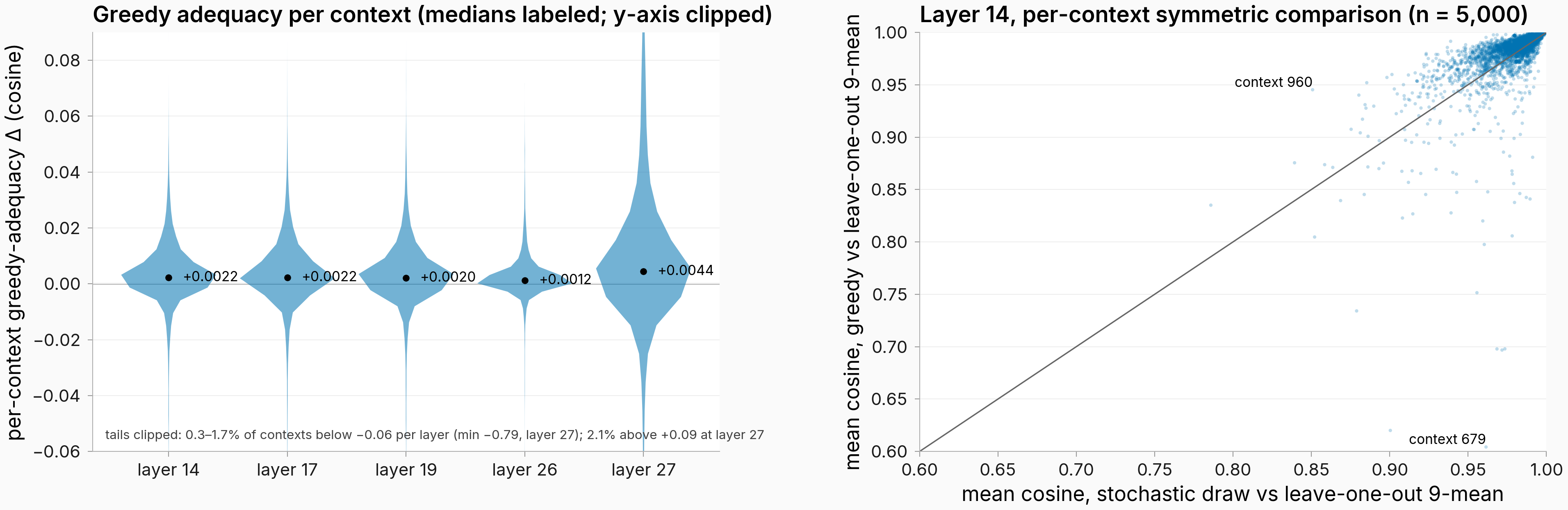
Figure. The greedy answer is at least as representative as a random draw — at the median. Medians +0.0012 to +0.0044 across layers, 66–71% of contexts positive; the violin axis is clipped (note in panel) — extremes reach −0.79 and +0.22 at layer 27.
All five layer medians are positive with bootstrap CIs excluding 0 (largest +0.0044 at layer 27). The sign survives worst-case duplicate handling: removing any 477 rows (the exact-duplicate mass) moves a median only within its p45.2–p54.8 band, positive at every layer. The distribution is median-positive with an adverse tail: 27–32% of contexts are negative and 1.3–5.9% fall below −0.02, so the claim covers the aggregate only. A near-duplicate sweep (char-5-gram Jaccard ≥ 0.9: 606 rows in multi-row clusters vs 477 exact) leaves every representative-restricted median positive with CIs excluding 0.
Target agreement is uniform across all 28 layers, and cosine levels ride an anisotropy floor
What is plotted: left — GCV pooled held-out R² across all 28 layers per arm, degenerate cells clipped at −1 and marked; mean-target floor (the degenerate prefix arm) and shuffled-pairing null at ≈0. Right — mean per-context cosine of each single-draw target to the 10-rollout average, per layer.
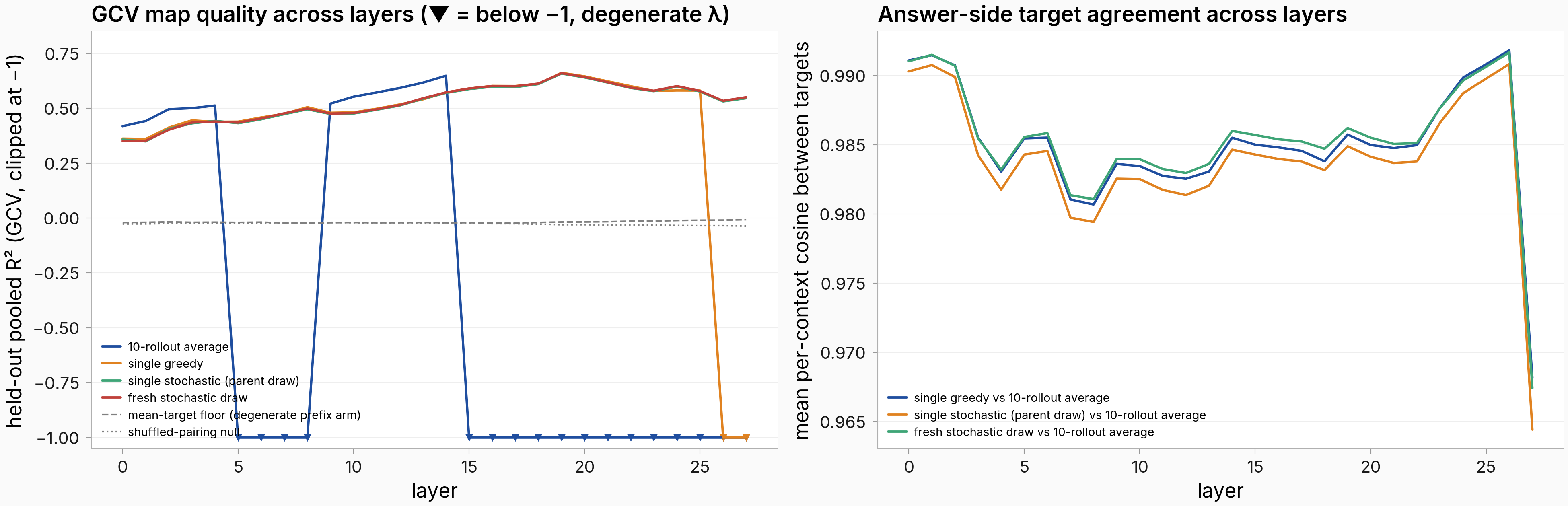
Figure. No layer breaks the pattern. Left: healthy cells overlay across arms; the 10-average arm degenerates in layer bands under GCV. Right: greedy-to-average cosine (0.968–0.992) sits at or above the parent stochastic draw's curve at every layer.
No layer shows a greedy-specific distortion; the regime effect is uniform across the stack. Raw cosine levels sit on an anisotropy floor (the global-mean prediction already reads 0.82–0.90 at most read-out layers, 0.46 at layer 27), so paired same-context differences carry the claim; the fresh-draw curve sits mechanically closer to the average (it is one of its ten components). Mean-floor and shuffle-null R² near 0 indicate the paired differences are not floor-driven.
No monitoring verdict flips under any target regime (low-power read)
What is plotted: the per-condition Pearson r points behind each trait×mode monitoring cell (the per-unit data underlying the hero figure's right panel), the maps trained on each regime's targets side by side, 4–8 graded conditions per cell.
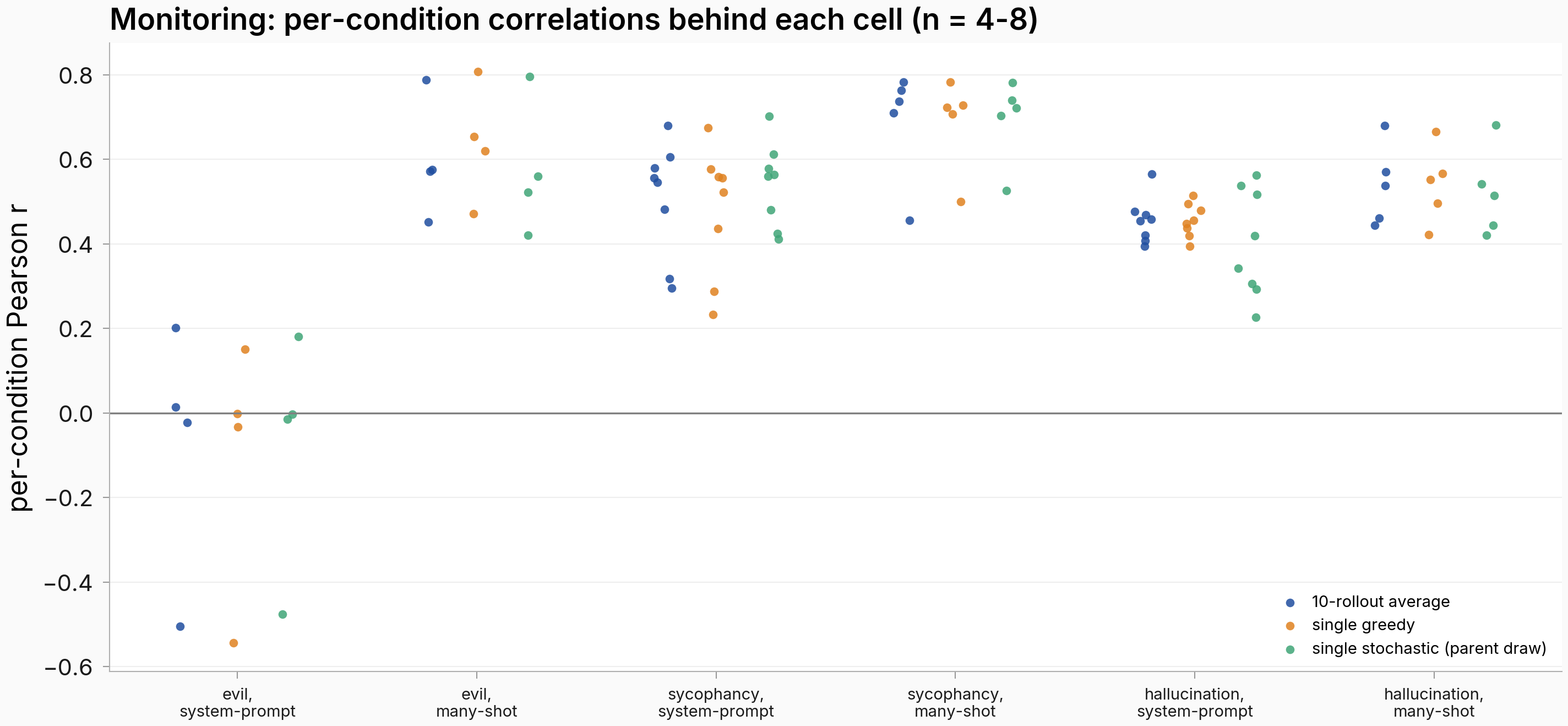
Figure. Per-condition spreads overlap across arms in all six cells. Joint-resample arm differences are at most |Δr| = 0.06; no cell's map-vs-raw-projection verdict flips between the greedy-target and averaged-target maps (flip probability 0.000–0.102).
With 4–8 conditions per cell this is a low-power read: the correct claim is failure-to-reject a flip, not demonstrated equivalence. The greedy-vs-fresh-stochastic pair does differ detectably in 3 of 6 cells, with mixed sign (−0.035 to +0.060; largest in hallucination many-shot). The one weak cell (evil, system-prompt mode: all map arms r ≈ −0.07 to −0.11 vs raw projection +0.17) fails identically under every regime — a weakness of the parent map that every regime inherits.
Greedy answers are slightly shorter and truncate slightly more often; the adequacy margin narrows with length but stays positive
What is plotted: left — response-length histograms (fraction of responses per token bin): single greedy (n = 5,000) vs all stochastic rollouts (n = 50,000), cap 1,024 tokens. Right — the median per-context greedy-adequacy Δ recomputed within greedy-response-length terciles (short ≤76, mid 77–397, long >397 tokens) per layer.
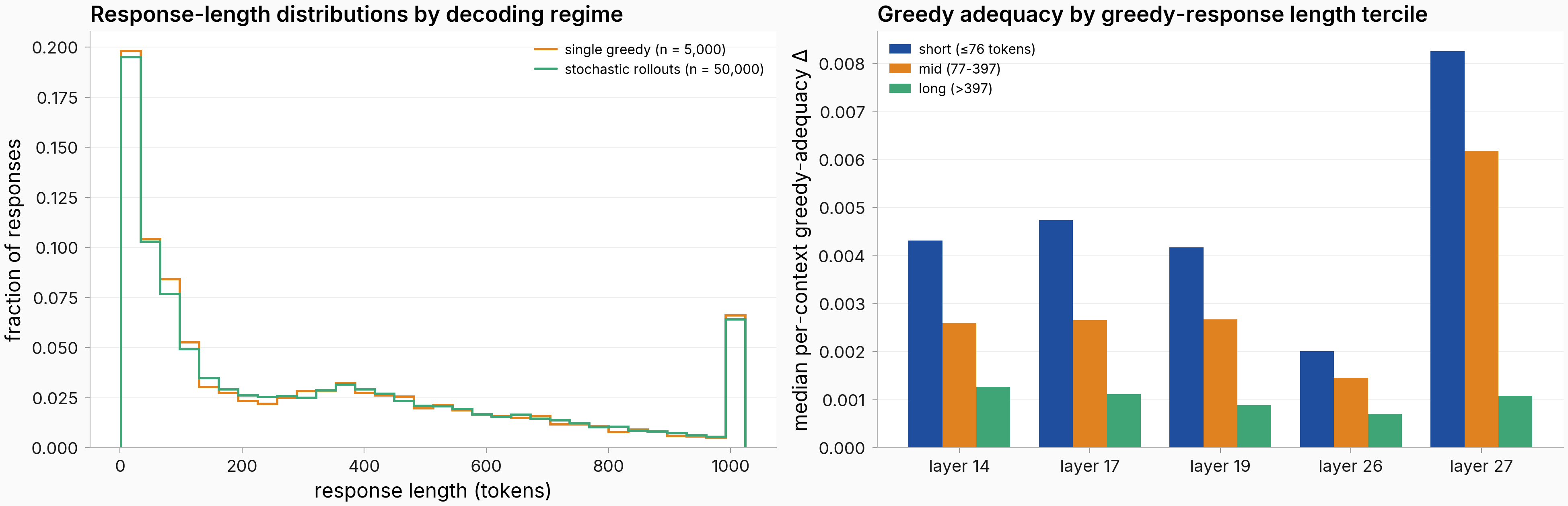
Figure. A mild regime property, not a failure mode. Greedy: median 198 tokens, 6.3% truncation; stochastic: median 207, 5.9%. The adequacy Δ stays positive in every tercile × layer, attenuating from ~+0.002–0.008 (short; the L26 short-tercile median is +0.0020) to ~+0.001 (long).
Greedy decoding shifts the length distribution slightly, with no mode-collapse signature at this resolution. Point-estimate Δ medians stay positive in all 15 layer × tercile cells, attenuating roughly three- to six-fold from short (+0.0020..+0.0083) to long (+0.0007..+0.0013) responses; no per-tercile CI was computed, so the long-tercile margin is a point estimate near zero. The length-stratified read doubles as a sensitivity check: the greedy-adequacy sign is not carried by truncated or degenerate-length responses.
Repro: GCE 1× A100-80 (eps-issue-1073), ~2.9 h wall across 2 attempts, ~0 Anthropic calls (judge scores reused) · Code @ c0621177 (scripts/issue1073_{gen,capture,fits,figures,common}.py, issue1073_driver.sh) · Eval JSONs: eval_results/issue_1073 (incl. neardup_sensitivity.json, the 9a-ter free-analysis fold-in) · Figures: figures/issue_1073 · Rollout text + per-rollout fp16 tensors + predictions: issue1073_decode_regime (raw_completions/{greedy,stoch10,probe}, analysis_tensors/{v_store,reductions,predictions}, eval_results/) · Reused inputs from #779: pass-B context/target bundle, trait-eval captures + graded judge scores, persona-vector directions, frozen-layer selection — all at HF revision 037fcbb2 — fit: same model/tokenizer/decode convention, revision-pinned coherent set, reproduction gate passed to 1.1e−16 · Duplicate-exclusion worst-case bound computed in-session from the committed JSONs.
Context: Originating prompt (verbatim, frontmatter origin_prompt):
file it as its own task and run in the background with happy coder (preceding ask: How do mapping and activations averaged over rollouts compare to mapping and activations for single rollout with deterministic vs single rollout with stochastic)
Lineage: #779 — parent context→answer monitoring map whose targets this experiment re-derives under three decoding regimes. Created 2026-07-06 · run 2026-07-06 (GCE, 2 attempts; final eval sync commit 1e24155d97; near-dup sensitivity commit 3fba23a937). Conciseness WARN acknowledged: the six result sections (four registered reads plus the estimator-pathology diagnostic and the per-tercile sensitivity) mean total prose exceeds the 800-word budget, five Takeaways bullets exceed 30 words, and six result beats exceed the 120-word soft cap (all under the hard cap) — the critique fold-ins (band-fork wording, tail calibration, estimator-diagnosis scoping, humanize-loop calibration fixes) added the length.