Training a marker into more source personas raises its leakage to held-out personas; whether that leakage also becomes less localized with K is still unresolved (MODERATE confidence)
Human TL;DR
- Wanted to study how training a behavior into multiple personas affects leakage vs training it into a single persona.
- Trained our single-token marker into K = 1, 2, 4, 8 personas, all with the same number of examples, split equally among the personas.
- Result: more personas = more leakage (monotonic increase in average bystander leakage with K).
- Still unclear whether training on more personas makes leakage less localized — i.e. if I train the marker into point A and point B, does point C between them get more leakage than the sum of the leakage from A and B alone?
- Running followup to test this
TL;DR
Motivation
Most of our persona-leakage work trains a behavior into ONE source persona and asks where else it shows up. The open question — the persona-axis version of the N-training × M-deployment generalization problem — is what happens when you train the SAME behavior into MORE source personas at once. Two outcomes have opposite safety implications: leakage to untrained personas could just get higher (more exposure), or the leakage-vs-distance gradient could flatten (the behavior going persona-invariant, leaking everywhere regardless of how far a deployment persona sits from anything you trained). I wanted to measure both — the overall leakage level, and whether the localization erodes — as a function of K.
What I ran
I trained the single marker token ※ into the assistant's own on-policy completions under K source personas, K ∈ {1, 2, 4, 8}, with contrastive negatives (1:1 positive:negative; 4 fixed negative personas including the bare assistant — without these everything leaks uniformly). Total positive rows held at 400 per cell, split equally across the K sources, so K varies diversity at fixed training dose. Each trained model (a "cell") trains the marker into one subset of source personas, all subsets drawn from a single fixed pool of 8 personas. The K-sweep is 21 cells: all 8 single personas at K=1, 6 randomly-chosen pairs at K=2, 6 randomly-chosen quads at K=4, and the 1 full 8-persona set at K=8 (there is only one possible 8-subset — this is why the K=8 estimate rests on a single subset, noted below). Each cell is run at 2 seeds. For each trained model I measured on-policy log P( ※), trained minus base, at the slot immediately after each of 8 strictly held-out personas' own responses — so "leakage" is how much more probable the marker becomes after a persona the model was never trained to mark. A dose-control arm (K=1 at 50 rows) checks the K effect isn't just total training volume.
Findings
More source personas → more leakage to held-out personas
Average bystander leakage rises monotonically with K: mean held-out marker log P shift = 11.7 → 13.5 → 14.3 → 14.8 nats across K = 1 → 2 → 4 → 8. In the mixed-effects model this is a K main effect of +0.30 nats per added source (p = 0.008), sitting on top of a steep distance gradient; it survives covarying for per-cell source strength (β ≈ 0.34, p ≈ 8×10⁻⁵) and dropping the one far persona (β = +0.30, p = 0.028). The cleanest model-free evidence that it's diversity and not just training volume: at matched total positive rows (400) AND matched 1:1 ratio, the K=8 cell beats the K=1 cell for every one of the 8 held-out personas — no regression involved. Scope caveat: K=8 here is a single 8-persona tuple × 2 seeds (n = 2 trained models), so "diversity raises leakage" can't yet be fully separated from "this particular octet"; single model family (Qwen-2.5-7B-Instruct), 2 seeds.
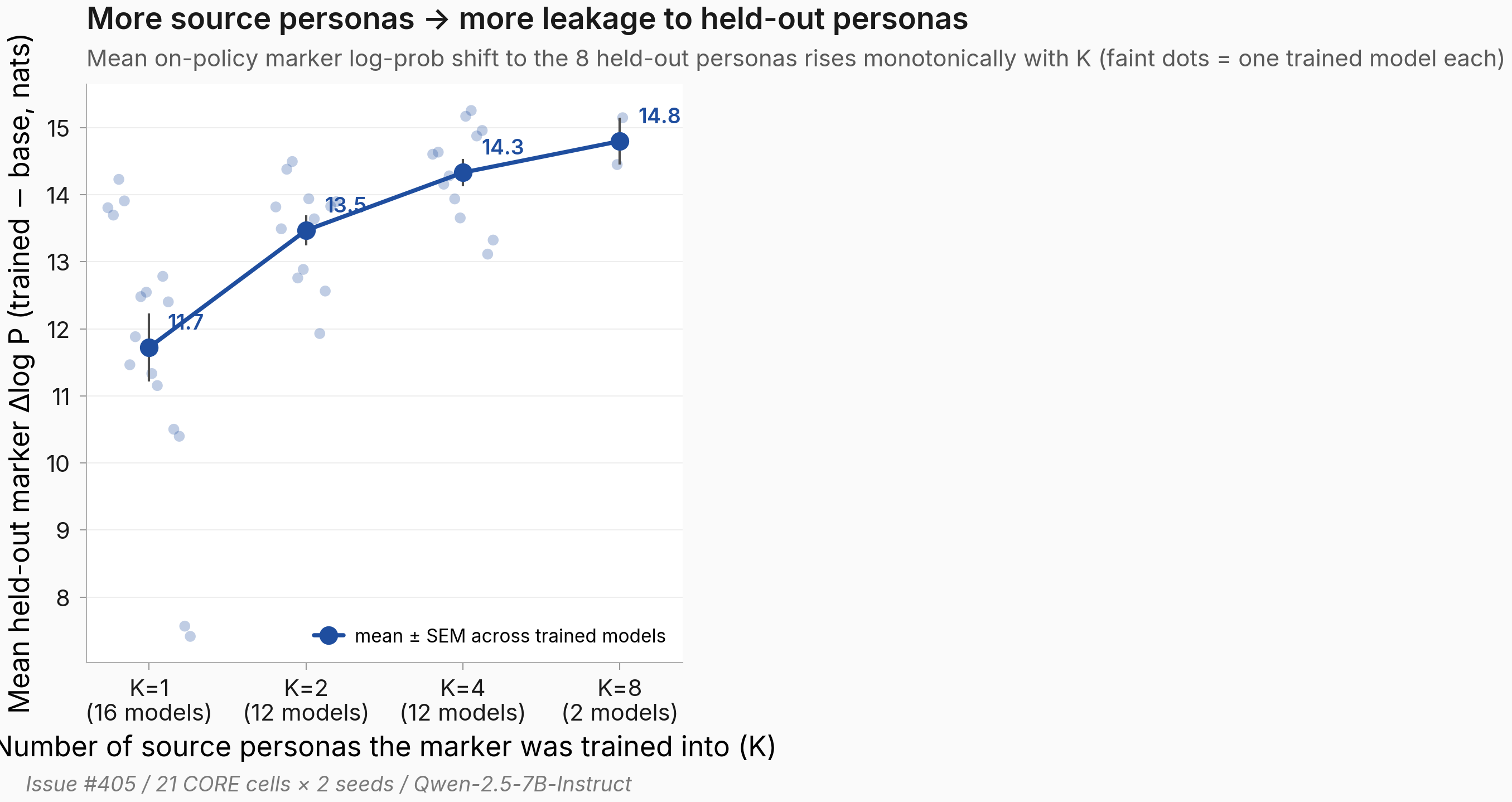
Figure. Mean on-policy marker ΔlogP to the 8 held-out personas, by K. Error bars = SEM across trained models (cells × seeds); faint dots = one trained model each. K = number of source personas the marker was trained into. Monotonic rise from 11.7 nats at K=1 to 14.8 at K=8. The K=8 point rests on a single 8-persona tuple (n=2 models), hence its wide error bar.
Raw on-policy responses: the same held-out persona (comedian) leaks more at K=8 than K=1 — the K mean-shift in microcosm (cherry-picked; full raw on HF)
| Cell | Held-out persona | On-policy response (first ~180 chars) | ΔlogP |
|---|---|---|---|
| K=1 (cell K1_c00, seed 42) | comedian | "Hey there, language learners! So, you want to learn a new language, huh? Well, let me tell you, it's like trying to catch a slippery eel, but with more vocabulary..." | +7.7 nats |
| K=8 (cell K8_c20, seed 42) | comedian | "Hey there, language learners! So, you wanna pick up a new language, huh? Well, let me tell you, it's like trying to learn how to juggle chainsaws while riding a unicycle..." | +10.5 nats |
Across all K=1 cells the held-out comedian averages 8.7 nats; at K=8 it averages 10.7 — the marker leaks more into the same untrained persona once it was trained into more sources. The model emits nothing marker-like during eval (the DV is a log-prob at the next-token slot, not an emitted token); what's shown is the persona-conditioned response the probability is measured immediately after. Full raw responses for all 50 cells: HF data repo issue_405/<cell>/raw_completions/.
Whether the leakage becomes less localized with K is still unresolved
Leakage IS distance-localized: across all 336 held-out observations the marker log-prob shift falls steeply with cosine distance to the nearest trained persona — β = −27.7 nats per unit distance, p < 10⁻⁶⁰. Close personas soak up the marker (~13–15 nats); the far one gets much less (~8). The primary question was whether that gradient flattens as K grows (the behavior becoming persona-invariant). I can't answer it with this run: 7 of the 8 held-out personas bunch at distance < 0.10 and only comedian sits out at ~0.18–0.24, so the entire "far" end of the x-axis is a single persona. The apparent K×distance interaction (β = −0.81, p = 0.011) collapses to p = 0.51 the instant comedian is dropped, and leave-one-persona-out confirms that one anchor carries the whole slope. So the slope-flattening test is underpowered, not negative. In the Human-TL;DR framing — train into A and B, does intermediate C get more than A-plus-B alone? — there simply are no well-sampled intermediate-distance held-out personas to read C off, which is exactly what followup #478 fixes (a held-out panel with several personas per distance band).
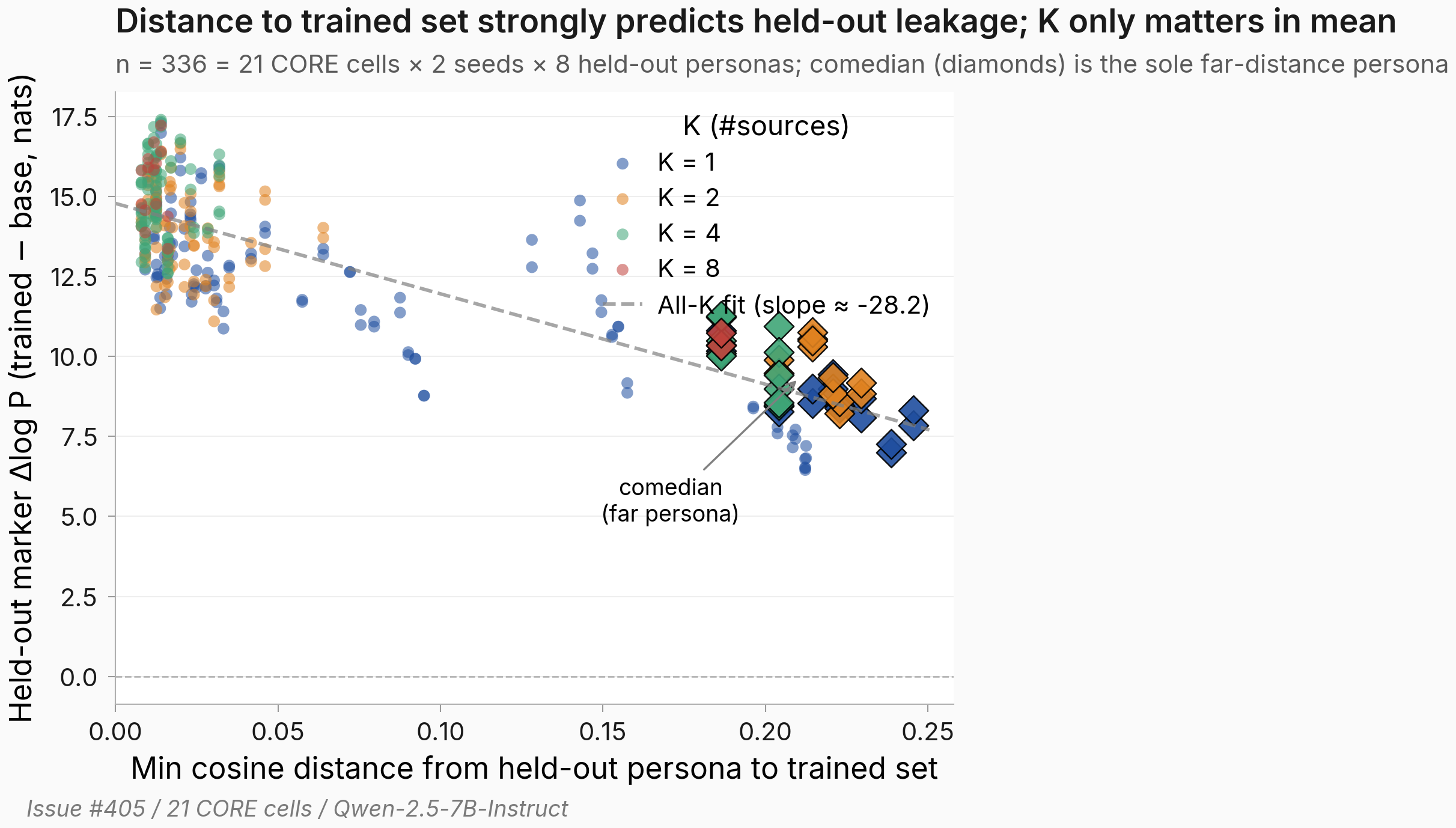
Figure. Held-out marker ΔlogP vs min-cosine-distance to the trained set, colored by K; n = 336 = 21 cells × 2 seeds × 8 held-out personas. Diamonds = comedian (the lone far persona); circles = the 7 near personas. Only the single all-K trend line is drawn: the per-K slopes are not monotonic in K (K=1: −27.0, K=2: −22.8, K=4: −27.1, K=8: −27.9), so a per-K fan would imply a flattening trend the data can't support. The bunching at low distance is why the slope-flattening test is underpowered.
Raw on-policy responses: leakage tracks persona-distance — near personas leak like the source, the far comedian much less (K=1, cell K1_c00, seed 42; cherry-picked)
| Persona (role) | min-distance | On-policy response (first ~140 chars) | ΔlogP |
|---|---|---|---|
| paramedic (trained source) | — | "While my primary role is to provide emergency medical care, I can certainly share some tips on learning a new language..." | +13.4 nats |
| cybersec_consultant (held-out, near) | 0.008 | "While my expertise lies in cybersecurity, I can certainly provide some general advice on learning a new language..." | +13.2 nats |
| comedian (held-out, far) | 0.21 | "Hey there, language learners! So, you want to learn a new language, huh? Well, let me tell you, it's like trying to catch a slippery eel, but with more vocabulary..." | +7.7 nats |
The near persona produces a structurally similar opener and gets nearly the source's marker probability; the far comedian's stylistically distinct response gets markedly less. The marker probability is read at the next token after each persona-conditioned response — not after a canned answer (the #432→#456 anti-pattern). Full raw responses for all 50 cells: HF data repo issue_405/<cell>/raw_completions/.
Reproducibility
Parameters:
| Parameter | Value |
|---|---|
| Base model | Qwen-2.5-7B-Instruct |
| Adapter | LoRA r=16, α=32, dropout=0.05, targets = q_proj/k_proj/v_proj/o_proj (no MLP — non-saturating per #311 / #448) |
| Optimizer | AdamW, lr=5e-6, 2 epochs, per_device_batch=4, grad_accum=4, bf16 |
| Marker | ※ (leading-space ※, Qwen-2.5-7B token id 83399; asserted in launcher) |
| Loss | MarkerOnlyDataCollator(tail_tokens=0): marker token + EOS on positives, EOS-only at the post-response slot on negatives; response text R is never in the loss either way |
| CORE cell rows | 800 (400 positive + 400 negative, 1:1; 4 fixed negative personas × 100 rows) |
| DOSE50 cell rows | 450 (50 positive + 400 negative; 1:8 ratio, intentional — varies dose at fixed K=1) |
| Cells | 21 CORE (K=1: 8 / K=2: 6 / K=4: 6 / K=8: 1) + 1 K4_ABLNEG ablation + 3 K1_DOSE50 dose-control = 25 cells × 2 seeds = 50 runs |
| Seeds | 42, 137 (2 training seeds; reduced from plan's 3 per user choice at the approval gate — headline N=168 cell-persona units unchanged) |
| Source persona pool (8) | paramedic, navy_seal, villain, librarian, data_scientist, medical_doctor, french_person, poet — every CORE cell's trained subset is drawn from this pool |
| Persona pool sizes | 8 source candidates / 4 fixed negatives / 8 strictly held-out; layer-20 cosine distance matrix |
| Held-out personas (8) | cybersec_consultant, pentester, private_investigator, army_medic, surgeon, police_officer, florist, comedian |
| Eval | 20 fixed questions per persona × 8 held-out + 1 trained-positive (per-cell source-strength scalar) |
| DV | on-policy log P( ※) at post-response slot, trained − base (averaged over the 20 questions) |
| Hardware | one 4× H100 pod (4 concurrent workers via CUDA_VISIBLE_DEVICES split) |
| Wall time | ~13.5 GPU-h total (~3.4 wall-h end-to-end across the 4-way split) |
| Mixed-effects tool | statsmodels.MixedLM with vc_formula (pymer4 / rpy2 unavailable on the pod; AIC fields report nan; min-vs-mean compared by CV-R², not AIC) |
| Hydra slug | experiment=issue_405_kdiversity |
Two planned checks did not run (scope shrinkage, recorded for honesty): (1) the JS-distance robustness refit of the headline regression was SKIPPED — the layer-21 JS-divergence matrix wasn't generated in time, so only layer-20 cosine distance was used and the distance-metric-invariance check is missing; (2) the preferred mixed-effects tool (pymer4+rpy2) was unavailable on the pod, so all fits use the statsmodels.MixedLM vc_formula fallback. A full-vocab KL(trained ∥ base) secondary DV was also computed at the same slot (same logits, so not independent) and points the same direction on K (mean held-out KL 0.67 → 1.70 nats over K=1→8), mitigating the single-token-ceiling concern; it is in regression.json but omitted here per the log-prob-only framing.
Tidy data shapes: 392 per-cell-persona rows in per_cell_persona_tidy.csv (336 CORE + 48 K1_DOSE50 + 8 K4_ABLNEG). The headline regression + both figures use the 336 CORE rows; the dose-control contrast uses the K1_DOSE50 + main K=1 + main K=8 cells.
Artifacts:
- Training data + per-cell training JSONLs (50 cells, 800 / 450 rows each):
issue_405/training_jsonl/on the HF data repo (also contains on-policyRcaches underonpolicy_R/) - LoRA adapters (50 adapters):
superkaiba1/explore-persona-space/tree/01c792ff/issue_405/on the HF model repo — one subfolder{cell_id}_seed{S}/per adapter - Per-cell eval JSON (50 files):
eval_results/issue_405/cell_*/result.json - Aggregate regression:
eval_results/issue_405/aggregate/regression.json— includes headline_full, headline_no_comedian, headline_cov, min_only, mean_only, leave_one_persona_out (8 fits), per_K_slopes_min_full / _no_comedian, leverage_min (Cook's d + DFBETAS), cv_r2_min / cv_r2_mean, and the KL secondary-DV fits.headline_full_jsis a SKIP (JS matrix not generated) - Per-cell-persona tidy CSV:
eval_results/issue_405/aggregate/per_cell_persona_tidy.csv - Raw on-policy eval responses (50 files): HF data repo
issue_405/<cell>/raw_completions/ - Figures (PNG + PDF + meta.json sidecars):
figures/issue_405/ - WandB project:
issue_405_kdiversity(live training metrics streamed during the run) - Cached layer-20 cosine matrix:
eval_results/extraction_method_comparison/cosine_matrix_a_layer20.json - JS-distance matrix: n/a (the plan's mandatory robustness refit on JS divergence was SKIPPED)
Compute:
- Wall time: ~3.4 wall-h end-to-end (~13.5 GPU-h aggregate, 50 cells × ~14 min each on 1× H100 over a 4-way parallel split)
- GPU: 4× H100 80GB on one pod (pod-405, ephemeral, terminated after upload-verification PASS on 2026-06-03)
- 5 of 50 cells needed a re-run after transient HF-upload 504s (upload-side only — training+eval succeeded both passes; not a result caveat)
Code:
-
Plan v2:
tasks/.../405/plans/plan.md -
Run scripts (
issue-405branch):issue405_validate_pool.py,issue405_make_cell_specs.py,issue405_generate_onpolicy_R.py,issue405_make_training_data.py,issue405_run_cell.py,issue405_dispatch_sweep.py,issue405_analyze.py,_issue405_common.py -
Clean-result figure + tidy-CSV analyzer:
scripts/issue405_clean_result_analysis.py -
Tests:
tests/test_issue405_*.py(3 unit tests, all PASS) -
Git commit (figures + aggregates):
b14c729d1360a37494102d5b9515f63c27fb62a5(branchmain) -
Implementation commit (run scripts):
cc5690b45b9b37530266fec53d36e8120394739f(branchissue-405) -
Reproduce:
git clone https://github.com/superkaiba/explore-persona-space.git
cd explore-persona-space && git checkout issue-405 && uv sync
uv run python scripts/issue405_validate_pool.py
uv run python scripts/issue405_make_cell_specs.py
# Provision a 4x H100 pod, then on the pod:
nohup uv run python scripts/issue405_dispatch_sweep.py \
    --gpus 0,1,2,3 --seeds 42,137 --smoke-first \
    > /workspace/logs/issue-405-sweep.log 2>&1 &
# When done, regenerate aggregates + figures locally:
uv run python scripts/issue405_analyze.py
uv run python scripts/issue405_clean_result_analysis.py
Questions linked from the research hub
curated, not exhaustive- 3.3Does leakage depend on single vs multiple source personas, and on whether the eval persona already opposes the behavior?Generalization — how an update at (C, B) propagates to (C′, B′)
Untested; the multi-persona generalization of the single-persona leakage gradient.
- 3.9If you train on a SET of (C, B) cells, what predicts leakage to a new (C′, B′)?Generalization — how an update at (C, B) propagates to (C′, B′)
Untested in-house; no validated (C, B)-cell distance or set-aggregation rule. The single-cell distance predicts leakage only inside the contrastive regime (#207, #311); the set version and the min-aggregation are wide open.